
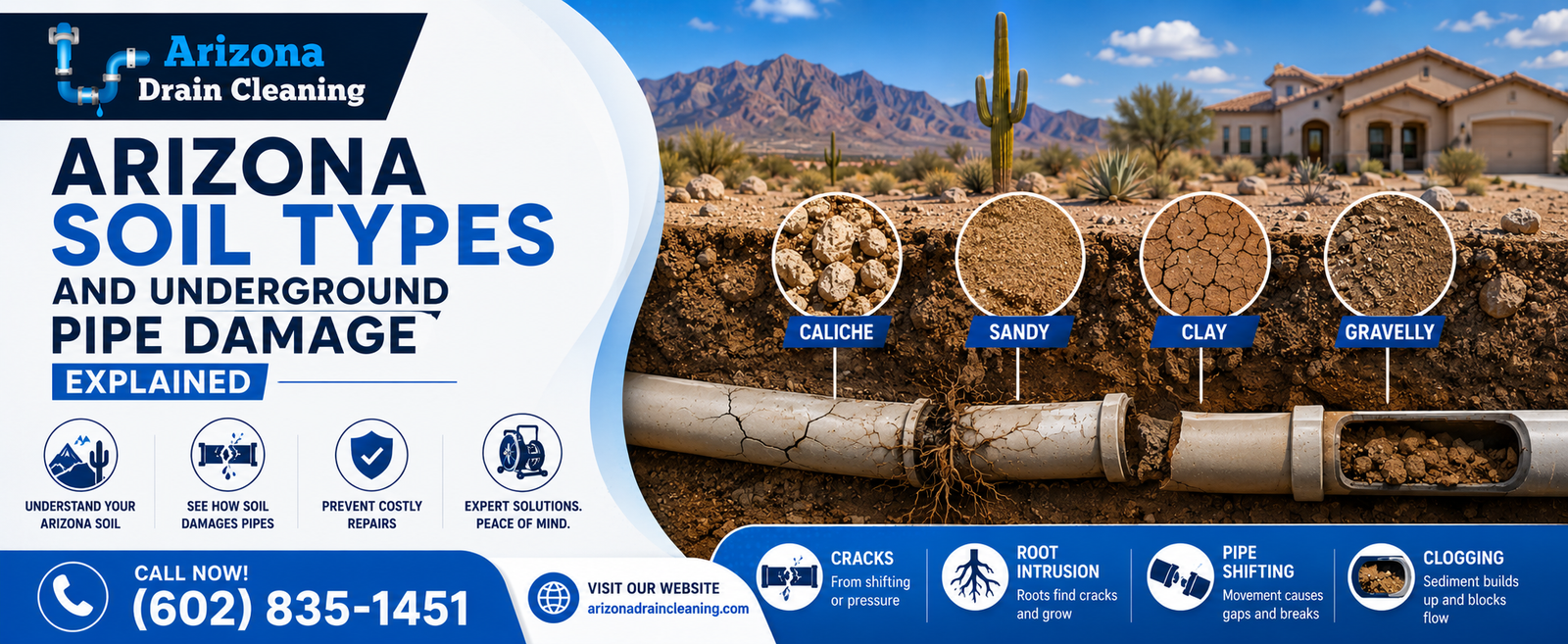
Arizona soil pipe damage is one of the most misunderstood threats facing homeowners across the Valley, and most people don’t discover it until a drain backs up, a slab cracks, or a yard stays wet long after the last monsoon storm. Unlike most states where the ground beneath a home is relatively predictable, Arizona sits on three fundamentally different soil types, and each one attacks your underground plumbing in a completely different way. If you have lived in Phoenix, Tucson, Yuma, or anywhere in between, the soil under your foundation has been quietly working against your pipes for years. The team at Arizona Drain Cleaning sees the consequences of this every week across the Valley, and the pattern is almost always the same: the ground moved, and the pipes paid for it.
Why Arizona Soil Types Are a Bigger Plumbing Threat Than Most Homeowners Realize
Most plumbing literature written nationally assumes a relatively uniform soil environment. Soft, predictable ground that can be shoveled by hand, modest temperature swings, and a frost line that pushes pipes deep. None of that applies in Arizona.
The Arizona Geological Survey has formally classified large portions of Arizona’s residential land as containing “problem soils,” a designation it gives to soils with high potential for structural damage from shrinking, swelling, or collapsing under changing moisture conditions. The AZGS notes that problem soils exist statewide, from Yuma in the far southwest to the northeast corner of the Colorado Plateau, covering virtually every major city where Arizona homeowners live.
What makes the state unusual is not that one bad soil type exists here. It is that three distinct problem soil categories exist across the state, often layered on top of one another or transitioning within a single neighborhood. Understanding which one is under your home is the first step toward protecting your drain system.
The 3 Arizona Soil Types That Cause Underground Pipe Damage
Soil Type 1: Expansive Clay; The Phoenix Metro’s Hidden Pipe Crusher
Expansive clay is the dominant underground threat across the Phoenix metro area, covering significant portions of central Phoenix, Scottsdale, Mesa, Tempe, Chandler, and Glendale. This soil type formed over thousands of years as runoff from the surrounding mountain ranges, including the White Tank Mountains, the McDowell Mountains, and the Sierra Estrella, deposited fine silt and clay minerals across the prehistoric basin that Phoenix now occupies.
The defining characteristic of expansive clay is the mineral smectite, a microscopic clay mineral with an expanding crystal structure that physically swells when it absorbs water. According to the Arizona Geological Survey, expansive smectite clay can swell to many times its original volume when saturated and then shrink significantly as it dries. Translated into your yard, this means that during monsoon season, typically mid-June through the end of September, the clay beneath your slab expands and presses against buried drain and sewer lines with enormous force. When the summer heat returns and the soil dries out, it contracts and pulls away, leaving voids around those same pipes.
What this does to your pipes: This constant expansion and contraction cycle, repeated across every Arizona monsoon season for decades, causes three main failure patterns in underground plumbing.
The first is pipe bellying, where sections of a sewer lateral sag downward as the supporting soil shifts unevenly. Wastewater slows in these low spots, debris accumulates, and the conditions for recurring blockages develop. The second is joint shearing, which is most common in older clay tile and cast iron lines installed in central Phoenix neighborhoods before the 1980s. As the ground shifts in opposite directions at a joint connection, the joint cracks or separates entirely. The third is crushing pressure, where the weight of saturated, expanded clay presses directly on an aging pipe wall and causes it to deform or collapse, particularly in pipes that corrosion has already weakened from the inside.
Where this soil is in Arizona: Expansive clay is most concentrated across the greater Phoenix metropolitan area, particularly in older neighborhoods in central Phoenix, Arcadia, Ahwatukee, north Tempe, and south Scottsdale. The Natural Resources Conservation Service maintains shrink-swell potential maps for the Phoenix basin that confirm high-risk zones across significant portions of Maricopa County. Newer developments further out in Queen Creek, Surprise, and Goodyear sit on varying combinations of clay and sandy soil depending on proximity to ancient drainage channels.
Soil Type 2: Caliche Hardpan; The Tucson and Valley-Wide Excavation Nightmare
Caliche is a cemented layer of calcium carbonate that forms in the subsoil across most of southern Arizona, and it creates a different category of underground pipe problem than expansive clay. Rather than moving aggressively, caliche creates a rigid, concrete-like barrier that traps water, makes excavation brutally expensive, and forces soil movement stresses to concentrate at specific transition points along buried pipes.
Arizona’s arid climate is uniquely suited to caliche formation. As groundwater evaporates in the desert heat over thousands of years, calcium salts accumulate and bind with surrounding sand and clay particles into a hardpan layer that can range from a few inches thick to several feet. The University of Arizona Cooperative Extension describes caliche as common throughout the state, with layers that can reach up to six feet in depth and that are essentially impossible to break through by hand.
What this does to your pipes: Caliche does not move like clay, but it causes pipe damage through two distinct mechanisms. First, it creates water perching. Because caliche does not absorb moisture, any water that reaches the layer, whether from rain, irrigation, or an underground pipe leak, pools on top of the hardpan. This perched water saturates the soil surrounding your slab and foundation, puts lateral pressure on buried drain lines, and attracts tree root systems aggressively looking for a reliable moisture source. Desert-adapted trees like palo verde, mesquite, and African sumac follow that perched water zone directly to your pipes.
Second, caliche creates stress concentration points along sewer laterals. Sewer lines installed through soil that transitions between the soft ground above and the rigid caliche layer below develop stress at those transitions. As seasonal moisture causes the softer soil above to shift, the pipe bends at the point where it meets the immovable caliche. Over years, those stress points crack, separate, and ultimately fail.
Where this soil is in Arizona: Caliche exists statewide but is most pronounced and shallow in the Tucson basin and throughout southern Arizona, including Marana, Sahuarita, Oro Valley, and Green Valley. In the Phoenix metro, caliche typically begins 18 to 36 inches below the surface, which places it directly in the zone where most residential sewer laterals run. In Tucson, caliche can begin as little as 6 inches below the surface in some older urban neighborhoods, which is one reason Tucson plumbing repairs involving excavation consistently require heavy equipment rather than basic hand digging.
Soil Type 3: Collapsing Sandy Soil; The Overlooked Threat in Yuma and Desert Fringe Communities
The third major soil category in Arizona is the one least covered by plumbing content but no less damaging to underground infrastructure. Collapsing soils, also called hydrocompaction soils, are loose, dry, low-density sandy and silty deposits that appear stable in dry conditions but suddenly compact and sink when they first encounter significant moisture.
These soils are common in wind-deposited and alluvial fan environments throughout western Arizona, including the Yuma area, the lower Colorado River valley, and the desert fringe zones around Phoenix where newer subdivisions have been built on previously undeveloped desert land. Arizona’s arid climate allows loose, undercompacted sediment to accumulate without ever getting wet enough to settle naturally. When irrigation, landscaping, or a slow pipe leak finally introduces consistent moisture, the soil collapses inward, sometimes rapidly and over a significant area.
What this does to your pipes: The damage mechanism with collapsing soil is sudden differential settlement. When the soil around a section of underground pipe collapses and drops several inches while adjacent soil remains supported, the pipe loses support underneath it. The unsupported section sags, and if the settling is uneven, which it almost always is, the pipe bends sharply enough to crack at that point. For sewer laterals, a sudden void forming under a 4-inch pipe can cause a complete joint separation within a single monsoon event if that first significant rainfall triggers rapid hydrocompaction in previously dry soil.
Homes built on collapsing soil in newer western Yuma subdivisions, in developing communities around Buckeye and Tonopah, and on desert infill lots throughout the Phoenix metro are most exposed to this risk during their first several monsoon seasons, before the soil has been sufficiently wetted and compacted around the home’s buried utilities.
Where this soil is in Arizona: Collapsing soils are most prevalent in Yuma County and along the lower Colorado River valley, across open desert alluvial fans west of the Phoenix metro, and in pockets throughout the Sonoran Desert basin wherever wind-deposited sandy sediments have accumulated on undisturbed ground. The Arizona Geological Survey notes that problem soils, including collapsing variants, exist throughout the state from the southwest to the northeast corner of the Colorado Plateau.
How Arizona Soil Types Combine to Multiply Pipe Damage Risk
One of the reasons soil types and Arizona plumbing problems are so difficult to diagnose without professional camera inspection is that these three soil types frequently occur in combination. A typical residential lot in central Phoenix or north Tempe may have expansive clay in the top 12 to 18 inches, followed by a caliche hardpan layer starting at 18 to 24 inches, with sandy alluvial deposits below that. Your sewer lateral runs straight through all three zones.
That means a single section of pipe can experience upward pressure from swelling clay above, rigid resistance from a caliche layer it crosses, and a potential void from sandy soil that settled unevenly below. The pipe sits at the intersection of three independent movement forces, none of which are coordinated, and all of which intensify during Arizona’s monsoon season when moisture suddenly enters the system.
This layered soil reality is also why underground pipes in Arizona cause problems that seem to come out of nowhere. A home that has had no drain issues for 20 years can suddenly develop a slow main line, recurring backups, or an unexplained wet spot in the yard. The soil has been working on the pipes the entire time. The homeowner just did not see it.
Arizona Expansive Soil Drain Problems; The Warning Signs by Soil Type
Knowing which warning signs to watch for based on your general location helps you catch problems earlier.
If you are in central Phoenix, Scottsdale, Mesa, or Tempe (expansive clay zone): Watch for recurring slow drains throughout the house, gurgling toilets after flushing, or a main line that backs up seasonally, often just after the first heavy monsoon rain. These patterns suggest clay-driven pipe bellying or joint shearing in your sewer lateral.
If you are in Tucson, Marana, Oro Valley, or Green Valley (shallow caliche zone): Watch for yard areas that stay wet long after irrigation or rain, water pooling near your foundation, and recurring root-related drain blockages in mature-tree neighborhoods. These patterns suggest caliche-driven water perching and root intrusion through caliche-stressed pipe joints.
If you are in Yuma, Buckeye, Tonopah, or newer desert-fringe developments (collapsing soil zone): Watch for sudden changes in drain performance after the first significant rains, especially in a newer home. A sewer line that worked perfectly for the first few dry years and then suddenly backs up or shows signs of joint separation may be experiencing hydrocompaction settlement under the pipe.
Underground Pipes in Arizona Soil: What Materials Hold Up Best
Not all pipe materials respond the same way to Arizona’s soil environment. Understanding which materials are most vulnerable informs both repair decisions and prevention priorities.
Clay tile, which was standard in Arizona homes built before the 1970s, is the most vulnerable. It is rigid, brittle, and installed in short jointed segments that shift and separate under even modest soil movement. Most failed sewer laterals found by camera inspection in older central Phoenix and midtown Tucson neighborhoods are clay tile that has separated at joints from decades of clay expansion and caliche-zone soil stress.
Cast iron, common in Arizona homes built through the 1970s and into the 1980s, is more durable than clay tile but still suffers from Arizona’s alkaline soil chemistry and mineral-rich hard water. Interior corrosion gradually weakens the pipe wall while exterior soil movement stresses the joints.
Modern PVC is significantly more flexible and resistant to joint separation under soil movement, which is one reason it has become the standard for new Arizona residential construction. However, even PVC can develop bellied sections and joint failures in extreme soil movement conditions, particularly in aggressive expansive clay zones.
What to Do If You Suspect Arizona Soil Is Damaging Your Pipes
The most important step is a professional sewer camera inspection. No surface diagnosis, no amount of snaking, and no drain cleaner product can tell you whether your sewer lateral has a bellied section, a separated joint, or a root intrusion point caused by soil movement. A camera puts eyes on the actual condition of the pipe, identifies exactly where and what the damage is, and guides the repair decision.
For homes built before 1985 anywhere in the Phoenix or Tucson metro area, a camera inspection is not optional maintenance. It is basic risk management given what is known about the soil conditions those older pipes have been sitting in for decades.
Annual drain cleaning before monsoon season, each April or May, is the other practical step every Arizona homeowner can take regardless of soil type. Clearing partial accumulations from any compromised sections of the drain system before monsoon moisture stresses the surrounding soil is the most cost-effective form of prevention available. Our team provides drain cleaning in Phoenix and throughout the greater Valley, and we work with Arizona homeowners every day who are dealing with exactly these soil-driven pipe issues.
For a deeper look at how caliche specifically traps water near your foundation and drives root intrusion problems, see our related post on Caliche Soil and Drain Damage in Arizona.
Frequently Asked Questions
Which Arizona city has the worst soil conditions for underground plumbing?
There is no single worst city because the threat type varies by location. Central Phoenix and the older East Valley neighborhoods face the most aggressive expansive clay conditions, which drive pipe bellying and joint shearing over time. Tucson and southern Arizona communities deal with very shallow caliche that makes excavation extremely difficult and expensive when repairs are needed. Yuma and newer desert-fringe developments in the western Valley carry the highest hydrocompaction risk in newer construction. Each is a serious risk to underground plumbing in its own way.
Can I find out what soil type is under my specific property?
Yes, with reasonable accuracy. The USDA Natural Resources Conservation Service operates a free online soil mapping tool called Web Soil Survey that allows you to enter your address and view the mapped soil series and classifications for your specific lot. The Arizona Geological Survey also provides shrink-swell potential maps for the Phoenix and Tucson areas. These tools give useful general guidance, but because soil conditions can vary meaningfully within a single block, a professional geotechnical assessment or sewer camera inspection gives you the most actionable information about your specific property.
Does new construction protect against Arizona soil pipe damage?
Modern new construction uses post-tensioned concrete slabs and PVC pipe materials that are better suited to Arizona’s soil conditions than older construction methods. However, new construction does not eliminate the risk. PVC can still belly and fail under significant soil movement. Newer homes in collapsing soil zones are often more vulnerable during their first monsoon seasons than homes in established neighborhoods where the soil has been compacted and settled around the utilities for decades.
How does monsoon season make soil-related pipe damage worse?
Monsoon season, which runs from mid-June through late September in Arizona, introduces sudden, intense moisture into soil that has been bone-dry for months. In expansive clay zones, that rapid saturation causes the soil to swell dramatically against pipe walls in a matter of hours. In collapsing soil areas, the first heavy monsoon rain can trigger hydrocompaction that drops the soil around a pipe by several inches almost overnight. In caliche zones, heavy surface runoff with nowhere to go creates perched water against foundations. All three soil failure modes intensify during monsoon season, which is why pre-monsoon drain inspection and cleaning is particularly valuable in Arizona.
Is Arizona soil pipe damage covered by homeowner’s insurance?
Generally, no. Standard homeowner’s insurance policies in Arizona exclude gradual damage from soil movement, which is the category that covers expansive clay shifting, caliche-driven joint separation, and hydrocompaction settlement. Sudden and accidental losses may qualify depending on the specific policy and circumstances, but long-term soil-driven pipe deterioration is typically treated as a maintenance issue rather than a covered loss. Reviewing your specific policy with your insurance agent is the right starting point if you have active pipe damage.
The Right Team for Arizona Soil Pipe Damage Makes All the Difference
Arizona soil pipe damage is not a problem that responds to generic plumbing advice from a national website or a standard drain snake from a big box store. It requires professionals who understand the specific soil conditions in Phoenix, Tucson, and the surrounding communities, and who have the diagnostic tools and repair methods built around Arizona’s underground reality.
Arizona Drain Cleaning works with homeowners across the Valley who deal with expansive clay, caliche hardpan, and collapsing soil conditions every single season. Whether you need an annual drain cleaning before monsoon hits, a camera inspection on a home built decades ago, or a professional diagnosis of why your main line keeps backing up, we are the team to call.
Call Arizona Drain Cleaning at (602) 835-1451 right now to schedule a drain cleaning before the next stage of that escalation arrives. Same-day availability for urgent situations, upfront pricing before any work begins, and ROC-licensed technicians who understand what Arizona’s specific conditions do to drain systems that are not maintained