
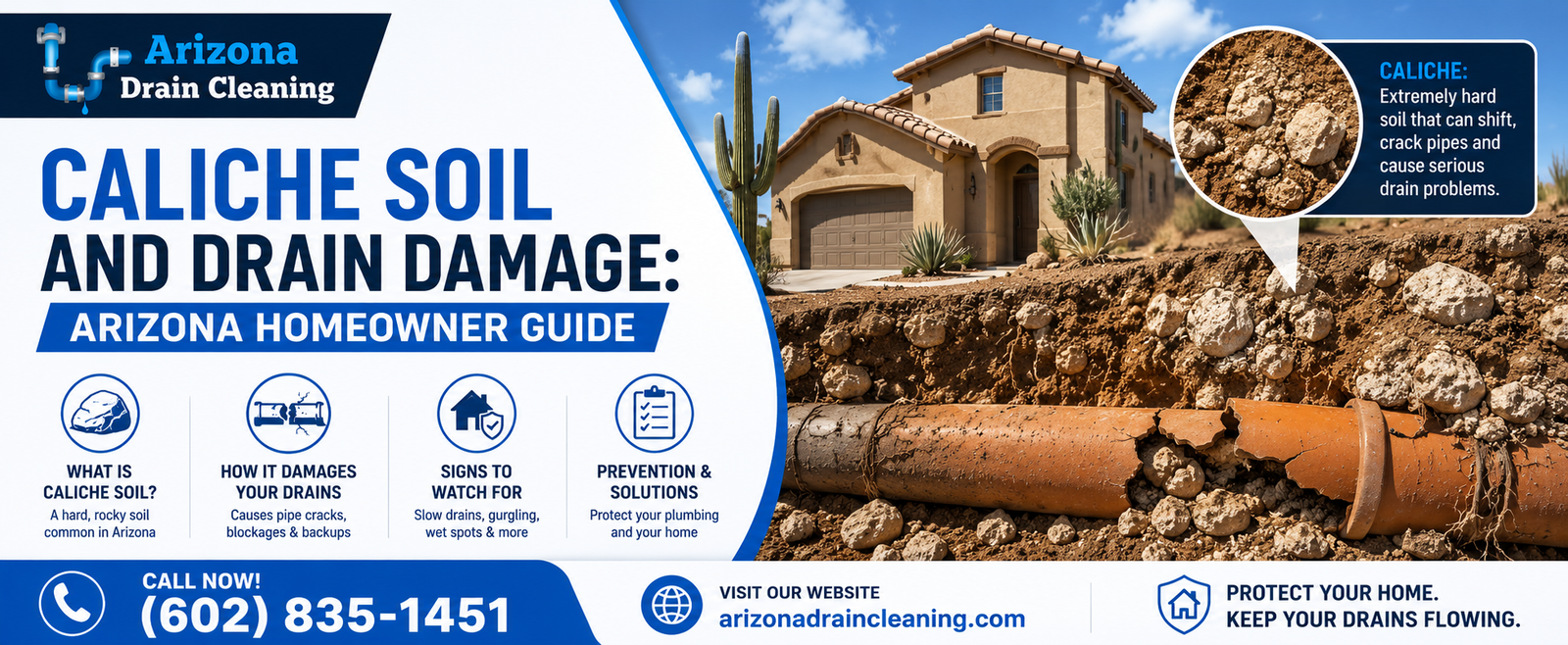
Caliche soil drain problems in Arizona are not a plumbing myth or a minor inconvenience; they are a slow, invisible force that quietly works against your pipes, your foundation, and your drainage system every single year. If you live in Phoenix, Tucson, Scottsdale, Mesa, or anywhere else in the Valley, you are almost certainly building your life on top of a layer of calcium carbonate hardpan that no other state in the country deals with at this scale. Understanding what caliche is, how it interacts with your plumbing, and what warning signs to watch for can save you from thousands of dollars in repair costs down the road.
What Is Caliche and Why Does It Only Exist at This Scale in Arizona?
Caliche is a dense, rock-like layer of calcium carbonate that forms beneath the surface when calcium-rich groundwater evaporates in arid conditions over thousands of years. As water rises through the soil and evaporates in Arizona’s relentless heat, it leaves behind calcium salts that bind with surrounding soil particles, sand, and clay into a cemented hardpan that can range from a few inches thick to several feet deep. The result looks and behaves like buried concrete.
Arizona’s Sonoran Desert climate, with its extreme summer heat, very low annual rainfall, and rapid evaporation rates, creates ideal conditions for caliche formation. While small caliche deposits exist in parts of New Mexico, Nevada, and West Texas, no other state has widespread residential caliche layers as thick, as shallow, or as consistently impenetrable as Arizona. The University of Arizona Cooperative Extension has studied this extensively and considers caliche one of the defining soil challenges for southern Arizona homeowners.
How Deep Is Caliche in Phoenix vs. Tucson?
The depth of caliche varies meaningfully between the two largest metro areas in Arizona, and that difference matters for your plumbing.
In the Phoenix metro area, including Scottsdale, Mesa, Chandler, Gilbert, and Tempe, caliche typically begins between 12 and 36 inches below the surface. In many neighborhoods across the East Valley and central Phoenix, you hit a distinct hardpan layer right around the 18 to 24 inch mark, which happens to be exactly where residential sewer laterals and drain lines run. Some areas in the West Valley and newer developments in Queen Creek or Maricopa encounter deeper caliche starting closer to 3 to 4 feet down, but the layer itself can extend several feet in thickness.
In Tucson and surrounding communities like Marana, Sahuarita, and Oro Valley, caliche can begin as shallow as 6 to 12 inches below the surface in some yards. Tucson’s older neighborhoods, including Sam Hughes, Barrio Viejo, and the Armory Park district, sit on particularly compact caliche formations that have complicated underground pipe repairs for decades. When excavation contractors in Tucson say they need heavy equipment just to dig a service trench, caliche is almost always the reason.
How Caliche Creates Drain Problems in Arizona Homes
This is where caliche moves from a landscaping nuisance to a genuine plumbing threat. The mechanism is straightforward but the damage it causes compounds over time in ways most homeowners do not notice until the problem is already serious.
Water Perching Above the Caliche Layer
Because caliche does not absorb water, any moisture that reaches the layer from above has nowhere to go. It pools and sits directly on top of the hardpan in a phenomenon called water perching. In practical terms for your home, this means that water from irrigation, rain, a slow exterior faucet drip, or a minor underground leak does not drain away. It accumulates. That perched water collects against your foundation, saturates the soil surrounding your slab, and eventually creates the kind of persistent moisture environment that puts lateral pressure on underground pipes.
During monsoon season, which officially runs from mid-June through the end of September in Arizona, this problem intensifies dramatically. A monsoon storm can dump two inches of rain onto bone-dry Phoenix or Tucson streets in under an hour. When that water hits caliche-underlain soil, it has almost no vertical escape route. Surface runoff overwhelms yard drains, the ground surrounding your foundation becomes saturated almost instantly, and any existing vulnerability in your underground drain system faces immediate stress.
Pipe Pressure and Joint Separation From Caliche Soil Movement
Caliche is not entirely static. While it is extremely hard when dry, it expands slightly when it absorbs moisture and contracts when it dries out. Combine that with the expansive clay soils that often sit above and around caliche layers in Phoenix and Tucson, and you have a ground environment that puts your buried pipes through a continuous stress cycle every single year.
In summer, the soil above the caliche dries and shrinks, creating micro-voids around pipe walls. When monsoon moisture hits, the clay expands rapidly and presses hard against underground drain lines. This push-pull cycle, repeated year after year across Arizona’s extreme temperature swings, gradually shifts pipe sections out of alignment, stresses joint connections, and creates the low spots and separations known as pipe bellying. A bellied section of drain pipe is essentially a sag where wastewater slows, debris accumulates, and the conditions for a full backup develop.
Older pipe materials, particularly clay tile and cast iron installed in Phoenix and Tucson neighborhoods built before the 1980s, are especially vulnerable to this movement. These rigid materials do not flex with the ground. They crack, separate at joints, or develop the kind of structural micro-fractures that allow root intrusion to begin.
Root Intrusion Targeting Moisture Near Caliche
This is one of the most misunderstood aspects of caliche and pipes in Arizona. Desert-adapted trees like palo verde, mesquite, and African sumac are built to find water at great distances. Their root systems extend aggressively outward and downward in search of moisture. When caliche creates a perched water zone near your foundation or sewer line, it essentially signals to nearby tree roots that there is a reliable water source in that exact location.
As roots probe the perched moisture zone, they encounter your drain pipes. Hairline cracks from caliche-driven soil movement become entry points. Older clay and cast iron lines with compromised joint seals are particularly susceptible. Once a root enters a pipe, it grows, branches, and catches debris with every flush. What starts as a slowed drain becomes a full blockage, and by the time most homeowners notice, the root mass inside the pipe can be substantial.
In Tucson, palo verde and mesquite root intrusion into caliche-stressed drain lines is among the most common reasons older residential sewer laterals require replacement rather than cleaning. In Phoenix neighborhoods like Arcadia, Ahwatukee, and central Phoenix with mature tree canopies, the same dynamic plays out in cast iron lines that have been accumulating stress since the 1950s and 1960s.
Warning Signs That Caliche Soil Is Affecting Your Arizona Drain System
Knowing what to look for is half the battle. These signs do not always mean caliche is the direct cause, but in Arizona, if you are experiencing any of them, caliche-related pipe stress belongs near the top of the diagnostic list.
Slow drains throughout the house, not just one fixture. A single slow drain usually points to a localized clog. When multiple drains run slowly at the same time, it suggests a partial blockage or pipe issue further down the main sewer lateral, which is exactly where caliche-driven pipe bellying or root intrusion tends to occur.
Gurgling sounds from drains or toilets. Gurgling indicates that air is being displaced by a partial blockage downstream. In Arizona homes with older pipe systems, this is often the first audible sign of a debris accumulation forming in a bellied pipe section.
Standing water in your yard after minimal irrigation or rain. If your yard pools water quickly and it lingers for hours, caliche is almost certainly preventing proper downward drainage. That same water is likely putting pressure on your foundation and any underground pipes nearby.
Recurring drain backups despite regular cleaning. If you find yourself calling for drain service every few months for the same drain, the root cause is not just a clog. Pipe bellying, root intrusion, or a compromised joint is catching debris repeatedly. This pattern is common in Arizona homes built on dense caliche formations.
Sewage odors inside the house. In Phoenix, extreme heat evaporates P-trap water seals faster than almost anywhere else in the country. But if odors persist even when traps are full, compromised sewer lateral sections from caliche-related joint separation may be allowing sewer gases to escape underground and migrate into your home through cracks in the slab.
Caliche and Pipes in Arizona: How Excavation Makes Repairs Expensive
One of the less discussed consequences of caliche layer plumbing issues in Arizona is what happens when a repair actually requires excavation. In most of the country, a plumber can dig a service trench by hand or with a small excavator. In Arizona, reaching a pipe buried in or beneath a caliche layer often requires jackhammer work, pneumatic tools, or heavy excavation equipment that adds significant labor cost and time to any repair.
This is one of the primary reasons trenchless repair methods, including pipe lining and pipe bursting, have become particularly valuable in Arizona. By accessing the pipe through existing clean-out openings rather than digging through caliche, these methods sidestep the most expensive part of underground repair work in the desert. They also produce a seamless pipe interior that resists root intrusion far better than older jointed systems.
If a contractor tells you that a repair in your Phoenix or Tucson yard will require breaking through caliche to reach the pipe, it is not an exaggeration. It is a straightforward reality of Arizona geology, and budgeting accordingly is the right approach.
How to Protect Your Drain System From Caliche Soil Pipe Damage
You cannot remove the caliche from under your property, but you can take specific steps to reduce the risk it poses to your plumbing.
Annual drain cleaning before monsoon season. Scheduling professional drain cleaning in April or May, before the first storms hit in mid-June, is the single most effective preventive step Arizona homeowners can take. Clearing any partial debris accumulation from bellied or aging pipe sections gives your system the best possible capacity to handle monsoon surges.
Camera inspection of older lines. If your home was built before 1985 and you have never had a video camera inspection of your main sewer lateral, now is the time. A camera inspection reveals bellied sections, joint separations, root intrusion, and scale buildup that no surface diagnosis can detect. In Phoenix, Tucson, and the surrounding communities, homes of this age sitting on known caliche formations have a high likelihood of harboring undiscovered pipe issues.
Manage landscaping near sewer lines. Know where your sewer lateral runs from your home to the municipal connection, and avoid planting palo verde, mesquite, African sumac, or other aggressive-rooting desert trees within 10 to 15 feet of that line. If mature trees already exist close to your line, annual root treatment and cleaning is a reasonable preventive investment.
Address yard drainage issues proactively. If your yard shows signs of caliche-driven water perching, French drains or properly graded surface drainage can redirect monsoon water away from your foundation before it has a chance to saturate the soil against your slab and buried pipes.
Caliche Soil Drain Problems Arizona: Phoenix vs Tucson at a Glance
| Factor | Phoenix Metro | Tucson |
|---|---|---|
| Typical caliche depth | 18 to 36 inches | 6 to 18 inches |
| Highest risk pipe types | Cast iron, galvanized (pre-1980s) | Clay tile, cast iron |
| Primary root intrusion trees | African sumac, olive | Palo verde, mesquite |
| Monsoon impact | High (rapid flooding, clay expansion) | High (flash flood risk, shallow hardpan) |
| Excavation difficulty | Moderate to high | High (very shallow caliche) |
Frequently Asked Questions About Caliche Soil and Drain Problems in Arizona
Does every Arizona home have caliche under it?
Not every single property, but the vast majority of residential land in southern Arizona, including the Phoenix metro and the Tucson basin, sits above some form of caliche formation. The depth, thickness, and density vary by neighborhood and lot. Homes in newer developments on the urban fringe and properties near sandy desert wash areas may have thinner or deeper caliche layers, while older urban neighborhoods in central Phoenix and midtown Tucson tend to have denser and shallower hardpan formations.
Can caliche directly crack or break a drain pipe?
Caliche itself does not typically fracture a pipe through direct contact. The damage mechanism is indirect. Caliche traps moisture, which saturates surrounding soil and creates pressure cycles against pipe walls. It also causes surrounding clay soils to expand and contract dramatically with Arizona’s seasonal moisture swings, which shifts, bellies, and cracks pipes over many years. The pipe damage is real and significant, but it develops gradually rather than as a sudden event.
How do I know if my slow drain is caused by caliche soil issues or just a normal clog?
A clog caused by hair, grease, or soap buildup typically affects one fixture and clears with standard drain cleaning. If multiple drains throughout your home are running slowly, if you experience recurring backups in the same drain after professional cleaning, or if a camera inspection reveals pipe bellying or joint separation, those are signs that caliche-related soil movement is the underlying cause rather than surface buildup.
Is trenchless pipe repair worth the cost in Arizona?
For most Arizona homeowners dealing with caliche-related pipe damage, trenchless methods offer significant advantages over traditional open-cut repair. Because breaking through caliche requires heavy equipment and substantially increases labor time and cost, avoiding excavation saves money overall even when the per-foot trenchless repair cost seems comparable on paper. Trenchless lining also produces a seamless interior that resists future root intrusion far better than jointed pipe systems.
How often should I have my drains cleaned if I live in Phoenix or Tucson?
For a typical Arizona home with no history of drain problems, professional drain cleaning once a year before monsoon season is a sound preventive schedule. If your home was built before 1985, has mature trees near the sewer lateral, or has a documented history of recurring backups, twice a year is a more appropriate interval. Older homes in central Phoenix, Tempe, and midtown Tucson sitting on dense caliche layers with aging clay or cast iron lines benefit most from this more frequent schedule.
Can I break through caliche myself to improve yard drainage?
Small surface areas of shallow caliche can sometimes be broken up with a rebar bar, a pickaxe, or a rented electric jackhammer. However, for any work near underground utilities, irrigation lines, or sewer laterals, DIY excavation carries real risk. Always call 811 before any digging to have underground lines marked. For drainage corrections that require deeper work or work close to the foundation, professional assessment and excavation is the safer and more effective approach.
The Bottom Line: Caliche Is an Arizona Reality You Cannot Ignore
Caliche soil drain problems in Arizona are not something you can solve with a bottle from the hardware store or a drain snake from the garage. The forces at work, trapped water, shifting soil, joint separation, root intrusion, are geological and long-term. They require professional diagnosis, the right repair methods, and a maintenance approach built around Arizona’s specific soil and climate conditions.
If your drains are slow, your yard holds water, or you have not had a camera inspection on a home built before 1985, the time to act is before the next monsoon season loads additional stress onto a system that may already be compromised.
Arizona Drain Cleaning serves homeowners across the Valley who deal with these exact conditions every day. Our team understands caliche, knows what it does to drain systems in Phoenix and Tucson, and has the equipment to diagnose and resolve the problem correctly the first time. For drain cleaning in Phoenix or anywhere in the greater Phoenix metro, Call Arizona Drain Cleaning at (602) 835-1451 right now to schedule a drain cleaning before the next stage of that escalation arrives. S