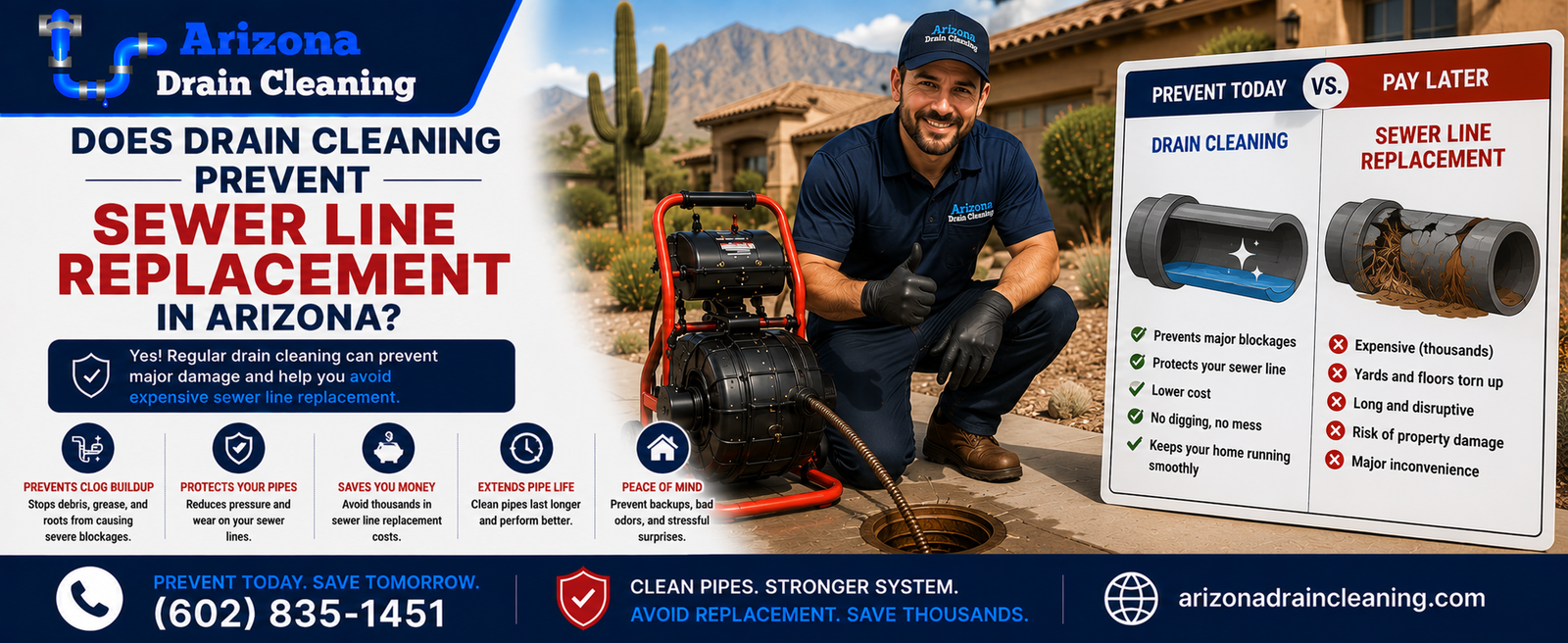
Drain cleaning can absolutely prevent sewer line replacement in Arizona, and for most Valley homeowners it does exactly that year after year. The caveat is that this is only true up to a certain point. Once a pipe has crossed from maintenance territory into structural failure territory, cleaning is no longer the right tool for the job. Knowing where that line is and what it costs to stay on the right side of it is one of the most useful things an Arizona homeowner can understand about their plumbing system.
Regular Arizona drain cleaning helps remove grease, sludge, mineral scale, root intrusion, and other buildup before these issues have an opportunity to create long-term damage inside the sewer line. In many Arizona homes, especially those with older cast iron or clay sewer systems, preventative cleaning is far less expensive than dealing with a collapsed pipe, severe corrosion, or a major sewer backup that requires excavation and replacement.
The key is understanding that drain cleaning is a maintenance strategy, not a structural repair. If a sewer line is still fundamentally sound, routine cleaning can extend its usable life for years and sometimes even decades. However, when camera inspections reveal cracks, major offsets, severe corrosion, bellies, or sections of pipe that have already begun to fail, cleaning alone cannot reverse that damage. At that stage, repair or replacement becomes the appropriate solution.
For many homeowners, the most cost-effective approach is a combination of periodic drain cleaning and occasional sewer camera inspections. This allows problems to be identified while they are still manageable, helping prevent the type of deterioration that eventually leads to full sewer line replacement.
What Regular Drain Cleaning Actually Does for Your Sewer Line
A sewer lateral is not a sealed, static system. It accumulates material continuously: grease from the kitchen, mineral scale from Arizona’s hard water, hair and soap residue from bathrooms, and in many Valley yards, root tips from palo verde, mesquite, and citrus trees following the perched moisture that caliche hardpan creates right at the depth where residential sewer lines run.
Left unaddressed, that accumulation does not stay at a manageable level. It compounds. Each layer of scale gives the next layer something to adhere to. Each root tip that enters a joint hairline grows into a strand, then a mass, then a dam. Each grease coating traps debris from every flush and every drain cycle. What is a partially narrowed pipe one year is a chronically slow pipe the next year and a backed-up main line the year after that.
Regular drain cleaning, specifically professional hydro jetting at 3,000 to 4,000 PSI, removes all of that accumulation down to the pipe wall. It clears the scale, breaks apart and flushes grease buildup, and cuts through root intrusion that is in the early to moderate stage. Done on a consistent schedule, typically every 18 to 24 months for most Valley homes and annually for properties with trees near the sewer line or older cast iron pipe systems, it keeps the inside of the pipe in a condition close to its original designed capacity.
That maintenance cycle does something else that most homeowners do not think about until they have a camera inspection report in front of them: it extends the functional life of a pipe that is already aging. A cast iron lateral in a 1965 Phoenix home that has been cleaned consistently every year or two is in meaningfully better condition than the same pipe with no cleaning history. The mineral scale that hard water deposits on the interior wall of a neglected cast iron pipe is not just a flow restriction. It is a corrosive environment that accelerates wall thinning from the inside. Removing that scale regularly does not reverse corrosion that has already occurred, but it slows the rate of ongoing deterioration.
In practical terms, a cast iron lateral that might require full replacement at year 40 with no maintenance may still be serviceable at year 50 with consistent cleaning and camera monitoring. That is ten years of sewer line replacement cost that preventive maintenance pushed down the road.
The Cost Comparison: What You Are Actually Choosing Between
This is where the ROI argument becomes very concrete.
Sewer line replacement costs in Phoenix average $4,123, with most homeowners spending between $1,818 and $6,429 depending on material selection, pipe length, and excavation challenges. That is the standard range for relatively straightforward projects. The cost to repair a main sewer line in Phoenix can run anywhere from $5,000 to $20,000, with the average cost being $10,000. For jobs involving significant caliche excavation, full lateral replacement, trenchless rehabilitation, or complex access conditions, the high end of that range is real and not unusual.
Phoenix soils vary from sandy loam to hard caliche, which can significantly impact excavation costs and equipment needs. Caliche requires special tools and can make excavation take longer and cost more than in other regions. This is the Arizona-specific factor that makes the cost difference between prevention and replacement starker here than in most of the country. Breaking through caliche with pneumatic equipment and heavy machinery adds labor cost and time to any excavation job that simply does not apply in softer-ground markets.
A professional main line drain cleaning in Phoenix typically runs $150 to $400 for standard cable snaking on a routine maintenance visit, or $300 to $600 for hydro jetting that genuinely strips the pipe interior clean. A camera inspection that gives you a documented baseline of the pipe’s current condition adds $150 to $300. An annual or biennial maintenance program that includes cleaning and periodic inspection costs most Valley homeowners $300 to $700 per year depending on the property and service scope.
The math is straightforward. Ten years of consistent annual drain cleaning costs $3,000 to $7,000 in total maintenance expenditures. One sewer line replacement in that same period costs $5,000 to $20,000, plus the disruption, the caliche excavation premium if applicable, landscaping restoration, permit fees, and the stress of managing an emergency that was not budgeted for.
That comparison is not close, and it only gets more favorable for preventive maintenance when you account for the fact that a well-maintained pipe is unlikely to require emergency replacement at all within a normal homeownership window, while a neglected one often does.
When Drain Cleaning Can No Longer Prevent Sewer Replacement in Arizona
This is the part that honest drain cleaning companies tell you clearly, and that some do not. There is a point at which cleaning is no longer a substitute for repair or replacement, and misidentifying that point leads homeowners to spend money on cleaning that cannot address the actual problem.
Here are the specific conditions that move a pipe beyond what cleaning can fix.
Structural Pipe Collapse or Severe Deformation
A pipe section that has collapsed inward, whether from soil loading, freeze-thaw damage in higher-elevation Arizona properties, or the end-stage of years of joint stress and corrosion, cannot be cleaned back to function. The pipe cross-section is physically deformed or missing material. Hydro jetting at any pressure does not restore pipe geometry. This situation requires either section replacement or, in some cases, pipe lining if the adjacent sections are intact enough to support a liner.
Severely Offset Joints With Soil Infiltration
A pipe joint that has shifted enough that soil from the surrounding ground is visible through the gap during camera inspection is a joint that has become an open breach in the sewer system. Wastewater is escaping into the surrounding soil. Soil is infiltrating the pipe. Cleaning removes the debris catching at the offset step but does not close the gap or stop the ongoing soil intrusion. This condition requires repair at the offset location. In Arizona, where the expansive clay and caliche transition zones create specific stress points that cause joint offsets in older pipe systems, this finding is not rare in homes built before the 1980s.
Advanced Root Intrusion With Compromised Pipe Wall Entry Points
Root intrusion in the early to moderate stage, meaning fibrous strands or a partial root mass that entered through a hairline seam, can be cleared with hydro jetting and managed with annual cleaning and root treatment. The pipe wall at a hairline seam is essentially intact. Remove the roots and seal or line the entry point, and the pipe continues to function.
Root intrusion where the entry point is a crack or fracture with visible pipe wall displacement is a different situation. The root entered through a structural failure in the pipe itself. Clearing the root mass does not repair the fractured entry point. That entry point will re-admit root growth within one to three growing seasons, and each re-entry cycle makes the fracture larger. Pipe lining is the appropriate response for this stage if the surrounding pipe is structurally adequate for a liner. If the fracture is in a pipe section that is already severely corroded or otherwise compromised, section replacement may be more cost-effective.
Multiple Co-Located Findings
A camera inspection that reveals a bellied section, root intrusion at a joint, and corrosion-thinned walls all within the same ten-foot section of sewer lateral is not a cleaning situation. It is a repair situation. The combination of structural findings in a concentrated zone indicates a pipe that has reached end-of-life in that section. Cleaning the root intrusion and ignoring the belly and the wall thinning produces temporary symptom relief followed by a failure that was entirely predictable.
Our post on how to read a sewer camera inspection report in Arizona walks through each of these findings in detail, including the PACP grading system that classifies findings by urgency and the specific action each finding category requires. If you have a camera report you are trying to interpret, that post is the right starting point.
The Honest Middle Option: Pipe Lining as a Bridge Between Cleaning and Replacement
For Arizona homeowners whose pipe condition is beyond what cleaning alone can address but whose pipe has not yet failed completely, pipe lining, also called cured-in-place pipe lining or CIPP, offers a meaningful alternative to full excavation and replacement.
Pipe lining installs a seamless resin liner through the existing pipe interior using existing access points, without excavation. The liner adheres to the existing pipe wall, bridges moderate offset joints and small cracks, eliminates the rough interior surfaces that accelerate buildup, and creates a root-impenetrable surface that solves the re-entry problem that clearing roots without addressing the entry point cannot. In Arizona, where excavating through caliche adds substantial cost to any open-cut repair, trenchless pipe lining’s avoidance of that excavation premium makes it particularly cost-effective compared to full replacement.
Pipe lining is not appropriate for every situation. Collapsed sections, severe deformation, and very large offset joints may prevent a liner from being installed. A camera inspection determines whether a given pipe section is a candidate. But for the large category of Arizona sewer laterals that are deteriorating but not yet failed, pipe lining extends functional life significantly at a fraction of full replacement cost.
Prevent Sewer Problems in Arizona Before They Become Replacement Decisions
The window where preventive drain cleaning keeps a Phoenix homeowner out of sewer replacement territory is wide for most properties. It requires consistent maintenance, periodic camera inspection to monitor what the cleaning cannot fix, and honest assessment of what the footage shows when structural findings begin to appear. What it does not require is spending $10,000 on a replacement that a $300 annual cleaning could have delayed by a decade or more.
For drain cleaning in Phoenix on a maintenance schedule that actually protects your sewer line investment, Arizona Drain Cleaning provides honest assessments, professional cleaning, and camera inspections without the pressure to recommend repairs that are not yet warranted.
To understand the Arizona-specific soil conditions that make preventive maintenance especially important in the Valley, our post on caliche soil and drain damage in Arizona explains exactly what is happening underground and why the maintenance calculus here is different from most of the country.
Contact us today (602) 835-1451 or visit our Phoenix drain cleaning service page to schedule your next maintenance visit. A few hundred dollars now or several thousand later. That decision is yours to make, and we are here to make sure you have the information to make it correctly.
Frequently Asked Questions: Drain Cleaning vs Sewer Replacement in Arizona
How much does sewer line replacement actually cost in Phoenix?
Sewer line replacement in Phoenix averages $4,123, with most homeowners spending between $1,818 and $6,429 depending on pipe length, material selection, and excavation requirements. For major repairs involving significant pipe damage, costs can run from $5,000 to $20,000, with an average closer to $10,000 for a full main sewer lateral repair. Arizona’s caliche hardpan layer adds excavation cost that does not exist in most other states, as breaking through caliche requires specialized heavy equipment and substantially more labor time than digging through softer soil. That caliche premium is a significant factor in why preventive drain cleaning has such a strong ROI in the Valley compared to national averages.
At what point does drain cleaning stop being effective for preventing sewer replacement?
Drain cleaning stops being the right intervention when the pipe has structural damage that cleaning cannot address. The specific thresholds are: pipe sections that have collapsed or severely deformed, offset pipe joints where soil is visibly infiltrating through the gap, root intrusion entering through an open crack or fracture rather than a hairline seam, and any combination of structural findings concentrated in the same section of pipe. A camera inspection identifies which side of that line your pipe is on. Below the threshold, cleaning is the right tool. Above it, cleaning addresses symptoms while the structural problem continues to worsen.
How often should I clean my sewer line to avoid replacement?
For most Arizona homes, annual to every-18-months professional main line cleaning is the maintenance interval that meaningfully extends sewer line life and keeps the pipe in a condition where camera monitoring can catch structural issues early. Homes with mature citrus, palo verde, or mesquite trees near the sewer lateral, and homes built before 1985 with cast iron or clay tile laterals, should be on annual cleaning with a camera inspection every two to three years. The pre-monsoon window in April and May is the most strategically valuable time for this service, as it puts the pipe in its best condition before Arizona’s monsoon season creates the soil movement and surge conditions that stress underground plumbing most aggressively.
Is pipe lining a good alternative to full sewer replacement in Arizona?
For pipes that have deteriorated beyond what cleaning alone can address but have not yet experienced complete structural failure, pipe lining is frequently the most cost-effective intervention in Arizona. The trenchless installation approach avoids the caliche excavation premium that makes open-cut sewer work particularly expensive in the Valley. Pipe lining eliminates root re-entry, bridges moderate joint gaps and small cracks, and creates a smooth interior surface that resists future scale buildup. Whether a specific pipe section is a pipe lining candidate depends on its current structural condition, which a camera inspection determines. A pipe that is already collapsed or severely offset may not be an appropriate liner candidate, but a large percentage of deteriorating Arizona sewer laterals are.
What is the best evidence that drain cleaning has extended my sewer line’s life?
A camera inspection performed after several years of consistent cleaning provides the clearest evidence. If the inspection shows the pipe interior is in materially better condition than comparable pipes of the same age and material in homes without maintenance histories, the cleaning is doing its job. In practical terms, a 40-year-old cast iron lateral in a Tempe home that shows moderate interior scale with no root intrusion, no significant corrosion pitting, and no offset joints after years of consistent maintenance is a pipe that has been genuinely extended beyond its likely condition without that maintenance. The camera footage is the record. That is why Arizona Drain Cleaning recommends periodic camera inspection as part of any consistent maintenance program, not just when a problem is suspected.