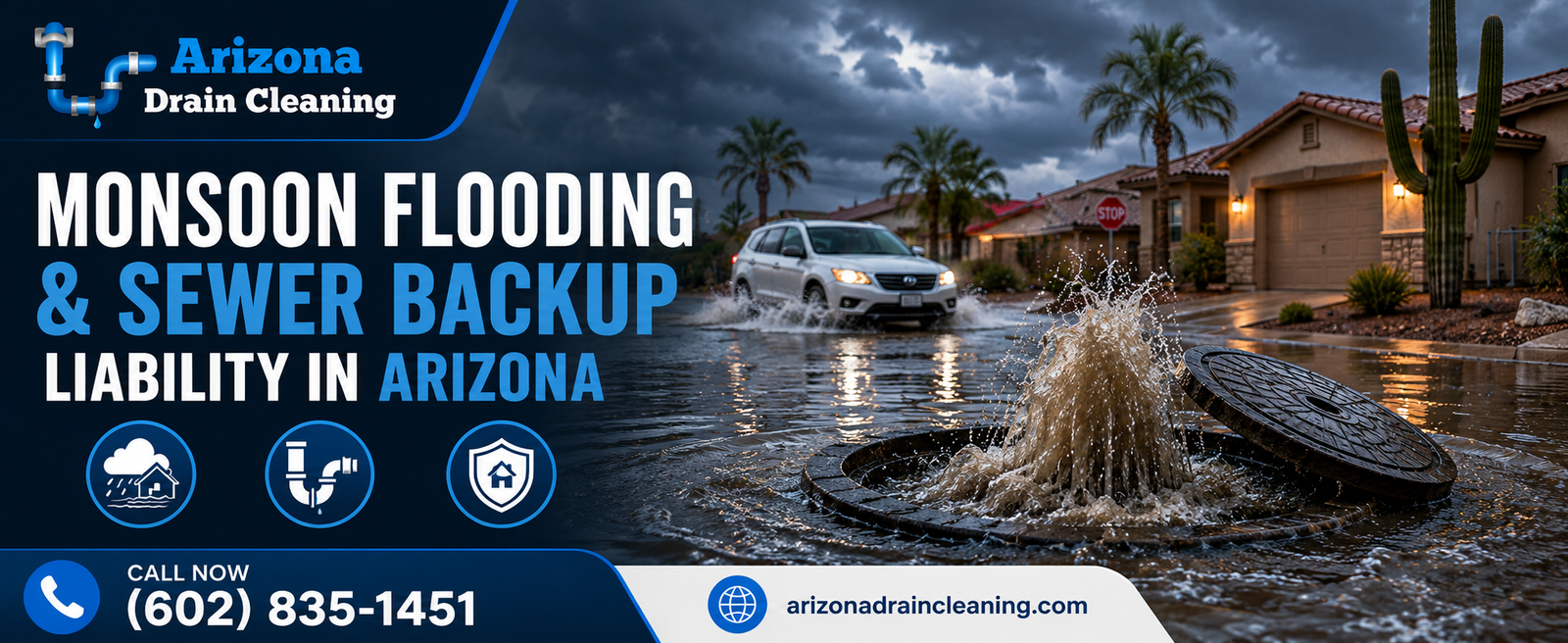
Monsoon sewer backup in Arizona turns an ordinary summer storm into a plumbing emergency that can cost anywhere from $3,000 to well over $20,000 in cleanup, repairs, and damaged belongings. If you have ever walked into your laundry room during a July storm and found sewage rising through the floor drain, or if you are trying to understand your exposure before this season begins, this guide is for you.
Arizona is not a state that gets a lot of sympathy from insurance companies or municipalities when it comes to storm damage. The monsoon season, which officially runs from June 15 through September 30, delivers roughly 60 to 70 percent of Arizona’s annual rainfall in concentrated, violent bursts according to the Arizona Department of Water Resources. That water hits the Phoenix metro’s hardscape, clay soil, and desert ground at a rate the earth simply cannot absorb, and everything that cannot soak in has to go somewhere. Much of it ends up in storm drains and the municipal sewer system, which were designed for average conditions, not the occasional haboob-followed-by-two-inches-in-forty-minutes event that Arizona considers a normal Tuesday in August.
When that system overloads, the pressure has to go somewhere. It goes up. Into your home. Through the path of least resistance, which is often a laundry room floor drain, a ground-floor toilet, or a shower drain in the lowest bathroom in the house.
The question that follows is one of the most stressful a homeowner can face: whose problem is this? This guide answers that question honestly and completely.
The Arizona Monsoon and Why Your Drain System Is So Vulnerable
Before getting into liability and insurance, it helps to understand exactly why Arizona homes face a backup risk during monsoon season that is genuinely different from what homeowners in other states deal with.
The Soil Problem Every Phoenix Homeowner Faces
For most of the year, the soil across the Phoenix metro, Maricopa County, Scottsdale, Mesa, Chandler, and the broader Valley is hard, dry, and nearly impermeable. Clay-rich desert soil contracts during the long dry season, pulling away from foundations, shrinking around underground pipes, and developing a crust that repels water rather than absorbing it. The Arizona Department of Transportation has invested heavily in freeway pump stations specifically because Valley soil simply does not soak up water during storm events, and even those pump stations have been overwhelmed during significant monsoon events.
When a storm drops one to two inches of rain in under an hour, which is not an unusual event in July or August, virtually all of that water runs off the surface and into whatever drainage infrastructure exists nearby. In older Phoenix neighborhoods like Arcadia, Encanto, and Central Phoenix, where Phoenix Water Services manages more than 5,000 miles of aging sewer lines that were designed for a fraction of the current population, the system is already working close to capacity before the first summer storm arrives.
How Backup Actually Happens During a Monsoon
The mechanism behind a monsoon sewer backup is straightforward but easy to misunderstand. When storm runoff overwhelms the municipal system, pressure builds in the main sewer lines. That pressure travels backward through the network, eventually reaching the sewer lateral that connects your home to the street main. If your lateral is clear, the pressure may dissipate without entering your house. If your lateral has partial blockages from grease buildup, mineral scale from hard water, root intrusion, or a sagged pipe section, that partial restriction acts as a dam. The surge has nowhere to go but up through the lowest drain in your home.
This is why the same storm will back up three homes on a block while the neighbors on either side are completely unaffected. The difference is almost always the condition of the individual sewer lateral, not the severity of the storm.
Monsoon Sewer Backup Arizona: Who Is Actually Liable?
This is the core question, and the answer requires understanding three distinct segments of your home’s drain and sewer system. Liability follows the pipe, and knowing which pipe failed determines who is responsible for the damage.
What the Homeowner Owns and Is Responsible For
The sewer lateral, also called the private lateral or building connection, is the underground pipe that runs from your home’s main drain connection out to the municipal sewer main beneath the street. In Arizona, most cities, including Phoenix, Mesa, Scottsdale, Chandler, Gilbert, Tempe, and Glendale, operate under the principle that this lateral is the homeowner’s property and the homeowner’s financial responsibility, from the house all the way to the connection point at the public main.
City of Phoenix Municipal Code Section 28-5(a) states this explicitly: the property owner is responsible for the cleaning, maintenance, and repair of the building connection piping from the home to the public sewer line. This applies even to portions of the lateral that extend through the public right-of-way, such as under the sidewalk or the street itself, up to the connection point.
What this means for monsoon backups is that if your lateral had a partial blockage from grease and mineral scale that the storm surge pushed over the edge into a full backup, the damage inside your home is your financial responsibility. The storm was the trigger. The deferred maintenance on your private lateral was the cause.
This is the scenario that catches most Arizona homeowners completely off guard, and it is the most common reason monsoon backup claims are denied, disputed, or left entirely to the homeowner.
When the City May Bear Responsibility
The municipality is responsible for maintaining the public sewer main that runs beneath the street and the broader network of public sewer infrastructure. If a backup originated from a failure or severe capacity limitation in the main line and not from a problem in your private lateral, you may have grounds for a claim against the city.
However, holding a municipality legally responsible in Arizona is significantly harder than most homeowners expect. Arizona cities carry governmental immunity protections under state law, and the legal bar for establishing city liability is higher than simply showing that a storm overwhelmed the system. To have a viable claim, a homeowner generally needs to demonstrate that the city had documented knowledge of a specific infrastructure problem, such as a known capacity deficiency or a reported main line blockage, and failed to address it within a reasonable time.
General system overload during an exceptional rain event, without evidence of a specific known defect that the city neglected, is unlikely to support a successful claim. What does matter is prompt action on your part. If you believe the main line was involved in your backup, report it to your city’s public works or wastewater department immediately while conditions are fresh, and request written confirmation of that report. That record becomes relevant if a liability conversation develops later.
The first legal step toward any action against an Arizona municipality is filing a formal notice of claim with the city. Arizona law requires this notice before any civil lawsuit can be filed, and strict time limits apply. For significant damages where city responsibility may be involved, consulting an Arizona property attorney is the most important thing you can do in the days immediately following the event.
HOA Liability in Arizona Planned Communities
For homeowners in HOA-governed communities across the Valley, including the many master-planned developments in Chandler, Gilbert, Queen Creek, Peoria, and North Scottsdale, liability involves a third layer that depends entirely on the community’s governing documents.
Under Arizona Revised Statutes Title 33, Chapter 16, which governs planned communities across the state, HOAs are responsible for maintaining and repairing common areas and shared infrastructure. The specific application to a sewer backup depends on several factors:
Where the backup-causing blockage or failure was located matters most. If the problem was in a shared sewer line that runs through an HOA-maintained common area, the association may bear responsibility for the resulting damage. If the problem was in the private lateral that serves only your individual home, HOA responsibility is generally limited regardless of where that lateral runs geographically.
Causation from HOA-maintained landscaping is also significant. Tree root intrusion from trees planted and maintained by the HOA in common areas is a documented cause of sewer lateral failures across Arizona communities where mature desert trees have had decades to grow toward moisture sources in underground pipes. If HOA trees caused the root intrusion that caused your backup, that causal link matters to the liability analysis.
Your community’s CC&Rs (Covenants, Conditions, and Restrictions) govern all of this in your specific development. Not all CC&Rs are identical, and responsibility splits vary considerably from one community to another. Pull your governing documents, specifically the sections covering sewer line maintenance, shared plumbing infrastructure, and damage caused by association negligence, before assuming either way.
What Insurance Covers for Monsoon Drain Backup in Arizona
Here is where the financial picture becomes genuinely complicated, and where the gap between what homeowners assume they are covered for and what they are actually covered for becomes most painful.
The Default Coverage Gap in Standard Homeowners Policies
A standard homeowners insurance policy in Arizona, as confirmed by the Arizona Department of Insurance and Financial Institutions (DIFI), does not cover sewer backup damage by default. The exclusion exists because insurers classify sewer backup as a maintenance-related and predictable risk category rather than a sudden, accidental covered event. This exclusion applies whether the backup was triggered by a monsoon event, a standalone clog, or a main line problem.
The standard policy also excludes flood damage, meaning water entering the home from outside at ground level. This creates a specific problem during Arizona monsoon events, when a backup through interior drains and surface flooding from runoff can happen in the same incident. The sewage coming up through your floor drain and the water sheeting under your front door from a flooded street are covered by entirely different policies, and neither is included in your base homeowners coverage.
According to data on water damage insurance claims in Arizona, average water damage claim payouts run between $11,000 and $14,000, and approximately 9 to 10 percent of those claims are denied entirely, which is the highest denial rate in the property insurance category. Understanding your policy before you need it is the only reliable way to avoid being in that 9 to 10 percent.
The Water Backup Endorsement: What It Does and Does Not Cover
A water backup endorsement is an add-on to a standard homeowners policy that specifically covers interior damage from water or sewage backing up through drains, sewer lines, or a sump pump. This endorsement is what most Arizona homeowners who have gone through a monsoon backup wish they had purchased before the storm.
The endorsement covers interior cleanup and remediation, structural repairs to floors and walls, and damaged personal property, all up to the endorsement’s coverage limit. Most limits offered by Arizona carriers fall between $5,000 and $25,000, and it is worth asking your agent whether your limit is genuinely adequate given the scale of damage a full sewage backup event can cause in a slab-on-grade home.
What the endorsement does not cover is equally important to understand. It does not cover flood damage, meaning water entering from outside the structure. It does not cover repairing or replacing the sewer lateral itself. If tree roots destroyed a section of your pipe and excavation is needed to fix it, that is a maintenance repair that falls to the homeowner or possibly the HOA depending on causation, but not to the water backup endorsement. A separate service line endorsement addresses underground pipe repair costs and is worth asking about alongside the water backup endorsement.
The annual cost of adding a water backup endorsement to an Arizona homeowners policy typically runs $50 to $250 per year, which represents an extremely low cost relative to the cleanup and repair expenses that a significant backup event generates. If you are reading this in May or early June, calling your insurance agent today to add this endorsement before monsoon season begins is the single most financially protective action available to you right now.
Flood Insurance Through the NFIP or Private Carriers
Surface water entering your home from outside, whether from monsoon runoff pooling against your foundation, a wash overflowing its banks nearby, or street flooding pushing under your front door, requires a separate flood insurance policy. The DIFI specifically notes that Arizona’s hard desert soil does not absorb water rapidly, making surface flooding from monsoon events a meaningful risk even for homes outside formally designated Special Flood Hazard Areas.
Flood insurance is available through the National Flood Insurance Program (NFIP) administered by FEMA, or through private flood insurance carriers. NFIP policies cover direct physical losses from flooding, and notably, if a sewer backup is directly caused by flooding, the backup damage may be covered under an NFIP flood policy rather than requiring a separate water backup endorsement.
The critical timing issue with NFIP coverage is the standard 30-day waiting period from the date of purchase before coverage takes effect. This means purchasing flood insurance in response to an approaching storm provides no protection for that event. The right time to set up flood coverage is during the fall and winter months, well before the following year’s monsoon season begins.
What to Do Immediately After Monsoon Flooding and Drain Backup
What you do in the hours immediately following a backup directly determines the outcome of any insurance claim and preserves any third-party liability options you may have. Working through these steps methodically under stress is difficult, which is why knowing them in advance matters so much.
Safety Before Everything Else
Sewage water is classified as category three black water, which contains harmful bacteria, pathogens, fecal coliform, and potentially chemical contaminants. It is not something to wade through to assess damage or retrieve belongings. Before entering any room with standing sewage water, turn off the electrical breaker for that area. If the electrical panel is in the affected space, do not attempt to reach it yourself. Call your utility company or a licensed electrician. Keep children and pets out of all affected areas until professional remediation has been completed and surfaces have been properly treated.
Document Everything Before Cleanup Begins
Insurance claims for sewage backup damage depend heavily on documentation gathered before any cleanup or repairs begin. This is the most critical window, and it is short because the health hazard of standing sewage accelerates pressure to start cleaning immediately.
Take photos and video of every affected room showing the full extent of coverage, close-up water lines on walls showing how high the backup reached, every piece of damaged furniture and personal property, the drain or toilet where the backup originated, and any visible evidence of the backup source such as a gurgling floor drain or overflowing toilet. Enable timestamps on your device before shooting.
Record serial numbers of every damaged appliance or electronic device. Photograph purchase receipts or account statements for items where receipts are unavailable. Save small samples of damaged flooring, carpet, or wall material in sealed bags. Physical samples support material replacement claims in ways that photographs alone sometimes cannot.
Call Your Insurance Company Before Starting Any Work
Many Arizona homeowners make the costly mistake of beginning cleanup before notifying their insurer. Most carriers require prior authorization before remediation begins, and starting work without that contact can complicate coverage approval or reduce the payout. Call your insurance company immediately after documentation is complete, file the claim, get a claim number, and ask specifically whether a licensed water damage restoration company needs to be involved before you remove anything or begin drying.
The average water damage claim payout is far higher when a professional restoration company provides documentation to the adjuster than when homeowners attempt self-remediation. Licensed restoration professionals understand exactly what documentation adjusters require; they know the difference between category two gray water and category three black water in ways that affect coverage treatment, and they provide the kind of written assessment that supports rather than undermines a claim.
Get a Drain Camera Inspection and Written Report
If the cause of the backup is unclear, or if you believe the city’s main line or an HOA shared line may have been involved, a licensed plumber’s camera inspection provides objective documentation of what the pipe looked like at the time of the event. That report may show a cleanly maintained lateral that was overwhelmed by external surge pressure, which supports a conversation with the city or HOA. It may show a root-packed or scale-narrowed lateral, which supports understanding why the backup happened and informs the repair needed going forward.
Either way, this documentation is far more useful than a verbal account of what happened. Get it in writing while conditions are fresh.
Who Pays for Sewer Backup in Arizona When Responsibility Is Disputed
Disputed liability situations are more common after monsoon backups than most homeowners expect, and how they resolve depends almost entirely on documentation and timing.
When a homeowner believes the city’s main line was responsible, the path forward is formal. File the notice of claim with the municipality promptly, gather the camera inspection report, and consult an Arizona property attorney if the damages are significant enough to warrant it. Cities have legal teams experienced at defending against these claims, and approaching the process informally rarely produces a favorable outcome.
When the dispute involves an HOA, the governing documents are the starting point. Send all communications in writing and keep copies. Arizona Revised Statutes give homeowners the right to inspect HOA financial records and insurance documents, which may be relevant to understanding what master policy coverage the association carries. If the HOA refuses to engage or denies responsibility without explanation, an Arizona property attorney familiar with planned community law can help you understand your options under the CC&Rs and applicable statutes.
When the dispute is with your own insurance company, document denial reasons in writing and respond specifically to each point with supporting evidence. The Arizona Department of Insurance provides a complaint and mediation process for homeowners who believe their claim was handled improperly, and that resource is available and free to use.
Monsoon Drain Problems in Phoenix and the Valley: Prevention That Actually Works
Prevention is where this guide becomes most practical. Every step below reduces the probability of a backup, and taken together they represent a meaningful risk reduction program for a problem that costs Arizona homeowners millions of dollars every monsoon season.
Pre-Monsoon Professional Drain Cleaning
Professional drain cleaning of your main sewer lateral before June is the most direct prevention step available. A lateral that is fully open handles surge flow from a monsoon event far better than one that is 30 or 40 percent narrowed by grease buildup, mineral scale from Phoenix’s extremely hard water, or partial root intrusion. The cost of a professional mainline cleaning, typically $200 to $500, is a fraction of the deductible on a sewer backup insurance claim, let alone the total cost of a significant backup event.
If your home was built before 1990, a sewer camera inspection alongside the cleaning is worth the additional $150 to $400. Homes of that age in Phoenix neighborhoods like Arcadia, South Mountain, Maryvale, and central Phoenix commonly have clay or cast iron drain lines that have accumulated decades of mineral scale and may have root intrusion from mature trees. A camera inspection turns an unknown underground situation into a known one before the storms arrive.
Install a Backwater Valve
A backwater valve, also called a backflow prevention device, is a one-way valve installed in the sewer lateral that allows wastewater to exit your home but physically prevents it from flowing backward into the home when the main line pressurizes. It is essentially a mechanical override of the surge problem that causes monsoon backups.
For new construction in Phoenix, backwater valve installation costs approximately $500. Retrofitting an existing home typically costs $2,000 to $5,000 depending on access to the sewer lateral and whether the concrete slab needs to be cut. That range sounds significant until it is compared to the $5,000 to $20,000 in cleanup and repair costs that a single serious backup event generates, and the backwater valve works passively without any power or activation required.
Parker and Sons, a Phoenix-based plumbing company, and others serving the Valley recommend backwater valves as one of the most effective preventive measures available for slab-on-grade Arizona homes exposed to the surge pressures of monsoon season.
Clear All Outdoor Drain Infrastructure Before June
Walk your property in April or early May and clear every outdoor drain grate, patio catch basin, yard drain, and cleanout access cap of accumulated dry-season debris. Phoenix’s dry spring leaves significant amounts of dust, decomposed plant material, and gravel sitting in or on outdoor drain fixtures. When the first major monsoon storm arrives, that debris immediately becomes a blockage that backs water against your foundation or into your home’s outdoor-adjacent spaces.
Check that your sewer cleanout cap is secure and intact. The cleanout is a pipe stub with a cap that protrudes a few inches from the ground near your foundation. During a monsoon surge, a loose or cracked cleanout cap is an open entry point for floodwater to enter your sewer system and compound the backup problem.
Refresh Unused Drain Traps Before Monsoon Season
Floor drains in garages, utility rooms, and laundry rooms that go unused for weeks or months during the dry season can have their p-trap water evaporate completely in Arizona’s combination of extreme heat and low humidity. A dry p-trap means there is no water seal between your living space and the sewer system, allowing sewer gas and, during a backup event, raw sewage to enter through that drain without the slight resistance a water seal would provide.
Pour a cup of water into every rarely used floor drain in your home before monsoon season. For drains that will remain unused for an extended period, a few drops of food-grade mineral oil poured on top of the water forms a film that slows evaporation significantly in the heat.
Review and Update Your Insurance Coverage Before June 15
This step costs nothing in labor and potentially saves everything else. Review your homeowners policy declarations page and confirm whether you carry a water backup endorsement and a service line endorsement. If you do not have both, call your agent before the official start of monsoon season. Most endorsements take effect immediately upon purchase, meaning there is no waiting period the way NFIP flood insurance has. A call to your agent in late May or early June provides coverage that is effective for the entire monsoon season.
Ask your agent three specific questions: Does my policy include a water backup endorsement, and what is the coverage limit? Does my policy include a service line endorsement for underground pipe repair? What is the coverage for flood damage from external surface water?
The answers to those three questions will tell you exactly where your coverage gaps are before the storms make those gaps expensive.
Frequently Asked Questions About Monsoon Sewer Backup in Arizona
Does standard homeowners insurance in Arizona cover monsoon sewer backup damage?
No. A standard homeowners insurance policy in Arizona excludes sewer backup damage by default. Coverage requires a water backup endorsement, which is an add-on to the base policy that most homeowners need to specifically request and pay for separately. The endorsement covers interior cleanup, structural repairs, and damaged personal property up to its coverage limit. It does not cover flood damage from external water, which requires a separate flood insurance policy. Calling your insurance agent before monsoon season begins to confirm whether you have this endorsement is one of the most important financial protection steps an Arizona homeowner can take.
Who is responsible for a sewer backup in Arizona, the homeowner or the city?
In most Arizona cities, including Phoenix, Mesa, Scottsdale, Chandler, and Tempe, the homeowner is responsible for the sewer lateral from the house to the public main sewer line in the street, even when that lateral extends through the public right-of-way. If a monsoon backup was caused by a blockage or failure in the homeowner’s private lateral, the resulting damage is the homeowner’s financial responsibility. The city is responsible for the public main sewer line. If a main line failure contributed to the backup, the homeowner may have a claim against the city, but establishing city liability requires more than showing that a storm overwhelmed the system. It requires demonstrating that the city knew of a specific problem and failed to act.
What should I do immediately after a sewer backup during a monsoon storm?
Prioritize safety first by turning off electricity to affected areas before entering standing sewage water. Then photograph and video everything before any cleanup begins, documenting water levels, affected rooms, and all damaged property. Call your insurance company to file a claim before starting cleanup, as most carriers require prior authorization. Contact a licensed plumber for a camera inspection to document the cause and condition of the drain system. If the backup may have involved an HOA shared line or the city’s main line, report it to the relevant party in writing while the situation is fresh and conditions are documentable.
What is a backwater valve, and should Phoenix homeowners have one?
A backwater valve is a one-way valve installed in the home’s sewer lateral that allows wastewater to exit but physically prevents sewage from flowing back in when the municipal system pressurizes during a storm. For Phoenix and Valley homeowners on slab foundations in areas prone to monsoon surge backups, it is one of the most effective prevention tools available. Installation in an existing home costs $2,000 to $5,000 depending on access and slab cutting requirements. That cost compares favorably to the $5,000 to $20,000 or more that a serious monsoon backup event can generate in cleanup, remediation, and repair costs.
My HOA says they are not responsible for my sewer backup. Is that correct?
It depends on where the backup-causing failure occurred and what your community’s CC&Rs specify about sewer line responsibility. If the failure was in your private lateral serving only your home, the HOA is generally not responsible. If the failure was in a shared line running through HOA-maintained common area, or was caused by root intrusion from HOA-maintained trees, the association may bear responsibility. Review your CC&Rs specifically for language about sewer line maintenance, shared plumbing infrastructure, and damage caused by association negligence. If the situation is unclear or the HOA is unresponsive, an Arizona property attorney familiar with planned community law under Title 33 can advise you on your specific position.
Can I make a claim against the City of Phoenix if their sewer backed up into my home?
Potentially, but the standard of proof is high, and the process requires specific steps. You must file a formal notice of claim with the City of Phoenix before any civil legal action can be filed, and strict time limits apply following the date of the incident. You also need evidence that the city had knowledge of a specific infrastructure problem and failed to address it, not simply that the storm was large and the system was overwhelmed. Document everything immediately after the event, report the backup to the city’s public works department in writing, and consult an Arizona property attorney if the damages are significant. Acting promptly matters because documentation deteriorates and filing deadlines are firm.
How can I reduce the risk of a sewer backup before monsoon season?
The four most effective pre-monsoon steps for Arizona homeowners are having your main sewer lateral professionally cleaned and, if needed, camera-inspected before June, installing a backwater valve in your sewer lateral, clearing all outdoor drains and cleanout caps of dry-season debris, and adding a water backup endorsement to your homeowners policy if you do not already have one. For homes built before 1990 with clay or cast iron drain lines, and for properties with mature trees planted near the sewer line, both the cleaning and camera inspection are particularly important given the accumulated scale and root intrusion risk those conditions create.
Call Arizona Drain Cleaning Before Monsoon Season Hits
The best outcome after a monsoon storm is a drain system that handled the surge without incident because it was properly maintained and prepared. The worst outcome is discovering your coverage gaps while standing in sewage water at midnight.
Call Arizona Drain Cleaning at (602) 835-1451 to schedule pre-monsoon drain cleaning, mainline camera inspections, and sewer lateral assessment across the Phoenix metro and surrounding communities. Same-day availability, transparent pricing before any work begins, and licensed technicians who understand what Arizona’s climate and hard water do to residential drain systems year after year.