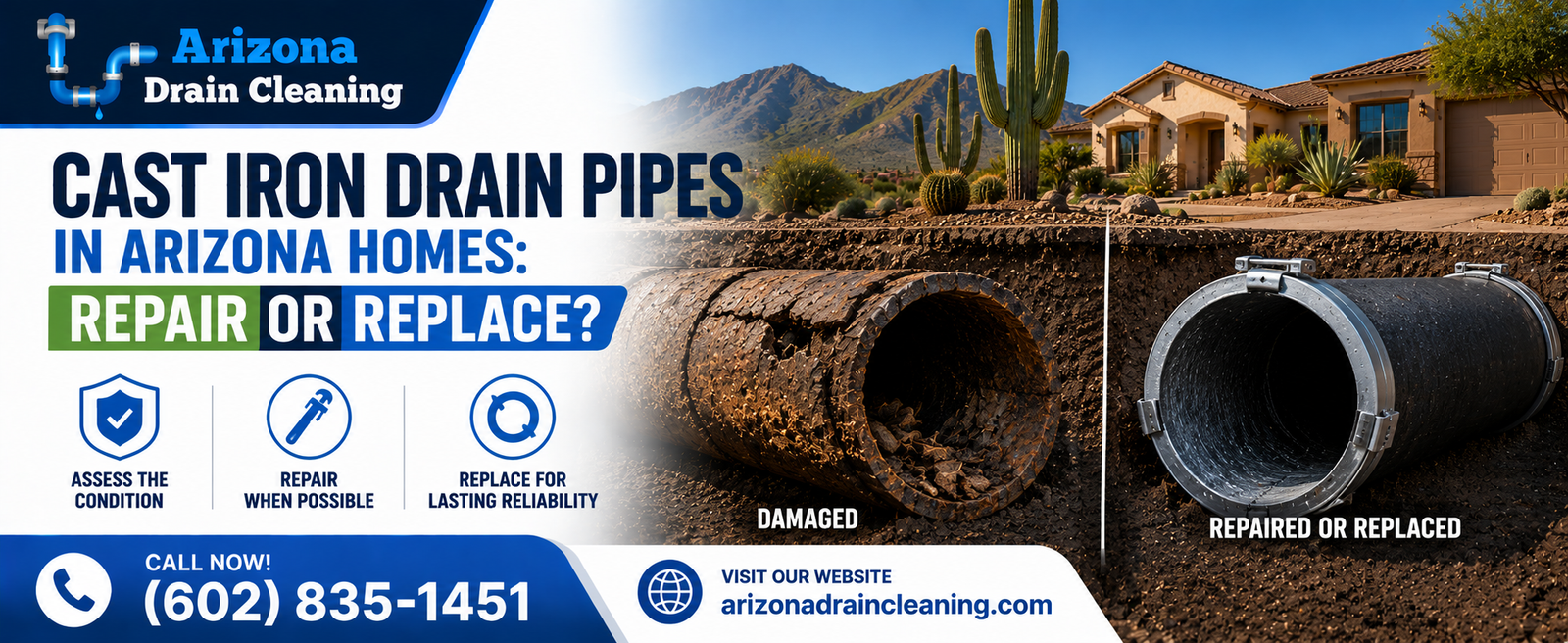
Cast iron drain pipes in Arizona homes are failing at an accelerating rate, and the combination of factors driving that failure is specific to this state in ways that national plumbing guides rarely capture accurately. If your home was built before 1975 in Phoenix, Tempe, Mesa, Scottsdale, Chandler, Glendale, or anywhere else in the Valley, there is a very reasonable chance your drain system still relies on original cast iron pipes that are now anywhere from 50 to 80 years old. And those pipes have spent every one of those decades fighting hard water, alkaline desert soil, extreme temperature swings, and the internal chemistry of wastewater in ways that shorten their service life compared to what you might read in a generic plumbing guide.
At Arizona Drain Cleaning, we inspect failing cast iron drain systems across the Phoenix metro every week, and many homeowners are surprised to learn how advanced the internal corrosion has become before obvious symptoms even appear. In many cases, the pipe walls have already begun flaking, scaling, or collapsing beneath the slab long before a complete blockage or backup occurs. That is why early inspection and accurate diagnosis are critical for avoiding larger structural plumbing problems and more expensive repairs later.
The question most Arizona homeowners arrive at is not whether their cast iron pipes will eventually need attention but rather when. It is whether they need attention now, what kind of attention makes the most financial sense, and what the real cost difference is between patching a section, lining the entire pipe from the inside, or replacing it outright. This guide answers all three questions with Arizona-specific context and current pricing for the Phoenix market.
How Cast Iron Drain Pipes Became the Standard in Pre-1975 Arizona Homes
Understanding why cast iron was used so extensively in older Valley homes explains both its strengths and why those same properties are showing signs of trouble today.
Cast Iron Was the Default Before Plastic Changed Everything
From the post-World War II building boom through the early to mid-1970s, cast iron was the dominant material for drain, waste, and vent systems in American residential construction. Phoenix’s explosive growth during the 1950s and 1960s, when the city’s population more than tripled in just two decades, produced tens of thousands of homes built with cast iron drain lines as the standard. Neighborhoods across Arcadia, South Phoenix, Maryvale, Encanto, Tempe, and older sections of Mesa and Scottsdale that were developed during this period share the same underground infrastructure characteristic: cast iron drain lines now approaching or well past the 50-year mark.
Cast iron was genuinely excellent material for its time. It is heavy, durable, resistant to physical impact, and it dampens the sound of flowing wastewater far better than plastic pipes do. Properly installed in a neutral environment with average water chemistry, cast iron drainpipe can realistically last 75 to 100 years. The problem is that Arizona is not a neutral environment, and Phoenix’s water chemistry is not average.
ABS and PVC Changed the Standard in the Mid-1970s
When plastic drain pipe materials became widely available and code-approved in the early to mid-1970s, the plumbing industry shifted rapidly. ABS plastic was adopted first across the Phoenix market, followed by PVC. Homes built from approximately 1975 onward in the Valley typically have ABS or PVC drain lines rather than cast iron. The transition point is not perfectly consistent across all Arizona cities and builders, so homes built between 1972 and 1978 sometimes have a mix of cast iron in older sections and plastic in later additions. If your home was built before 1972, the probability that cast iron is still in place is very high. If it was built between 1972 and 1978, a camera inspection is the only reliable way to confirm what material is actually there.
Why Arizona’s Environment Accelerates Cast Iron Pipe Corrosion
This is the section that most national guides miss entirely, and it matters enormously for Arizona homeowners trying to understand why their pipes are showing problems at an age when identical pipes in other states might still be performing well.
Phoenix Hard Water and Internal Corrosion
Corrosion in cast iron drainpipes happens from two directions simultaneously: the outside from soil chemistry and the inside from the wastewater and water quality flowing through the pipe. In Arizona, the internal corrosion driver is particularly aggressive.
Phoenix water delivered through the Salt River Project and the Central Arizona Project canal system carries a hardness rating of 12 to 20 grains per gallon across most Valley service areas. That extreme mineral load means every gallon of water flowing through a cast iron drain line deposits small amounts of calcium carbonate and magnesium scale on the pipe interior. Over decades, that scale layer builds up and creates a rough, irregular surface that traps grease, hair, and debris while simultaneously retaining moisture against the cast iron wall.
The more significant internal corrosion mechanism in any drain pipe is hydrogen sulfide gas, which is produced naturally by bacterial activity in wastewater. Hydrogen sulfide oxidizes at the waterline inside the pipe to form sulfuric acid. That acid attacks cast iron through a process called microbially influenced corrosion, eating through the iron from the inside out. In cast iron pipe that has been in service for 50 or more years, the accumulation of this acid attack produces thinned pipe walls, pitting, and eventually through-wall penetration at the most vulnerable points. Arizona’s year-round warm temperatures, which accelerate bacterial activity inside drain pipes relative to colder climates, mean this process runs more aggressively here than it would in a state with cold winters.
Arizona Alkaline Soil and External Corrosion
The soil across the Phoenix metro is predominantly alkaline, with pH values commonly ranging from 7.5 to 8.5 in the valley floor and higher in areas with significant caliche deposits. Research on buried metal pipe corrosion, including work published in the journal Corrosion Science, confirms that soil chemistry is a primary driver of external corrosion rates on cast iron pipe. While highly acidic soils are classically associated with rapid corrosion, alkaline soils with high mineral content create their own electrochemical environment that accelerates iron oxidation, particularly when moisture is present.
The mineral-rich, clay-heavy soil common in much of the Phoenix metro holds moisture against buried pipe surfaces in a way that sandy desert soil does not. According to Nu Flow Phoenix, which performs trenchless pipe rehabilitation across the Valley, the combination of alkaline, clay-heavy soil and Phoenix’s hard water creates a dual-attack environment that shortens cast iron drain pipe service life compared to the theoretical maximums cited in material specification sheets. A pipe that might survive 80 years in a neutral-soil, moderate-water-chemistry environment may show significant internal and external deterioration in Arizona after 40 to 50 years.
Thermal Cycling in the Arizona Climate
Phoenix’s temperature range is unusual. Summer daytime highs exceed 110 degrees Fahrenheit regularly, while winter nights drop to near freezing roughly ten to twelve nights per year. That seasonal range of 80 degrees or more, combined with daily swings of 25 to 35 degrees during shoulder seasons, creates repeated thermal expansion and contraction cycles in underground cast iron pipe and at the hub-and-spigot joints that connect pipe sections.
Cast iron has a relatively low thermal expansion coefficient compared to plastic, but over 50 years of daily thermal cycling, cumulative stress at joints produces micro-cracks and joint separation that neither a visual inspection nor a dye test from above can detect. These joint gaps become entry points for Arizona’s aggressive desert tree root systems, which are discussed in detail in our post on tree root intrusion in Arizona sewer lines.
Warning Signs That Your Cast Iron Drain Pipes in Arizona Need Attention Now
Cast iron pipe failure is usually a gradual process, but it does produce observable warning signs before it reaches the crisis point. Recognizing these signs in their early stages is what separates a manageable repair decision from an emergency replacement forced by a collapsed pipe.
Persistent Slow Drains Across Multiple Fixtures
A single slow drain usually means a localized clog at that fixture. Multiple slow drains across the house simultaneously, or a progressive slowing of drainage throughout the home over weeks and months, points to the main sewer line. In pre-1975 Phoenix homes with cast-iron drain lines, the pattern of progressive multi-fixture slow drainage almost always reflects one of three things: significant scale buildup narrowing the pipe interior, root intrusion at joint gaps, or early structural deformation in the pipe wall. All three are diagnosable by camera inspection, and all three are more common in aging Arizona cast iron than in younger PVC systems.
Discolored Water or Staining in Fixtures
Brown, reddish-orange, or rusty water that appears in bathtubs, sinks, or showers after periods of non-use is one of the most direct signs that cast iron corrosion has progressed to the point where rust particles are entering the water stream. The discoloration typically appears after water sits in the pipe overnight and then flushes through when flow resumes. Rust staining on porcelain fixtures, particularly around drain openings, is another visible indicator of active internal corrosion. If you see rust-colored water in a Phoenix home built before 1975, it warrants a camera inspection of the drain lines, not simply a cleaning.
Sewer Gas Odors From Drains
As cast iron pipe walls thin and joint gaps widen, the sealed environment that normally contains sewer gas inside the drain system develops breaches. Hydrogen sulfide, the primary component of sewer gas, has a distinctive rotten-egg odor that is detectable at very low concentrations. If this smell is coming from floor drains, rarely used fixture drains, or from below-slab areas of the home, it often indicates that pipe integrity has been compromised somewhere in the system. In Arizona’s older homes, sewer gas from corroded cast iron is a more common source of this complaint than most homeowners initially assume.
Visible Corrosion, Rust, or Dampness on Accessible Pipe Sections
Not all cast iron in a pre-1975 Phoenix home is buried or hidden. Sections that run along garage walls, through utility spaces, or under crawl spaces (rare in slab-on-grade Valley homes but present in some older hillside properties) may be visually inspectable. Active surface rust that is flaking or producing a powdery orange oxide layer, sections that appear pitted or have lost their original smooth exterior, or areas where the pipe surface shows a white mineral crust from evaporated moisture are all visible indicators of advanced external corrosion. Any section showing these characteristics should be considered a candidate for full replacement rather than relining, because the pipe wall may not have sufficient remaining thickness to support a liner.
Recurring Clogs That Return Quickly After Snaking
A cast iron drain line that has significant scale buildup or structural roughness from internal corrosion will produce recurring clogs on a predictable cycle. The snake punches through the immediate blockage but cannot remove the scale layer and corroded internal surface that is trapping debris. If your drain backs up three weeks after being snaked, then three weeks after being snaked again, the underlying cause is physical degradation of the pipe interior, not the kind of buildable organic clog that regular maintenance can permanently address.
Foundation or Slab Moisture Near Drain Line Paths
A cast iron joint that has separated under pressure from soil movement or root intrusion in a slab-on-grade Phoenix home leaks wastewater directly into the soil under the slab. Over time, that moisture saturates the subgrade and can produce slab movement, settlement cracks in the floor surface, or unexplained moisture appearing at the base of interior walls. Arizona’s expansive clay-rich soil is particularly susceptible to differential movement when it becomes locally saturated, which is one reason under-slab cast iron failures in Phoenix homes sometimes produce structural symptoms rather than the more obvious surface water signs you would see in an above-grade leak.
Cast Iron Pipe Repair, Relining, and Replacement: Comparing Your Three Options in Arizona
Once a camera inspection confirms that your cast iron drain system has issues beyond what routine cleaning can address, you are facing a decision with significantly different cost profiles, disruption levels, and longevity outcomes. Here is an honest comparison of all three approaches with current Phoenix market pricing.
Option 1: Spot Repair of Localized Sections
If a camera inspection reveals that the overall pipe is in reasonable condition but there are one or two specific problem sections, perhaps a joint separation at a known root intrusion point or a single thinned section showing active pitting, targeted spot repair may be the most economical approach.
Spot repair involves cutting out the damaged section, removing it, and installing a replacement section of schedule pipe or fitting that is compatible with the existing cast iron system. In accessible locations, such as above-slab sections in a garage or utility room, spot repair costs between $200 and $800 per repair point depending on the pipe diameter, accessibility, and whether a permit is required. For under-slab repairs, concrete cutting is required, raising the cost to $1,500 to $4,000 per repair point depending on the depth and scope of the cut and the concrete restoration afterward.
Spot repair is appropriate when the rest of the pipe is genuinely in good condition. If the camera reveals that the pipe is showing corrosion and scale throughout its length, and you address only the one section that is currently leaking, you are buying time rather than solving the problem. The next section will fail on its own timeline, requiring another cut, another repair, and another set of disruption costs. A comprehensive assessment of the entire pipe condition is what tells you whether spot repair is genuinely the right answer or just the cheapest short-term option.
Option 2: Cured-in-Place Pipe Lining for Cast Iron
CIPP lining is the option that most Arizona homeowners in pre-1975 homes have not fully heard about, and it represents a genuinely different category of solution from both spot repair and full replacement. Rather than removing the existing cast iron pipe, CIPP lining creates a new structural pipe inside the old one. A flexible liner saturated with an epoxy or polyester resin is inserted into the cleaned and hydro-jetted cast iron pipe, inflated to press against the existing pipe walls, and cured using heat, steam, or UV light until the resin hardens into a smooth, seamless tube.
The resulting lined pipe has no joints for roots to enter, a smooth interior surface that resists scale accumulation compared to corroded cast iron, and a manufacturer-rated service life of 50 years or more. It also fully contains the existing cast iron structure, meaning any remaining pipe wall thickness is supplemented and strengthened rather than removed.
CIPP is appropriate for cast iron pipe that has corrosion and scaling but still has enough structural continuity to hold the liner during installation. Severely collapsed sections, large cracks, or pipe that has lost more than half its effective wall thickness may not be good lining candidates. The camera inspection determines this, which is why inspection is a prerequisite, not an optional step.
For Phoenix-area homeowners, CIPP lining of residential cast iron drain systems costs between $80 and $250 per linear foot depending on pipe diameter, access conditions, and whether descaling of heavy mineral buildup is required before lining can proceed. A typical 40 to 60-foot sewer lateral in a pre-1975 Phoenix home runs approximately $4,000 to $10,000 for a complete lining. Full interior drain systems, including branch lines, vents, and the main lateral, run higher depending on the scope.
CIPP is typically 30 to 40 percent less expensive than full excavation and replacement once the total project cost, including excavation, concrete cutting, pipe removal, backfill, concrete restoration, and landscape repair, is factored into the comparison. For Phoenix homeowners with a landscaped yard, a paved driveway, or a travertine patio over the sewer line path, the avoided restoration cost alone can be substantial.
The one significant limitation of CIPP in Arizona’s specific environment is that it requires careful assessment of pipe condition before installation. The heavy mineral scale that accumulates in Valley cast iron pipes requires hydrojetting and often descaling before the liner can be properly inserted and seated. A company that quotes CIPP lining without accounting for that preparatory step is likely underquoting the project.
Option 3: Full Cast Iron Pipe Replacement
When the camera inspection reveals a pipe that is too far deteriorated for lining to be a viable option, collapsed sections, severe through-wall pitting, or joint separations that have allowed significant soil intrusion, full replacement is the appropriate course. Replacement removes the old cast iron entirely and installs modern PVC or ABS drain pipe that is inherently resistant to the corrosion mechanisms that destroyed the original system.
Full replacement in the Phoenix market is executed through two primary approaches.
Trenchless pipe bursting pulls a bursting head through the existing cast iron, fracturing it outward into the surrounding soil while simultaneously pulling new HDPE pipe into the created space. This method requires two access pits rather than a continuous trench, preserving most of the surface above the pipe. In Phoenix, pipe bursting costs between $60 and $200 per linear foot, with total projects for a residential sewer lateral typically running $4,000 to $12,000 depending on line length, depth, and caliche layer conditions in the soil.
Trenchless methods in Phoenix cost $60 to $200 per linear foot, while CIPP lining ranges from $80 to $250 per linear foot. The Phoenix-specific note on caliche is significant: Phoenix soils vary from sandy loam to hard caliche, which can significantly impact excavation costs and equipment needs, as caliche requires special tools and can make excavation take longer and cost more than in other regions.
Traditional excavation and replacement involves digging a full trench along the pipe path, removing all old cast iron, installing new pipe, backfilling, and restoring the surface. This is the most disruptive and expensive option but remains the only choice when trenchless methods cannot access the line or when the surrounding soil conditions make bursting impractical. Full excavation replacement in Phoenix runs $100 to $300 per linear foot for the pipe work itself, plus excavation costs of $3,500 to $7,500 and surface restoration of $7,500 to $10,000 or more depending on what needs to be repaired: landscaping, concrete driveway, travertine patio, or interior flooring if the pipe is under slab and slab cutting is required.
Sewer line replacement costs in Phoenix average $4,123, with most homeowners spending between $1,818 and $6,429 for straightforward projects, though complex jobs involving caliche excavation, under-slab access, or significant surface restoration can reach $15,000 to $25,000 or more.
The Financial Decision Framework: Repair, Reline, or Replace Your Arizona Cast Iron Pipes
Choosing between these three options without knowing your pipe’s actual condition is how homeowners end up spending money on the wrong solution. Here is a practical framework for applying the camera inspection findings to the decision.
When Spot Repair Makes Sense
Choose spot repair when the camera inspection shows an overall pipe in good structural condition with isolated problem points, the problem points are accessible without slab cutting or excavation, the home is relatively new to the pre-1975 category (built between 1965 and 1975 rather than 1945 to 1960), and you are not planning to sell the property in the near future. Spot repair is the lowest upfront cost but the least comprehensive solution. It makes financial sense for well-maintained pipes with genuinely isolated issues, not for pipes that are showing widespread deterioration.
When CIPP Lining Is the Smart Middle Path
CIPP lining is the right choice when the camera shows general corrosion, scale buildup, minor to moderate cracking, or early root intrusion at multiple joint points across a pipe that still maintains its basic structural shape. For the typical pre-1975 Phoenix home with cast iron that is deteriorating but not yet collapsed, lining delivers a 50-year service life at a cost that is meaningfully less than full replacement when surface restoration costs are included in the comparison. It is also the superior choice for homes where the pipe runs under mature landscaping, a paved driveway, a travertine patio, or a tiled interior floor, because the surface disruption is minimal.
When Full Replacement Is the Only Realistic Answer
Full replacement is appropriate when the camera reveals pipe collapse, severe through-wall breaches, sections that have bellied so severely that lining cannot restore proper slope, or pipe that has deteriorated to the point where the liner has nothing structurally sound to bond to. It is also appropriate when the full drain system is involved rather than just the sewer lateral, meaning the decision is to replace the entire interior drain, waste, and vent system of the house rather than just the main line to the street.
For buyers purchasing a pre-1975 Phoenix home, a pre-purchase sewer camera inspection is one of the most valuable diligence steps available. A finding of deteriorated cast iron with active corrosion is a negotiating point, and knowing in advance whether you are looking at a lining project or a full replacement project changes the financial analysis of the purchase significantly.
What Arizona Homeowners Often Ask About Old Cast Iron Pipes
Does Arizona’s hard water make cast iron pipes fail faster than in other states?
Yes, in meaningful ways. Arizona’s water hardness of 12 to 20 grains per gallon produces significant mineral scale accumulation on cast iron interiors over decades, while the alkaline clay-rich soil of the Phoenix metro creates an electrochemical corrosion environment for the pipe exterior. Both factors accelerate the deterioration timeline compared to the theoretical service life of cast iron pipe in a neutral-chemistry environment. Phoenix plumbers consistently report seeing significant corrosion in Valley cast iron that is only 45 to 55 years old, at an age when the same pipe material in other markets might still be performing adequately.
How do I know if my pre-1975 Phoenix home has cast iron or another pipe material?
The most reliable method is a sewer camera inspection by a licensed plumber, which identifies both the pipe material and its current condition. Home inspection reports sometimes note the drain pipe material, though inspectors typically cannot access the buried portions of the system without a camera. If you have a cleanout access point, your plumber can often identify the material by looking into the opening with a flashlight. Cast iron appears dark gray or black with a rough, slightly pitted surface, distinctly different from the smooth off-white or black plastic of PVC or ABS pipe.
Is CIPP lining a permanent solution for corroded cast iron in Arizona?
CIPP lining with a properly installed epoxy resin liner is rated by most manufacturers for 50 or more years of service. The liner creates a new, seamless pipe interior that is not susceptible to the hard water mineral scale accumulation that degrades cast iron, because the resin surface is non-reactive with calcium carbonate. It is also jointless, eliminating the entry points that Arizona’s desert tree roots exploit in aging cast iron. For Phoenix homeowners considering CIPP as an alternative to full replacement, the 50-year service life is a realistic and well-supported expectation, not a marketing estimate, provided the pipe is properly prepared and the installation is performed by a licensed, experienced technician.
What permits are required for cast iron pipe repair or replacement in Phoenix?
The City of Phoenix requires a plumbing permit for major pipe repair or replacement work. The base fee for a plumbing permit in Phoenix is $150, based on a sliding scale of the project’s total value. If the work crosses a public sidewalk or involves any work in the street right-of-way, a standard sewer tap or connection fee of $95 applies in Phoenix, plus an additional $150 for right-of-way permits if the project involves work on Maricopa County sidewalks or streets. Your plumbing contractor should pull all required permits before work begins. Unpermitted plumbing work on a sewer system can create complications when you sell the property and may void warranty claims on the repair work.
How long does CIPP lining take compared to full replacement in Phoenix?
CIPP lining for a standard residential sewer lateral is typically completed in one to two days, including the hydro jetting preparation, liner installation, curing, and final camera inspection confirmation. Traditional excavation and replacement takes three to seven days for the pipework itself, plus additional time for concrete or surface restoration that may extend the full project timeline to two weeks or more. For homeowners in an occupied residence, the one to two-day timeline for lining compared to the one to two-week disruption of full excavation is a significant quality-of-life consideration alongside the cost comparison.
Can I just keep having the cast iron pipes cleaned instead of replacing or lining them?
Routine drain cleaning, whether snaking or hydro jetting, is effective maintenance for cast iron drain lines that are in structurally sound condition with organic clog buildup. It is not an effective long-term strategy for pipes that have thinned walls, through-wall pitting, joint separation, or significant structural deformation. Cleaning removes the immediate blockage but does not address the physical deterioration of the pipe itself, and each hydro jetting session on severely deteriorated cast iron carries some risk of accelerating existing damage at weak points in the pipe wall. Once a camera inspection confirms structural deterioration beyond simple buildup, cleaning becomes a short-term band-aid rather than genuine maintenance, and the decision between lining and replacement should not be deferred indefinitely.
Does homeowners insurance cover cast iron pipe failure in Arizona?
Standard homeowners insurance policies in Arizona do not cover the repair or replacement of drain pipes that have failed due to age-related deterioration or corrosion, because these are classified as maintenance issues rather than sudden and accidental covered events. A service line endorsement, which is an add-on to a standard policy available from most Arizona carriers, covers underground pipe repair and replacement costs for service lines, including sewer laterals. If you have a pre-1975 Phoenix home and do not currently carry a service line endorsement, asking your insurance agent about adding it is worth the conversation. The endorsement typically costs $40 to $100 per year and provides coverage that standard policies specifically exclude.
Ready to Find Out What Is Actually Inside Your Arizona Cast Iron Drain System?
The most expensive mistake a pre-1975 Phoenix homeowner can make is waiting until a pipe fails as an emergency to find out what condition it was in. A camera inspection scheduled proactively, before any visible problems force the issue, is the difference between a planned $5,000 to $10,000 lining project and a $15,000 to $25,000 emergency excavation and replacement that had to happen on a Friday night during monsoon season.
If you know your home has cast iron drain pipes and you have never had a professional camera inspection, or if your drains have been increasingly slow or problematic over the past year or two, the time to get that inspection is now.
For the intersection between cast iron pipe vulnerability and Arizona’s monsoon season, our post on monsoon flooding and sewer backup liability in Arizona explains why a deteriorated cast iron lateral significantly increases your backup risk during storm events, and what the financial and legal implications look like when that backup happens.
Call Arizona Drain Cleaning at (602) 835-1451 for a camera inspection, an honest assessment of what your cast iron drain system actually needs, and upfront pricing before any work begins. No pressure to commit to a scope of work before you have seen the camera findings. Just the facts and the full range of options that fit what your pipes actually need.