
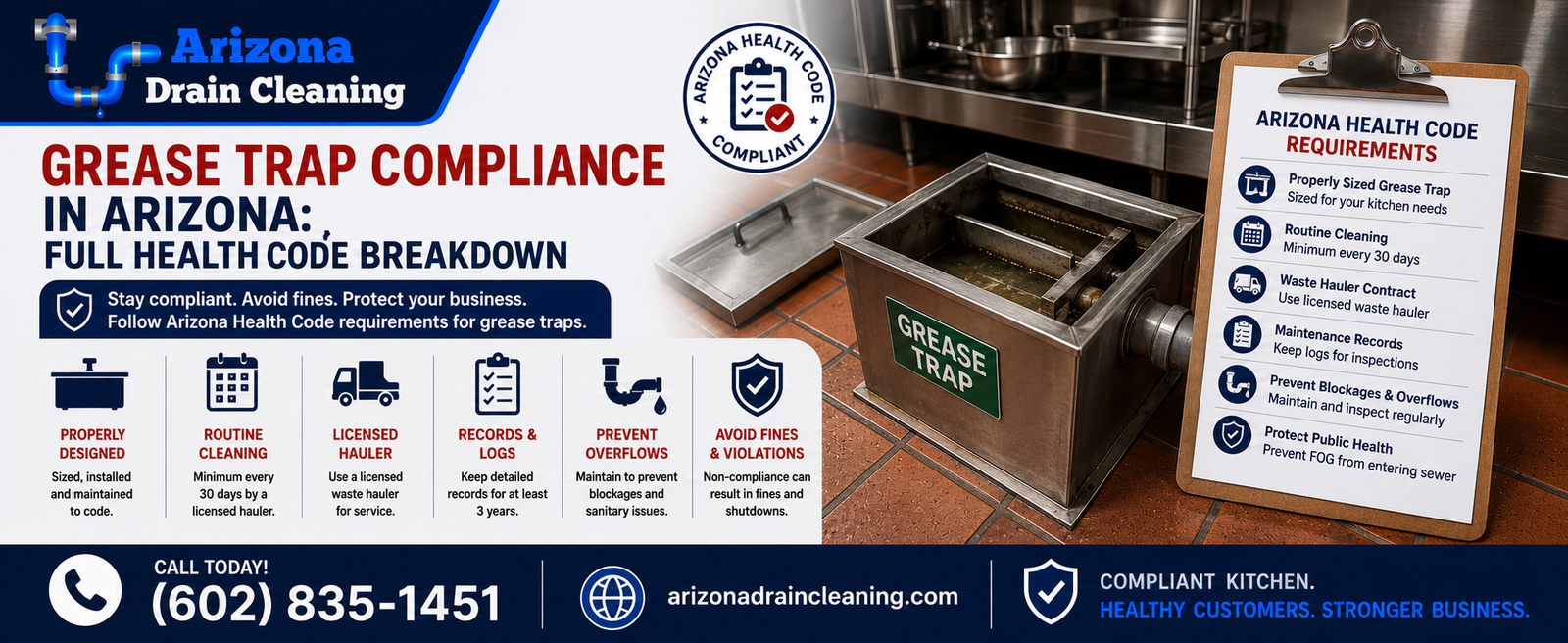
Grease trap compliance in Arizona involves far more than scheduling occasional cleanings. Restaurant owners, commercial kitchen operators, and food service managers must navigate a combination of state regulations, local wastewater requirements, and municipal grease management programs designed to protect public sewer infrastructure and prevent sanitary sewer overflows. Because multiple agencies may have authority over the same facility, compliance failures can occur even when operators believe they are meeting basic maintenance requirements.
At Arizona Drain Cleaning, we work with restaurants, cafeterias, hotels, schools, healthcare facilities, and commercial kitchens throughout Arizona that depend on properly functioning grease interceptors and grease traps to remain compliant with local regulations. Many businesses discover during inspections that documentation gaps, inadequate cleaning schedules, or improperly maintained interceptors can create compliance issues long before an actual drain backup occurs.
Arizona health inspectors are cracking down on grease trap violations in 2026.
Stay compliant and avoid costly fines. Call now for a full grease trap inspection.
This guide provides a comprehensive overview of grease trap compliance requirements in Arizona, including grease interceptor sizing standards, inspection and maintenance expectations, recordkeeping requirements, cleaning frequency guidelines, and the responsibilities imposed by local FOG (Fats, Oils, and Grease) programs. Whether you operate a single restaurant location or manage multiple food service properties, understanding these requirements can help reduce the risk of violations, avoid costly penalties, and maintain uninterrupted operations.
The Regulatory Structure Behind Grease Trap Compliance in Arizona
Before getting into specific requirements, operators need to understand who has authority over their grease interceptor system, because the answer determines which rules apply and which agency conducts the inspection that matters most.
Arizona Department of Environmental Quality and the ADEQ Framework
Grease trap compliance requirements in Arizona stem from federal Clean Water Act provisions and are implemented through Arizona’s Aquifer Protection Permit program and individual municipal utility standards. The Arizona Department of Environmental Quality (ADEQ) administers the state-level environmental framework, including the standards that govern what food service establishments may discharge into the municipal sewer system. ADEQ’s Aquifer Protection Permit program establishes the baseline prohibition on discharging FOG (Fats, Oils, and Grease) that forms the legal foundation for local pretreatment programs.
Arizona food service facilities must comply with FOG regulations administered by the Arizona Department of Environmental Quality and local pretreatment authorities.
Municipal Pretreatment Programs: The Operational Enforcement Layer
In practice, the day-to-day compliance enforcement that most Arizona restaurant operators encounter comes from their municipal water authority’s pretreatment program. Phoenix, Tucson, and Mesa operate robust FOG Control Programs requiring interceptor installation, scheduled cleaning (typically every 90 days), and maintenance log retention for a minimum of three years. Facilities discharging excessive FOG may be subject to surcharges, compliance schedules, or permit revocation.
Every city and town with its own wastewater treatment infrastructure operates a pretreatment program of this type, including Chandler, Scottsdale, Gilbert, Tempe, Peoria, Glendale, and the smaller communities throughout Maricopa County. The specific ordinance numbers, sizing methodologies, and documentation requirements vary slightly between cities, but the core obligations are consistent: install a properly sized interceptor, maintain it according to schedule, and keep the records to prove you did.
County Health Inspections: The Food Safety Enforcement Layer
Maricopa County Environmental Services and the Pima County Health Department administer food establishment inspections under the delegated authority of the Arizona Department of Health Services. Their inspections enforce the food safety requirements of Arizona Administrative Code Title 9, Chapter 8, including drain and plumbing maintenance standards. A non-functional or overflowing grease trap that creates a food safety condition during a kitchen inspection will generate violations from this layer of authority in addition to any FOG program violations from the municipal pretreatment program. Both enforcement pathways can run simultaneously on the same compliance failure.
One failed grease trap inspection can shut your Arizona business down fast.
Our compliance experts keep your kitchen running and your health code record clean.
Grease Interceptor Requirements in Arizona: Who Must Have One
The installation requirement is the starting point. Understanding who is required to have a grease interceptor and what type prevents the foundational non-compliance of operating without a required device, which carries the most serious enforcement consequences.
Establishments Required to Install Under Arizona Code
Any food service establishment that discharges grease-laden wastewater to the municipal sewer system is required to have a grease interceptor installed before that discharge point. In Arizona, this requirement applies broadly to the following:
Full-service restaurants, fast food operations, quick service establishments, cafeterias, hotel and casino kitchens, hospital food service, school cafeterias operating commercial cooking equipment, commercial catering facilities, commissary kitchens serving food trucks, and any other commercial kitchen that generates wastewater containing cooking fats, oils, or grease.
The Goodyear municipal code, reflecting standards applied across municipalities in Maricopa County, requires that grease interceptors and grease traps shall be required, installed, and maintained as specified for the sizing and cleaning of interceptors and traps for food preparation establishments. A grease trap shall be installed whenever a three-compartment sink is required by Maricopa County.
Because a three-compartment sink is required for virtually all food service establishments that wash dishes or utensils on-site, the grease interceptor requirement effectively applies to all cooking establishments in Maricopa County. Low-volume operations like coffee shops or small sandwich shops that do not wash dishes on-site and use only disposable serviceware may qualify for a smaller hydromechanical unit rather than a full gravity interceptor, but they are not exempt from the pretreatment requirement entirely.
Hydromechanical Grease Interceptors vs. Gravity Interceptors
Arizona municipalities allow two primary types of grease interceptor: hydromechanical grease interceptors (HGI) and gravity grease interceptors (GGI). Understanding which type is appropriate for your operation is part of the initial compliance determination.
Hydromechanical grease interceptors, which are generally installed inside, may be used when there are four or fewer fixtures. The minimum size HGI installed shall be rated no less than 25 gallons per minute with a 50-pound grease retention capacity.
Gravity interceptors, which are the large in-ground concrete or fiberglass tanks commonly installed outside a restaurant building, are required for larger operations with more than four connected fixtures or higher flow volumes. The minimum size for all gravity interceptors is a capacity of 500 gallons and the maximum size is a capacity of 2,500 gallons. Interceptors must be constructed with at least two chambers.
Most full-service restaurants in Phoenix, Scottsdale, Mesa, Tempe, and the broader Valley that operate a commercial kitchen with a three-compartment sink, a dishwasher, and multiple prep sinks are required to have a gravity interceptor rather than an HGI, because their fixture count and flow volume exceed the threshold for under-sink devices. An HGI installed in a high-volume kitchen that requires a gravity interceptor is a code violation regardless of how frequently it is pumped.
Arizona Grease Trap Size Requirements: The Calculation Methodology
Sizing a grease interceptor correctly is one of the most technically specific compliance obligations an Arizona food service operator faces, and it is one where getting it wrong creates problems that are expensive to correct after installation.
The Phoenix City Grease Trap Sizing Formula
The City of Phoenix Water Services Department provides explicit sizing guidance for food service establishments within its service area. For the purpose of interceptor sizing, a value of 3 gallons per minute (GPM) is assigned for each connected fixture unit determined from the applicable plumbing code table. The total storage capacity in gallons of the fixtures discharging into the grease trap shall not exceed 2.5 times the certified GPM flow rate of the grease trap.
The Phoenix formula uses a retention time approach: total fixture units multiplied by 3 GPM multiplied by the retention time in minutes equals the minimum capacity required. For a kitchen with 33 fixture units, the calculation is 33 fixture units multiplied by 3 GPM multiplied by 17 minutes of retention time, producing a minimum capacity of 1,683 gallons. The operator would then choose the next larger available standard size, such as a 1,700, 1,750, 1,800, or 2,000-gallon interceptor.
This calculation applies to gravity interceptors serving commercial kitchens in the City of Phoenix service area. The retention time used in the formula reflects the time required for adequate FOG separation at the flow rates generated by commercial kitchen equipment.
Is your Arizona restaurant fully grease trap compliant for 2026 health codes?
Do not wait for an inspector to find out. Get a compliance check done today.
Fixture Unit Values for Common Kitchen Equipment
Fixture unit values used in grease trap sizing calculations are established by the applicable plumbing code. Standard values for common commercial kitchen equipment include:
A three-compartment sink is typically assigned a fixture unit value based on the total capacity of its three compartments. A standard three-compartment sink with compartments holding 20 gallons each has a 60-gallon total capacity and a corresponding fixture unit value. A commercial dishwasher is assigned fixture units based on its rated capacity per cycle. Prep sinks, mop sinks, and hand sinks each carry their own fixture unit assignments.
The actual maximum waste flow rate of individual fixtures may be substituted for the standard 3 GPM per fixture unit flow rate when substantiated by engineering calculations and manufacturer documentation. This alternative calculation pathway allows operators with equipment whose actual flow rate differs significantly from the standard assignment to demonstrate a more accurate sizing requirement.
Goodyear and East Valley Sizing Requirements
The sizing requirements applied in Goodyear, reflecting standards used across many East Valley communities, provide specific parameters that establish minimum and maximum interceptor capacities. The minimum size for all interceptors is a capacity of 500 gallons and the maximum size is a capacity of 2,500 gallons. Interceptors must be constructed with at least two chambers. The method for determining the size of traps or interceptors is the drainage fixture unit value.
The two-chamber minimum requirement is worth noting specifically: a single-chamber interceptor of any size does not meet this requirement regardless of its gallon capacity. The two-compartment design ensures that grease retained in the first chamber does not carry through to the outlet in the second, which is the functional separation mechanism the interceptor is designed to provide.
Pima County Sizing Standards for Tucson-Area Operations
For food service operators in Tucson and the broader Pima County area, the sizing methodology follows a similar fixture-unit-based approach. Pretreatment devices shall be designed and installed in accordance with the sizing criteria specified by the authority having jurisdiction. A sampling port or T, which will accommodate the collection of a valid oil and grease sample, shall be included on all pretreatment device installations.
The sampling port requirement is specific to Pima County and Tucson area installations. This port allows inspectors and compliance auditors to collect actual wastewater samples from the interceptor outlet to verify that FOG concentrations in the discharge comply with the applicable limits without requiring full interceptor inspection. Installations lacking the required sampling access point are non-compliant on installation criteria regardless of the interceptor’s size or maintenance status.
Getting Your Sizing Approved Before Installation
One of the most practical compliance steps Arizona food service operators can take is confirming interceptor size approval with the municipal water authority before purchasing or installing any device. Undersized grease traps fail inspections, back up during peak service, and attract FOG compliance violations. Oversized traps are a waste of capital and still require the same cleaning frequency if not used properly. Sizing a grease interceptor correctly the first time is the cheapest decision you will make in your kitchen infrastructure.
The City of Phoenix Water Services commercial compliance program provides sizing review as part of the permit process for new installations and major renovations. Submitting proposed sizing calculations for review before installation eliminates the risk of installing an interceptor that is rejected at inspection and must be replaced at the operator’s expense.
Grease Trap Cleaning Frequency Under Arizona Law
This is the section of grease trap compliance where the most enforcement actions originate, because cleaning frequency is the most frequently inspected and most frequently deficient element of ongoing compliance programs.
The 25-Percent Rule: The Operative Standard Across Arizona
Most municipalities in Arizona require grease trap cleaning when the trap reaches 25 percent capacity, known as the 25-percent rule. For high-volume commercial kitchens in Phoenix, this typically means cleaning every one to three months.
The 25-percent rule is operationalized differently from a simple calendar schedule. It means that the combined accumulation of grease, solids, sludge, and other materials in the interceptor must not exceed 25 percent of the total liquid volume capacity, measured at the static water level of the device, at any point. An operator who pumps on a 90-day calendar schedule but whose interceptor reaches 25-percent capacity in 60 days due to high grease volume is not in compliance during those final 30 days of the cycle. The schedule must match the actual accumulation rate, not a fixed calendar assumption.
This distinction matters because municipal FOG inspectors do not only inspect documentation. They physically assess interceptor condition, and an interceptor with visible accumulation exceeding 25 percent at the time of inspection is a violation regardless of what the maintenance log shows.
Phoenix City Code Section 28-15: The Specific Legal Standard
Under Phoenix City Code Section 28-15, interceptors must be maintained by the user in continuously effective operating condition at all times, which minimally requires periodic removal of all accumulated grease, lint, oil, sand, sludge, solids, wastewater, and other materials, thorough cleaning of the pretreatment device interior, and necessary repairs to internal structures. Users of gravity interceptors must fully pump out and clean the interceptor at a frequency such that the combined grease, lint, oil, sand, sludge, and solids accumulation does not exceed 25 percent of the total liquid volume capacity.
The phrase “continuously effective operating condition” is the most demanding element of this standard. It means compliance is not measured only at inspection points or scheduled pump-out dates. It is a continuous obligation. An interceptor that reaches 28-percent capacity on a Wednesday afternoon, three weeks before a scheduled pump-out, is non-compliant on that Wednesday afternoon even if no inspector is present.
The Goodyear code, applying to many Maricopa County communities, specifies that all grease traps shall be pumped out or cleaned out completely at least once every 180 days, or more frequently as required by the city. The 180-day minimum establishes a floor, not a ceiling. An establishment that needs monthly pumping to stay below 25-percent capacity cannot satisfy the requirement by pumping every 180 days. The 25-percent rule governs regardless of the minimum calendar schedule.
Grease trap violations in Arizona carry heavy fines and possible closure orders.
We handle cleaning, maintenance, and full health code documentation for your business.
How Arizona’s Summer Heat Changes the Cleaning Frequency Calculation
This is the Arizona-specific compliance variable that most national grease trap guides miss entirely, and it is the one that most commonly catches Phoenix and Tucson area operators who set their schedule based on experience in other markets.
In the hot Phoenix climate, proper grease trap maintenance becomes even more essential as higher temperatures can accelerate the breakdown of trapped materials, potentially causing odor issues and system failures. Summer temperatures exceeding 110 degrees Fahrenheit cause grease in exterior interceptors to remain liquid rather than solidifying, which can allow it to pass through traps and enter the sewer system before scheduled pump-outs. This means Phoenix restaurants often need more frequent cleaning during summer than the standard 90-day schedule.
The mechanism works like this: when ambient temperatures are moderate, cooking grease entering an interceptor cools and rises as a semi-solid layer that stratifies clearly on top of the water column. That stratification is the physical separation mechanism the interceptor relies on. When the interceptor is sitting in 110-degree outdoor heat during a Phoenix July, the grease layer stays warm enough to remain partially mobile, reducing its effective separation from the wastewater below and increasing the risk of FOG passing through the outlet into the municipal sewer.
Operators with exterior gravity interceptors in Phoenix, Mesa, Chandler, Scottsdale, and the broader Valley should budget for at least monthly pumping during the June through September period, and should perform mid-cycle capacity checks during this window rather than assuming their off-season schedule is adequate. Interceptors in shaded or indoor-adjacent locations are less affected by this dynamic than those in direct sun exposure.
Documentation Requirements: What Arizona Inspectors Are Looking for in Your Records
Documentation is where many Arizona food service operators who maintain their interceptors adequately still accumulate compliance findings. The maintenance record is as much a compliance obligation as the physical maintenance itself.
The Three-Year Maintenance Log Requirement
Phoenix, Tucson, and Mesa FOG control programs require maintenance log retention for a minimum of three years.
The user shall keep records of all cleaning, repair, and maintenance for at least three years. Such records shall be readily available for inspection by the director upon request at no expense to the city.
The practical implication is that your maintenance records from January 2023 are still within the required retention window as of January 2026. If an inspector visits today and requests your maintenance history, records going back three years must be accessible on-site. Records stored in an owner’s personal email, in a property manager’s offsite office, or in cloud storage that cannot be accessed during an inspection are effectively unavailable records for compliance purposes. Maintain a physical binder or immediately accessible digital file at the establishment.
The Waste Manifest: What It Must Contain
Most Arizona municipalities require a waste manifest documenting proper FOG disposal after each pump-out. Your grease trap service provider should issue this document. Keep manifests on file, as health inspectors and municipal auditors may request them during compliance checks.
A compliant waste manifest must document:
The date the service was performed. The name of the service provider and their Arizona-issued contractor identification. The license or permit number of the pumping company, which in Arizona requires compliance with ADEQ’s non-hazardous solid waste regulations for FOG disposal. The estimated volume of material removed. The name of the disposal facility where the material was delivered, confirming that waste was disposed of at an ADEQ-approved facility rather than illegally discharged.
A waste manifest that shows only a date and a company name is not a complete compliance record. Request a fully itemized manifest from your service provider after every pump-out and verify that all required fields are populated before filing it.
Inspection Frequency and How Records Factor In
More frequent inspections may occur based on performance, complaints, food service to highly susceptible populations, and hazards associated with specific operations. Permit class categories are subject to re-evaluation based on the activities that occur within an establishment.
This is significant from a documentation perspective: a strong, complete maintenance record covering three years of timely pump-outs with fully itemized waste manifests is active evidence that supports a favorable compliance assessment. An inspector reviewing a well-maintained three-year maintenance log is evaluating a very different compliance profile than one reviewing an establishment with gaps, missing dates, or manifests from unverified providers. Documentation quality influences not just whether you pass a current inspection but how your establishment is classified for future inspection frequency.
Most Arizona food businesses fail grease trap compliance without even knowing it.
Call today and let our certified team make sure your business passes every time.
Grease Trap Regulations in Arizona: Non-Compliance Consequences
Understanding the actual enforcement consequences motivates the compliance investment and helps operators frame the cost of maintenance against the cost of violations.
FOG Surcharges and Compliance Schedules
Facilities discharging excessive FOG may be subject to surcharges, compliance schedules, or permit revocation.
FOG surcharges are financial penalties assessed by the municipal water authority based on elevated FOG concentrations detected in a facility’s discharge. In Phoenix, these surcharges are calculated based on the measured concentration of FOG in the wastewater sample collected from the interceptor outlet, compared to the permitted discharge limit. High-volume dischargers whose interceptor is chronically under-maintained accumulate surcharge liability that compounds over time as each billing period adds to the balance.
A compliance schedule is a formal agreement between the food service operator and the municipal pretreatment authority that establishes a corrective timeline for bringing the facility into full compliance. While on a compliance schedule, the establishment is subject to more frequent inspections, often monthly rather than quarterly, and any failure to meet the schedule milestones accelerates enforcement to the next level.
Permit Suspension and Business Closure
Violations can result in fines, permit suspension, or mandatory remediation of sewer blockages caused by FOG discharge.
A permit suspension for a food service establishment means the operation must cease until compliance is achieved and verified by a re-inspection. For a restaurant, closure is the direct consequence. The financial impact of an unplanned closure spans lost revenue, employee costs during the closure period, compliance remediation costs, re-inspection fees, and the reputational impact of a public closure event. The Maricopa County Environmental Services inspection database is publicly searchable, and a suspension event creates a public record that customers can see.
Sewer Overflow Liability
The user shall be responsible for reimbursing the city for any and all expenses, costs, and penalty fees and fines for the cleanup of any sanitary sewer overflow from the sewer system that results from the user’s failure to properly maintain their grease interceptor.
This reimbursement obligation represents potentially the largest financial exposure from grease trap non-compliance. A FOG-related sewer overflow in Phoenix can involve emergency response by the city’s public works department, environmental containment, lateral cleaning, and potentially ADEQ notification if the overflow reaches a waterway or the ground surface. The costs the city incurs in responding to an overflow event are billed back to the establishment whose discharge caused it, on top of any civil penalties assessed separately.
A grease trap overflow in Phoenix can result in FOG discharge into municipal sewers, triggering fines from the local water authority. If your trap overflows, stop kitchen operations immediately, contain the spill, and contact an emergency grease trap service immediately. Providers with 24-hour emergency response can typically arrive within two to four hours.
Grease Interceptor Requirements Arizona: Building a Compliance Program That Holds Up at Inspection
Translating the requirements above into an operational compliance program requires a structured approach rather than reactive maintenance.
Capacity Monitoring Between Pump-Outs
The 25-percent rule requires knowing your interceptor’s actual capacity at any given point, not assuming it is within limits because the last pump-out was recent. Train kitchen managers to conduct a capacity check at least monthly, or more frequently during summer months. Most gravity interceptors have accessible covers that allow a visual or rod check of the grease layer thickness relative to the total liquid depth. Some operators install permanent monitoring access to make this check a standard part of weekly close-down procedures.
During the check, document the estimated capacity percentage, the date, and the name of the person who performed the check. This documentation, even though it is not specifically required by most codes, demonstrates active management of the device and is favorable evidence in any compliance review.
Choosing a Compliant Service Provider
Your grease trap service provider is a compliance partner. They must be licensed under Arizona law for non-hazardous waste transport and disposal. Their manifests must name an ADEQ-approved disposal facility. Their drivers must have appropriate commercial licensing for operating a vacuum truck. Using an unlicensed provider who disposes of FOG waste improperly transfers the compliance risk from your interceptor maintenance to the waste disposal chain, and the establishment is ultimately responsible for ensuring the entire chain is compliant.
Ask for proof of Arizona waste hauler registration before authorizing service. A provider who cannot demonstrate proper licensing is not an appropriate compliance partner regardless of their price.
Emergency After-Hours Service for Overflow Events
Interceptor overflow events do not schedule themselves around business hours. If your trap overflows, stop kitchen operations, contain the spill, and contact an emergency grease trap service immediately. Providers with 24-hour emergency response can typically arrive within two to four hours.
Emergency grease trap service in Phoenix and the Valley typically carries after-hours dispatch fees of $100 to $300 on top of the service cost, and labor rates at after-hours multipliers of 1.5 to 2 times the standard rate. Having the contact information for a licensed emergency service provider posted in the kitchen manager’s area before an overflow event happens eliminates the response delay of looking for a provider while an overflow is actively occurring.
For commercial kitchen drain line cleaning that supports grease interceptor function by keeping the lines from the kitchen to the interceptor clear, our Phoenix drain cleaning page covers commercial drain services across the Valley. For operators managing drain compliance as part of a broader health code commitment, our post on Arizona health department drain requirements for restaurants provides the full regulatory context for drain and plumbing compliance across all inspection areas.
Frequently Asked Questions About Grease Trap Compliance in Arizona
What is the legal cleaning frequency for grease traps in Arizona?
Most Arizona municipalities require grease trap cleaning when the trap reaches 25 percent capacity, the 25-percent rule. For high-volume commercial kitchens in Phoenix, this typically means cleaning every one to three months. The 180-day calendar minimum in many municipal codes establishes a floor, not a ceiling. If your interceptor reaches 25-percent capacity before 180 days, you must pump before that date regardless of the minimum calendar schedule. During Phoenix’s summer heat, more frequent cleaning is often necessary because ambient temperatures prevent adequate grease stratification in outdoor interceptors.
What size grease trap do I need for my Phoenix restaurant?
The City of Phoenix sizing formula assigns 3 GPM per connected fixture unit and uses a 17-minute retention time for gravity interceptors. A kitchen with 33 fixture units requires a minimum interceptor capacity of 1,683 gallons, rounding up to the next available standard size. Smaller establishments with four or fewer fixtures may qualify for a hydromechanical under-sink unit rated at a minimum of 25 GPM with 50-pound grease retention capacity. The appropriate type and size must be confirmed with the City of Phoenix Water Services commercial compliance program as part of the permit process before installation.
How long must I keep grease trap maintenance records in Arizona?
Phoenix, Tucson, and Mesa FOG Control Programs require maintenance log retention for a minimum of three years. Records must include the date of each service, the provider name and license information, the volume removed, and the waste manifest confirming proper FOG disposal at an ADEQ-approved facility. Records must be accessible on-site for review by inspectors upon request.
What happens if my grease trap causes a sewer overflow in Phoenix?
Under Phoenix City Code Section 28-15, the establishment is responsible for reimbursing the city for all expenses, costs, and penalty fees associated with cleaning up a sanitary sewer overflow caused by the establishment’s failure to properly maintain its grease interceptor. This reimbursement obligation is in addition to any civil penalties and in addition to any health code violations generated by the overflow event. Immediately stop kitchen operations, contain the spill, and call an emergency grease trap service to pump the interceptor before resuming food service.
Can I use a small under-sink grease trap instead of an outdoor interceptor at my Phoenix restaurant?
Hydromechanical grease interceptors may be used when there are four or fewer fixtures connected to the pretreatment device. Full-service restaurants with a three-compartment sink, a dishwasher, and multiple prep sinks typically have more than four fixtures and are required to install a gravity interceptor of at least 500-gallon capacity. An HGI installed in a situation that requires a gravity interceptor is a code violation regardless of how frequently it is pumped. Confirm the appropriate device type with your municipal water authority during the plan review and permit process.
What must be in a grease trap waste manifest in Arizona?
A compliant waste manifest for grease interceptor service in Arizona must include the service date, the pumping company name and Arizona waste hauler registration number, the estimated volume of material removed, and the name and address of the ADEQ-approved disposal facility where the waste was delivered. This manifest must be retained as part of your three-year maintenance record. An invoice showing only a date and amount paid does not constitute a compliant waste manifest. Request a fully itemized manifest from your service provider after every pump-out and verify completeness before filing it.
Do food trucks need grease trap compliance in Arizona?
Food trucks that discharge wastewater at a permitted commissary kitchen or base of operations are subject to the grease pretreatment requirements applicable to that commissary facility. The commissary’s grease interceptor must be sized to accommodate the combined discharge from both the commissary’s fixed kitchen operations and the connected food trucks. Food trucks that use disposable serviceware and do not generate grease-laden wastewater may have reduced requirements, but operators should confirm their specific obligations with Maricopa County Environmental Services or the applicable local health department for their commissary location.
Stay Ahead of Your Next Grease Trap Inspection
Grease trap compliance in Arizona requires more than scheduling a quarterly pump-out and hoping for the best. It requires sizing confirmation, continuous capacity management, complete documentation with proper waste manifests retained for three years, and an understanding of how Phoenix’s summer heat changes the 25-percent rule calculation in the real world.
Arizona Drain Cleaning provides commercial kitchen drain line cleaning, grease interceptor outlet line hydro jetting, and sewer camera inspection for food service establishments across the Phoenix metro, Scottsdale, Mesa, Tempe, Chandler, Gilbert, and surrounding communities. Keeping the drain lines from your kitchen equipment to the interceptor clear is part of ensuring the interceptor operates at its designed efficiency, and it is a maintenance obligation that supports your broader FOG compliance program.
Call Arizona Drain Cleaning at (602) 835-1451 to schedule commercial drain cleaning, discuss a maintenance program that keeps your kitchen drain system and interceptor functioning together, or request a camera inspection of outlet lines to confirm there are no partial blockages between your interceptor and the municipal connection. Transparent pricing, ROC-licensed technicians, and availability for urgent commercial service across the Valley.
Updated September 2026. Arizona grease trap pumping and manifest rules are unchanged for 2026, but city inspectors are checking manifests more often. Keep your last three service records accessible.
Related Arizona guides: