

Yes, you absolutely need a pipe camera inspection before buying a home in Arizona, and skipping it could cost you tens of thousands of dollars in hidden plumbing repairs after you close. A standard home inspection will tell you whether your toilets flush, but it tells you nothing about what is actually happening inside the underground sewer lines running beneath the property. In Arizona’s unique climate and geology, those underground pipes face challenges that buyers from other states rarely think about until it is too late.
If you are serious about protecting your investment in the Arizona real estate market, this guide covers everything you need to know about pipe camera inspections before signing on the dotted line.
What Is a Pipe Camera Inspection and How Does It Work
A pipe camera inspection, sometimes called a sewer scope or video pipe inspection, involves inserting a waterproof, high-definition camera attached to a flexible push rod into the sewer line of a home. The camera travels through the main sewer line from an access point, usually a cleanout near the foundation, a plumbing vent, or occasionally through a toilet. As it moves through the line, it transmits real-time video footage to a monitor that both the technician and the homebuyer can watch.
The camera captures the interior condition of the pipe along its entire length, from the house all the way to where it connects to the municipal sewer main or a private septic system. A distance counter logs how far the camera has traveled, so any problems are mapped to an exact location. A locating device above ground can then mark that spot in the yard, which is essential if repairs ever become necessary.
The footage reveals pipe material, pipe diameter, joint conditions, signs of corrosion, blockages, root intrusion, pipe bellies, and structural damage. At the end of the inspection, you receive a video recording and a written report summarizing the findings, which you can share with your real estate agent, the seller, or a licensed plumber to estimate repair costs.
Why Arizona Homes Have Unique Pipe Inspection Risks
Arizona’s environment creates specific plumbing challenges that make pre-purchase pipe camera inspections more critical here than in many other parts of the country.
The Legacy of Orangeburg Pipe in the Phoenix Valley
One of the most important things to know when buying an older home in the Phoenix metro area is the presence of Orangeburg pipe. Orangeburg was widely used in home construction across the Valley from roughly 1945 to 1972. It is a bituminized fiber pipe made from layers of wood pulp and hot pitch, and it was never meant to be a long-term solution. Its expected service life is between 30 and 50 years, which means any home built during that era that still has its original sewer line is almost certainly running on pipe that has exceeded or is at the very edge of its useful life.
Orangeburg absorbs moisture over time. As it does, it warps, collapses into an oval shape, and delaminates from the inside out. Once it starts to fail, the deterioration happens quickly. A pipe camera inspection is the only way to know whether Orangeburg is present and how far the deterioration has progressed. If you buy a home without checking and discover collapsed Orangeburg after move-in, you could be looking at a full sewer line replacement that runs well into the five-figure range.
Arizona’s Soil Movement and Monsoon Season Effects
Arizona soil, particularly expansive clay-based soil found in parts of the Phoenix metropolitan area, shrinks and swells with moisture changes. The monsoon season brings sudden, intense rainfall that saturates the ground, and then the summer heat dries it out rapidly. This repeated cycle of expansion and contraction puts significant stress on underground pipes. Joints can shift, separate, or crack. A section of pipe can sink and create what plumbers call a pipe belly, which is a low spot where wastewater pools instead of flowing toward the main. Over time, a pipe belly becomes a magnet for grease buildup, debris accumulation, and root intrusion.
Tree Roots and Desert Landscaping
People often assume Arizona’s desert landscape means fewer problems with tree roots in sewer lines, but that assumption is wrong. In established neighborhoods across Scottsdale, Tempe, Mesa, Chandler, Glendale, and Peoria, mature shade trees like Eucalyptus, Chinese Elm, and Ash have extensive root systems that actively seek out moisture. Older clay and cast iron sewer lines have multiple joints, and those joints are exactly where roots find an entry point. Once inside a pipe, roots continue growing until they create a complete blockage. A home can look beautifully landscaped from the street while harboring a root invasion that is slowly choking the sewer line underground.
Hard Water and Mineral Scale Buildup
Arizona has some of the hardest water in the United States. The Valley’s water supply carries high concentrations of calcium and magnesium, which deposit on the interior walls of supply pipes and can significantly reduce flow over time. A pipe camera inspection will reveal the extent of mineral scale accumulation inside your pipes, giving you a realistic picture of how much useful life remains in the supply lines as well as the drain system.
What a Standard Home Inspection Does Not Cover
This is one of the most critical points for Arizona homebuyers to understand. A licensed home inspector will run water through the fixtures, observe surface drainage behavior, and check for visible signs of water damage. If water disappears down the drain, a standard inspection typically gives the plumbing system a pass.
What the standard inspector does not do is send a camera into the underground sewer line. The pipe could have a partially collapsed section 40 feet from the house, a root mass beginning to form at a joint, or a corroded cast iron section that is weeks away from failing. None of that shows up during a routine home inspection unless the sewer line actually backs up during the walkthrough, which rarely happens because the seller knows the showing schedule and will avoid stressing the plumbing ahead of time.
For Arizona buyers who are purchasing homes built before 1990, and especially those built before 1975, a pipe camera inspection is not an optional add-on. It is a non-negotiable step that belongs alongside your standard inspection appointment.
What Problems Does a Pipe Camera Inspection Reveal
A thorough video inspection of a home’s sewer lines can uncover a wide range of issues, some minor and some immediately serious.
Pipe Material Identification
Knowing what your sewer line is made of tells you a great deal about its remaining lifespan and risk profile. PVC pipe installed in newer construction is generally durable, has smooth interior walls that resist buildup, and uses watertight joints. Cast iron, which was common in Arizona homes through the 1970s and into the 1980s, is prone to rusting from the inside out. As the rust develops, the interior surface becomes rough and jagged, causing waste and paper products to catch and accumulate. Clay tile pipe, another older material found in the Valley, is installed in short sections joined by rubber gaskets. Once those gaskets fail, they create open seams that are an open invitation to roots and soil infiltration.
Root Intrusion
Tree and shrub roots are one of the most common findings in Arizona sewer camera inspections. Early-stage root intrusion looks like a small cluster of hair-like roots at a joint. Left unaddressed, those roots grow into thick masses that restrict or completely block the line. The camera reveals both the location and the severity of any root presence, which helps determine whether rooter service can resolve the issue or whether a pipe repair or replacement is warranted.
Offset Joints and Separated Connections
Soil movement, particularly after years of Arizona monsoon cycles and ground settling, can cause pipe joints to shift out of alignment. An offset joint creates a ledge inside the pipe where debris accumulates, and a separated joint creates an open gap where soil can enter the line and where leakage into the surrounding soil occurs. These defects are entirely invisible from the surface and invisible to a standard home inspector.
Pipe Bellies and Negative Slope
A properly installed sewer line runs at a consistent downward slope so that gravity moves waste toward the main. When the ground shifts beneath a section of pipe, that section can sag, creating a low spot called a belly. Wastewater pools in a belly, solids accumulate there, and the location becomes a recurring problem even after professional cleaning. The camera reveals whether a slope issue exists and how significant it is.
Grease Buildup and Debris Accumulation
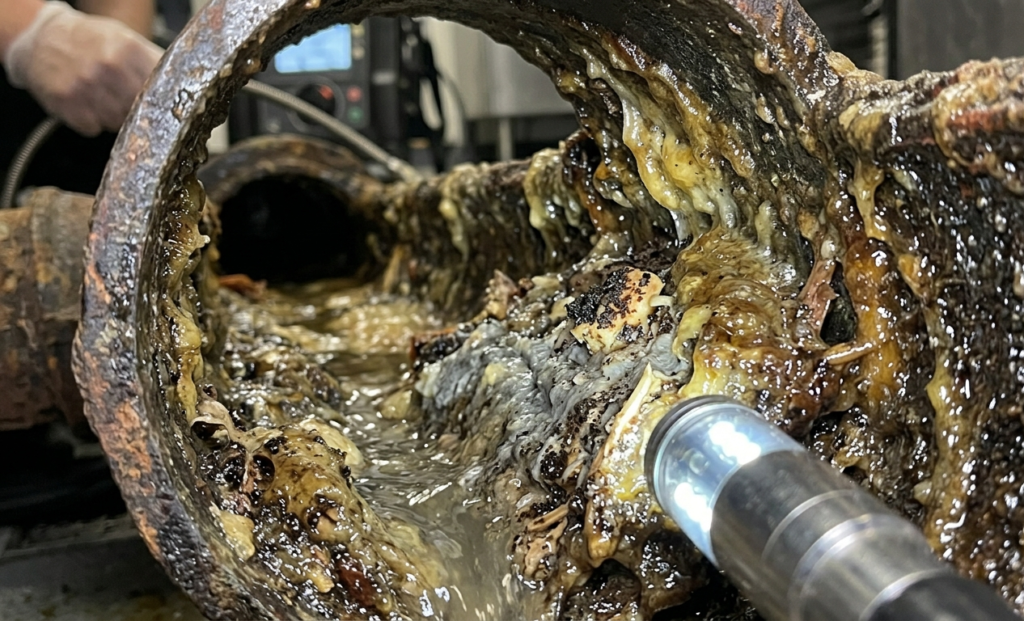
The living habits of previous owners leave a legacy inside the pipes. Heavy cooking with oils and fats that were rinsed down the kitchen drain build up a sticky coating on the interior pipe walls over years. Combined with soap scum and other organic debris, this buildup narrows the effective diameter of the pipe and creates recurring slow drain situations. A camera inspection makes this visible and gives you a realistic sense of how much deferred maintenance you would be inheriting.
Cracking, Corrosion, and Structural Failure
Physical damage to the pipe itself, whether from age, ground pressure, tree roots, or prior repair attempts, can range from hairline cracks to full collapses. The severity and location of structural damage determines whether a targeted spot repair, a trenchless pipe lining solution, or a full sewer line replacement is the appropriate response. Damage located beneath a concrete slab, a driveway, or the public right of way is dramatically more expensive to access and repair than damage beneath open lawn.
How a Pipe Camera Inspection Protects You During the Arizona Home Buying Process
Knowledge is leverage. When a pre-purchase pipe camera inspection reveals significant problems, you have several options that simply do not exist if you skip the inspection and discover the issues after closing.
You can request that the seller correct the problem before closing. You can negotiate a reduction in the purchase price that reflects the cost of necessary repairs. You can ask for a credit at closing that you then use to fund the repairs yourself after you move in. And in cases where the sewer line situation is severe enough to change your assessment of the property’s value, you have the right to walk away from the transaction altogether.
The cost of a pipe camera inspection in Arizona typically falls between $250 and $550 depending on the property size, pipe access, and the length of the line being inspected. Compare that against the cost of a sewer line repair, which can range from a few hundred dollars for minor rooter work to well over $10,000 for excavation and full line replacement. The math is clear. A pre-purchase inspection is one of the highest-return investments available to a homebuyer.
Is a Pipe Camera Inspection Necessary for New Construction in Arizona
Many buyers assume that a brand-new home comes with a sewer system that is automatically in perfect condition. This is not always the case. New construction sewer lines can have improperly sloped sections, misaligned joints at connection points, and even construction debris like cement, gravel, or wood scraps left inside the pipe during the building process. A camera inspection on a new build confirms that the installation was done correctly and that the line is clear before you assume responsibility for the property.
Real estate agents who are familiar with Arizona’s housing market increasingly recommend sewer scopes on all home purchases regardless of age, because the cost of skipping one can be catastrophic compared to the modest fee required to get one done.
What Happens During a Pipe Camera Inspection in Arizona: Step by Step
Understanding what to expect from the inspection process helps you prepare and ensures you get the most value from the experience.
The technician arrives at the property and locates the main sewer cleanout, which is typically a capped pipe access point near the exterior of the foundation. If no cleanout is present or accessible, the technician may access the line through a bathroom fixture. They insert the waterproof camera head into the line and slowly advance it while watching the live feed on a monitor.
As the camera travels through the pipe, the technician narrates what they observe, noting the pipe material, any defects, root presence, buildup, and joint conditions. The distance counter records how far from the access point any problem is located. If the technician identifies a specific area of concern underground, they can use a locating device above the ground surface to mark the exact position in the yard.
The inspection typically takes between 45 minutes and an hour and a half, depending on the line length and complexity. At the conclusion, you receive a video recording of the entire inspection and a written summary that describes the findings and recommends any necessary follow-up action.
When Should You Schedule a Pipe Camera Inspection
The ideal time to schedule a pipe camera inspection is immediately after your offer on a home is accepted, during the inspection contingency period. Most Arizona real estate contracts include an inspection period that gives buyers a defined window to conduct due diligence. Scheduling the sewer scope at the same time as or immediately following your standard home inspection allows you to have complete information before your contingency period expires.
If you are already a homeowner and did not get a pipe camera inspection before purchasing your current home, you do not need to wait for a crisis to find out what condition your sewer line is in. Proactive inspections every five to ten years are a sound maintenance practice, especially if your home was built before 1990, if you have mature trees on your property, or if you have experienced recurring slow drains or backups.
How to Choose the Right Pipe Camera Inspection Service in Arizona
Not every plumbing or inspection company delivers the same level of service, and the quality of what you learn from a sewer scope is directly tied to the quality of the equipment and the experience of the technician operating it.
Look for a company that uses high-definition camera systems, not older low-resolution equipment that makes it difficult to distinguish surface-level buildup from a crack. Ask whether the technician provides a video recording of the full inspection and a written report. Confirm that the company uses a locating device to mark problem areas above ground. Ask whether they will walk you through the footage in real time so you understand what you are looking at as it happens, rather than receiving a report you have to interpret on your own later.
A reputable Arizona drain and sewer inspection company should be able to clearly explain each finding, distinguish between issues that require immediate attention and those that can be monitored over time, and provide a clear recommendation for next steps without pressuring you into services you may not need.
Pipe Camera Inspection and Its Role in Negotiating Your Home Purchase
Real estate transactions in Arizona are negotiable right up until closing, and a pipe camera inspection report is a powerful document to have in hand during those negotiations. If the report reveals a pipe belly 30 feet from the cleanout, an offset joint near the property boundary, or the presence of Orangeburg pipe that will require replacement within a few years, that information has real dollar value.
Present the report to your real estate agent and work together to quantify the cost of the identified repairs. Use that number to request a price reduction, a seller concession, or a direct credit at closing. Sellers who are motivated to close often agree to these adjustments rather than risk losing a buyer and having to re-list the property. The inspection report gives your negotiation a factual foundation that is difficult for the seller to dismiss.
Final Thoughts on Pipe Camera Inspection Before Buying a Home in Arizona
Buying a home is one of the largest financial decisions most people make in their lifetime. In Arizona, where older pipe materials like Orangeburg, clay tile, and corroded cast iron are still present in a significant portion of the housing stock, and where monsoon-driven soil movement, desert heat, and hard water create ongoing stress on underground infrastructure, the risks of skipping a pipe camera inspection are simply too high to justify.
Schedule your sewer scope during the inspection contingency period, watch the footage alongside the technician, ask questions, and get a written report you can use to negotiate or plan. The modest cost of a pre-purchase pipe camera inspection in Arizona is one of the smartest investments you can make before you ever receive the keys.
Call Arizona Drain Cleaning at (602) 835-1451 right now to schedule a drain cleaning before the next stage of that escalation arrives. Same-day availability for urgent situations, upfront pricing before any work begins, and ROC-licensed technicians who understand what Arizona’s specific conditions do to drain systems that are not maintained.
Frequently Asked Questions
How long does a pipe camera inspection take for a home purchase?
Typically 30 to 60 minutes for a standard single-family home. You should be able to watch the inspection live and ask questions.
What does a pipe camera inspection cost in Arizona?
Most residential sewer scope inspections in Arizona cost between $150 and $350 depending on the company and property.
Should I be present during the camera inspection?
Yes if possible. Watching the inspection live and hearing the technician explain what they see is more useful than reading a written report after the fact.
What pipe materials are most common in Arizona homes?
Homes built before the 1970s often have clay or cast iron. Homes built in the 1970s through 1990s may have Orangeburg (a fiber pipe that degrades badly) or early PVC. Homes built after 2000 typically have ABS or PVC.
Can a camera inspection miss problems?
It can miss certain issues depending on access and conditions, but it is far more reliable than no inspection at all. A qualified technician will tell you if they were unable to fully inspect a section of pipe.