
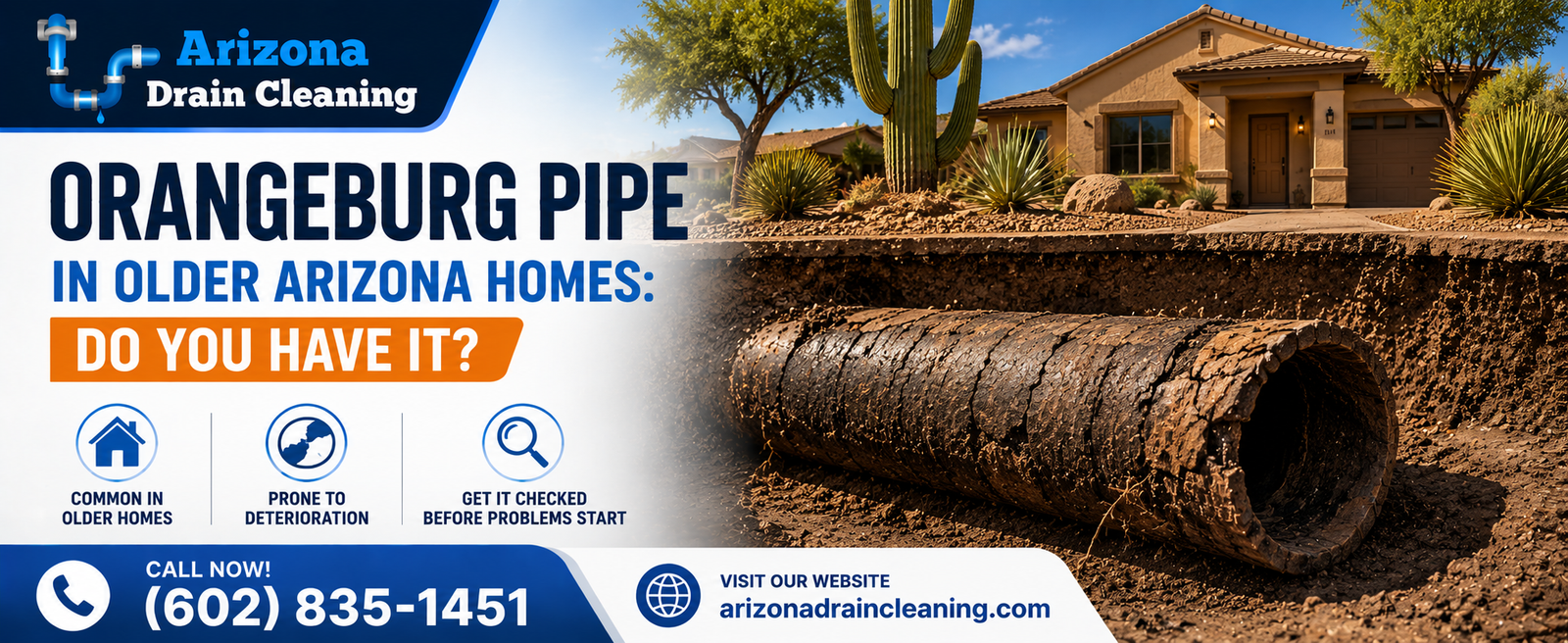
Orangeburg pipe in Arizona is one of the most underdiagnosed plumbing problems, sitting underneath thousands of homes built during the post-World War II housing boom. If your home was constructed anywhere between 1945 and 1972 in Phoenix, Tucson, Mesa, Tempe, Scottsdale, or the surrounding communities, there is a genuine possibility that the sewer line running from your foundation to the city main is made from this material. And if it is, the clock has been running for a long time. Most Orangeburg pipe was installed with an expected service life of 50 years. That deadline has already passed for every single piece of it.
This guide explains what Orangeburg pipe actually is, why Arizona’s specific climate and soil conditions make failure here particularly unpredictable, how to tell whether your home has it, what happens when it starts to go, and what replacement looks like from both a process and pricing standpoint in 2026. If you are buying an older Arizona home, already living in one, or managing rental properties built before the mid-1970s, this is information worth understanding before a backup forces the conversation.
What Is Orangeburg Pipe? A Quick but Important History
Orangeburg pipes, also known as bituminous fiber pipes, were widely used from the 1940s through the 1970s. Made from layers of wood pulp fibers bound with tar and compressed into a pipe shape, these pipes were lightweight and inexpensive compared to traditional clay or cast iron pipes. They were commonly installed in residential sewer systems because they were easy to handle and quick to install.
The name comes from Orangeburg, New York, where the material was originally manufactured. The company that produced it had actually been making bituminous fiber conduit since the 1800s for electrical uses, but the product found its widest residential application during and after World War II when iron and steel shortages forced builders to find affordable alternatives for sewer lines. Orangeburg pipes were made popular after iron and steel shortages during World War II forced plumbers to seek affordable alternatives. Originally expected to last 50 years, many systems began to fail after just 30 years of use, mostly due to structural complications in the materials used in the manufacturing process.
Orangeburg pipe was sold and installed in five-foot sections, and in its widest residential use it carried drain and sewer waste from homes to municipal systems or private septic fields. For about three decades, it was genuinely considered modern and practical. Builders loved it because it cost less, weighed less, and installed faster than alternatives. Homeowners had no reason to think twice about it.
By the 1970s, many municipalities stopped approving Orangeburg pipes for new construction due to frequent failures. Despite this, many older homes still have these pipes in place, often hidden underground and forgotten. The Orangeburg manufacturing facility itself closed in 1972, which effectively ended the era of new Orangeburg installation. The problem is that closing the factory did not remove what was already buried under millions of American homes, including a very large number of properties across Arizona.
Why Arizona Has a Significant Orangeburg Pipe Problem
Arizona’s post-World War II growth was explosive, and it happened right during the peak years of Orangeburg installation. Understanding the scope of that growth helps explain just how many Arizona properties are potentially affected today.
The Phoenix Metro Housing Boom of 1945 to 1972
Home construction in Phoenix soared in the five years following World War II, driven by GI Bill financing that made homeownership accessible across the Valley. Development continued at a rapid pace through the late 1940s, fueled by postwar prosperity and population growth. Neighborhoods like Encanto, Fairview Place, Woodlea, and the areas surrounding central Phoenix were built out almost entirely during this period. Responding to the enormous demand for homes after World War II, dozens of different builders developed neighborhoods throughout the Phoenix area, with construction peaking between 1945 and 1959.
Scottsdale, too, saw its defining era of residential development during these years. Scottsdale recorded its most significant postwar subdivision growth between 1946 and 1973, with construction periods during this window representing the majority of the city’s historic housing base. Every home built during those years was constructed under the prevailing plumbing standards of the time, and Orangeburg was a standard-approved sewer line material throughout that period.
Tucson’s Post-War Expansion
Tucson tells a nearly identical story. Tucson experienced a major post-World War II residential subdivision development period between 1945 and 1973, with hundreds of new developments built across Pima County during those years. The first postwar building peak in Tucson came in 1948, and development continued steadily through the 1960s as the population grew and the University of Arizona attracted permanent residents to the area. There were 311 new developments started in Tucson during the post-WWII period from 1945 to 1973. That represents an enormous volume of residential construction, virtually all of it completed during the window when Orangeburg was widely used.
Mesa and Tempe: Older Than Most People Realize
Tempe and Mesa have much older housing bases than most people assume, shaped by earlier development cycles. Their biggest development waves are now a generation old, placing a meaningful percentage of the housing stock squarely in the era when Orangeburg installation was standard practice.
Cities in Arizona where Orangeburg pipe is a documented problem include Apache Junction, San Tan Valley, Gilbert, Fountain Hills, Mesa, Scottsdale, Sun Lakes, Queen Creek, Chandler, and Tempe. That list is not exhaustive. Any Arizona community with meaningful housing inventory from the 1945 to 1972 period carries Orangeburg risk, and the list above covers some of the most densely populated cities in the state.
How Arizona’s Conditions Accelerate Orangeburg Failure
Orangeburg pipe fails everywhere eventually. The compressed wood pulp and tar construction was simply not built for long-term ground contact, and time alone is enough to degrade it. But in Arizona, several local conditions combine to make that degradation process faster and more unpredictable than in other parts of the country.
Extreme Heat and Thermal Cycling
Arizona summers push soil temperatures at shallow depths well above 120 degrees Fahrenheit. The pipe code in Tucson, for example, only requires sewer pipes to be buried 12 inches below grade. Tucson’s plumbing code requires pipes to be set just 12 inches deep, placed more to protect the pipe itself from basic surface disturbance than from any thermal concern. At that shallow depth, Orangeburg pipe in Arizona is exposed to temperature extremes that pipe buried four or five feet deep in northern states never experiences.
The extreme summer heat in Arizona causes plastic and copper pipes to constantly expand and contract, leading to stress fractures, leaks, and joint failures in the plumbing system. For Orangeburg, which is already structurally compromised by its composition, thermal cycling at Arizona temperatures accelerates the softening and deformation process considerably.
Caliche and Expansive Clay Soil Pressure
Two main culprits in the Phoenix Valley act against underground pipes: expansive clay and dense caliche. Expansive clay swells dramatically when it absorbs water during monsoon season, and when the ground dries out, it contracts and shrinks, creating voids. This cycle of expansion and contraction puts immense pressure on rigid sewer pipes, especially those made of older, more brittle materials. Caliche is a hardened layer of calcium carbonate found just below the surface in desert soils, incredibly dense and hard, often described as soft cement.
Caliche traps water above it and creates uneven pressure pockets that shift the soil around pipes. This movement leads to pipe shifting in Arizona homes, especially in those with older, more brittle pipe materials such as clay or Orangeburg. When an Orangeburg lateral runs above or near a caliche layer, the trapped moisture and resulting soil instability create lateral forces on an already weakened pipe wall. The pipe does not need to be in its final stages of degradation to start deforming under that kind of pressure.
Monsoon Season Wet and Dry Cycles
The underground soil conditions around Tucson and Phoenix are not like those in most regions. When summer storms dump intense rainfall onto baked desert soil, the ground soaks up moisture rapidly and presses hard against underground pipes. Once the heat returns, the soil dries and shrinks, leaving air gaps that cause pipes to sag.
For a pipe made from compressed wood fiber, this annual cycle of saturation followed by accelerated drying is particularly damaging. The wood pulp component absorbs moisture, softens, loses structural rigidity, and then bakes in the heat before the next monsoon season begins the process again. Over decades, each cycle contributes incrementally to the pipe’s loss of shape and load-bearing capability.
Desert Tree Root Systems
Tree roots from citrus, oleander, mesquite, and palo verde aggressively seek water, invading clay and Orangeburg drain lines at pipe joints. Arizona’s desert trees and landscaping plants have root systems that extend aggressively in search of moisture, and they are very good at finding it. Orangeburg pipe material is relatively soft and porous, making it easier for tree roots to penetrate the sewer line in search of water. Once roots enter through a joint or small crack, they cause blockages and accelerate deterioration from the inside.
Unlike clay pipe, which at least starts as a hard ceramic material, Orangeburg is already soft enough that root penetration does not even require a pre-existing crack. As the pipe wall softens over time, root tips can work through the material itself.
How to Identify Orangeburg Pipe in Your Arizona Home
This is the question most homeowners have once they learn about the issue. The honest answer is that definitive identification requires a professional camera inspection of the sewer line. But there are preliminary indicators worth knowing.
Your Home’s Construction Date
This is the starting point. Orangeburg pipe was commonly used in home construction from 1945 to 1972. If your home was built during this window and you have no documentation confirming the sewer line has been replaced, you have reason to investigate further. You do not have confirmation of Orangeburg, but you have reason.
Documentation worth looking for includes previous inspection reports, permits from past plumbing work, seller disclosures from your purchase, and any home inspection reports that referenced pipe materials. If a plumber pulled records during service calls, those records sometimes note pipe material.
Visual Inspection at Accessible Points
If you have access to any exposed section of your drain or sewer piping, such as near a basement floor drain, a cleanout cap inside a utility area, or where the line exits the foundation, you can look for physical indicators. Orangeburg pipes have a rough, corrugated surface that resembles the texture of cardboard. They are usually dark brown or black in color due to the coal tar pitch used in their manufacturing. The surface may feel slightly spongy to the touch. To confirm identification, look for stamped markings along the pipe’s surface indicating “OC,” “Orangeburg,” or similar terms.
Comparing this to what you would see with other older pipe materials helps: cast iron pipe is heavy, dark gray or rust-colored, rigid, and metallic. Clay pipe is ceramic, often a terra-cotta color, and breaks in sharp pieces. Galvanized steel is metallic, silver-gray when new and reddish-brown when corroded. Orangeburg looks and feels fundamentally different from all of these. The cardboard-like texture and spongy feel, if present, are unmistakable once you know what you are looking for.
Warning Signs From Within the House
Homeowners with Orangeburg sewer lines should watch for frequent drain clogs, which indicate the pipe may be collapsing or infiltrated by roots; indentations in the yard as the pipe deteriorates and the soil above it sinks; unpleasant odors suggesting a failing sewer line; and excessive moisture or mold growth if sewer water is leaking into surrounding soil or the foundation.
When Orangeburg starts to oval or collapse, waste cannot flow freely. Sinks, tubs, and toilets drain slower than before, and clogs that keep coming back despite repeated cleaning often point to a failing main sewer line rather than a local blockage.
Recurring drain issues that do not respond adequately to snaking are a particularly telling pattern. If you have had a plumber out to clear the main line two or three times in a 12-month period and each time the backup returns within weeks, you almost certainly have a pipe-condition problem rather than a simple clog problem. Never authorize a third drain snake without a camera scope first. At that failure frequency, the root problem is pipe condition, not blockage.
Signs in Your Yard
As an Orangeburg pipe collapses, the soil above it sinks. You may notice dips or soft spots in your yard that line up with where the sewer line runs. Soggy areas during dry weather or patches of unusually green grass also signal a leak. Sewage acts as fertilizer, so grass growing faster in one strip often marks the path of a leaking pipe.
In an Arizona yard during a dry stretch between monsoon seasons, a consistently wet patch of soil is a particularly obvious sign because you know the moisture is not coming from rain. If that wet patch corresponds roughly to the path your sewer lateral takes from the house to the street, get a camera inspection scheduled before that wet patch becomes a sinkhole.
The Only Definitive Answer: Camera Inspection
A sewer camera inspection is the only definitive way to identify your pipe material and assess its condition. A plumber feeds a video camera through the line to see exactly what is underground. Sewer line camera inspection costs between $175 and $350, with longer sewer lines costing more as they take longer to inspect.
For a pre-purchase inspection on an older Arizona home, this is one of the most valuable $200 to $300 you can spend. A general home inspector looks at visible and accessible systems. Your sewer lateral is neither visible nor accessible, and it is one of the most expensive components of your home to replace if it is already in a failed or near-failed state. Real estate transactions fall apart over Orangeburg findings, and they should, because the liability being transferred is real.
What Happens When Orangeburg Pipe Fails
The failure mode for Orangeburg is different from other pipe materials, and understanding it helps explain why the consequences can be sudden and severe.
Ovaling and Deformation
Rather than cracking or fracturing the way clay or cast iron pipe does, Orangeburg pipe deteriorates over time, leading to ovaling and collapse. The pipe loses its circular cross-section as the soil above presses down on it and the softened material cannot maintain its shape. An ovaled pipe has dramatically reduced flow capacity. A pipe that was originally four inches in diameter may function as if it were two inches in diameter once deformation is significant. Waste and toilet paper that would have flowed freely now catch, accumulate, and cause backups.
Complete Collapse
As Orangeburg deteriorates, it often flattens under soil pressure rather than cracking. When collapse occurs, waste can no longer flow through the line properly. Once a pipe has collapsed, repair is no longer an option. Full sewer line replacement is required to restore proper function and prevent ongoing damage.
Collapse can happen gradually over years or it can happen suddenly. A heavy vehicle driving over a soft spot in the yard, an intense monsoon season with sustained ground saturation, or a significant root intrusion that compromises the remaining pipe wall integrity can all trigger rapid failure in a line that had been slowly degrading for years.
Sewage Backups and Property Damage
When a collapsed Orangeburg lateral creates a full backup, the consequences inside the home can be significant. Homeowners with failing Orangeburg pipes face frequent sewer backups due to pipe collapse or root intrusion, soil contamination from leaking sewage, and expensive repairs when pipes fail completely. Sewage that backs up through floor drains or toilet bases is a health hazard, damages flooring and finishes, and requires professional remediation on top of the plumbing repair.
Orangeburg Pipe Replacement in Arizona: Your Options and Costs in 2026
Once Orangeburg is confirmed, replacement is the appropriate path. Any sewer line with documented Orangeburg material should be replaced in full at first failure. Spot repairs are unlikely to be cost-effective, as you are likely to face additional failures within a few years.
There are two primary approaches: traditional open trench excavation and modern trenchless replacement.
Traditional Excavation
Traditional excavation involves digging a trench along the entire length of the sewer line from the home to the municipal main. After locating the line, the crew excavates to expose the old pipe. This can be disruptive if the line runs under landscaping, patios, or driveways. Once exposed, the old Orangeburg pipe is removed and replaced with durable new pipe, typically PVC or HDPE. The main advantage of trenching is that it works in nearly any situation, especially when a pipe is severely collapsed.
Traditional open-trench sewer line replacement costs $4,000 to $15,000 depending on depth, length, and what is above the pipe. Repairing under a lawn adds $500 to $1,500 for re-grading and re-sodding. Under a concrete driveway, add $2,000 to $5,000 for demolition and restoration.
In Arizona, the caliche layer creates an additional complication for traditional excavation. In areas with shallow caliche, specialized equipment is needed to break through the calcified layer to reach the pipe. Caliche requires heavy excavation equipment and significantly adds to the time and labor cost of traditional repairs.
Trenchless Replacement: Pipe Bursting and CIPP Lining
Pipe bursting is ideal for replacing damaged Orangeburg pipes that still form a continuous path. Two small access points are excavated, then a specialized bursting head is pulled through the old pipe. This head breaks apart the old pipe while simultaneously pulling a new, seamless HDPE pipe into place. The process is efficient and can often be completed in a single day.
Cured-in-place pipe lining, known as CIPP, creates a pipe within a pipe. A flexible, resin-saturated liner is inserted into the damaged pipe and inflated. It is then cured with heat, forming a new, seamless pipe inside the old one. CIPP is excellent for pipes with cracks or leaks but is not suitable for pipes that are completely collapsed or severely misshapen.
Trenchless sewer repair methods such as pipe lining and pipe bursting are generally 30 to 40 percent less expensive than traditional excavation methods and cause significantly less disruption to landscaping. The average total cost for a residential trenchless sewer line replacement ranges from $4,000 to $15,000, with most projects landing between $6,000 and $12,000 depending on the method.
Sewer pipe liners installed via CIPP are rated to last up to 50 years. For Arizona homeowners concerned about ongoing root intrusion from desert landscaping, a fully cured pipe liner inside the old Orangeburg shell eliminates root penetration pathways for decades.
Is Trenchless Always an Option for Orangeburg?
Not necessarily. Trenchless replacement involves inserting a new liner or pipe inside the old one, but ovaling can prevent proper lining adhesion or passage through the pipe. For ovaled pipes, trenching is the safer approach. For intact pipes that are cracking but have not yet deformed, trenchless saves time and cost. A camera inspection not only confirms whether Orangeburg is present, but it also shows the current condition of the pipe and whether trenchless methods are feasible. Do not let any contractor recommend a replacement method without completing a camera inspection first.
What Drives Cost Variation in Arizona
Several Arizona-specific factors influence where your replacement cost falls within the price ranges above:
The length of your sewer lateral from the house to the city main varies significantly by lot size and setback. Lots in older Phoenix and Tucson neighborhoods can range from relatively short runs to quite long laterals on larger lots. Pipe depth matters because caliche complicates excavation when trenching is required. What sits above the line, including landscaping, a concrete driveway, a patio, or just open desert yard, determines restoration costs after the work is done. Whether your home has an accessible exterior cleanout affects how quickly the camera inspection and replacement access can be established.
Trenchless sewer line replacement is priced per linear foot, with traditional open-trench dig-up at $50 to $125 per foot, pipe bursting at $60 to $200 per foot, and CIPP lining at $80 to $250 per foot. A 60-foot lateral in a midtown Phoenix neighborhood is going to cost meaningfully less than a 120-foot lateral on a larger Scottsdale lot, regardless of the method used.
What Arizona Home Buyers Need to Know About Orangeburg Pipe
If you are buying an older Arizona home, Orangeburg pipe represents one of the most significant undisclosed liabilities you can inherit. A standard home inspection does not evaluate your sewer lateral. Your inspector looks at visible, accessible systems. The sewer line from the foundation to the street is underground and typically inspected only if you specifically request and pay for a separate sewer scope inspection.
Many homeowners and property managers are unaware that their sewer lines may still contain Orangeburg pipes. These pipes can cause serious problems, including frequent sewer backups due to pipe collapse or root intrusion, soil contamination from leaking sewage, and expensive repairs when pipes fail completely. Because Orangeburg pipes degrade internally and externally, visual inspection from the surface is not enough to assess their condition.
If you are purchasing any home in Phoenix, Tucson, Mesa, Tempe, Scottsdale, or any other Arizona city with housing stock from the 1945 to 1972 era, request a sewer scope inspection as part of your due diligence. Many sellers are not aware their home has Orangeburg and are not hiding it. But finding out after closing that you need a $6,000 to $12,000 sewer line replacement in your first year of ownership is a very different situation than knowing before you close and either negotiating a price reduction or having the seller address it as a condition of sale.
If Orangeburg is confirmed in a pre-purchase inspection, it does not automatically mean you should walk away. But it does mean the scope and cost of replacement should be fully understood and factored into your offer.
Take Action Now: Contact Arizona Drain Cleaning
If your home was built between 1945 and 1972 anywhere in Arizona and you have not had a sewer camera inspection completed in the past few years, you are operating without information you genuinely need. Orangeburg pipe does not announce its failure with warning lights. It announces it with a sewer backup into your home.
At Arizona Drain Cleaning, we work with older Arizona homes every day. We know what Orangeburg looks like on a camera, how Arizona’s caliche and monsoon cycle accelerate failure, and how to give you a clear, honest assessment of what is actually underground before recommending any specific repair path. We do not push replacement when a camera shows a pipe in manageable condition. We do not recommend snaking when a camera shows a pipe that is failing.
Call us today (602) 835-1451 or fill out our contact form to schedule a sewer camera inspection. If you have Orangeburg pipe, you will know exactly what condition it is in and exactly what your options are. That is the only way to make a fully informed decision about one of the most significant systems in your home.
Frequently Asked Questions
What exactly is Orangeburg pipe made from?
Orangeburg pipe was made from multiple layers of ground wood fibers bound with an adhesive mastic made from coal tar, impregnated with coal tar pitch. The resulting pipe looked like black tarred pipe and was lightweight and inexpensive to manufacture and install. The coal tar made it initially water-resistant, but that resistance breaks down over time as the organic wood fiber component absorbs moisture and degrades.
How do I know if my Arizona home has Orangeburg pipe?
Start with your home’s construction date. If it was built between 1945 and 1972, there is a possibility. Look for physical indicators at any accessible section of the drain line: dark brown or black color, rough cardboard-like texture, and a slightly spongy feel if the material has already begun to absorb moisture. A professional sewer camera inspection is the only definitive way to confirm the pipe material and assess its condition.
Is Orangeburg pipe dangerous to my health?
Failing Orangeburg pipe creates health risks primarily through sewage leakage. When sewer water leaks into surrounding soil or the foundation of your home, it creates excess moisture and conditions for mold growth. Sewage that backs up into living spaces is a direct health hazard. The pipe material itself, while made partially from coal tar, does not release harmful substances into your household water supply because Orangeburg was used exclusively for drain and sewer lines, not supply lines.
Can Orangeburg pipe be repaired rather than replaced?
In limited situations, a CIPP liner can be installed inside an Orangeburg pipe that has not yet significantly deformed or collapsed. But any sewer line with documented Orangeburg material should be replaced in full at first failure, as spot repairs are unlikely to be cost-effective given the likelihood of additional failures within a few years. If the pipe has already ovaled or collapsed in any section, trenchless lining is not an option and full replacement is the only path forward.
Does homeowners insurance cover Orangeburg pipe replacement in Arizona?
The government does not provide funds for Orangeburg replacement costs. On top of that, conventional homeowners insurance plans still provide somewhat limited coverage for sewage lines. Most standard homeowners policies exclude sewer line repair and replacement unless the damage is caused by a covered event such as a sudden accidental discharge. Gradual deterioration, which describes Orangeburg failure, is almost universally excluded. Some insurers offer sewer line coverage as an optional rider, and some utility companies offer separate sewer line protection programs. Review your specific policy and ask your insurer directly.
How long does Orangeburg pipe replacement take in Arizona?
Trenchless repair technology can often be completed in just a few hours, eliminating the need to tear down the home and yard to replace the pipes. A full pipe bursting replacement on a standard residential lateral typically takes one to two days including setup and cleanup. Traditional excavation takes longer depending on the length of the lateral and what surface restoration is required after the trench is backfilled.
Should I get a sewer inspection before buying an older Phoenix or Tucson home?
Yes, without question. A standard home inspection does not evaluate the underground sewer lateral. For any home built before 1973 in Arizona, a separate sewer scope inspection is one of the most valuable components of your due diligence. It costs $175 to $350 and gives you definitive information about one of the most expensive systems to replace in a residential property. Many buyers in older Arizona neighborhoods now routinely include sewer inspection as a standard contingency.
What pipe material replaces Orangeburg?
Today, Orangeburg pipe is replaced with more durable materials like PVC or HDPE. PVC is the most common choice for traditional excavation replacement. HDPE is widely used in trenchless pipe bursting applications because it is flexible enough to be pulled into place while being highly resistant to root intrusion, chemical corrosion, and the soil movement conditions common throughout Arizona.