
Catch basin cleaning in Arizona is a maintenance obligation that most property owners handle reactively, meaning they address it after a monsoon storm has already produced flooding in their parking lot, backed up water against their building foundation, or created standing water that lingers for days. The team at Arizona Drain Cleaning works with commercial property managers, homeowner associations, industrial facility operators, and residential property owners across the Valley every year, and the pattern is consistent: the properties that clean their catch basins before monsoon season are the ones that function correctly when the storms arrive. The properties that skip maintenance are the ones calling for emergency service during a storm event when the basin has overflowed and water is pooling where it should not be. This guide covers everything a property owner in Arizona needs to understand about catch basins, including what they are, how they work, why they require regular cleaning, what the cleaning process involves, what Arizona’s regulatory framework requires of private property owners, how to build a maintenance schedule that works for your specific property, and when professional service is the only appropriate response.
What a Catch Basin Is and How It Works
A catch basin is an underground drainage structure designed to collect stormwater runoff from paved surfaces, parking lots, driveways, loading docks, and any other impervious surface where water accumulates during rain events. The structure consists of a grated opening at the surface level that allows water to enter while blocking large debris, a concrete or polymer chamber below that collects water and traps sediment and smaller debris, and an outlet pipe that carries water from the chamber into the broader storm drain system or to a designated retention or detention basin.
The Basic Structure of a Catch Basin
The grate is the visible component, the metal or polymer grid that sits flush with or slightly below the surrounding pavement surface. The grate opening size determines what size debris enters the basin below. Under the grate is the basin body, which is typically a precast concrete box or cylinder ranging from two to six feet in depth and anywhere from two to four feet in internal diameter for residential and standard commercial applications. Larger commercial and industrial basins can be significantly bigger.
At the base of the basin body is the sump, a deeper section below the outlet pipe that is specifically designed to trap heavy sediment, sand, gravel, and other materials that would otherwise travel into the connecting storm drain pipe and accumulate there. The outlet pipe exits from the side of the basin body, typically near the top of the sump, and connects to the underground storm drain system. Water entering the basin fills the sump and flows out through the outlet pipe when it reaches the pipe elevation. The sump traps everything heavier than water, which is why the sump requires periodic cleaning when it fills with accumulated material.
How a Catch Basin Differs From a Storm Drain
These terms are often used interchangeably but they refer to different components of the same system. The storm drain refers to the entire underground pipe network that carries stormwater from collection points to its discharge location. A catch basin is a specific structure within that network, the collection chamber at the inlet point where stormwater enters the underground system. Understanding this distinction matters for maintenance because problems at the catch basin level and problems in the connecting storm drain pipe require different equipment and different approaches to address.
Why the Sump Is the Critical Maintenance Component
The sump’s function as a debris trap is its most valuable feature and also the source of its primary maintenance requirement. Every rainstorm that flows through a catch basin deposits sediment, organic material, and debris into the sump. Arizona’s wind-driven dust and desert grit add another consistent layer of fine particulate material with every storm event. Motor oil and petroleum residue from parking surfaces travel with stormwater into the sump and accumulate as a hydrocarbon layer on top of the sedimented material. Over time, the sump fills from the bottom up. When sump material reaches the elevation of the outlet pipe, it begins entering the connected storm drain, and when the sump fills to the grate level, the basin can no longer accept incoming stormwater at all.
Why Catch Basin Cleaning Matters in Arizona More Than Most States
Arizona’s specific combination of intense rainfall events, desert dust and debris, extreme summer heat, and the hard water that leaves mineral deposits on every surface the water contacts creates catch basin maintenance demands that are meaningfully more challenging than what property owners in most other climates experience.
Arizona’s Monsoon Season and Catch Basin Overload
Arizona’s monsoon season runs from mid-June through late September and delivers rainfall in a pattern that is essentially the worst-case scenario for catch basin performance. Storms are not measured in steady rainfall accumulation over hours. They are concentrated events that can drop an inch or more of rain in twenty to forty minutes across a localized area. A properly maintained catch basin in good condition can handle typical monsoon flow rates. A catch basin that is 50 to 70 percent full of accumulated sediment and debris cannot accept the incoming water volume fast enough, and the result is surface flooding in the time it takes for a monsoon cell to complete its passage.
In the City of Phoenix’s stormwater management program, catch basins and drainage grates are specifically identified as features that need to function during storm events, and the city requires that all stormwater features owned and operated by private entities, including homeowner associations, be properly maintained to promote performance consistent with the original design intent. This is not merely a technical recommendation. It is a compliance obligation for private property owners throughout the Phoenix metro area under the city’s post-construction stormwater program requirements.
Desert Dust and Debris Accumulation Rate
Between monsoon storms and during the long dry season, Arizona’s desert environment generates enormous quantities of wind-driven dust, decomposed granite particles, dried organic material from desert vegetation, and windblown trash that settle into every catch basin grate opening on the property. A catch basin in Phoenix can accumulate a meaningful sump load of fine material during a single dust storm without a drop of rain ever falling. This desert-specific accumulation pattern means that Arizona catch basins fill their sumps faster than basins in most other climates because they are receiving material continuously rather than only during rain events.
Heat and Petroleum Residue in Parking Surfaces
Arizona’s summer heat accelerates the leaching of petroleum compounds from asphalt parking surfaces, and those compounds travel with stormwater into catch basins during any rain event. Parking areas with heavy vehicle traffic, fuel drips, motor oil leaks, and hydraulic fluid residue from heavy equipment contribute a persistent petroleum layer to catch basin sumps that is distinct from the mineral sediment accumulation and that requires specific handling when the sump is cleaned. This petroleum component also creates environmental compliance considerations for commercial properties because the Clean Water Act and Arizona’s AZPDES permit program prohibit the discharge of petroleum pollutants into the storm drain system.
The Standing Water and Mosquito Problem
Under the City of Phoenix stormwater management guidelines, stormwater should fully dissipate from retention features within 36 hours of a storm event. Standing water that persists beyond this timeframe creates two problems. The first is mosquito breeding. Standing water in a catch basin sump that has not been cleaned is an ideal mosquito breeding environment, warm, protected from wind, and rich with organic material that supports mosquito larvae. West Nile Virus is a genuine public health concern in Maricopa County, and standing water on a commercial property that contributes to mosquito populations creates both a public health issue and a liability exposure for the property owner. The second problem is that standing water remaining in the sump indicates the outlet pipe is either partially blocked or that the sump fill level is restricting drainage, either of which requires professional attention.
Who Owns the Catch Basin Maintenance Obligation in Arizona
This question is more nuanced than it might appear, and getting the answer wrong creates either a compliance problem or an unnecessary financial burden.
Catch Basins on Private Property
Any catch basin located entirely within the boundaries of a private property is the maintenance responsibility of the property owner. This applies regardless of whether the basin connects to a public storm drain system, drains to a private retention basin, or discharges to a dry well on the property. The physical location of the basin determines the maintenance responsibility. A catch basin in your parking lot is your catch basin to maintain, period.
For commercial properties in Phoenix, Scottsdale, Mesa, Chandler, and throughout Maricopa County, the municipal stormwater programs are unambiguous on this point. Private stormwater infrastructure, including catch basins, must be maintained by the private property owner to the performance standard of the original design. Failure to maintain this infrastructure creates both a code compliance issue and a liability exposure if the unmaintained basin contributes to flooding, property damage, or stormwater quality violations.
Homeowner Associations and Shared Drainage Infrastructure
In many Arizona residential communities, particularly master-planned communities and gated subdivisions throughout the Valley, the catch basins serving common areas, street drainage, and community parking facilities are owned and maintained by the homeowner association rather than individual homeowners. The HOA’s CC&Rs and the municipal stormwater compliance obligations both require that the HOA maintain this infrastructure. HOA boards that defer catch basin maintenance in shared drainage areas are exposing the association to compliance risk and to liability if deferred maintenance contributes to flooding or property damage to individual homeowners.
Catch Basins in Public Rights-of-Way
Catch basins located in public streets, city-owned parking facilities, or municipal rights-of-way are the maintenance responsibility of the city or municipality rather than private property owners. The distinction between a basin in the street and a basin in your parking lot adjacent to the street is important, and in some situations it requires a site assessment to determine precisely where private property ends and public right-of-way begins. If you are unsure whether a specific basin on or near your property is your maintenance responsibility, contacting your municipality’s public works department for clarification before investing in cleaning is the appropriate step.
Signs Your Catch Basin Needs Cleaning Now
Many property owners do not inspect their catch basins regularly enough to catch deteriorating conditions before they become emergency situations. These warning signs are visible without any specialized equipment and indicate that professional cleaning is needed before the next significant rain event.
Standing Water in the Basin After Dry Weather
If you look into a catch basin during a prolonged dry period and see standing water in the sump that should have drained, one of two things is happening: the outlet pipe is partially or fully blocked and water cannot flow out, or the sump is so full of accumulated material that the outlet pipe opening is restricted. Either condition means the basin cannot accept its full intended volume of stormwater during the next rain event, and both conditions require professional attention.
Sump Fill Level at or Above One-Third Capacity
A common professional standard is that catch basin sumps should be cleaned when sediment and debris accumulation reaches approximately one-third of the sump depth below the outlet pipe. At this fill level there is still adequate capacity to function during a rain event, but the accumulation is substantial enough that deferring cleaning further risks reaching the outlet pipe elevation before the next service visit. Property owners who can safely look into their catch basin through the grate opening can visually estimate the sump fill level relative to the outlet pipe. If the debris surface is within a foot of the outlet pipe, cleaning is overdue.
Debris Visible at or Near the Grate Level
Organic material, trash, leaves, and sediment that have accumulated to a level visible at or near the grate surface indicate a basin that is completely or nearly full. A basin in this condition provides essentially no stormwater management function. Surface flooding will occur during any meaningful rain event because incoming water has no chamber to flow into.
Foul Odors from the Basin
A functioning catch basin with a clean sump and clear outlet pipe should not produce noticeable odors under normal conditions. Persistent foul odors from a catch basin indicate decomposing organic material in the sump, an anaerobic biological process that produces hydrogen sulfide and other sulfur compounds. This odor is more common in catch basins near food service facilities, where grease and food waste travel with stormwater into the sump, or in basins surrounded by heavy organic landscaping material. The odor indicates organic accumulation that needs to be removed both for function and for sanitation.
Slow or No Drainage During Rain Events
If you observe during a rain event that a catch basin grate area is pooling water rather than accepting flow rapidly, the basin is failing to perform its intended function. This is the most obvious but also the most dangerous sign to wait for, because observing it means the failure has already occurred and flooding may already be affecting your property. Surface puddling around a catch basin grate during moderate rainfall that should be well within the system’s design capacity is a clear indication that professional cleaning is needed immediately.
Visible Structural Damage to the Grate or Basin Body
Grates that are bent, cracked, or displaced create both a safety hazard for pedestrians and vehicles and a condition where larger debris can enter the basin without filtration. Visible cracks or deterioration in the exposed basin body or frame indicate structural issues that may be allowing sediment to enter the connected storm drain pipe through the basin wall rather than through the outlet pipe. Structural damage to catch basin components requires repair that goes beyond cleaning and should be assessed by a licensed drain contractor.
The Professional Catch Basin Cleaning Process
Understanding what professional catch basin cleaning actually involves helps property owners make informed decisions about service providers, schedule service at appropriate intervals, and evaluate whether the service performed was thorough.
Initial Inspection and Assessment
Before any cleaning equipment is deployed, a professional service technician inspects the catch basin to assess the sump fill level, the nature of the accumulated material, the condition of the grate and basin body, the visible condition of the outlet pipe, and whether any structural damage exists that needs to be addressed alongside the cleaning. For commercial properties with multiple catch basins, this assessment also determines the cleaning priority order across the property and whether any basins require different handling due to petroleum contamination or other special waste streams.
A pipe inspection with video camera of the outlet pipe and connected storm drain line is valuable during this assessment stage particularly when a basin has been backed up, when the outlet pipe appears restricted, or when the connected storm drain line has not been professionally inspected in several years. The camera reveals whether the drain line downstream of the catch basin is clear or whether accumulation in the pipe is contributing to the drainage problem at the basin level.
Manual Debris Removal
The first cleaning step is manual removal of large debris from the grate and the visible upper portion of the basin. Leaves, trash, large organic material, and surface debris that accumulated above the water line in the basin body are removed by hand or with long-handled tools before vacuum equipment is deployed. This step prevents large material from being drawn into the vacuum equipment improperly and ensures the cleaner path for the vacuum nozzle to reach the sump.
Vacuum Truck Extraction
The primary cleaning method for commercial catch basin sump cleaning is vacuum truck extraction. A vacuum truck equipped with a high-capacity industrial wet-dry vacuum and a sump pump system deploys a suction hose into the catch basin sump and extracts the accumulated sediment, water, and debris as a combined slurry. The vacuum truck tank stores the extracted material for transport to an approved disposal or processing facility.
Vacuum truck extraction removes the bulk of sump material efficiently and thoroughly, including the heavy sediment at the bottom of the sump that would be too heavy to move with water pressure alone. The vacuum process can also extract the petroleum-contaminated layer that settles above the sediment and below the waterline in basins serving parking areas with vehicle traffic.
High-Pressure Water Jetting for Thorough Cleaning
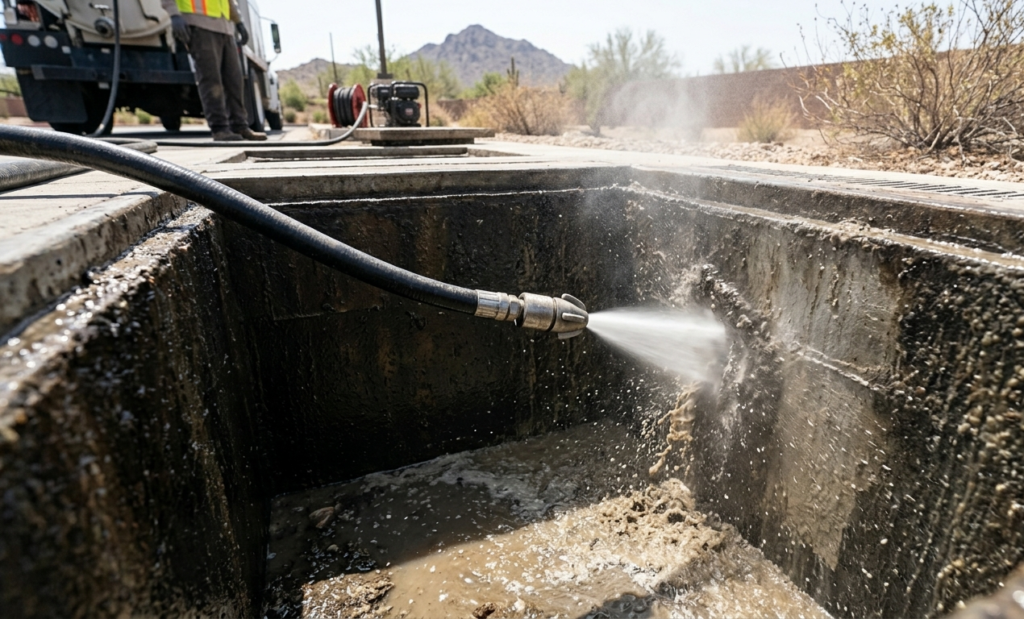
Following vacuum extraction of the primary sump material, hydro jetting with a specialized nozzle is used to dislodge material that has adhered to the basin walls and sump floor, rinse down remaining fine sediment for extraction, and flush the outlet pipe to confirm it is clear. The high-pressure water breaks up compacted sediment and organic material that the vacuum alone cannot remove and ensures the sump is genuinely clean rather than simply emptied of loose material.
For catch basins where the outlet pipe shows restriction or where downstream pipe condition is uncertain, hydro jetting of the connected storm drain line using a specialized storm drain cleaning nozzle removes any accumulated material in the pipe itself rather than just in the basin. This combined approach ensures that the entire drainage pathway from the catch basin grate through the connected storm drain line is functioning at full capacity.
Final Inspection and Documentation
After cleaning is complete, a final inspection confirms that the sump is clean, the outlet pipe is clear and flowing correctly, the grate and basin frame are in sound condition, and no structural damage is present that requires follow-up repair. For commercial properties maintaining compliance records, a written service report documenting the date, the work performed, the material volume extracted, and the post-cleaning condition of the basin is an important compliance and maintenance documentation item.
How Often Arizona Catch Basins Need Professional Cleaning
The appropriate cleaning frequency depends on several factors specific to each property and each catch basin’s location and load characteristics.
The Annual Minimum for Most Arizona Properties
For most Arizona commercial and residential properties, annual catch basin cleaning is the appropriate minimum service interval. The EPA recommends annual inspection of catch basins, with cleaning one to two times per year or more frequently in high-use areas. In Arizona’s monsoon environment, annual cleaning performed before monsoon season begins, typically in April or May, gives basins their maximum capacity when they will face their highest demand.
Annual cleaning before monsoon season is not arbitrary timing. It ensures the sump is clear of the entire previous year’s accumulation, including the material deposited during the prior monsoon season and the dry-season dust accumulation from months of wind-blown desert material. Going into monsoon season with a clean sump means the basin can accept the full design capacity of stormwater during the first major storm rather than starting the season with reduced capacity from the prior year’s buildup.
Properties Requiring More Frequent Service
Certain property types and certain catch basin locations generate accumulation faster than the annual minimum can manage effectively.
Commercial properties with significant vehicle traffic, particularly parking lots with heavy truck activity, fuel delivery areas, or fleet parking, accumulate petroleum residue at a rate that warrants semi-annual or quarterly cleaning. The petroleum layer that builds in these basins creates both a drainage restriction and an environmental compliance concern under Arizona’s stormwater quality regulations.
Catch basins located near food service facilities receive grease and food waste with every stormwater event and often with kitchen wash-down water. Grease accumulation in a catch basin sump creates odor problems and accelerates the development of anaerobic conditions that damage basin structural components over time. Basins serving restaurant loading docks, outdoor dining areas, or any food service facility drainage benefit from quarterly cleaning.
Basins located in areas with heavy tree canopy or significant landscaping that drops leaves, seeds, flowers, and organic debris into the grate opening accumulate organic material at a significantly higher rate than basins in paved open areas. Quarterly or biannual cleaning is appropriate for basins in heavily landscaped areas.
Properties located in or near construction zones receive dramatically elevated loads of construction dust, concrete washout material, and sediment runoff that can fill a catch basin sump in a single wet season. Monthly or bimonthly inspection and cleaning during active adjacent construction is appropriate to prevent basin overflow and downstream storm drain impacts.
Post-Monsoon Inspection as a Supplement to Annual Cleaning
Even properties that clean their basins before monsoon season benefit from a post-monsoon inspection in October or November to assess how much material a particularly active monsoon season deposited. An active monsoon year with multiple significant storm events can deposit enough material to warrant a second cleaning before the winter and spring dry season, particularly in basins serving large impervious surface areas that generate high runoff volumes per storm event.
Arizona Regulatory Framework for Catch Basin Maintenance
ADEQ and the AZPDES Program
The Arizona Department of Environmental Quality administers the Arizona Pollutant Discharge Elimination System program, Arizona’s implementation of the federal Clean Water Act’s National Pollutant Discharge Elimination System requirements. The AZPDES program governs stormwater discharges and requires that stormwater leaving private property through the storm drain system meet water quality standards that protect receiving waters including Arizona’s rivers, lakes, and groundwater resources.
A catch basin that overflows because it has not been cleaned is releasing untreated stormwater carrying petroleum residue, sediment, trash, and organic pollutants directly across paved surfaces and potentially into adjacent public rights-of-way and the municipal storm drain system. This constitutes a potential AZPDES compliance issue for commercial properties. Commercial property owners and industrial facility operators who generate stormwater discharges that enter a municipal storm sewer system are subject to stormwater management requirements that include maintaining their on-site stormwater infrastructure in functional condition.
Phoenix Post-Construction Stormwater Program
Effective July 1, 2022, the City of Phoenix implemented a post-construction stormwater controls program that inventories, tracks, inspects, and confirms adequate maintenance of stormwater control measures for public and private projects of one acre or more. All stormwater features on private property, including catch basins, that serve as post-construction stormwater controls must be properly maintained by the private property owner to promote performance consistent with the original design intent.
This program applies to commercial properties, industrial facilities, and homeowner associations throughout Phoenix. Properties subject to this program should maintain documentation of their catch basin cleaning service history as part of their stormwater compliance records. The city can inspect private stormwater features and require corrective action when maintenance has not been performed.
Maricopa County Stormwater Regulations
Maricopa County operates a stormwater quality management program under its Stormwater Quality Management and Discharge Control Regulation, which applies to unincorporated Maricopa County areas and establishes requirements for private property owners to prevent stormwater pollution and maintain functional drainage infrastructure. In the Valley, the distinction between the municipal storm sewer system that treats stormwater before discharge and the Municipal Separate Storm Sewer System that conveys stormwater directly to receiving waters without treatment is important. As the Maricopa County program notes, MS4 water does not go to a water treatment plant. It goes directly to retention basins, washes, rivers, or lakes. Maintaining clean catch basins that trap pollutants before they enter this system is both a regulatory obligation and an environmental responsibility for Arizona property owners.
Catch Basin Cleaning for Specific Arizona Property Types
Commercial Parking Lots and Retail Centers
Parking lots and retail center drainage systems typically have multiple catch basins distributed throughout the lot at low points and at the intersections of drive aisles and parking fields. The basin load in retail parking varies significantly by tenant mix. A basic retail center with general merchandise stores has a different accumulation profile than one with a grocery anchor, multiple restaurants, and a car wash. Annual cleaning of all basins with more frequent service for the highest-load locations is the appropriate approach for most retail center stormwater management.
For retail centers subject to the City of Phoenix’s post-construction stormwater program, maintaining a documented cleaning schedule and service records for all catch basins on the property is part of the compliance obligation. Storm drain cleaning of the connected pipe network at the same time as catch basin cleaning ensures the entire drainage pathway is functioning, not just the individual basin collection points.
Industrial and Manufacturing Facilities
Industrial catch basins face the most demanding maintenance requirements of any property type. The combination of petroleum-contaminated stormwater from vehicle and equipment operations, process water residue, and high sediment loads from heavy vehicle traffic creates sump accumulation that requires more frequent service and specialized handling. Industrial catch basin cleaning waste may qualify as a regulated waste stream depending on the contamination level, and disposal must be at an approved facility.
Industrial facility operators subject to the AZPDES Multi-Sector General Permit for industrial stormwater discharges have specific documentation and inspection requirements for their stormwater infrastructure that typically include catch basin inspection and maintenance records as part of their facility’s Stormwater Pollution Prevention Plan.
Homeowner Associations
HOA-maintained catch basins in Arizona residential communities typically include basins in community parking areas, at street intersections within gated communities, at entry drive transitions, and in common area drainage corridors. These basins serve residents who have no visibility into whether they are being maintained until a monsoon flood event makes the consequences of deferred maintenance visible to everyone simultaneously.
HOA boards should build catch basin cleaning into their annual maintenance budget alongside other recurring infrastructure maintenance items. Pre-monsoon cleaning of all community catch basins, combined with a post-monsoon inspection that assesses whether any basins received particularly heavy loads during the season, provides the minimum appropriate maintenance program for most residential HOA stormwater systems.
Restaurants and Food Service Properties
Restaurant catch basins, particularly those serving areas where kitchen wash-down water or outdoor grease trap overflow can reach a grate, develop hydrocarbon and grease accumulation that requires more frequent service and often specialized cleaning. Grease trap cleaning and catch basin cleaning scheduled together creates a comprehensive approach to the grease management obligation that food service properties carry throughout Arizona’s regulatory environment.
Frequently Asked Questions
How do I know if the catch basin on my property is my responsibility to maintain?
Any catch basin located within your property boundaries is your maintenance responsibility. This applies regardless of whether the basin connects to a public storm drain system. If you are uncertain about property boundaries relative to a specific basin location, your property survey documents or a call to your municipality’s public works department can clarify responsibility. Do not assume that a catch basin near a public street is the city’s responsibility without confirming the specific location relative to the property line.
What is the difference between catch basin cleaning and storm drain cleaning?
Catch basin cleaning addresses the collection chamber including the sump, basin body, and grate. It removes accumulated sediment, debris, and contaminants from the basin structure. Storm drain cleaning addresses the underground pipe network that connects catch basins to their discharge points. Both components need to be maintained for the drainage system to function correctly. A clean catch basin connected to a storm drain pipe that is 60 percent full of accumulated sediment will still drain slowly during heavy rainfall because the restriction is downstream of the basin rather than in it.
Can I clean my catch basin myself without professional equipment?
Surface grate cleaning and removal of large debris from the visible portion of the basin can be performed by property maintenance staff. Actual sump cleaning that removes accumulated sediment and debris from the bottom of the basin requires vacuum truck equipment that generates sufficient suction to extract the combined sediment and water slurry. This equipment is specialized, expensive, and requires trained operators and licensed waste transport and disposal. For any meaningful sump cleaning beyond surface maintenance, professional service is the practical and regulatory requirement.
What happens if I never clean my catch basin in Arizona?
An uncleaned catch basin fills progressively until it reaches the outlet pipe elevation and can no longer accept stormwater. From that point forward, any rain event causes surface flooding in the area the basin is designed to drain. For commercial properties this means parking lot flooding, potential building entry flooding, and customer and tenant disruption. Beyond the operational impact, continued failure to maintain private stormwater infrastructure creates regulatory compliance exposure under Phoenix’s post-construction stormwater program and Maricopa County’s stormwater management regulations. Surface flooding that affects adjacent public streets or downstream properties creates liability exposure for the property owner as well.
Is there an environmental risk from not cleaning catch basins in Arizona?
Yes. Accumulated petroleum residue from vehicle parking, grease from food service activities, and sediment loaded with urban pollutants all reach a tipping point where they begin entering the storm drain system as the basin fills. Once in the MS4 storm drain system this material flows directly to receiving waters including the Salt River, retention basins, and eventually the Colorado River system without treatment. Arizona’s AZPDES program specifically addresses this risk and requires commercial property owners to manage their stormwater discharges in a way that prevents pollutant loading to the storm drain system.
What does catch basin cleaning cost in Arizona?
Standard residential or small commercial catch basin cleaning, which includes vacuum extraction of sump material and confirmation of outlet pipe flow, typically runs from $150 to $350 per basin. Larger commercial basins with deeper sumps, higher accumulation volumes, or petroleum-contaminated material typically run from $250 to $450 or more per basin depending on the volume of material extracted and the disposal requirements. Multi-basin properties scheduled on a regular service program typically receive more favorable pricing than single-visit emergency cleanings. Properties that defer cleaning until a basin is completely full and has contributed to flooding may face additional costs for emergency service rates, downstream pipe cleaning, and any property damage remediation.
How long does catch basin cleaning take?
A standard residential or small commercial catch basin cleaning visit including grate removal, vacuum extraction, and outlet pipe confirmation typically takes 30 to 60 minutes per basin for a professional crew with appropriate equipment. Larger basins with significant accumulation, petroleum contamination, or structural issues requiring assessment take longer. A commercial property with ten catch basins on a pre-monsoon cleaning program can typically complete the full property in a half-day service visit by a professional crew with a vacuum truck.
Do I need to notify my municipality before cleaning my catch basin?
For standard maintenance cleaning of catch basins on private property, municipal notification is typically not required. For any catch basin cleaning that involves excavation, structural repair, or work in or adjacent to a public right-of-way, a permit or municipal coordination may be required. If catch basin cleaning waste includes petroleum-contaminated material that qualifies as a regulated waste under ADEQ standards, the waste transport and disposal must be handled by a licensed waste management contractor rather than disposed with general trash.
The Bottom Line on Catch Basin Cleaning in Arizona
Catch basin cleaning is not the most glamorous property maintenance task, but it is one of the most consequential. In Arizona’s monsoon environment, an unmaintained catch basin is a flooding event waiting for the right storm to reveal it, and that moment almost always arrives at the worst possible time during a peak monsoon storm when emergency service demand is highest and the consequences of a flooded parking lot or building entry are most visible and most costly.
The property owners and facility managers who handle catch basin maintenance well do two things consistently: they clean before monsoon season and they inspect after. That simple rhythm, combined with more frequent service for the highest-load basins on the property, is what keeps Arizona drainage systems functional through years of desert dust accumulation and intense monsoon rainfall without emergency interventions.
Arizona Drain Cleaning provides professional catch basin cleaning, storm drain cleaning, hydro jetting of connected drainage pipe, and pipe inspection with video camera for commercial properties, industrial facilities, homeowner associations, and residential property owners across Phoenix, Scottsdale, Mesa, Chandler, Gilbert, Tempe, Glendale, Peoria, Surprise, Goodyear, Queen Creek, Buckeye, Tucson, and throughout Arizona. Call Arizona Drain Cleaning at (602) 835-1451 right now to schedule a pre-monsoon catch basin cleaning or to set up a scheduled maintenance program that keeps your drainage infrastructure functional before the storms arrive.