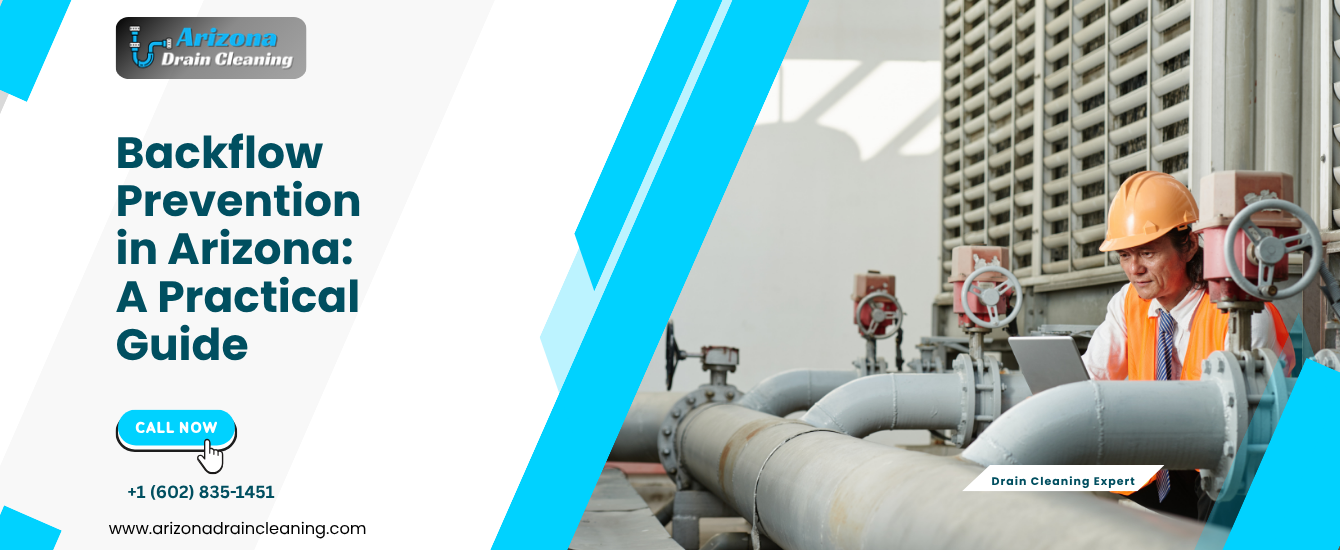
Backflow prevention in Arizona is not just a plumbing recommendation. It is a legal requirement for most properties connected to a municipal water supply, and it plays a critical role in protecting both private plumbing systems and the public water supply.
At its core, backflow prevention is about controlling direction. Water is meant to flow in one direction only—from the clean municipal supply into your property and then out through drains or designated discharge points. When that flow reverses, contaminated water can be pulled back into clean lines, creating a potential public health risk.
This issue becomes especially important in Arizona due to heavy irrigation use, widespread swimming pools, and extreme seasonal temperature changes that can stress plumbing systems and backflow devices.
Backflow can contaminate your home’s water supply without warning.
Arizona certified backflow prevention experts — get your system inspected today.
What backflow actually is
Backflow occurs when water flows in the opposite direction of its intended path.
| Normal Flow | Backflow Situation |
|---|---|
| Clean water enters property | Contaminated water enters supply line |
| One-direction pressure flow | Pressure reversal occurs |
| Safe distribution to fixtures | Risk of contamination in drinking water |
When backflow happens, contaminants can enter the municipal supply or internal plumbing system depending on where the failure occurs.
At Arizona Drain Cleaning, we work with Valley homeowners and commercial property managers every season who are either out of compliance without knowing it or operating with a device that has not been tested in years. This guide covers exactly what backflow is, why it happens, what the law requires of Arizona property owners, the different types of devices and which applications they suit, what annual testing involves, what it costs, and how to stay in compliance without headaches.
What Backflow Is and Why It Matters in Arizona
Backflow is the unintended reversal of water flow in a plumbing system. Your municipal water connection operates under pressure that is designed to push water consistently from the supply line into your property. Backflow happens when that pressure relationship is disrupted in one of two ways.
The Two Types of Backflow
Back-siphonage occurs when pressure in the supply line drops suddenly, creating a vacuum effect that pulls water backward from your property into the main supply. This can happen during a water main break, when fire department crews draw heavily on a hydrant near your property, or during periods of high municipal system demand when supply pressure temporarily falls below normal operating levels. The vacuum created by the pressure drop acts exactly like a drinking straw: it pulls the nearest available liquid back toward the low-pressure zone.
Back-pressure occurs when downstream pressure on your property exceeds the incoming supply pressure, pushing water backward against the normal flow direction. This can happen in systems with boilers, heat exchangers, elevated storage tanks, or pumping equipment that creates pressure exceeding the supply line pressure. It can also occur in irrigation systems where pumps create pressure that temporarily exceeds the municipal supply.
Types of backflow prevention devices
| Device Type | Where It Is Used | Purpose |
| Air Gap | Residential and commercial fixtures | Physical separation of water sources |
| Double Check Valve Assembly (DCVA) | Low to moderate hazard systems | Prevents reverse flow |
| Reduced Pressure Zone Device (RPZ) | High-risk commercial systems | Provides highest level of protection |
| Pressure Vacuum Breaker (PVB) | Irrigation systems | Prevents siphoning from outdoor systems |
Each device is selected based on the level of contamination risk and the type of system it protects.
Arizona backflow testing requirements
Most municipalities in Arizona require annual testing of backflow prevention devices.
| Requirement | Description |
| Annual inspection | Certified testing by approved technician |
| Documentation submission | Report filed with water authority |
| Device maintenance | Repairs or replacement if failure is detected |
| Compliance tracking | Records kept by property owner or HOA |
Failure to comply can result in fines, service interruption, or mandatory corrections.
Why Arizona Properties Face Elevated Backflow Risk
Arizona’s combination of year-round outdoor water use, widespread pool ownership, heavy reliance on drip and sprinkler irrigation systems, commercial properties with landscape fertilizer injection, and the intense heat that degrades plumbing components and device seals more quickly than in cooler climates creates a backflow risk profile that is meaningfully higher than average. The Valley’s hard water also contributes to accelerated wear on backflow preventer check valves and springs, since calcium and magnesium mineral deposits build up on valve seats and moving components over time, gradually reducing the device’s effectiveness well before its expected service life ends.
A single backflow event where non-potable water from an irrigation system or pool enters the municipal supply can affect not just your property but every property connected to the same supply main. This is why Arizona’s regulatory framework treats backflow prevention as a public health matter rather than simply a private property concern.
Arizona’s Legal Requirements for Backflow Prevention
Arizona’s backflow prevention requirements are grounded in state law and enforced at both the state and municipal level, with each water purveyor maintaining specific program requirements that may be stricter than the state baseline.
Arizona Administrative Code R18-4-215
The foundational legal authority for backflow prevention in Arizona is Arizona Administrative Code Title 18, Chapter 4, Article 215, entitled Backflow Prevention. This regulation, enforced by the Arizona Department of Environmental Quality, requires that property owners isolate their water system from the public supply by eliminating unnecessary cross-connections where possible, protect any cross-connections that cannot be eliminated with an approved backflow prevention device or assembly, and conduct timely annual testing of all backflow prevention assemblies on their property. These requirements apply to both new and existing water services and have been effective in some form since August 1991.
The Uniform Plumbing Code and International Plumbing Code
Arizona jurisdictions also apply the Uniform Plumbing Code and International Plumbing Code to backflow prevention installation requirements. Under IPC Section 608.16.5, potable water supplies to lawn irrigation systems must be protected against backflow by an atmospheric-type vacuum breaker, a pressure-type vacuum breaker, or a reduced pressure principle backflow preventer. Where chemicals including fertilizers are introduced into an irrigation system, only a reduced pressure principle backflow preventer meets code requirements. These are not optional guidelines. They are codified installation requirements enforced during permit inspections and, in many jurisdictions, during routine cross-connection control program audits.
Municipal Program Requirements in Phoenix
The City of Phoenix Water Services Department enforces a backflow prevention program based on state requirements but with specific local additions. All backflow prevention assemblies in Phoenix must be tested annually by a certified tester. Commercial properties, multi-family residential buildings, and any facility with a cross-connection involving irrigation systems, fire sprinkler systems, or pools falls under this requirement. Test results must be submitted to the city within ten business days of the test completion date, and facilities must maintain their records for a minimum of three years. Failure to comply with Phoenix’s program can result in penalties and in serious cases, water service interruption.
Tucson and Other Valley Municipalities
Tucson and other Arizona municipalities operate their own cross-connection control programs aligned with the state requirement and the requirements of their water purveyors. Arizona Water Company, EPCOR Arizona, and other water providers serving communities throughout the state each maintain their own backflow prevention programs, notification processes, and certified tester lists. The specific submission deadlines and documentation requirements vary by provider, but the underlying obligation to install approved devices and test them annually is universal across the state.
Is your Arizona home protected against backflow contamination?
One faulty valve can put your family’s health at risk — call now for a fast check.
Types of Backflow Prevention Devices and Which Arizona Properties Need Them
Selecting the right backflow preventer requires matching the device type to the hazard level of the potential contamination source and the specific application. Arizona code and local water purveyor requirements dictate which device types are approved for specific situations.
Reduced Pressure Zone Assemblies
The Reduced Pressure Zone assembly, commonly called an RPZ or RPZD, provides the highest level of protection available in a testable assembly and is required for high-hazard applications where contamination of the potable water supply could create a significant health risk. An RPZ contains two independently acting spring-loaded check valves with a hydraulically operated pressure differential relief valve between them. If either check valve fails or if back-pressure causes the pressure differential between the supply and the zone between the two check valves to decrease below a set threshold, the relief valve opens and discharges water to atmosphere rather than allowing it to flow backward into the supply.
In Arizona, RPZ assemblies are required for commercial irrigation systems where fertilizers, pesticides, or other chemicals are injected into the water supply, for commercial laundries and dry cleaning operations, for medical and dental facilities, for chemical processing and manufacturing, for car washes, and for any application where the potential contaminant represents a health hazard rather than merely an aesthetic or nuisance concern. RPZ devices must be installed above ground with adequate clearance for testing and access, and they require a nearby drain to safely manage the water discharged through the relief valve when the device activates.
Double Check Valve Assemblies
The Double Check Valve Assembly, abbreviated as DCVA or DCA, contains two independently operating spring-loaded check valves in series and four test cocks for verification. It provides moderate protection against both back-siphonage and back-pressure and is appropriate for low to moderate hazard applications where the potential contaminant is an aesthetic nuisance rather than a health hazard.
Common applications in Arizona include residential and commercial fire sprinkler systems, commercial irrigation systems without chemical injection, boiler make-up water connections where the boiler uses only low-toxicity additives, and commercial refrigeration equipment connections. Double check valve assemblies can be installed below grade in a pit or vault, which makes them useful in situations where an above-grade installation would be impractical or would conflict with landscaping or hardscape.
Pressure Vacuum Breakers
The Pressure Vacuum Breaker, or PVB, is the most common backflow prevention device found on residential irrigation systems throughout Arizona. It consists of an inlet shutoff valve, a single check valve, a pressure-actuated air inlet valve, two test cocks, and an outlet shutoff valve. When supply pressure drops, the spring-loaded air inlet opens and vents the downstream side of the valve to atmosphere, preventing back-siphonage. A PVB must be installed at least twelve inches above all downstream outlets and piping to function correctly.
PVBs are the standard device for residential lawn and landscape irrigation in Phoenix, Scottsdale, Mesa, Chandler, Gilbert, and across the Valley because they provide adequate protection for the hazard level presented by residential irrigation, they are relatively inexpensive, and they are straightforward to test and maintain. The limitation of a PVB is that it does not protect against back-pressure, only back-siphonage. It cannot be used downstream of any valve, it must not be subject to continuous pressure, and it is not appropriate for applications where chemical injection occurs or where the potential contamination is a health hazard rather than a nuisance.
Atmospheric Vacuum Breakers
The Atmospheric Vacuum Breaker, or AVB, is the simplest and most basic backflow prevention device. It consists of a body, air inlet valve, and check valve. AVBs are typically installed on individual irrigation zone valves rather than on the main supply line serving an entire system. They cannot be subjected to continuous pressure for more than twelve hours at a time and must be installed at least six inches above all downstream outlets. They protect only against back-siphonage and provide no protection against back-pressure.
In Arizona residential applications, AVBs are sometimes found on hose bib connections and individual drip irrigation zone connections. They are not a substitute for a system-level backflow preventer on an irrigation system and should not be relied on as the sole backflow protection for any application with a meaningful contamination risk.
Air Gaps
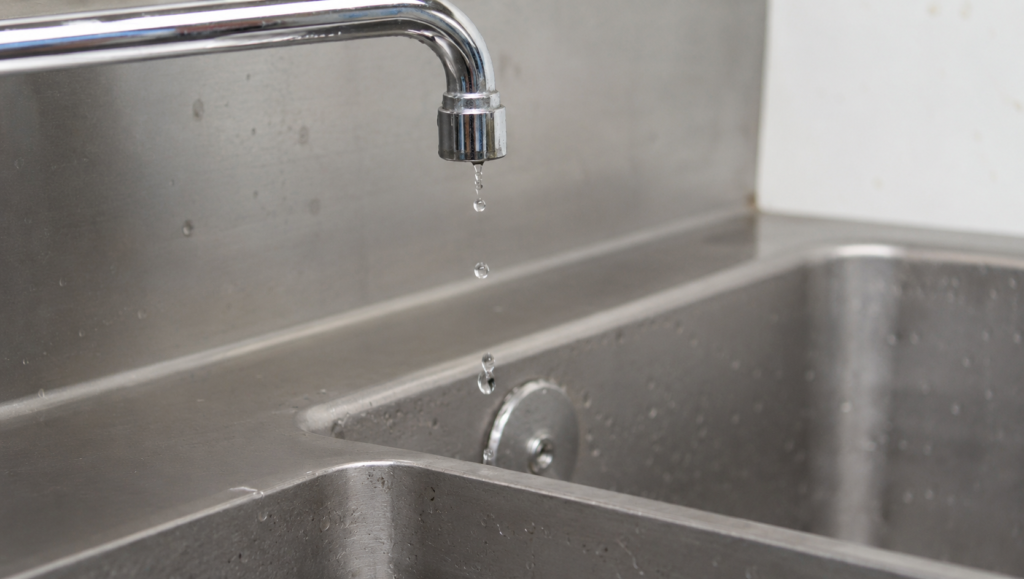
An air gap is not a mechanical device but rather a physical separation between the supply pipe outlet and the flood level rim of a receiving fixture. It is the most absolute and fail-safe form of backflow prevention because there is no mechanical component that can fail. Arizona code accepts air gaps as an approved backflow prevention method for specific applications including food service equipment, laboratory sinks, and other fixtures where the physical separation can be maintained reliably. The required air gap distance is typically twice the diameter of the supply pipe but never less than one inch.
Who Is Required to Have a Backflow Prevention Device in Arizona
Understanding which property types and system configurations require a backflow preventer is essential for both homeowners and commercial property owners throughout the state.
Residential Properties
Most Arizona homeowners who have an in-ground irrigation or sprinkler system connected to the municipal water supply are required to have an approved backflow preventer on that system. This applies to both traditional spray and rotor systems and drip irrigation systems. If you have a swimming pool with an automatic fill valve connected to the potable water supply, a backflow preventer is required on that connection as well. Homes with hose bib connections that are used for anything other than clean water dispensing, including filling garden sprayers, connecting fertilizer injectors, or supplying water to livestock, require a backflow preventer on those connections.
The required device type for most residential irrigation applications is a Pressure Vacuum Breaker installed at least twelve inches above the highest irrigation head the system serves. Many older Valley homes installed their backflow preventers decades ago and have never had them tested, or have devices that have been damaged by Arizona’s summer heat and hard water deposits to the point where they no longer function reliably. If you are unsure whether your irrigation backflow preventer is properly installed, functioning, and compliant with current requirements, a professional backflow prevention services assessment is the appropriate first step.
Commercial Properties
Commercial properties in Arizona face a more complex and comprehensive backflow prevention obligation than residential. The cross-connection control programs operated by Phoenix, Tucson, Mesa, Scottsdale, Chandler, and other municipalities require commercial properties to survey their water systems, identify all cross-connections, install approved devices at each cross-connection, and test those devices annually by a certified tester. This applies to office buildings, retail centers, medical and dental offices, restaurants, hotels, industrial facilities, warehouses, schools, and any other commercial or institutional occupancy.
High-hazard commercial applications including restaurants with chemical dishwashers, automotive facilities with steam cleaning equipment, medical offices with sterilization equipment, and any facility where toxic or health-hazard materials have any connection to the water system require RPZ assemblies at the service connection and at each individual cross-connection. The failure to maintain compliant backflow prevention at a commercial property can result in municipal enforcement action, fines, and in cases where contamination actually reaches the supply, significant liability.
Irrigation Systems with Chemical Injection
This is the application where the device type requirement is most critically important and most commonly misunderstood. Any irrigation system that uses a fertilizer injector, pesticide injection, wetting agent injection, or any other chemical addition to the water supply requires a Reduced Pressure Zone assembly as the backflow preventer, not a Pressure Vacuum Breaker. This applies to both residential and commercial irrigation. A PVB is not approved for applications with chemical injection under Arizona code because it does not protect against back-pressure, and fertilizer injector pumps create back-pressure that a PVB cannot prevent from reaching the potable supply.
Fire Sprinkler Systems
Fire sprinkler systems in Arizona commercial buildings require backflow prevention at the water supply connection because the water stored in a fire suppression system is non-potable. The standing water in sprinkler pipes collects sediment, rust, and biological material over time. Without backflow prevention, this water can be drawn back into the potable supply under back-siphonage conditions. Double Check Valve Assemblies are the most common device type for fire suppression backflow prevention in commercial applications, with the specific device type and installation configuration determined by the local fire authority having jurisdiction.
Signs your backflow device may need attention
| Warning Sign | Possible Issue |
| Reduced water pressure | Internal valve restriction |
| Visible leaks | Seal or diaphragm failure |
| Dirty or discolored water | Potential contamination risk |
| Failed annual inspection | Device malfunction |
| Unknown testing history | Possible non-compliance |
Annual Backflow Testing in Arizona: What It Involves and What It Costs
Arizona Administrative Code and municipal program requirements mandate annual testing of all backflow prevention assemblies. Understanding what that testing involves and what it should cost helps property owners comply efficiently and avoid being overcharged or underserved.
Who Is Certified to Test Backflow Preventers in Arizona
Arizona requires that backflow prevention assemblies be tested by certified testers approved under Arizona Administrative Code A.A.C. R18-4-215, as administered by the Arizona Department of Environmental Quality. Certifying authorities recognized in Arizona include the Arizona State Environmental Technical Training Center (ASETT), the California-Nevada Section of the American Water Works Association (CANV Section, AWWA), and other ADEQ-approved third-party certifying organizations including the American Backflow Prevention Association and the American Society of Sanitary Engineering. All Arizona backflow tester training and examination must follow the USC 10th Edition Testing Procedures. Local jurisdictions and water purveyors may impose additional registration requirements beyond the state certification, so confirming tester qualifications with your specific water provider before scheduling an annual test is advisable.
What the Annual Test Actually Involves
A certified backflow tester arrives at your property with a calibrated differential pressure gauge and the appropriate test kit for your device type. For a Pressure Vacuum Breaker, the tester checks the operation of the air inlet valve, tests the check valve for tightness under supply pressure, and verifies that the device opens correctly when supply pressure drops. For an RPZ assembly, the tester checks the operation of both check valves independently, verifies the relief valve opening differential, and confirms that the relief valve closes properly when system pressure is restored. For a Double Check Valve Assembly, both check valves are tested independently for tightness.
The physical test takes fifteen to thirty minutes for a standard residential device and longer for commercial installations with multiple assemblies. After the test, the tester completes a test report form documenting the device details, test results, and whether the device passed or failed. If the device fails, it must be repaired or replaced before a passing test report can be submitted to the water purveyor.
What to Do If the Device Fails
A device that fails its annual test cannot be left in service in its failed condition. The tester will document the failure and the specific component that did not perform within acceptable parameters. Most backflow preventer failures involve worn check valve seats, deteriorated O-rings or rubber components, or mineral scale interfering with valve operation. Many failures can be addressed through an on-site repair that replaces the worn internal components without replacing the entire assembly. After repair, the device must be retested to confirm it now meets the required performance standard before a passing report can be submitted.
In Arizona’s hard water environment, internal component degradation happens faster than the manufacturer’s standard service life projections because mineral deposits accelerate wear on check valve seats and springs. Preventive maintenance that replaces internal rubber components on a schedule aligned with the local water hardness conditions can reduce the frequency of test failures and the associated repair costs.
What Annual Backflow Testing Should Cost in Arizona
A standard annual test of a single residential PVB or Double Check Valve Assembly by a certified tester in the Phoenix metro area typically runs from $50 to $150 depending on the provider and whether the report filing with the water purveyor is included in the service fee. RPZ assembly testing is typically $75 to $200 per assembly due to the additional complexity of the test procedure. Commercial properties with multiple assemblies are typically priced per assembly with volume discounts for larger service calls. Repair costs when components need replacement depend on the device brand and size, with most minor repair jobs running from $50 to $200 in parts and labor. Full assembly replacement ranges from $200 to $800 or more depending on device type, size, and installation conditions.
Installation Requirements and Location Considerations in Arizona
Where and how a backflow preventer is installed determines whether it functions correctly, whether it can be tested and maintained efficiently, and whether it will survive Arizona’s specific environmental conditions over its expected service life.
Height Requirements for Pressure Vacuum Breakers
A PVB must be installed with its air inlet assembly at least twelve inches above the highest downstream outlet or irrigation head the system serves. This elevation requirement is not optional and is critical to the device’s function. A PVB installed below the elevation of a downstream outlet cannot vent properly and will fail to prevent back-siphonage. In Arizona homes where irrigation systems serve raised planters, raised garden beds, or multi-level landscaping, verifying that the PVB installation height is adequate for the entire system is an important compliance check.
Heat Exposure and Device Longevity in Arizona
Arizona’s summer temperatures create a device durability challenge that property owners throughout the Valley need to account for. A backflow preventer installed in direct sun in Phoenix can reach surface temperatures well above ambient air temperature on summer afternoons. The rubber internal components including O-rings, check valve seats, and diaphragms degrade significantly faster at elevated temperatures. PVB devices are particularly susceptible because their air inlet mechanism relies on rubber components to seal and open properly.
Providing shade protection for outdoor backflow preventers, installing insulation covers during extreme heat periods, and scheduling annual testing after the harshest summer temperatures have passed, typically in October or November, gives devices the best opportunity for passing their annual tests with intact internal components.
Access and Clearance for Testing and Maintenance
An RPZ assembly requires adequate clearance on all sides for the tester to attach differential pressure gauges to the test cocks and observe the relief valve operation. Minimum clearances of twelve inches on the sides and adequate vertical clearance above the assembly are typical code requirements. RPZ assemblies installed in enclosed spaces, inside walls, or beneath landscaping without adequate access create compliance problems because they cannot be tested properly without disassembly or modification. If you have an RPZ assembly on your property that is not easily accessible, a pipe inspection with video camera and professional assessment of the installation can identify what modifications are needed to bring it into a testable and maintainable condition.
Freeze Protection for Northern Arizona Properties
While Valley homeowners rarely need to worry about pipe freezing, Arizona property owners in Flagstaff, Prescott, Sedona, Payson, and other higher-elevation communities face winter freeze conditions that require additional consideration for backflow preventer installation. Backflow preventers must be installed with freeze protection, either inside a heated space, inside a properly insulated enclosure, or with the ability to be drained and winterized before freezing temperatures arrive. RPZ assemblies are particularly vulnerable to freeze damage because the relief valve mechanism can be cracked or displaced by ice formation inside the housing.
Cross-Connection Control Programs and What They Mean for Property Owners
Arizona water purveyors are required by state law to operate Cross-Connection Control programs that identify, track, and ensure the proper protection of cross-connections throughout their service areas. Understanding how these programs work helps property owners anticipate what they will be asked to do and when.
How Cross-Connection Surveys Work
A cross-connection survey is a systematic evaluation of your property’s plumbing system to identify every point where potable water connects with or has the potential to connect with a non-potable source. For a residential property, this typically covers the irrigation system connection, pool fill connections, hose bib connections, and any auxiliary systems like solar water heating or evaporative coolers with water supply connections. Commercial surveys are more comprehensive and may cover dozens of individual cross-connections depending on the facility type and operations.
Water purveyors conduct these surveys either through their own program staff or through certified contractor inspections, and they use the results to issue requirements for backflow preventer installation where none exists and to verify that existing devices are appropriate for the hazard level at each cross-connection.
Record Keeping Requirements
Arizona’s state rule and individual municipal program requirements mandate that backflow prevention assembly test records be maintained for at least three years. For commercial properties with multiple assemblies, this means maintaining a log that tracks each device by location, type, size, manufacturer, serial number, installation date, and test history. Water purveyors may audit these records during routine compliance checks, and the inability to produce test records for the required period is treated as a compliance failure regardless of whether the assemblies were actually tested.
Backflow Prevention for Common Arizona Residential Applications
Translating the regulatory requirements into practical guidance for the most common residential backflow situations helps homeowners understand what they specifically need rather than navigating generic code language.
Residential Irrigation Systems
The standard requirement for a residential irrigation system connected to the municipal supply in Arizona is a Pressure Vacuum Breaker installed at the service connection before the first zone valve, at least twelve inches above the highest sprinkler head in the system. If your irrigation system uses a fertilizer injector of any kind, that PVB needs to be upgraded to an RPZ assembly. If your current PVB has never been tested, is visibly corroded, or was installed more than five years ago without a professional inspection, it needs to be assessed and likely tested or replaced.
Swimming Pools
A residential swimming pool with an automatic fill valve connected to the potable water supply requires a backflow preventer on the fill water connection. The appropriate device is typically an atmospheric vacuum breaker on the hose bib serving the fill connection, or a double check valve assembly depending on the local water purveyor’s specific requirements. Pools with chemical treatment systems including salt chlorination systems or automated chemical feed equipment may require higher-level protection depending on how those systems interface with the fill water supply.
Evaporative Coolers
Arizona’s widespread use of evaporative coolers, also called swamp coolers, creates a cross-connection at every cooler water supply connection. The water inside an evaporative cooler pad is non-potable. It is warm, it collects minerals from evaporation, it may carry biological material, and it is recirculated through the system throughout the cooling season. A backflow preventer on the water supply to each evaporative cooler is required, and an atmospheric vacuum breaker or a PVB on the supply line is the most common device used for this application.
Hose Bib Connections
Standard hose bibs throughout Arizona residential properties technically constitute cross-connections because a garden hose can be submerged in any non-potable source including a bucket of chemicals, a pond, or a pool. Arizona plumbing code requires hose bib vacuum breakers, which are small in-line check valve devices that thread directly onto the hose bib outlet, on all exterior hose bib connections. These simple devices are inexpensive and often overlooked but are a required component of a code-compliant residential plumbing system.
Frequently Asked Questions
Do I need a backflow preventer if I already have one on my irrigation system?
Having a device installed is not the same as being in compliance. Arizona requires that the device be an approved type for your specific application, that it be tested annually by a certified tester, and that the test report be submitted to your water purveyor within the required timeframe. An existing device that has never been tested, that is the wrong type for your application, or that failed its last test and was not repaired is a compliance problem even though something physical is present on the pipe.
How do I know what type of backflow preventer I have?
The device type is typically marked on the body of the assembly. A PVB will often have the letters PVB or the manufacturer’s model name indicating a vacuum breaker on the housing. An RPZ will be a larger assembly with a clearly visible relief valve port and drain. A double check valve assembly will be enclosed in a housing with test cocks but no relief valve port. If you cannot identify your device type, a licensed plumber or certified backflow tester can identify it during a scheduled service call.
What happens if I do not comply with Arizona’s backflow testing requirements?
Non-compliance consequences range from written notice from your water purveyor to financial penalties and, in cases of persistent non-compliance, water service interruption. Commercial properties face more immediate and more significant enforcement actions than residential because their cross-connections typically present higher contamination hazards and their program obligations are more formally tracked by municipal water departments. Residential homeowners who receive a compliance notice should treat it as requiring prompt action rather than an advisory.
Can I install my own backflow preventer in Arizona?
Installation of a backflow preventer must be performed by a licensed plumber under Arizona contractor licensing requirements. The installation may require a plumbing permit depending on the local jurisdiction and the scope of the work. Testing of the installed device must be performed by a certified backflow tester. Homeowners can replace simple hose bib vacuum breakers themselves since those are considered minor maintenance items, but any work on an in-line assembly serving an irrigation system, pool, or other cross-connection should be performed by a licensed professional.
How long does a backflow preventer last in Arizona?
Device lifespan in Arizona is significantly shorter than manufacturer projections developed for standard water conditions. Hard water mineral deposits accelerate internal component wear, and the extreme summer heat degrades rubber seals and O-rings faster than in cooler climates. A PVB that might last ten to fifteen years in moderate climate conditions may need internal component replacement every three to five years in Phoenix’s hard water environment. Annual testing catches the early signs of internal wear before they result in a device failure in service.
What is the difference between a backflow preventer and a check valve?
A simple check valve allows flow in one direction and closes to prevent reverse flow but cannot be tested or repaired in-line, has no redundancy if the valve fails, and is not approved as a backflow preventer for cross-connection control purposes under Arizona code. Approved backflow prevention assemblies are testable through dedicated test cocks, have internal redundancy through multiple check valves, and are designed to maintain their performance characteristics over time in a way that can be verified through standardized test procedures. A check valve is a plumbing component. An approved backflow prevention assembly is a code-compliant safety device.
Does backflow prevention affect water pressure in my irrigation system?
Yes, but the effect is typically small and manageable. A PVB creates a minor pressure drop of a few PSI through the device. An RPZ creates a slightly larger pressure drop due to the additional check valves and the pressure differential maintained by the relief valve mechanism. For most residential irrigation systems, this pressure drop is fully compensated during system design by accounting for the device’s rated pressure loss in the hydraulic calculations. If you notice a significant reduction in irrigation system performance after backflow preventer installation, a pressure test and system assessment by a licensed irrigation professional can identify whether the issue is the device, the pressure supply, or the system design.
The Bottom Line on Backflow Prevention in Arizona
Backflow prevention in Arizona is not optional and it is not a technicality that enforcement bodies overlook. It is a public health protection built into state and local code because the consequences of a backflow event, where fertilizers, pool chemicals, or non-potable water enters the public supply, are immediate and potentially serious for everyone sharing the same supply main. The annual testing requirement exists because these devices operate continuously under Arizona’s demanding conditions of hard water, intense heat, and year-round irrigation use, and they need to be verified as functional rather than simply assumed to be working.
For most Arizona homeowners, the practical obligations are manageable: confirm you have an approved device on your irrigation system, have it tested annually by a certified tester, and submit the test report to your water purveyor within the required timeframe. For commercial property owners, the obligation is more complex and the compliance tracking is more formal, but the underlying principle is the same.
The backflow prevention services provided by Arizona Drain Cleaning cover assessment, testing coordination, and the associated plumbing maintenance that keeps the broader drain and supply system in a condition that makes backflow prevention work as intended. Homeowners and commercial property owners across Phoenix, Scottsdale, Mesa, Chandler, Gilbert, Tempe, Glendale, Peoria, Surprise, Goodyear, Tucson, Flagstaff, Prescott, and throughout the state can call Arizona Drain Cleaning at (602) 835-1451 right now to schedule a backflow assessment or to get clear answers about their current compliance status.
Updated September 2026. Backflow assembly testing remains an annual requirement across Arizona water providers for 2026. Keep your latest test report on file.
Related Arizona guides: