Drain cleaning for schools and universities in Arizona is a facility maintenance obligation that operates on a completely different scale, timeline, and risk profile than residential or standard commercial drain service. A backed-up drain in a school cafeteria during lunch service, a failed restroom drain in a residence hall during finals week, or a sewer line collapse beneath a university building during the academic year creates consequences that go well beyond the plumbing system itself. Instruction is disrupted. Health code compliance becomes an immediate concern. Hundreds or thousands of students, faculty, and staff are affected. The team at Arizona Drain Cleaning works with facility managers, operations directors, and maintenance supervisors at educational institutions across the Valley and throughout the state, and the consistent reality we see is that the institutions that build professional drain maintenance into their academic calendar avoid the emergencies entirely. This guide covers every dimension of drain cleaning for educational facilities in Arizona, including the unique drain challenges that schools and universities face, why Arizona’s specific conditions intensify those challenges, how to schedule service intelligently around the academic calendar, what professional methods apply to each facility type, and what compliance obligations educational institutions carry under Arizona’s environmental and health standards.
Why Educational Facilities Have Unique Drain Cleaning Challenges
A school or university campus is not a scaled-up version of a commercial office building. The plumbing systems in educational facilities face a combination of high occupancy density, diverse building functions, unpredictable use patterns, and in many cases, aging infrastructure that creates drain maintenance demands unlike those of any other commercial property category.
High Occupancy and Concentrated Use Patterns
A high school campus with 2,000 students and 200 staff members generates restroom drain loads during passing periods that are entirely unlike the steady-use pattern of a commercial office. Within the four to five minutes between classes, the restrooms on an educational campus experience the equivalent of a hundred individual uses in rapid succession. This concentrated load creates water hammer effects, pressure surges, and debris accumulation at drain traps and branch lines that progressive, steady use patterns would never generate.
University residence halls present an even more demanding scenario. Buildings housing 300 to 800 students on a shared floor plan create shower drain loads in the morning peak period, kitchen drain loads in dormitory common areas, and laundry facility floor drain loads that accumulate continuously throughout the academic year. Arizona State University’s Tempe campus, the University of Arizona in Tucson, Northern Arizona University in Flagstaff, and every community college and university campus throughout the Valley manage plumbing systems that serve student populations equivalent to mid-sized towns within the footprint of a single campus.
Diverse Building Functions Within a Single Campus
An educational campus is not a single building type. It is a collection of fundamentally different facility types, each generating its own drain challenge, connected by the same underground infrastructure. A K-12 campus in the Paradise Valley Unified School District, the Scottsdale Unified School District, the Mesa Unified School District, or any of the Valley’s other large school districts may have a cafeteria kitchen generating daily grease loads, gymnasium floor drains receiving mop water and athletic equipment wash-down, science classroom drains receiving chemical waste from laboratory activities, restroom facilities serving the entire student population simultaneously during breaks, and outdoor area drains managing monsoon runoff from large hardscaped play areas and parking facilities.
A university campus adds to this list with chemistry and biology laboratory drainage containing chemical and biological waste streams, culinary arts program kitchen drains, campus dining hall kitchen facilities, student health center drains with specific sanitation requirements, natatorium and aquatic facility floor drains with chlorine and chemical treatment residue, and in some cases, research facility drains connected to specialized waste treatment systems.
Each of these building types generates a different type of drain accumulation, requires a different maintenance approach, and fails in a different way when maintenance is deferred.
Aging Infrastructure in Arizona’s Educational Building Stock
Many of Arizona’s public school buildings were constructed during the state’s major population growth periods of the 1960s through the 1980s. School districts across Maricopa County, including the Mesa Unified School District, the Tempe Elementary School District, the Chandler Unified School District, and the Gilbert Public Schools system, have campus buildings of this era that were originally built with cast iron or clay sewer pipe that is now 40 to 60 years old. University buildings from the same era on the ASU Tempe campus, which dates construction on some facilities to the late 19th and early 20th century, and on other Arizona university campuses throughout the state, carry similar infrastructure age challenges.
Cast iron pipe at this age carries significant internal corrosion that roughens the pipe interior, accelerates the accumulation of grease and scale, and creates brittle pipe walls that are susceptible to fracture under the mechanical stress of heavy use and Arizona’s clay soil expansion and contraction cycles. Facilities managers at Arizona’s educational institutions who have not performed a systematic camera inspection of their campus drain infrastructure in recent years are making maintenance and capital planning decisions without knowing the actual condition of their most fundamental plumbing systems.
Arizona-Specific Conditions That Intensify School and University Drain Challenges
Hard Water Scale in a High-Volume Environment
Arizona’s municipal water supply delivers the hardest water in the United States to schools and universities throughout the Valley and in communities served by hard groundwater sources throughout the state. The calcium and magnesium mineral content that deposits scale inside every pipe connected to this supply does so at a rate that is three to five times higher than the national average. In a high school cafeteria kitchen running commercial dishwashers continuously through multiple meal services per day, in a university dining hall serving hundreds of meals per session, or in a residence hall with hundreds of showers running every morning, the mineral scale accumulation rate inside drain lines is measurably faster than the manufacturer-suggested maintenance intervals developed for softer-water markets.
Facility maintenance schedules based on generalized national recommendations for institutional plumbing maintenance are systematically under-serving Arizona educational facilities because those recommendations do not account for Arizona’s water hardness reality. A drain maintenance program calibrated for Arizona’s specific mineral deposition rate will require more frequent service than a standard institutional schedule, and the cost of that additional service frequency is reliably less than the emergency response cost and instructional disruption cost of the drain failures that result from underservicing.
Monsoon Season and Campus Outdoor Drainage
Arizona’s monsoon season creates a specific vulnerability for school and university campuses that facility managers must address proactively rather than reactively. The combination of large impervious hardscape areas, athletic field perimeter drainage, parking lot catch basins, and building area drains that serve educational campuses creates significant stormwater management obligations when a monsoon cell drops an inch of rain in thirty minutes.
Outdoor area drains, catch basin cleaning of parking lot collection points, and storm drainage connecting building exits to the broader campus drainage system all require professional inspection and cleaning before monsoon season to ensure they can handle peak storm flows without backing up onto walkways, into building entries, or across athletic surfaces. A school campus where outdoor drains are functioning at partial capacity during the first major monsoon storm of the season faces potential flood damage to facilities, slip and fall liability on flooded walkways, and in the worst case, building entry flooding that creates water damage to interior spaces and educational materials.
Laboratory and Science Classroom Drain Considerations
Arizona’s public K-12 schools and university campuses with laboratory facilities face a specific drain concern that goes beyond accumulation and blockage. Science classroom and laboratory drains in high school chemistry programs, university chemistry and biology departments, and research laboratory facilities receive a combination of diluted chemical compounds, reagent rinse water, biological waste, and in some cases, hazardous waste streams that must be handled in compliance with Arizona Department of Environmental Quality regulations and the specific waste management requirements of each institution.
Drain lines serving laboratory sinks accumulate chemical residue on pipe walls over years of use. Depending on the specific compounds involved, this residue may create drain odors, accelerate corrosion of metal drain components, or in some cases create incompatible chemical combinations if reactive compounds are rinsed down the same drain at different times. Professional drain cleaning of laboratory drain lines requires awareness of what these drains have received and appropriate precautions during cleaning to protect technicians and avoid creating hazardous conditions within the pipe during the cleaning process.
The Academic Calendar Advantage: Scheduling Drain Service Intelligently
This is the single most valuable operational insight that educational facility managers can apply to their drain maintenance programs: the academic calendar provides built-in windows for intensive drain service that no other property type has access to. Using those windows effectively transforms drain maintenance from a reactive emergency-driven process into a planned, budgeted, and systematically executed maintenance program.
Summer Break: The Primary Service Window
Arizona’s K-12 school districts typically conclude their academic year in late May or early June and begin the new school year in late July or early August, providing a summer break window of approximately eight to ten weeks. Arizona State University, the University of Arizona, Northern Arizona University, and other Arizona universities and community colleges have summer sessions that reduce campus occupancy significantly compared to fall and spring semesters, providing service access to facilities that would otherwise be occupied and in use.
The summer break window is the most important drain service opportunity of the year for educational facilities. With buildings unoccupied or at reduced occupancy, service can be performed in any area of the campus without disrupting instruction, without the coordination overhead of working around class schedules, and without the public health and operational concerns that accompany drain service in actively occupied facilities. The full range of professional drain services, including hydro jetting of main sewer lines and branch lines, pipe inspection with video camera of all campus drain infrastructure, grease trap cleaning in cafeteria and dining facilities, and outdoor area drain and catch basin clearing, can all be performed during this window.
Summer break also coincides with the period immediately preceding monsoon season, which means campus drain systems cleaned and inspected during late June or July are in their best condition at exactly the time they face their highest outdoor drainage demand.
Winter and Spring Break Windows
Arizona K-12 schools typically have a winter break of two to three weeks in December and January and a spring break of one week in March or April. University campuses have corresponding break periods between semesters. These shorter windows are appropriate for targeted service in specific high-priority facilities, camera inspection of lines that showed concerning results in earlier service visits, and drain cleaning in kitchen and cafeteria facilities that did not receive full service during the summer.
For facilities with year-round operation such as university residence halls with year-round residents, these break windows represent the only practical opportunity for service in residential areas that are otherwise always occupied.
Weekend and After-Hours Service for In-Session Facilities
For drain concerns that arise during the academic year and cannot wait for a break window, emergency drain cleaning services that can be scheduled outside of school hours, typically after 4:00 PM on school days, during weekends, or on teacher workdays when students are not present, minimize the disruption to the educational environment. A kitchen drain cleaning that is scheduled for a Saturday morning rather than a Thursday afternoon during lunch service involves no compromise to school operations and only minor coordination with the facility staff who need to provide access.
Developing a relationship with a professional drain service provider who understands the scheduling constraints of educational facilities and who can work flexibly around academic calendars is a significant operational advantage for facility managers at Arizona schools and universities.
Drain Cleaning by Facility Type on Educational Campuses
Cafeteria and Dining Hall Drains
The cafeteria kitchen is the highest-maintenance drain location on any K-12 school campus. Commercial kitchen floor drains in school cafeterias receive cooking grease, food waste, cleaning chemical residue, and wash-down water from every meal service. In Arizona’s heat, the grease that enters these drains behaves differently than in cooler climates: it stays liquid longer in the warm kitchen environment and travels further into the drain line before solidifying in the cooler underground pipe, creating distributed grease accumulation throughout a longer section of pipe rather than concentrating near the drain body.
For university dining halls serving hundreds or thousands of meals per day, the grease load is proportionally greater, and the drain maintenance interval should reflect that scale. A university dining facility that serves 1,500 meals per day generates dramatically more kitchen drain load than a K-12 cafeteria serving 400 meals at lunch, and the service frequency should be calibrated to actual production volume rather than applied uniformly across all dining facilities.
Kitchen drain cleaning performed by hydro jetting during the summer break at the conclusion of the school year removes the accumulated grease from the full school year before it can harden and densify over the summer heat. This timing also positions the kitchen drain system for full-capacity operation on the first day of the new school year, rather than entering the year with accumulated grease from the prior year already narrowing the drain pipe interior.
Restroom Facilities
School and university restrooms operate at intensity levels that commercial restroom facilities in other sectors rarely approach. During class change periods, a high school restroom serving three to four hundred students generates concentrated use loads in compressed time windows. The floor drains, sink drains, and fixture drains in these facilities accumulate soap scum, mineral scale, biological material, and hair at rates proportional to that concentrated use.
Bathroom drain cleaning in educational restrooms should be performed at minimum annually during the summer break. High-use restrooms in main campus buildings, gymnasium locker rooms, and athletic facility restrooms benefit from more frequent service. Gymnasium locker room floor drains in particular accumulate the combination of body oil, soap, and shampoo residue from athletic program showers that builds into the hair and soap scum composite that creates persistent slow drains and drain odors in active athletic facilities.
Drain odor removal services are particularly relevant for educational restroom facilities where persistent drain odors affect the environment of adjacent hallways and classrooms. Biofilm accumulation inside floor drains and trap sections produces sulfur compounds that can be detectable outside the restroom, creating a perception problem for students and staff that professional sludge removal and drain cleaning resolves at the source.
Science Laboratories and Chemistry Classrooms
Laboratory drain maintenance requires a more careful approach than standard drain cleaning because of the chemical history of these drain lines. Before scheduling hydro jetting or other mechanical cleaning of laboratory drain lines, a facility manager should consult with the science department regarding what compounds have been used in the laboratory over the preceding year and what safety precautions are appropriate for cleaning a drain line that has received those compounds.
For most K-12 chemistry classroom drains where the compound exposure has been limited to diluted acids, bases, and common lab reagents, professional drain cleaning with appropriate protective equipment and advance awareness of the drain history is straightforward. For university research laboratory drains with more complex chemical histories, a consultation between the facilities team and the environmental health and safety office before scheduling cleaning service is the appropriate protocol.
Gymnasium and Athletic Facility Drains
Athletic facility drainage encompasses floor drains in weight rooms and training areas, locker room shower and floor drains, natatorium and pool deck drains, sports court cleaning drains, and in some cases underground drainage serving outdoor athletic surfaces. Each of these drain types has distinct accumulation characteristics.
Pool and natatorium floor drains receive the combination of pool water carrying dissolved chlorine compounds, sunscreen and body oil residue from swimmers, and in some cases calcium hypochlorite or other chemical treatment compounds. This combination creates a specific type of buildup in connected drain lines that differs from the grease and mineral scale combination found in other campus drain lines. Floor drain cleaning for natatorium areas should account for this specific chemical environment and should be performed with equipment appropriate to the pipe material and the chemical residue present.
Residence Hall Drains
University residence halls in Arizona present the most complex drain maintenance challenge in the educational sector because they are never truly empty during the academic year, they serve student populations with highly variable habits regarding what goes down a drain, and they operate under occupancy densities that generate drain loads comparable to commercial hotel operations.
Shower drain cleaning in residence hall bathrooms, particularly in shared bathroom configurations serving multiple students per floor, requires attention during every break period because hair and soap scum accumulation during an academic semester is substantial. A residence hall floor with twenty students sharing communal bathrooms generates a shower drain load equivalent to a small hotel floor in terms of hair and product residue accumulation rate.
Kitchen and common area kitchen drains in residence halls with communal cooking areas also require regular attention. Students cooking in communal kitchens without the cooking practice of a trained kitchen staff generate grease disposal patterns that differ substantially from a commercial kitchen: cooking oil disposal in sinks, improper disposal of food waste, and general lack of awareness about drain care all contribute to accumulation that requires professional service to address effectively.
Outdoor Campus Drainage
Educational campuses in Arizona have extensive outdoor hardscape areas including parking lots serving student, faculty, and staff vehicles, athletic surface perimeter drainage, main pedestrian walkways and plazas, and building perimeter drainage. All of these surfaces shed runoff toward catch basins and area drains during monsoon rain events.
Storm drain cleaning of campus outdoor drainage before monsoon season is the outdoor equivalent of what hydro jetting is for building drain lines: it ensures the system can handle its peak demand when that demand arrives. A campus where parking lot catch basins are cleaned, outdoor area drains are cleared of accumulated dust and debris, and building perimeter drains are confirmed flowing before the first June monsoon storm is a campus that manages monsoon rainfall without operational disruption.
Professional Drain Cleaning Methods for Educational Facilities
Video Camera Inspection as the Starting Point
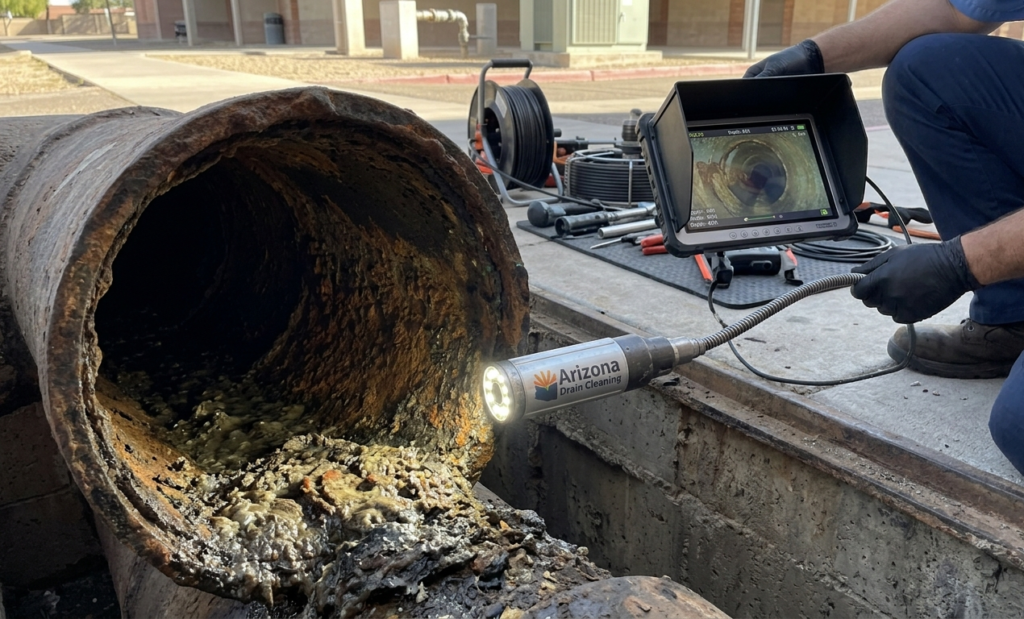
For any campus building with infrastructure older than twenty years, or any drain line that has experienced recurring problems, a pipe inspection with video camera before scheduling cleaning services is the professional standard. The camera inspection reveals the actual interior condition of the drain lines, identifies the specific nature and location of any accumulation or structural issues, and provides the documentation that facilities managers need for capital planning and for communicating infrastructure condition to administration and boards.
For school district facilities managers overseeing multiple campuses, systematic camera inspection of older campus buildings on a rotating schedule provides the building-by-building condition assessment needed to prioritize capital investment in drain infrastructure repair and replacement across a large portfolio. A camera inspection program that inspects the oldest and highest-risk campus buildings first, then systematically extends to the full portfolio, ensures that the most serious conditions are identified and addressed before they become emergency failures.
Hydro Jetting for Campus Kitchen and Main Line Applications
Hydro jetting is the standard professional cleaning method for campus kitchen floor drains, main sewer lines serving high-occupancy buildings, residence hall drain lines, and any educational facility drain line with accumulated grease, mineral scale, or biofilm that snaking alone cannot remove from the pipe wall surface. The high-pressure water strips accumulated material from the pipe wall entirely rather than simply punching a hole through the current obstruction, which is why hydro-jetted lines stay clean significantly longer than snaked lines under equivalent use conditions.
For university campuses with extensive underground sewer infrastructure connecting multiple buildings to the municipal connection, main line hydro jetting during the summer break window provides the most thorough available cleaning of the infrastructure that serves the entire campus drain system. A main line that has been hydro-jetted at the start of the academic year is in its best condition for handling the full fall semester occupancy load.
Drain Snaking for Targeted Branch Line Issues
Drain snaking remains the appropriate response for isolated, first-time blockages in individual fixture branch lines where the obstruction is localized and the pipe structure is sound. A single classroom sink that backs up during the school year, a specific restroom fixture that develops a clog between scheduled maintenance visits, or an individual drain in a science classroom are appropriate candidates for snaking as a prompt-response solution rather than waiting for a scheduled hydro jetting service.
The practical approach in an educational facility maintenance program is to use snaking for responsive individual fixture issues during the school year and hydro jetting for systematic line cleaning during break windows. This two-tier approach addresses immediate problems without disrupting academic operations while ensuring that thorough, lasting cleaning of the full drain system occurs on the appropriate scheduled cycle.
Trenchless Repair for Infrastructure Failures
When camera inspection reveals structural failures in campus drain infrastructure, specifically cracked or collapsed pipe sections, separated joints, advanced corrosion in cast iron lines, or pipe bellies causing persistent accumulation points, trenchless drain repair is often the most practical repair option for educational campus settings. Cured-in-place pipe lining can rehabilitate a failing sewer line beneath a campus building, parking lot, or pedestrian walkway without excavation, avoiding the surface disruption and restoration costs that traditional open-cut replacement requires.
For school districts and university facilities managers who need to present capital improvement projects for board approval, a documented camera inspection report showing the structural condition of the affected pipe combined with a written trenchless repair estimate provides the specific, evidence-based project scope that administrative approval processes require. The comparison between the trenchless lining cost and the traditional excavation-and-replacement cost, which typically includes substantial hardscape restoration expense for campus settings, makes the trenchless option particularly compelling in educational infrastructure project proposals.
Compliance and Health Standards for Educational Facility Drainage in Arizona
Arizona Department of Health Services Requirements
The Arizona Department of Health Services regulates food safety and sanitation in school cafeterias and university dining facilities under the Arizona Food Code. Functional and sanitary drainage is a basic compliance requirement for food service operations, and a backed-up drain in a school kitchen constitutes a critical violation during an inspection. Arizona school and university food service operations that document their grease trap cleaning and kitchen drain maintenance schedules have a demonstrable compliance record to present if drain condition is ever questioned during an inspection.
Maricopa County Environmental Services
For school districts and universities in Maricopa County, the Maricopa County Environmental Services Department enforces food safety regulations including drainage requirements for cafeteria and dining operations. Commercial food service facilities are subject to scheduled inspections and the drain and sanitation conditions observed during those inspections are documented. Facility managers who maintain documented professional drain maintenance records are prepared for these inspections in a way that reactive-only maintenance programs are not.
Arizona Department of Environmental Quality
Laboratory and research facility drain systems that receive chemical compounds or biological waste streams are subject to ADEQ oversight through the hazardous waste program and the water quality program. Educational institutions with research activities that generate regulated chemical waste streams are required to manage those waste streams in compliance with applicable permits and regulations. Drain cleaning activities in laboratory settings should be coordinated with the institution’s environmental health and safety office to confirm compliance with any applicable waste handling requirements.
Building a Drain Maintenance Program for Arizona Educational Institutions
The Summer Pre-Season Program
The summer break drain service program for an Arizona educational institution should include a systematic approach to every building type on the campus. Kitchen and cafeteria drains in all food service facilities should receive hydro jetting and, where appropriate, grease trap service coordinated together. Restroom facilities throughout the campus should receive floor drain cleaning, with particular attention to high-use restrooms in main academic buildings and athletic facilities. Main sewer lines serving the highest-occupancy buildings should receive camera inspection, with hydro jetting performed on any line showing significant accumulation. Outdoor area drains and parking lot catch basins should be cleared of accumulated dust and debris before monsoon season begins. Residence hall shower drains and communal kitchen drains should receive professional cleaning before the fall semester occupancy begins.
The Break Period Program
Winter break and spring break service should focus on the highest-demand facilities that accumulate drain loads most rapidly. Kitchen and dining drains are the priority. Residence hall bathroom drains that showed slow drainage during the preceding semester are next. Any drain that received a service response during the academic year and was treated with a temporary snaking fix should receive a more thorough hydro jetting service during the break period.
Documentation and Compliance Records
Every professional drain service performed on a school or university campus should be documented with a service date, the specific locations serviced, the method used, the observations made during service, and any follow-up recommendations. This documentation serves both facility maintenance planning and compliance record purposes. For school districts subject to state facility inspection programs and for university campuses subject to ADEQ oversight, documented maintenance records demonstrate a proactive maintenance posture that supports compliance positions and provides evidence-based capital planning support for infrastructure improvement requests.
Frequently Asked Questions
How often should school cafeteria drains be professionally cleaned in Arizona?
School cafeteria kitchen floor drains should receive professional hydro jetting at minimum twice per year, once at the end of the school year as part of the summer break service program and once at the midpoint of the school year, typically during the winter break. High-volume cafeterias in large high schools or university dining halls with multiple daily meal services may benefit from quarterly service. The grease trap cleaning schedule should be coordinated with the kitchen drain cleaning schedule because a grease trap that is not cleaned frequently enough creates overflow conditions that dramatically accelerate kitchen drain accumulation.
What is the best time of year to schedule comprehensive drain cleaning on an Arizona school campus?
The summer break window between late May and late July is the optimal time for comprehensive campus drain maintenance. Buildings are unoccupied or at reduced occupancy, service can be performed in any facility without disrupting instruction, and the timing positions the campus drain system in its best condition before both the new academic year and the peak of monsoon season. For K-12 campuses in districts that begin the new school year in late July, scheduling comprehensive drain service in June is ideal.
Can drain cleaning be performed during the school day without disrupting classes?
Minor drain issues in individual fixtures can be addressed with targeted snaking during school hours with minimal disruption when proper access coordination is in place. However, hydro jetting of main sewer lines, kitchen drain cleaning that requires shutting down food service operations, or any service that involves accessing drain cleanouts in occupied areas is best scheduled outside school hours. Most comprehensive drain maintenance work on educational campuses is appropriately scheduled during break windows, on weekends, or after school hours to avoid any impact on instruction.
How does Arizona’s hard water affect drain maintenance at schools and universities?
Arizona’s high water hardness causes mineral scale to deposit inside drain lines at a rate significantly higher than most of the country. In high-use educational facilities, this means drain pipes narrow faster than national institutional maintenance guidelines anticipate. Facility managers at Arizona schools and universities should calibrate their drain maintenance intervals to Arizona’s specific water hardness conditions rather than following generic institutional plumbing maintenance schedules. A drain maintenance frequency that is adequate in a soft-water state may be insufficient in Arizona, leading to blockages that a more frequent service schedule would have prevented.
What should facility managers do when a drain backs up during the school day?
For a drain backup during school hours, the immediate response is to isolate the affected area if it is a restroom or kitchen, stop using the drain, and assess whether the backup involves sewage surfacing at the drain or nearby fixtures. If sewage is surfacing, the affected area should be closed immediately for sanitation reasons and an emergency drain service call should be placed. For a standard slow drain or minor clog that is not surfacing sewage, the facility can typically remain in operation while a service call is scheduled for that day or the next morning. Maintaining a relationship with a professional drain service provider who can respond promptly to educational facility emergency calls minimizes the disruption when these situations occur.
Is trenchless sewer repair appropriate for school and university campus buildings?
Trenchless repair is often the preferred method for school and university campus drain infrastructure repair because it avoids the surface excavation and restoration costs that traditional replacement requires in campus settings. A failed sewer line running beneath a school parking lot, a university building floor slab, or a campus pedestrian walkway can typically be relined using cured-in-place pipe technology without excavating the surface above it. This is particularly valuable for educational facilities where disruption of parking, walkways, or building access during the academic year creates significant operational and administrative complications.
The Bottom Line on Drain Cleaning for Arizona Schools and Universities
Educational facilities in Arizona carry drain maintenance obligations that are more complex, higher stakes, and more time-constrained than almost any other commercial property category. The combination of high occupancy density, diverse building functions, aging infrastructure in many campuses built during Arizona’s major growth decades, and Arizona’s specific hard water and monsoon season conditions creates a drain maintenance challenge that rewards proactive planning and punishes deferred maintenance with emergency situations that disrupt instruction and create compliance exposure.
The facility managers and operations directors who handle educational facility drain maintenance well share a common approach: they use the academic calendar intelligently, scheduling comprehensive service during summer and break windows rather than responding reactively to failures during the academic year. They document their service history for compliance purposes. They invest in camera inspection of aging infrastructure rather than guessing at the pipe condition beneath their campuses. And they work with professional drain service providers who understand the scheduling constraints and operational priorities of educational environments.
Arizona Drain Cleaning serves K-12 school districts, charter schools, community colleges, universities, and every other educational institution category throughout the Valley and across the state. From routine preventive drain maintenance programs built around academic calendars to emergency drain cleaning services for situations that cannot wait, we understand what educational facility drain service requires and we schedule around the constraints that matter to your operations. We serve campuses across Phoenix, Scottsdale, Mesa, Tempe, Chandler, Gilbert, Glendale, Peoria, Surprise, Goodyear, Tucson, Flagstaff, Prescott, and throughout Arizona. Contact us to schedule a campus drain assessment or to discuss building a professional drain maintenance program calibrated to your academic calendar and your facility’s specific needs.