Drain cleaning during a home sale or purchase in Arizona is one of those hidden due-diligence steps that rarely gets discussed in standard real estate conversations, but it often determines who ends up paying for thousands of dollars in underground problems after closing. A typical home inspection will check visible plumbing performance: sinks drain, toilets flush, and there are no obvious leaks. What it will not show you is the condition of the sewer line beneath the slab or running from the house to the municipal connection. That’s where the real financial risk sits.
In Arizona, especially across Phoenix, Mesa, Chandler, Tempe, and Scottsdale this risk is amplified because many homes have aging clay, cast iron, or even Orangeburg sewer lines combined with aggressive root intrusion, hard water scale buildup, and shifting caliche soil. These conditions can create “invisible failures” that only show up after a property changes hands.
A sewer camera inspection during a transaction is essentially a way of turning uncertainty into documented evidence. Instead of discovering a backup after moving in, buyers get a clear view of what condition the sewer system is actually in before they commit.
Here’s how the typical inspection gap compares in real estate transactions:
| Inspection Type | What It Covers | What It Misses | Risk Level |
|---|---|---|---|
| Standard Home Inspection | Fixtures, visible leaks, water flow | Underground sewer line condition | High (for hidden issues) |
| Sewer Camera Inspection | Full interior view of drain/sewer lines | Only cost of deeper excavation (if needed later) | Low |
| Pre-Listing Drain Check | Identifies issues before listing | None if properly done | Reduces negotiation risk |
| No Sewer Inspection | Only surface plumbing checks | Entire underground system | Very High |
For buyers, the biggest risk is inheriting a partially compromised sewer line that still functions during inspection but fails under normal long-term use. For sellers, the risk is discovering an issue after listing that suddenly becomes a negotiation point or delays closing.
Arizona Drain Cleaning works with buyers, sellers, and real estate agents throughout the Phoenix metro area and across the Valley, and the pattern we see consistently is this: the homeowners who invest in a drain camera inspection before a transaction are protected. The ones who skip it are the ones calling us six months after closing when the main line collapses. This guide covers exactly what buyers need to inspect, what sellers need to do before listing, how Arizona’s specific pipe conditions change the risk equation, how drain findings affect negotiations, and what the legal disclosure requirements look like under Arizona law.
Why Standard Home Inspections Miss the Most Expensive Drain Problems
A licensed Arizona home inspector is trained and certified to evaluate visible and accessible components of the property. During a standard inspection, the inspector runs every faucet and fixture, checks that water drains from sinks and tubs, looks for visible signs of water damage, and notes any accessible plumbing concerns such as exposed pipe corrosion, inadequate water pressure, or obvious drain body damage. This is valuable information and it belongs in every transaction.
What a standard inspection cannot evaluate is the condition of the pipe walls, the structural integrity of underground connections, the presence of pipe bellies where sections have sagged and trap waste permanently, the extent of root intrusion at underground joints, or whether the main sewer line is approaching structural failure due to age, material deterioration, or the soil movement that is endemic to Arizona’s caliche and clay soil environment. All of these conditions can exist in a property that passed every visible component of a standard inspection without producing a single observable symptom at the time of the inspection visit.
What Goes Undetected Without a Camera
A pipe that has a belly where waste pools creates a recurring slow drain that may not be apparent during a brief inspection period when the toilet was only flushed twice and the shower was only run for a few seconds. A cast iron sewer line that has been corroding from the inside for twenty years may appear functional on the day of inspection and fail catastrophically within the first rainy season after the buyer moves in. A root mass that is 40 percent of the way through a sewer line creates no visible symptom at all until the obstruction is complete enough to cause a backup.
A pipe inspection with video camera run by a licensed drain contractor fills this gap completely. The camera travels the full length of the drain lines and sewer line, transmitting live footage that shows the interior condition of every foot of pipe from inside the structure to the municipal connection. It reveals exactly what a standard inspection cannot see, and in an Arizona property with any pipe history more than fifteen years old, it almost always reveals something worth knowing before closing.
What Buyers Need to Know About Drain Inspection Before Purchasing an Arizona Home
The Arizona Inspection Period Is Your Window
Arizona real estate contracts provide for an inspection period, typically ten days from acceptance, during which the buyer has the right to conduct any and all inspections and to terminate the contract or request repairs if the findings are unsatisfactory. This window is when a drain camera inspection must be completed. Once the inspection period closes, the buyer loses their contractual leverage to request repairs or credits for conditions that existed at the time of purchase. A drain camera inspection scheduled and completed during the inspection period is the buyer’s strongest tool for understanding the actual condition of the plumbing system before they are legally committed to the purchase.
Properties Over 30 Years Old Are the Highest Priority for Pre-Purchase Drain Inspection
The Phoenix metro area experienced its most explosive residential development during the 1960s through the 1980s. Properties built during this period were predominantly installed with cast iron or clay sewer pipe that is now anywhere from 40 to 60 years old. Cast iron pipe at this age has typically experienced significant internal corrosion, and the rough, pitted interior surface that results from corrosion creates a condition where grease, mineral scale, and debris accumulate far faster than they would in newer pipe. Clay pipe at this age has been through decades of caliche soil expansion and contraction cycles that stress joints progressively until they crack, separate, or admit tree root intrusion.
A newly renovated home in an older neighborhood deserves particular scrutiny. Sellers who renovate a home cosmetically, updating kitchens, bathrooms, flooring, and paint, frequently do not replace the original plumbing system that runs beneath the new finishes. A beautifully updated kitchen draining into a 55-year-old cast iron pipe that is 60 percent corroded through is a real scenario in Valley real estate, and it is one that a camera inspection reveals in minutes.
What a Pre-Purchase Camera Inspection Reveals
When a licensed drain contractor runs a camera through the sewer line of a property under contract, the footage typically reveals one of several conditions: the pipe is clean and structurally sound with no issues requiring immediate attention; the pipe has significant buildup from years of accumulated grease and scale that needs professional cleaning but no structural repair; the pipe has early-stage root intrusion at one or more joints that should be addressed but is not yet causing failure; or the pipe has structural defects including cracks, collapsed sections, separated joints, or significant pipe bellies that will require repair or replacement.
Each of these outcomes has a different implication for the transaction, and the buyer who has that information during the inspection period is in a completely different position than the buyer who discovers it after closing at their own expense.
How Buyers Should Use Drain Inspection Findings in Negotiations
When a pre-purchase drain inspection reveals a condition that requires professional attention, the buyer has several negotiating options within the inspection period framework of the Arizona Residential Purchase Contract. The buyer can request that the seller remedy the specific drain conditions identified before closing, either by having the lines professionally cleaned or by having structural repairs completed by a licensed contractor. The buyer can request a price reduction in an amount that reflects the estimated cost of the required service. The buyer can request a seller credit at closing, allowing the buyer to use those funds to complete the work after taking ownership. Or the buyer can terminate the contract if the findings are severe enough to fundamentally change the value proposition of the purchase.
The key is having a written report from the drain inspection that documents the specific findings with sufficient detail to support the negotiating position. A camera inspection performed by a licensed contractor produces this documentation as a matter of standard practice. The report, combined with a written estimate for the required work, gives the buyer’s real estate agent the specific, verifiable information needed to present a credible repair request to the seller.
What Sellers Need to Do Before Listing an Arizona Home
The Pre-Listing Drain Inspection Advantage
Sellers who order a camera inspection of their drain and sewer system before listing their home gain a significant strategic advantage in the Arizona real estate market. The inspection puts the seller in control of the information rather than leaving it to be discovered during a buyer’s inspection period in a way that creates urgency, leverage loss, and potential deal disruption.
If the pre-listing inspection reveals clean, sound pipes, that documentation becomes a marketing asset. A seller who can provide a recent camera inspection report showing a clean sewer line and functional drain system is differentiating their property in a meaningful way, particularly in neighborhoods where older pipe is common and buyers are increasingly aware of the risk.
If the pre-listing inspection reveals conditions that need attention, the seller has the opportunity to address them on their own timeline, with a contractor of their choosing, at standard rather than emergency pricing, before the property ever goes on the market. A sewer line that has been professionally cleaned and documented as clean is worth more to a buyer than one with an unknown history, and it removes a common deal disruption point entirely.
What Sellers Are Required to Disclose Under Arizona Law
Arizona is a disclosure state. The Arizona Residential Seller Disclosure Statement, required under Arizona Revised Statutes Section 33-423, requires sellers to disclose any material defects or adverse conditions known to the seller that may affect the value or desirability of the property. Plumbing system defects, including known sewer line problems, recurring drain backups, and any drain or sewer conditions the seller is aware of, must be disclosed. Failure to disclose known material defects creates legal liability for the seller after closing if the buyer discovers those conditions and can demonstrate that the seller had prior knowledge.
A seller who has experienced recurring drain problems, who had a main line backup at any point during their ownership, or who has received any professional assessment indicating drain or sewer system defects has an obligation to disclose those facts. A pre-listing drain inspection that documents a clean and functional system provides protection against future disclosure claims by creating a record of the system’s condition at the time of listing.
Drain Cleaning Before Listing Versus After Discovery
The financial math of pre-listing drain cleaning is straightforward. A professional hydro jetting and camera inspection service before listing typically costs between $300 and $700 for a standard residential property. A buyer’s inspection that reveals significant grease accumulation, scale buildup, or early-stage root intrusion typically results in a repair request or price reduction that is multiples of the preventive service cost, because buyers and their agents typically request more than the bare minimum when writing repair requests following inspection findings.
A seller who cleans their drains professionally before listing, documents the result with a camera inspection report, and presents that documentation as part of the listing package pays once for a service that protects the listing price, reduces buyer leverage during the inspection period, and accelerates the time from listing to accepted offer.
Arizona-Specific Conditions That Make Drain Inspection Critical in Real Estate Transactions
Caliche Soil and Underground Pipe Stress
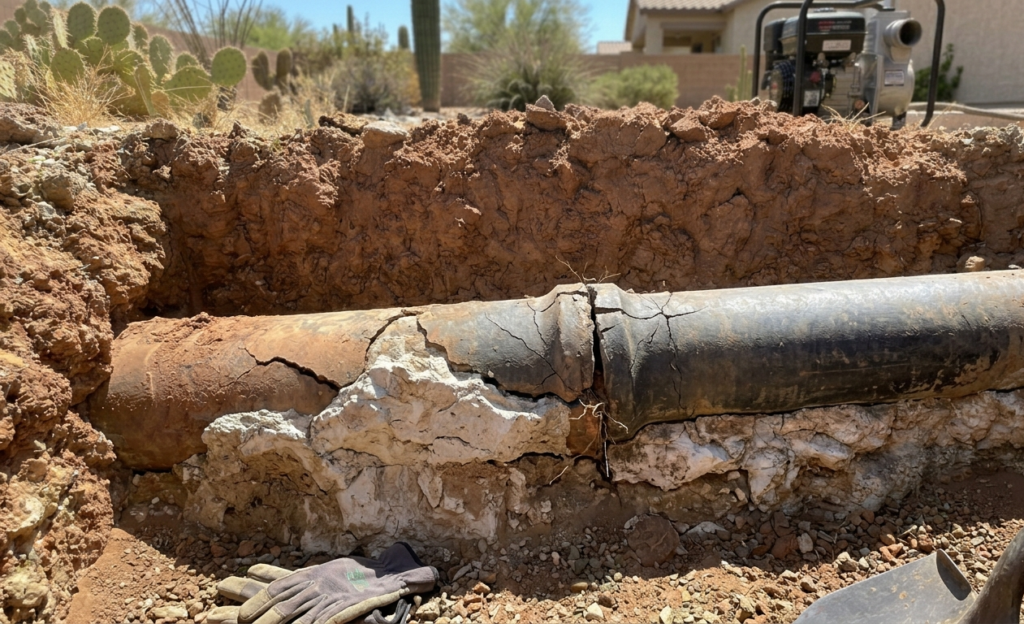
Arizona’s caliche and clay soil creates pipe stress conditions that are genuinely different from what buyers and sellers in most other states encounter. Caliche is a hardened calcium carbonate layer that occurs at varying depths throughout the Valley’s soil profile. Underground pipes that run through caliche experience different soil behavior above and below the caliche layer, creating differential settlement that stresses pipe joints and can cause separation over time. Clay soil above the caliche expands during the monsoon season and contracts during dry periods, a cycle that exerts continuous mechanical stress on every underground pipe joint through each annual cycle.
A property that has been in the same ownership for twenty years has experienced twenty full wet and dry soil cycles, each of which has applied cumulative stress to the underground pipe joints. In a property with 40-year-old clay pipe, that is forty cycles of stress on original joints that were never designed to absorb that level of repeated movement. Camera inspection before a transaction reveals whether those joints have held or whether they have cracked, separated, or admitted root intrusion.
Hard Water Mineral Scale Accumulated Over Ownership History
Arizona’s extremely hard municipal water supply, with calcium and magnesium content significantly higher than most major American cities, continuously deposits mineral scale on every pipe interior connected to the system. In a property that has been in the same ownership for fifteen years with no professional drain cleaning performed during that time, the interior diameter of kitchen drain lines, the main line, and any other heavily used pipe has been progressively narrowing for fifteen years of continuous mineral deposition.
A buyer taking possession of this property inherits that accumulated scale, which will cause drain slowdowns and eventually full blockages at a rate they are not expecting if they assume the plumbing system is clean because it looked fine at the inspection. Professional hydro jetting before closing, either performed by the seller as part of a repair agreement or by the buyer shortly after taking possession, removes that accumulated scale and gives the new owner a genuine baseline for their plumbing maintenance going forward.
Tree Root Intrusion in Established Neighborhoods
Many of the Valley’s most desirable established neighborhoods, including central Phoenix, arcadia, Scottsdale’s older areas, and numerous historic districts throughout Mesa, Tempe, and Chandler, have mature tree canopy that significantly increases the risk of tree root intrusion into underground sewer lines. Root systems in search of moisture are drawn toward the water inside sewer pipes and exploit any crack, separated joint, or open cleanout access point to grow inside the line.
In a property surrounded by mature oleanders, citrus trees, mulberry trees, or any other large-root-system species common to Arizona landscaping, root intrusion in the sewer line is not a remote possibility. It is a predictable condition that any camera inspection in these neighborhoods has a meaningful chance of finding. The severity ranges from early-stage root wisps at joints that are easily cleared to a mature root mass that has occupied a significant portion of the pipe’s interior diameter for years.
Orangeburg and Clay Pipe in Pre-1980 Construction
Properties built in the Phoenix metro area and across the Valley before approximately 1975 may have Orangeburg pipe as their sewer line material. Orangeburg is compressed wood pulp and pitch that absorbs moisture over time, softens, deforms from a circular to an oval cross section, and eventually collapses. There is no repair approach for Orangeburg. A property with Orangeburg pipe needs replacement, and the cost of that replacement is a material transaction consideration that no buyer should absorb without knowing about it in advance.
Clay pipe from the same era is not Orangeburg-level problematic, but 50-year-old clay pipe at joints that have absorbed decades of soil movement is a legitimate inspection concern. Camera inspection of any pre-1980 property in Arizona is not optional due diligence. It is the minimum responsible approach for anyone making a significant financial commitment.
How Drain Findings Affect the Arizona Real Estate Transaction
What Constitutes a Material Finding Worth Negotiating
Not every camera inspection finding is equally significant from a transaction standpoint. Minor grease accumulation in a kitchen drain that has not been professionally cleaned in several years is a maintenance item. A main sewer line with a complete collapse in the center of the pipe is a material structural defect. Understanding the difference helps buyers and sellers respond proportionally to inspection findings rather than either overreacting to minor maintenance needs or underestimating genuine structural failures.
Findings that typically warrant repair requests or price adjustments include main sewer line root intrusion that is significantly restricting flow or that has penetrated at multiple joint locations along the line, pipe bellies where sections have sagged enough to consistently trap waste and solids, collapsed pipe sections that prevent normal flow, separated joints in the main line that are allowing sewage to escape into the surrounding soil, evidence of Orangeburg pipe material in any portion of the line, and severe mineral scale accumulation in the main line combined with evidence of corrosion in cast iron pipe that indicates imminent structural failure.
Findings that are typically addressed through cleaning rather than repair negotiation include grease accumulation in kitchen branch lines, soap scum and hair buildup in bathroom branch lines, light mineral scale in the main line that responds to hydro jetting, and early-stage root tendrils at a single joint that can be cleared and treated with root inhibitor.
Writing an Effective Repair Request Based on Drain Findings
A repair request based on drain inspection findings is most effective when it references specific documentation, specifies the required scope of work rather than just describing the symptom, and reflects a realistic assessment of what the condition actually requires rather than the most expensive possible remediation. A repair request that says “buyer requests seller clean and inspect sewer line due to significant root intrusion and scale accumulation observed in camera inspection dated June 14, 2025” supported by the actual inspection report is a credible and defensible request. A vague repair request without supporting documentation is easily disputed.
For structural findings that require repair rather than cleaning, a written estimate from a licensed contractor specifying the scope, method, and cost of the required work provides the strongest support for a price reduction or seller credit request. A trenchless drain repair estimate for a cured-in-place pipe lining of a main sewer line with multiple joint issues, accompanied by the camera inspection report showing those joints, gives the buyer’s agent concrete numbers to present and a legitimate basis for a price adjustment that reflects the documented condition.
The Seller’s Response Options When Drain Issues Are Found
A seller who receives a repair request based on drain inspection findings has the same four basic response options that apply to any inspection item: agree to remedy the specific condition identified, offer a partial credit or price adjustment rather than performing the repair directly, counter with a different scope or different credit amount, or reject the request entirely and accept the risk that the buyer may terminate. The seller’s decision should be informed by the actual severity of the condition, the estimated cost of the required work, and the current market environment for the specific property.
A seller who rejects a legitimate repair request for a material sewer line condition and loses the buyer faces the same disclosure obligation on the next offer. A material defect that was documented in a buyer’s inspection report during a transaction that fell through must be disclosed to subsequent buyers. The seller who was unwilling to address a $3,500 sewer line cleaning and minor repair at the first buyer’s request now must disclose the known condition to every subsequent buyer, which is a less comfortable negotiating position than simply addressing the issue.
Drain Cleaning and Septic System Considerations in Arizona Transactions
Arizona’s Mandatory Septic Inspection Requirement
For properties served by a private septic system rather than a municipal sewer connection, Arizona law requires a septic system inspection prior to the transfer of ownership. Under Arizona Administrative Code R18-9-A316, a septic inspection is mandatory within six months prior to any property transfer involving a septic system, and this requirement cannot be waived by either buyer or seller through contractual agreement. The seller is responsible for arranging and paying for this inspection, and the results must be provided to the buyer before the sale finalizes.
This mandatory inspection covers the septic tank itself, including the tank condition, the distribution system, and the drainfield. What it does not cover is the condition of the pipe running from the house to the septic tank.
Why the Line to the Septic Tank Also Needs Inspection
The mandatory septic inspection in Arizona does not include a camera inspection of the drain line running from the structure to the septic tank. This line is private property, it is underground, and its condition has no bearing on the septic tank inspection outcome. A property can receive a passing septic inspection while the drain line connecting the house to the tank has significant root intrusion, a partial collapse, or a pipe belly that traps solids and will cause ongoing maintenance problems for the new owner.
For buyers purchasing any Arizona property with a septic system, a camera inspection of the building drain line from the structure to the septic tank inlet is an important supplement to the mandatory septic inspection that provides a complete picture of the entire waste disposal pathway rather than just the tank component. Septic tank cleaning combined with a camera scope of the connecting drain line gives the buyer comprehensive knowledge of the entire system before closing.
How Real Estate Agents Should Approach Drain Inspection in Arizona Transactions
Experienced Arizona real estate agents who have seen sewer line failures and main drain backups occur shortly after closing have consistently incorporated sewer line camera inspection into their standard buyer due diligence recommendation list. The agents who recommend sewer scoping to every buyer in a property over 20 years old are the ones whose clients do not call them six months after closing with a $12,000 sewer line repair surprise.
Recommending the Right Professional for the Job
A sewer camera inspection performed as part of buyer due diligence requires a licensed drain contractor with appropriate ROC credentials, professional camera equipment that produces clear footage across the full length of the sewer line, and a written report that documents the findings in enough detail to support a repair request if findings warrant one. A general home inspector who offers sewer scoping as an add-on service may not have the same level of equipment capability or the same depth of drain and pipe system knowledge as a specialized drain contractor. For any finding that needs to be used as the basis for a repair request or price negotiation, the documentation from a licensed professional drain contractor carries the most credibility.
Coordinating Drain Inspection Within the Inspection Period Timeline
The ten-day inspection period in a standard Arizona purchase contract moves quickly. Real estate agents who pre-qualify their preferred drain inspection contractor and can schedule within 24 to 48 hours of contract acceptance give their buyers the most useful inspection period. A camera inspection scheduled on day eight of a ten-day inspection period leaves very little time to evaluate findings, get repair estimates, and present a repair request with sufficient time for the seller to respond before the period closes.
The Cost of Drain Inspection in a Real Estate Context
What a Pre-Purchase Camera Inspection Costs Versus What It Protects
A pipe inspection with video camera of a residential sewer line performed as buyer due diligence in the Phoenix metro area typically runs from $150 to $300 depending on the property configuration and pipe length. This cost is borne by the buyer in most cases as part of their inspection due diligence budget, though in some transactions it can be negotiated as a seller-paid concession.
The protection this investment provides is measured in the potential findings it produces. A camera inspection that identifies a main sewer line that needs a cured-in-place lining due to multiple cracked joints has protected the buyer from a $4,000 to $8,000 post-closing surprise. A camera inspection that identifies Orangeburg pipe requiring full replacement has protected the buyer from a $6,000 to $15,000 post-closing discovery. Even a finding of significant grease and scale accumulation requiring professional cleaning is worth the inspection cost because it shifts the cost and negotiating responsibility to the appropriate party before closing rather than to the new owner after.
Drain Cleaning Cost as a Negotiating Item
When a camera inspection identifies conditions that require cleaning rather than structural repair, the cost of professional drain cleaning is a reasonable item to include in a repair request or to have remedied before closing. Professional hydro jetting of a residential main sewer line typically runs from $300 to $600. This is a legitimate transaction cost item when the cleaning is necessitated by conditions that existed during the seller’s ownership and that the seller had an opportunity to address through normal property maintenance.
A seller who agrees to have the sewer line professionally cleaned and camera-inspected post-cleaning as a condition of the repair request resolution has provided the buyer with a documented clean baseline at the time of possession. This is a clean resolution that addresses the finding appropriately and gives both parties confidence in the condition of the plumbing system at the time of transfer.
Frequently Asked Questions
Is a sewer camera inspection required to buy or sell a home in Arizona?
A sewer camera inspection is not legally required as part of a standard Arizona real estate transaction for municipal sewer-connected properties. It is strongly recommended as part of buyer due diligence, particularly for any property over 20 years old, any property with mature landscaping, and any property where the seller has disclosed prior drain or sewer problems. For properties with septic systems, the mandatory septic inspection is legally required but does not cover the drain line from the house to the tank, which needs a separate camera inspection.
Who pays for a drain camera inspection during a home purchase in Arizona?
In most Arizona transactions, the buyer pays for any inspection services they order during the inspection period as part of their due diligence costs. This is negotiable and in some cases sellers offer pre-listing inspections including sewer scope to facilitate a smoother transaction. If a buyer’s camera inspection reveals conditions that the seller agrees to remedy, the cost of the remediation work is typically paid by the seller as part of the repair resolution.
What happens if a sewer camera inspection reveals a major problem during escrow?
The buyer has several options during the inspection period. They can request the seller remedy the specific condition before closing, request a price reduction reflecting the estimated repair cost, request a seller credit at closing to apply toward post-closing repairs, or terminate the purchase contract and receive return of their earnest money deposit if the findings constitute grounds for termination under the contract terms. The specific options available depend on the terms of the Arizona Residential Purchase Contract in effect for the transaction.
Can a seller refuse to fix drain problems found during a buyer’s inspection?
Yes. A seller can respond to a repair request by agreeing, countering with a different scope or different credit amount, or declining entirely. However, declining a repair request for a documented material condition creates an obligation to disclose that condition to subsequent buyers. A seller who receives and declines a repair request for a main sewer line issue, then re-lists the property, must disclose the known condition in the seller’s disclosure statement for the next transaction.
How long does a sewer camera inspection take during a home purchase?
A camera inspection of the main sewer line and primary branch lines of a standard single-family home typically takes between 45 minutes and two hours depending on the number of drain lines inspected, the access conditions, and the length of the main sewer line from the house to the municipal connection. The inspection produces a written report with footage documentation that is typically available within 24 hours of the inspection completion.
Is drain cleaning after a home purchase worth doing even if no issues were found during inspection?
Yes, for older Arizona properties. A camera inspection that shows no structural issues in a sound pipe with some buildup accumulation provides an accurate picture of the pipe condition at that moment. A professional hydro jetting service that removes years of accumulated grease, scale, and organic material from those sound pipes gives the new owner a genuinely clean baseline from which their ongoing maintenance schedule starts, rather than inheriting years of buildup that will create drain problems within the first year of ownership.
What should a buyer do if the seller refuses to allow a sewer camera inspection?
A seller who refuses to allow a buyer to conduct any inspection during the contractually provided inspection period is acting outside the standard terms of the Arizona Residential Purchase Contract, which grants the buyer the right to inspect. A seller who is reluctant to allow a sewer scope inspection of a property with obvious risk factors, such as mature tree landscaping, older construction, or a disclosed history of drain problems, is a red flag worth discussing with the buyer’s real estate agent. In most cases, a refusal to allow inspection is itself a signal that warrants serious consideration of whether to proceed.
The Bottom Line: Drain Cleaning in an Arizona Home Sale or Purchase
Drain inspection and cleaning during a home sale or purchase in Arizona is the due diligence step that costs the least and protects the most. The gap between what a standard home inspection reveals and what a camera inspection shows is where the most expensive post-closing surprises hide. Arizona’s combination of aging pipe materials, caliche soil movement, hard water mineral accumulation, and mature-tree landscaping in established neighborhoods creates a real estate environment where undetected sewer line problems are more common than buyers and sellers from other states expect.
For buyers, the camera inspection during the inspection period is the investment that gives you actual information about the plumbing system rather than an assumption that everything is fine because the faucets ran. For sellers, the pre-listing drain inspection and professional cleaning is the preparation that protects your listing price, reduces inspection period surprises, and satisfies disclosure obligations with documented evidence.
Arizona Drain Cleaning provides camera inspection, professional hydro jetting, drain snaking, sewer line cleaning, and trenchless drain repair for buyers, sellers, and real estate agents throughout Phoenix, Scottsdale, Mesa, Chandler, Gilbert, Tempe, Glendale, Peoria, Surprise, Goodyear, Queen Creek, Tucson, and across Arizona. We schedule promptly to fit inspection period timelines and provide written reports that document findings in the format buyers and agents need for effective negotiation. Call Arizona Drain Cleaning at (602) 835-1451 right now to schedule a pre-purchase or pre-listing drain inspection and get the information you need before the transaction closes.