

Hair and soap scum are doing far more damage to your shower drain than a slow-draining tub suggests. Most homeowners treat a sluggish shower drain as a minor nuisance, pour something down it, and move on. What they do not realize is that inside the pipe, a compounding process has been underway for months or years, one that is progressively narrowing the interior diameter of the line, creating a surface that catches everything that passes through it, generating persistent odors from bacterial activity, and in some cases, building toward a backup that surfaces not just in the shower but in other fixtures connected to the same drain line. Here is what is happening inside your shower drain over time:
| Stage | What is Building Inside the Pipe | What You Notice in the Shower |
|---|---|---|
| Early stage | Small hair strands and light soap residue | Slightly slower drainage |
| Developing buildup | Hair mat forms with soap scum coating | Water pooling during showers |
| Heavy blockage | Thick, sticky clog restricting pipe flow | Standing water and slow drainage after use |
| Advanced blockage | Fully restricted pipe with bacterial buildup | Frequent backups and unpleasant odors |
Once this buildup forms, it does not simply stay in one place. It continues to collect more debris, gradually reducing the pipe’s internal diameter and creating a rough surface that traps even more material.
The team at Arizona Drain Cleaning has cleared thousands of shower drains across the Valley, and the pattern is remarkably consistent: the homeowners who address shower drain buildup routinely spend very little. The homeowners who wait until the drain is completely blocked and backed up spend significantly more and deal with a considerably more unpleasant situation. This guide covers exactly what hair and soap scum are doing inside your pipes, why Arizona’s specific water conditions make it worse, what the professional cleaning options are, and what a practical maintenance approach looks like.
What Is Actually Happening Inside Your Shower Drain Right Now
The inside of a shower drain pipe is not visible, which is exactly why it is so easy to underestimate what is happening in there. What looks like a functional drain from the outside is often a pipe whose interior diameter has been reduced by a significant percentage from accumulated material that took months or years to build up to its current state.
How Hair Behaves Inside a Pipe
Human hair sheds at an average rate of between 50 and 100 strands per day, and a significant portion of that shedding happens during shampooing. When hair enters a shower drain, it does not flush straight through and disappear. It catches on the drain cover, collects in the trap, wraps around the drain snake threads on older drain fittings, and accumulates at every directional change and joint in the drain line.
Hair that collects in a drain does not behave like a solid blockage in the way a foreign object would. It behaves more like a net. Individual strands collect and interweave, creating a three-dimensional mesh that allows some water to pass through while progressively catching everything else that the water carries. Skin cells, body oils, shampoo and conditioner residue, and soap scum all become entangled in the hair mesh. Over time the mesh densifies, shrinks in diameter, and begins to restrict water flow. The longer it is left unaddressed, the more compressed and the harder to remove it becomes.
In a household with multiple people showering daily, this process happens faster than most people expect. A completely clear drain can develop a significant hair accumulation within three to six months of regular use, particularly when conditioner-heavy hair care products are used because conditioner is specifically formulated to coat and cling to hair strands, including the ones collecting in your drain.
What Soap Scum Is and How It Forms in Pipes
Soap scum is not simply soap residue. It is a specific chemical compound that forms when the fatty acids in soap react with the calcium and magnesium ions present in hard water. The reaction produces calcium stearate and magnesium stearate, two insoluble compounds that are waxy, sticky, and do not dissolve in water. They adhere to surfaces and accumulate in layers over time.
In Arizona, where the municipal water supply is among the hardest in the United States, soap scum formation happens at a significantly accelerated rate compared to soft-water markets. Every shower in a Phoenix, Scottsdale, Mesa, Chandler, or Gilbert home is generating soap scum at a rate determined by the interaction between the soaps and shampoos used and the mineral content of the water, which in the Valley is consistently high year-round.
Bar soap produces more soap scum than liquid soap because its fatty acid content is higher. However, liquid shampoos, conditioners, and body washes all contribute their own residue in the form of oils, thickening agents, silicones, and surfactants that coat pipe walls and contribute to the overall accumulation layer alongside mineral-based soap scum.
Inside the pipe, soap scum builds in a way that is particularly damaging to long-term drain function. It coats the interior surface of the pipe wall in a layer that hardens over time as water deposits additional minerals on top of the existing coating. This hardened layer is not smooth. It is irregular and rough, and that rough surface gives every subsequent piece of debris that passes through the pipe something to adhere to. Once soap scum establishes a coating on a pipe wall, the rate of accumulation of everything else accelerates because the adhesive surface is now significantly larger than the smooth pipe wall that was there originally.
The Compounding Effect: How Hair and Soap Scum Work Together
Hair and soap scum are individually manageable problems. Together they create something more serious than either would produce alone. This is the core of what is happening in most slow shower drains, and understanding it explains why the problem keeps coming back after incomplete interventions.
Hair forms the structural framework for the accumulation. It is three-dimensional, it anchors to drain components and pipe walls, and it creates a mesh through which water passes but in which everything else tends to collect. Soap scum coats every strand of that hair mesh, binding the individual strands together and progressively filling the spaces in the mesh that water was still passing through. Body oils, skin cells, and product residue add additional layers that harden as mineral deposits from Arizona’s hard water continue to accumulate on top of them.
The result is a compacted, bound mass that is not simply sitting in the drain. It is chemically bonded to the pipe wall through the soap scum coating and mineral scale that surrounds it. A DIY drain snake that hooks some hair from the mass and pulls it out provides temporary relief by removing the densest part of the obstruction. But the soap scum and mineral coating that bound the hair to the pipe wall remains, the pipe wall is still roughened and adherent, and new hair begins collecting immediately because the conditions that caused the original accumulation are unchanged.
The Role of Arizona’s Hard Water in Making Shower Drain Problems Worse
If you have lived in other parts of the country and moved to the Phoenix metro area or anywhere else in the Valley, you have almost certainly noticed the difference in how soap behaves in Arizona water. It does not lather as easily. Shampoo does not rinse clean as readily. Shower doors and tiles develop a white film faster than you expect. All of these experiences are direct consequences of Arizona’s extremely high water hardness, and the same chemistry that creates those visible surface effects is creating a much more significant and invisible problem inside your shower drain pipes.
Water Hardness Numbers in Arizona Context
The Phoenix metro area water supply consistently measures in the range of 200 to 300 parts per million of total dissolved solids, which places it firmly in the very hard to extremely hard category by standard water classification scales. For context, water with 60 parts per million or less is considered soft, and most water quality guidelines suggest that anything over 180 parts per million is very hard. Arizona homeowners are dealing with water hardness levels two to five times what residents in many other major American cities experience.
At these hardness levels, the soap scum formation reaction that produces the sticky calcium and magnesium stearate compounds inside your drain pipe happens continuously and aggressively with every shower. The mineral scale that deposits on top of accumulated soap scum and hair is not a thin film. It is a progressively thickening layer that changes the internal geometry of the pipe over time.
Mineral Scale on Top of Organic Accumulation
In Arizona shower drains, the accumulation inside the pipe is typically a composite material rather than a single-substance clog. The innermost layer is usually hair held together by soap scum. On top of and around that organic mass, mineral scale from hard water deposits accumulate in successive layers as the water that passes through the partial obstruction evaporates or dries on the surrounding material. This mineral-encrusted composite is significantly harder than a simple hair clog and significantly more resistant to removal by simple mechanical means.
A drain snake that is adequate for removing a soft hair accumulation in a soft-water market may be entirely ineffective against the same accumulation in an Arizona shower drain because the mineral scale has hardened the mass to a point where the snake cable passes around it rather than hooking into it. This is one of the primary reasons that Arizona homeowners often report that DIY drain cleaning attempts and even some professional snaking services produce only temporary improvement before the same slow drainage returns quickly. The hardened mineral-organic composite was not fully removed. It was disturbed but left in place.
What Happens When Shower Drain Buildup Is Left Untreated
Stage One: Gradual Slowdown
The first stage of shower drain accumulation is the one that most homeowners initially dismiss. Water drains noticeably more slowly than it used to, and there may be a slight tendency for water to pool around your feet toward the end of a shower before it eventually drains away. At this stage the obstruction is typically located in the trap or just below it, the accumulation is relatively loose and not yet fully hardened, and professional cleaning or even thorough DIY intervention is straightforward and inexpensive.
Stage Two: Standing Water and Odors
As the accumulation progresses and the hair and soap scum mass densifies and hardens, water begins pooling more significantly during a shower and taking noticeably longer to drain after the water is turned off. Persistent foul odors begin developing as bacteria colonize the organic material in the accumulation. The bacteria decompose the hair, skin cells, and protein-based residue in the mass, producing hydrogen sulfide and other sulfur compounds that create the characteristic drain smell that no amount of ventilation or bathroom cleaning seems to fully eliminate. At this stage, the accumulation typically extends beyond the trap and into the connecting pipe, making it more resistant to removal.
Stage Three: Complete Blockage or Secondary Fixture Involvement
In the worst case, untreated shower drain accumulation progresses to a complete blockage where no water drains at all, or to a situation where the restriction in the shower drain line creates backpressure that begins affecting other fixtures connected to the same branch line. A shower drain blockage that has reached this stage is no longer a simple maintenance issue. It typically involves a mass that has been compressing and hardening for months, a pipe wall that is roughened and coated throughout its length, and in many Arizona homes, a mineral-encrusted composite that requires professional hydro jetting at sufficient pressure to remove completely.
Why Chemical Drain Cleaners Are Not the Answer for Shower Drains
The chemical drain cleaner bottles that line the shelves of every grocery and hardware store in Arizona are marketed as the convenient fix for exactly the type of shower drain clog described in this guide. They are not a reliable or appropriate solution, and understanding why prevents a common and costly mistake.
What Chemical Cleaners Actually Do to Soap Scum and Hair
Chemical drain cleaners typically use sodium hydroxide, potassium hydroxide, or sulfuric acid as their active ingredient. These compounds generate significant heat through a chemical reaction when they contact the organic material in the accumulation. Sodium hydroxide-based cleaners convert fatty acids and oils into soap, which theoretically flushes away. Sulfuric acid-based products dissolve organic material through chemical degradation.
In practice, the performance of these products on a compacted, mineral-encrusted hair and soap scum accumulation in an Arizona shower drain is inconsistent at best. The chemical reaction generates heat, and the heat helps dissolve the softer organic components of the clog. But the mineral scale layer encasing the accumulation is not organic and is not dissolved by either caustic or acid-based formulations. The chemical cleaner creates a path through the center of the clog while leaving the mineral-hardened outer shell and the pipe wall coating intact. The drain flows better temporarily, then slows again as new material collects in the roughened interior that was never cleaned.
The Pipe Damage Issue
Beyond their limited effectiveness on mineral-encrusted accumulations, chemical drain cleaners create a pipe damage risk that compounds over time with repeated use. The heat generated by caustic cleaners can soften PVC pipe connections, particularly at joints where pipe cement creates a thinner and more temperature-sensitive bond. In older homes throughout the Valley with original pipe materials, repeated chemical cleaner use accelerates the deterioration of pipe wall integrity. Acid-based cleaners that are more effective against mineral scale also attack metal pipe components, including trap fittings and drain body materials.
A shower drain that is cleaned chemically month after month for years will eventually develop the combination of interior coating and weakened pipe joints that makes a more serious and expensive repair inevitable. The cost savings from the $8 bottle of drain cleaner over a professional service call accumulates in the wrong direction when the pipe condition worsens with each application.
Professional Shower Drain Cleaning Methods That Actually Work
Drain Snaking for Shower Drains
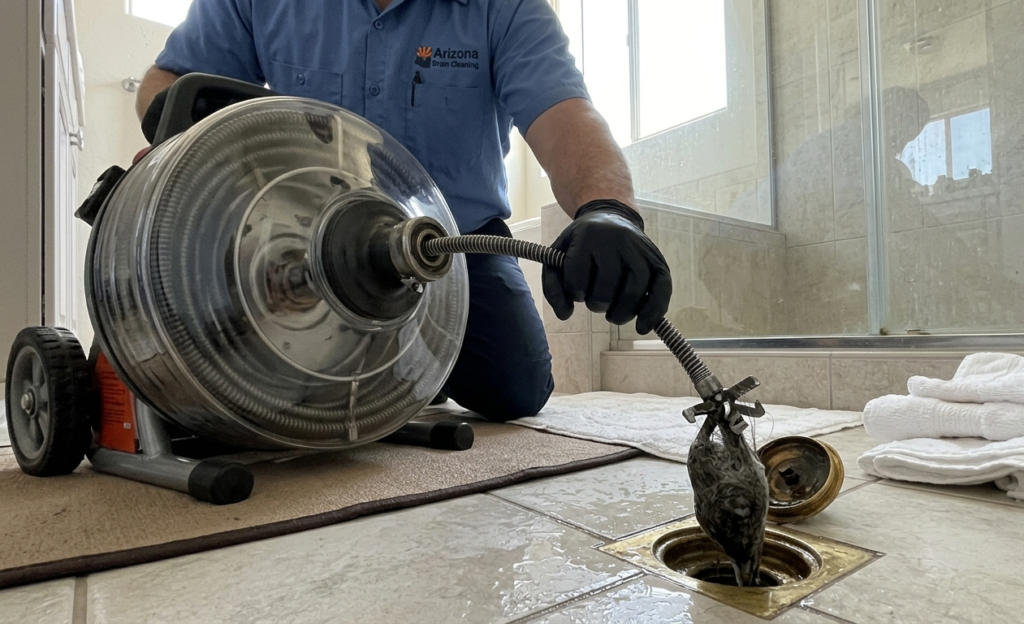
Drain snaking uses a rotating cable with a specialized cutting or hooking head to physically engage with the accumulation and either pull it back out of the drain or break it up into pieces that can be flushed through. For a shower drain accumulation that is primarily hair and relatively soft soap scum located within the first few feet of the drain line, professional snaking performed with the right cable size and head configuration removes the obstruction effectively.
The keyword is professional. A hardware store hand auger used without the right technique typically does one of two things: it hooks a portion of the hair mass and pulls it out, leaving the soap scum coating and the denser inner mass behind, or it compacts the accumulation further by pushing it deeper into the pipe without removing it. Professional drain snaking with properly sized equipment and correct technique removes significantly more of the accumulation and provides longer-lasting results than DIY attempts.
For Arizona shower drains where mineral scale has hardened, snaking is often an appropriate first step rather than a complete solution. It removes the organic mass and restores adequate flow, and it can be followed by hydro jetting to clean the pipe wall coating that the snake could not address.
Hydro Jetting for Shower Drain Cleaning
Hydro jetting is the professional shower drain cleaning method that produces the most thorough and lasting result for the type of accumulated material found in Arizona shower drains. High-pressure water at appropriate PSI for the pipe material and diameter is directed through a specialized nozzle that simultaneously blasts forward through any remaining obstruction and backward against the pipe wall at a 360-degree sweep, stripping the soap scum coating, mineral scale deposits, and organic residue from the interior surface.
The lasting benefit of hydro jetting for shower drain cleaning is the same as it is for any other drain type: it does not just restore flow through the center of the accumulation. It restores the condition of the pipe wall itself. A hydro-jetted shower drain pipe has a smooth, clean interior surface that resists the adhesion of new soap scum and does not provide the roughened texture that makes new hair accumulations dense and compressed so quickly. The interval before the next service is significantly longer after a hydro jetting service than after snaking alone.
For Arizona homeowners in the Phoenix metro area who have dealt with recurring slow shower drains that seem to need attention every few months, regardless of what they do, hydro jetting is typically the service that breaks that cycle.
Shower Drain Camera Inspection
For shower drains that have been slow for an extended period, that have received multiple service attempts without lasting improvement, or that are accompanied by odors or other fixture involvement that suggests a deeper problem, a pipe inspection with video camera before service selection is the professional approach. The camera reveals the actual condition of the pipe interior, the location and nature of the accumulation, and whether any structural issues exist in the pipe that would explain why cleaning alone has not produced lasting results. In older homes throughout the Valley, a shower drain that consistently resists clearing may have a pipe belly, a separated joint, or advanced corrosion that no cleaning method will permanently resolve.
Arizona-Specific Considerations for Shower Drain Maintenance
How Hard Water Changes Your Maintenance Timeline
In a soft-water market, a household shower drain might develop a significant enough accumulation to require professional attention once every two to three years under normal use conditions. In Arizona’s hard water environment, the same use pattern and the same pipe configuration will typically produce a service-requiring accumulation significantly faster, often within twelve to eighteen months, because the mineral scale component of the buildup is forming continuously and at a much higher rate.
Arizona homeowners who have moved from other states are often surprised by how quickly their shower drains slow down after functioning well for years in their previous home. The difference is not the behavior of their hair or their soaps. It is the mineral content of the water, which is accelerating the soap scum and scale formation process that builds the adhesive pipe wall coating on which everything else collects.
Building this reality into your maintenance planning, rather than treating each service call as an unexpected event, is the practical response. An annual shower drain cleaning service in a Valley home with hard water use is maintenance rather than repair, and it costs a fraction of what emergency service on a completely blocked drain requires.
Multi-Person Households and Shared Showers
In Arizona rental properties, multi-family homes, and any household with multiple people sharing a shower, the accumulation rate is directly proportional to the volume of use. A shower drain in a busy household shared by four people accumulates hair and soap scum at roughly four times the rate of a single-occupancy shower. The maintenance interval needs to reflect that reality.
For rental property owners managing Arizona properties, professional shower drain cleaning at every tenant turnover is not excessive maintenance. It is the baseline that protects the drain system from the compounding effect of different tenants’ hair and product chemistry on top of each other across multiple occupancy cycles. Arizona Drain Cleaning works with property managers across Phoenix, Scottsdale, Mesa, Chandler, Gilbert, Tempe, and throughout the Valley specifically on turnover drain service programs that keep rental properties in the condition that tenants expect and that leases require.
Prevention Strategies That Actually Reduce Shower Drain Buildup
Drain Strainers and Hair Catchers
The most effective and least expensive prevention strategy for shower drain buildup is a properly fitting drain strainer that catches hair before it enters the pipe. Mesh strainers that sit in or over the drain opening intercept the majority of shed hair during showering and keep it out of the pipe entirely. The key is cleaning the strainer after every shower rather than allowing accumulated hair to create a surface obstruction that water pools around. A thirty-second cleaning routine after each shower removes the hair before it compresses into a mass and before soap residue begins binding it together.
Not all strainers are equally effective. A strainer with a mesh opening too large allows fine hair to pass through. A strainer that does not sit flush with the drain cover creates gaps that hair bypasses. Choosing a strainer designed specifically for your drain configuration and keeping it clean consistently provides genuine protection against the primary component of shower drain accumulation.
Flushing After Showering
Running the shower on hot water for thirty to sixty seconds after you finish showering flushes residual soap, conditioner, and body oil down the drain while the pipe interior is still warm and the residue is still fluid rather than beginning to cool and adhere to the pipe wall. This simple habit does not eliminate soap scum formation over time, but it reduces the amount of product residue that is left to dry and harden inside the drain pipe between showers, which meaningfully slows the accumulation rate.
Switching From Bar Soap to Liquid Body Wash
Bar soap produces soap scum at a significantly higher rate than liquid body wash because its fatty acid composition is higher. In Arizona’s hard water environment where soap scum forms aggressively regardless of product choice, switching from bar soap to liquid body wash in the shower noticeably reduces the rate of soap scum accumulation in the drain. This is a small change with a meaningful impact on maintenance frequency over time.
Monthly Enzymatic Maintenance
Enzymatic drain treatments that use live bacterial cultures to digest organic material inside pipes are a safe, pipe-friendly maintenance option that slows the rate of accumulation between professional service visits. Used monthly on a clear or recently professionally cleaned shower drain, enzymatic treatments digest the early-stage organic buildup on the pipe wall before it hardens and before mineral scale has time to deposit on top of it. They are not effective as a treatment for an established blockage, and they do not remove mineral scale, but as a maintenance tool used after professional cleaning they extend the interval before the next service is needed.
When to Call a Professional for Shower Drain Cleaning
The Drain Is Slow Despite Regular DIY Maintenance
If you are using a hair strainer, flushing the drain after showering, and performing occasional DIY maintenance and the drain is still noticeably slow, the accumulation is beyond what surface maintenance can address. A professional shower drain cleaning service that clears the accumulated material from within the pipe and ideally cleans the pipe wall is the appropriate next step.
The Drain Has Completely Stopped Flowing
A shower drain that has stopped flowing entirely or that is backing up during a shower is past the point where any DIY intervention is appropriate. The accumulation is complete enough that the pipe interior is effectively blocked, and attempting to clear it with chemical products risks creating a pool of caustic liquid that sits in contact with the pipe walls while failing to dissolve the mineral-hardened core of the obstruction.
Foul Odors That Persist After Surface Cleaning
Persistent sewage-like or musty odors from a shower drain indicate active bacterial decomposition of organic material inside the pipe that surface cleaning cannot reach. Professional drain cleaning that physically removes the organic accumulation eliminates the bacterial food source and resolves the odor at its source rather than masking it temporarily.
The Same Drain Has Been Cleaned Multiple Times Without Lasting Results
If a shower drain has been snaked or professionally cleaned more than twice in twelve months and the slow drainage returns within weeks each time, the pipe interior condition is what needs to be addressed rather than just the current obstruction. A pipe inspection with video camera followed by hydro jetting that cleans the pipe wall along with the accumulation will produce a significantly longer-lasting result than continued snaking of a pipe that is coated in mineral-hardened soap scum throughout its length.
Frequently Asked Questions
How often should I have my shower drain professionally cleaned in Arizona?
In Arizona’s hard water environment, most single-occupancy showers benefit from professional cleaning annually. High-use showers shared by multiple people may need service every six to eight months. The useful indicator is drainage speed rather than a fixed calendar interval: a shower that is noticeably slower than it was six months ago has accumulated enough material to warrant professional attention before it progresses to a complete blockage.
Why does my shower drain smell even when it drains normally?
A shower drain that smells bad but still flows normally has organic material accumulated in the trap or on the pipe walls that is being colonized by bacteria. The decomposition of hair, skin cells, and protein-based residue produces sulfur compounds responsible for the odor. The drain body and trap need to be physically cleaned of this accumulation, and the pipe wall coating that is providing the surface for bacterial activity needs to be removed. Professional cleaning that includes the drain body, trap, and connected pipe resolves this situation more thoroughly and for longer than pouring a cleaning product down the drain, which addresses the surface smell without removing the bacterial substrate.
Is it normal for shower drains to need cleaning every few months in Arizona?
Needing professional drain service every two to three months suggests either that the service being performed is not fully clearing the pipe wall accumulation, leaving the conditions for rapid re-accumulation intact, or that the use volume is high enough to require a more aggressive preventive maintenance approach. Hydro jetting rather than snaking typically produces a longer service interval because it removes the pipe wall coating rather than just the current obstruction. For high-use showers, combining professional service with consistent use of a drain strainer and monthly enzymatic maintenance can significantly extend the interval between professional visits.
Can hair and soap scum damage my pipes permanently?
Prolonged accumulation does not typically damage the pipe wall structure itself in the way that corrosion or mechanical stress does. However, the hardened mineral-organic composite that forms in Arizona shower drains can be difficult to remove without the right equipment and technique if it is left for long enough, and in pipes that are already compromised by age or corrosion, the moisture retained against the pipe wall by accumulated organic material can accelerate existing deterioration. The practical risk of long-term neglect is not direct pipe damage from the accumulation itself but rather the pipe damage risk from chemical cleaners applied repeatedly to address the symptom, and the risk of overflow and water damage when a completely blocked drain goes unaddressed.
What is the best drain cover to prevent hair from entering my shower drain?
Silicone hair catchers that sit over the drain opening rather than inside it tend to be more effective in most shower configurations because they catch a wider area of the floor surface surrounding the drain and because their fine mesh openings prevent even short hair from passing through. The design does not matter as much as the cleaning discipline: any hair catcher that is cleaned after every shower prevents the primary component of shower drain accumulation from entering the pipe, regardless of its specific design.
Does conditioner cause more shower drain buildup than shampoo?
Yes, significantly. Conditioner is specifically formulated to coat and cling to hair strands, which is what it does inside your drain pipe just as effectively as it does on your head. Conditioner residue coats the hair that collects in the drain, adding a sticky layer that binds individual strands together and makes the accumulated mass more cohesive and harder to remove than a simple dry hair clog. Leave-in conditioners and thick hair treatment products contribute even more to this problem. Rinsing thoroughly after conditioning and flushing the drain with hot water after shampooing and conditioning are the most practical habits for reducing the conditioner-specific contribution to shower drain accumulation.
The Bottom Line on Shower Drain Cleaning in Arizona
Hair and soap scum are not just a nuisance. They are building a compounding accumulation inside your shower drain pipe that is narrowing the interior diameter, creating a bacterial environment that produces persistent odors, and in Arizona’s hard water conditions, becoming encrusted with mineral scale that makes each passing month of inaction harder and more expensive to address.
The solution is straightforward when you approach it correctly. Use a hair strainer and clean it consistently. Schedule professional shower drain cleaning on a timeline appropriate to your household’s use volume and Arizona’s hard water conditions. When professional service is needed, choose a method that cleans the pipe wall rather than just punching a hole through the current obstruction. And when a drain keeps coming back to the same slow condition within weeks of service, get a camera inspection rather than scheduling another cleaning that will produce the same short-lived result.
Arizona Drain Cleaning provides professional shower drain cleaning and bathroom drain cleaning services for homeowners across Phoenix, Scottsdale, Mesa, Chandler, Gilbert, Tempe, Glendale, Peoria, Surprise, Goodyear, Tucson, and throughout Arizona. Call Arizona Drain Cleaning at (602) 835-1451 right now to schedule a shower drain cleaning or to request a camera inspection if recurring slow drainage has not responded to previous service.