
Floor drain cleaning for commercial properties in Arizona is not a maintenance task you can defer until something goes wrong. The moment a floor drain backs up in a restaurant kitchen, a hotel laundry room, a manufacturing facility, or a commercial restroom, business operations slow down or stop entirely, health code compliance becomes an immediate concern, and the cost of the situation multiplies far beyond what a scheduled service call would have cost. The team at Arizona Drain Cleaning works with commercial property managers, facility directors, restaurant operators, and business owners across the Valley and throughout the state, and the conversation is always the same when a drain emergency hits: the problem is never really a surprise, it just was not addressed before it became a crisis. This guide covers everything a commercial property owner or facility manager in Arizona needs to know about floor drain cleaning, including why commercial floor drains are more demanding than residential ones, what industry-specific risks apply to your property type, the methods that actually work, how Arizona’s specific conditions affect your maintenance timeline, and how to build a service schedule that protects your operations and keeps you on the right side of health inspections.
Why Commercial Floor Drains Demand a Different Approach Than Residential Drains
A residential sink or shower drain collects hair, soap scum, and minor grease from routine household use. A commercial floor drain collects everything that falls, spills, drains, or flows across the floor of a high-traffic, high-volume operation every single day. The volume difference is not incremental. It is an order of magnitude greater, and the composition of what flows into a commercial floor drain is dramatically more challenging to manage.
The Volume and Composition Problem
A restaurant kitchen floor drain receives hot cooking oil, animal fat, food solids, cleaning chemical residue, and high-temperature wash-down water multiple times per shift. A manufacturing facility floor drain handles coolants, lubricants, metal shavings, and industrial cleaning agents. A car wash floor drain manages road grime, detergents, mineral-laden water, and tire residue continuously throughout business hours. A commercial laundry floor drain receives lint, detergent residue, and lint-laden water from dozens of machine cycles per day.
Each of these waste streams creates a different type of accumulation inside the drain pipe, and each requires a different approach to remove effectively. The generic approach of pouring a chemical drain cleaner down the drain and hoping for the best does not work in commercial applications and can actively cause problems by generating heat that softens drain line connections, introducing chemical compounds that react unpredictably with industrial waste already in the pipe, or simply moving the blockage further down the line without removing it.
The Compliance Dimension
For commercial properties in Arizona, a backed-up floor drain is not just an operational inconvenience. It is a compliance event. Arizona Department of Health Services regulations and local municipal health codes require food service establishments to maintain functional drainage as a basic condition of operation. A floor drain that is backing up during a restaurant inspection does not just create a comment in the report. It can trigger a critical violation that requires correction before the establishment can continue operating. For healthcare facilities, the standard is even more demanding. For manufacturing and industrial operations, drainage failures can trigger environmental compliance concerns if the backed-up material includes regulated substances.
Understanding that commercial floor drain maintenance is a compliance obligation rather than simply a maintenance preference changes how facility managers should think about their service schedule.
The Most Common Commercial Floor Drain Problems in Arizona
Grease Accumulation in Food Service Facilities
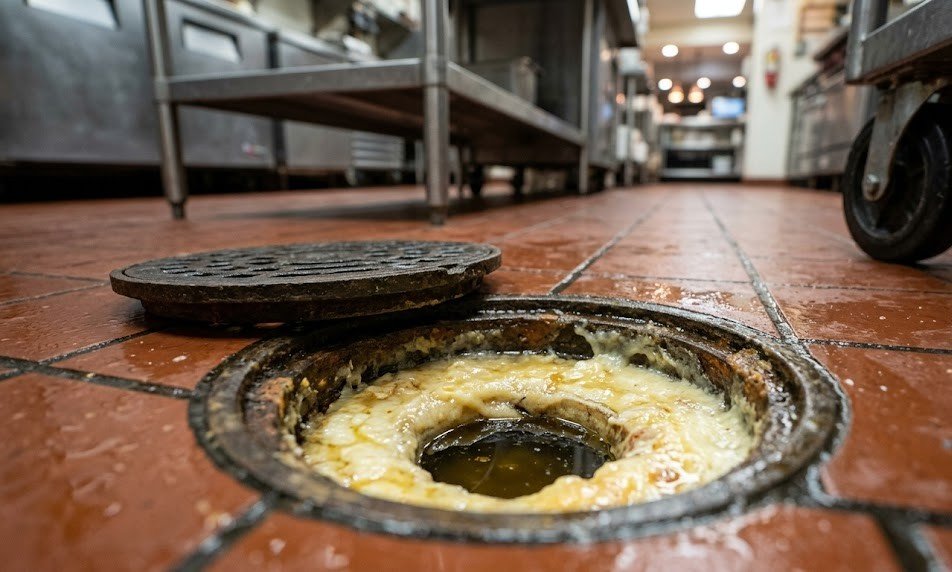
Grease is the number one floor drain problem in every food service operation in Arizona, and it is a problem that compounds daily without visible warning until the drain fails. Every commercial kitchen produces cooking grease, animal fat from protein preparation, and oil from frying operations that finds its way to floor drains through kitchen wash-down, equipment cleaning, and normal production activity. In Arizona’s climate, grease behavior inside drain pipes is especially problematic.
During the summer, the intense heat keeps grease in a liquid state while it is inside the heated kitchen environment, but as it travels into the cooler pipe system underground it solidifies rapidly and adheres to the pipe wall. This cycle of liquid grease entering the drain and solidifying against cool pipe walls happens continuously throughout every service day. Each layer adds to the previous one, gradually narrowing the pipe interior until flow becomes restricted and eventually stops. A drain snake punches a hole through the accumulated grease, restoring temporary flow, but leaves the hardened layers on the pipe walls intact. Within weeks the cleared channel fills back in and the problem returns. Only hydro jetting at sufficient pressure removes the grease from the pipe wall surface entirely, which is why it is the standard professional method for commercial kitchen floor drain maintenance.
Mineral Scale from Arizona’s Hard Water
Every commercial property in the Phoenix metro area, Tucson, and across the Valley deals with the consequences of Arizona’s extremely hard water. The high calcium and magnesium mineral content in the municipal water supply deposits scale continuously on every pipe interior connected to the system. In commercial settings where floor drains receive high volumes of water throughout each business day, this mineral accumulation builds faster than in residential applications.
Mineral scale creates a rough, irregular surface on the pipe interior that grease, food particles, lint, and other debris adhere to far more readily than they would on a smooth pipe wall. The scale narrows the pipe diameter over time and accelerates the development of blockages. In older commercial properties throughout the Valley, particularly those in buildings constructed before 1990, the combination of aging pipe materials and decades of hard water scale accumulation creates drain systems that are operating at a fraction of their original capacity.
Sludge and Biofilm Buildup
In commercial restrooms, locker rooms, laundry facilities, and any drainage system that receives warm water and organic material regularly, a dark, gelatinous sludge develops inside floor drain bodies and connecting pipes. This biofilm is a colony of microorganisms feeding on the organic matter in the drain, and it is the source of the persistent foul odors that commercial facilities experience from floor drains that appear to be flowing normally. The drain is not clogged in a traditional sense, but the biofilm coating the interior of the pipe and the drain body itself is degrading continuously, producing sulfur compounds and other odorous gases. Sludge removal combined with enzymatic treatment is the appropriate professional response to this type of drain condition.
Debris and Solid Material Accumulation
Manufacturing facilities, automotive shops, warehouses, and any commercial property with floor drains in areas where solid material is present deal with a specific type of drain problem: accumulation of solids including metal shavings, sand, gravel, plastic particles, cardboard fiber, and other solid debris that settles in the drain body, the trap, and the connected pipe. This type of accumulation is not addressed by either snaking or standard hydro jetting. It requires physical removal from the drain body followed by pipe flushing to clear connected lines of any finer particles that have traveled downstream.
Root Intrusion in Outdoor and Below-Grade Drains
Commercial properties throughout Arizona with mature landscaping face the same underground sewer line root intrusion risk that residential properties do, but with greater consequence when it occurs. A main drain line serving a commercial kitchen, a manufacturing floor, or a hotel laundry facility handles volumes that a partially root-obstructed pipe cannot accommodate during peak production hours. Root intrusion in commercial drain lines requires trenchless drain repair to address the entry points after the roots are cleared, preventing the rapid regrowth that makes repeated cutting alone an unsatisfying long-term solution.
Commercial Property Types and Their Specific Floor Drain Needs
Restaurants and Commercial Kitchens
Restaurant floor drains in Arizona are the highest-maintenance drain assets in commercial property management. A full-service restaurant operating two service periods per day produces enough grease, food waste, and cleaning chemical residue to partially block an unserviced drain line within a few months. High-volume fast food and fast casual operations produce even greater loads.
The floor drains in a commercial kitchen require cleaning on a service schedule that matches the production volume. For most mid-volume Arizona restaurants, professional floor drain cleaning by hydro jetting on a quarterly schedule provides adequate protection against service-impacting blockages. High-volume operations producing significant grease loads benefit from monthly or bimonthly service. The connection between floor drain maintenance and the grease trap cleaning schedule is important to understand: when a grease trap is allowed to overflow because it is not cleaned frequently enough, the excess grease enters the floor drain system directly and dramatically accelerates accumulation in the connected pipes.
Arizona’s Maricopa County Environmental Services Department and the Arizona Department of Health Services both require food service establishments to maintain clean and functional drainage as part of standard health code compliance. A restaurant that manages both its grease trap service schedule and its floor drain cleaning schedule together avoids the compounding accumulation problem that develops when either is neglected.
Hotels and Hospitality Properties
Hotel floor drains span multiple categories of commercial drainage challenge. Laundry facility floor drains collect lint, detergent residue, and water mineral deposits at very high volumes. Commercial kitchen and banquet facility drains handle the full food service grease load. Pool deck drains and spa area floor drains collect sunscreen residue, body oils, and chemical treatment byproducts. Parking garage floor drains collect motor oil, road contamination, and sediment.
For a full-service hotel property in Phoenix, Scottsdale, or elsewhere in the Valley, a consolidated floor drain maintenance program that addresses each drain category on a schedule appropriate to its specific load is the practical approach. Laundry and kitchen drains warrant quarterly hydro jetting as a baseline. Pool deck and spa drains benefit from pre-season cleaning before summer occupancy peaks. Parking garage floor drains should be cleared before Arizona’s monsoon season when rainfall volumes overwhelm partially restricted outdoor drains rapidly.
Healthcare Facilities and Medical Office Buildings
Healthcare facility floor drains operate under stricter sanitation standards than any other commercial property category. The drains in clinical areas, procedure rooms, sterilization rooms, and laboratory spaces must not only flow freely but must be maintained in a sanitary condition that does not allow bacterial biofilm to develop into a contamination source.
Medical facility floor drain maintenance requires not just mechanical clearing of any accumulation but sanitizing treatment that addresses the biological component of the buildup. Bio-enzymatic treatments that use live bacterial cultures to digest organic material without generating heat or chemical byproducts are appropriate as part of an ongoing maintenance program for healthcare floor drains. Professional preventive drain maintenance built around a documented service schedule provides the record-keeping support that healthcare facility compliance documentation requires.
Manufacturing and Industrial Properties
Manufacturing floor drains are the most varied in terms of what they receive and therefore the most variable in terms of what cleaning method and schedule they require. A food manufacturing facility has drain loads similar to a large commercial kitchen. A metal fabrication facility has drain loads dominated by coolants, lubricants, and fine metal particulate. A chemical manufacturing or processing facility may have floor drains receiving regulated substances that require specific handling procedures.
For Arizona manufacturing facilities, a pipe inspection with video camera before establishing a maintenance program is the appropriate starting point. The camera inspection reveals the current condition of the drain lines, identifies any existing structural issues in the pipe, and provides the baseline documentation needed to establish a realistic service interval. Manufacturing facilities that have been operating for years without professional floor drain service often discover significant accumulation and occasionally structural pipe issues that need to be addressed before a routine maintenance program can be established.
Retail Centers and Shopping Plazas
Large retail centers including strip malls, power centers, and enclosed shopping plazas have floor drain maintenance needs driven primarily by the anchor tenant mix. A plaza with a grocery anchor, multiple restaurants, a nail salon, and a car wash has a dramatically more demanding drain maintenance requirement than one occupied exclusively by professional offices. Floor drains in anchor tenant kitchen and service areas, common area restrooms, food court drains, and any back-of-house service corridor need to be on a maintenance schedule appropriate to their specific loads.
Property managers responsible for multi-tenant retail centers in the Valley should establish minimum drain maintenance standards for tenant leases and maintain the common area drain infrastructure through a professional preventive drain maintenance program that covers shared drain lines and public area floor drains on a documented schedule.
Automotive Service Facilities
Car washes, auto repair shops, tire dealers, and quick-lube facilities produce floor drain loads that include motor oil, transmission fluid, brake fluid, grease, road grime, and chemical cleaning agents. These substances create some of the most stubborn pipe wall accumulations encountered in commercial floor drain maintenance. The combination of petroleum-based compounds and road sediment builds a dense, adhesive layer that standard snaking cannot adequately address and that chemical drain cleaners may not be able to dissolve through in a reasonable time.
Commercial hydro jetting at appropriate pressure for the pipe material is the standard professional approach for automotive service floor drains. Arizona’s regulatory environment also requires that automotive facilities manage their drain discharge correctly, as motor oil and other automotive fluids cannot be discharged to municipal sewer systems without appropriate treatment or collection. A drainage system installation consultation that confirms your floor drain system routes through appropriate oil-water separation before reaching the sewer is an important compliance consideration for Arizona automotive service operators.
Professional Floor Drain Cleaning Methods for Commercial Properties
Video Camera Inspection
Before any significant commercial floor drain service, a pipe inspection with video camera establishes the actual condition of the drain line and identifies the nature of the accumulation or obstruction. For commercial properties, the camera inspection serves both a diagnostic function and a documentation function. The footage shows facility managers exactly what the interior of their drain lines looks like, which supports both maintenance planning and regulatory compliance documentation.
Camera inspection is especially valuable in commercial buildings where the drain system layout is not fully documented, where recent construction or renovation may have altered drain connections, or where a persistent drain problem has not responded to previous service attempts in the expected way. The camera reveals what is actually happening inside the pipe rather than requiring the service technician to guess based on surface observations.
Commercial Hydro Jetting
Commercial hydro jetting uses water at pressures significantly higher than residential applications, typically 2,000 to 4,000 PSI delivered through specialized nozzle configurations that direct water both forward to break through obstructions and backward against the pipe wall to scour accumulated material from the interior surface. For commercial kitchen floor drains, hydro jetting removes the grease layer from the pipe wall completely, restoring the full interior diameter and eliminating the adhesive surface that new grease deposits cling to.
The lasting benefit of commercial hydro jetting compared to mechanical snaking is that it does not just restore temporary flow. It restores the condition of the pipe interior. A floor drain that is hydro-jetted at appropriate pressure flows at near-original capacity and resists re-accumulation for a significantly longer period than one that is merely snaked. For high-production commercial kitchens, the difference between the two approaches is often measured in months of additional service life before the next intervention is needed.
Drain Snaking for Commercial Applications
Commercial drain snaking uses motorized equipment with cables of greater length, diameter, and cutting head variety than residential snaking equipment. It is appropriate for isolated obstructions that are clearly located at a specific point in the line, for clearing solid material accumulation from drain bodies and trap sections, and as a first-pass clearing step before hydro jetting in severely blocked lines where the jetting hose cannot initially advance past the obstruction.
For commercial floor drains with heavy grease accumulation, drain snaking alone is rarely a satisfactory long-term solution because it does not remove the pipe wall coating that causes recurrent accumulation. It is most valuable as part of a combined approach where snaking restores initial flow and hydro jetting then cleans the line completely.
Enzymatic and Bio-Active Treatments
Enzymatic drain treatments use specially formulated bacterial cultures that produce enzymes specifically designed to digest the organic compounds most commonly found in commercial drain waste, including fats, oils, grease, proteins, and starches. These products are non-corrosive, non-toxic, safe for all pipe materials, and entirely compatible with municipal sewer systems.
For commercial properties, enzymatic treatments are most valuable as a maintenance tool used between professional hydro jetting visits rather than as a standalone solution for established accumulation. A restaurant that hydro-jets its floor drains quarterly can extend the period between service calls and reduce the severity of accumulation at each service visit by implementing a weekly enzymatic treatment program. The treatment supports the professional service schedule rather than replacing it. It is not capable of clearing a drain that is significantly restricted, but it slows the rate of re-accumulation in a pipe that was recently professionally cleaned.
Sludge and Sediment Removal
For commercial floor drains where solid sediment or biological sludge accumulation is the primary issue rather than grease or mineral scale, direct physical removal from the drain body combined with appropriate flushing of connected lines is the required approach. This typically involves removing the drain grate and strainer basket, vacuuming or manually removing accumulated material from the drain body and trap section, then flushing the line downstream with hydro jetting to clear any material that has migrated into the pipe. Sludge removal performed on a regular schedule in commercial restrooms, laundry facilities, and any drain receiving high organic loads prevents the biofilm odor problem and keeps the drain body itself in a condition that allows it to function as designed.
Building a Commercial Floor Drain Maintenance Schedule for Arizona Properties
The right maintenance schedule depends on the property type, the volume of production activity, the specific waste streams entering the floor drains, and the age and condition of the drain infrastructure. Here is a practical framework organized by property category.
Restaurants and High-Volume Food Service
High-volume restaurants producing significant grease loads benefit from quarterly hydro jetting of all kitchen floor drains and connected lines as a baseline service interval. Very high-volume operations, including hotel banquet kitchens, stadium concession drain systems, and large quick-service restaurant chains, may need monthly or bimonthly service. The grease trap service schedule should be coordinated with the floor drain service schedule because grease trap overflow directly accelerates floor drain accumulation. A monthly enzymatic treatment program between professional service visits is a cost-effective approach to managing buildup between visits.
Healthcare and Medical Facilities
Medical facility floor drains benefit from quarterly professional cleaning combined with a documented enzymatic maintenance program between visits. The documentation component is particularly important for healthcare facilities because sanitation maintenance records are subject to regulatory inspection. Every professional service visit should produce a written service report that becomes part of the facility’s compliance documentation file.
Hotels and Multi-Use Commercial Properties
A consolidated annual program that addresses each drain category on a schedule appropriate to its specific load covers the core obligation for most hotel properties. Kitchen and laundry drains at quarterly service intervals, pool and spa drains pre-season, common area restroom floor drains semi-annually, and parking and outdoor area drains before monsoon season provides comprehensive coverage without excessive service frequency for lower-load drain locations.
Industrial and Manufacturing Properties
Manufacturing drain maintenance schedules need to be established based on the specific waste streams the facility produces. A camera inspection baseline assessment followed by a service plan developed specifically for the facility’s drain layout and production volumes is the appropriate approach. Semi-annual professional service is a reasonable starting point for most manufacturing floor drain systems in Arizona, with adjustment based on the observed accumulation rate at each service visit.
General Commercial Office and Retail
Lower-drain-load commercial properties including professional office buildings, general retail, and service businesses without food service or manufacturing activities can typically maintain compliant floor drain conditions with annual or semi-annual professional service combined with routine grate and trap cleaning performed by facility maintenance staff.
Arizona-Specific Factors That Affect Commercial Floor Drain Maintenance
Hard Water Scale Accelerates Maintenance Needs
Arizona’s consistently high water hardness creates a mineral scale accumulation challenge in commercial floor drain lines that property managers outside the state rarely encounter. The calcium and magnesium content in Valley municipal water deposits scale continuously on drain pipe interiors, narrowing the usable diameter and creating an adhesive surface that grease, food particles, lint, and other debris cling to more readily than they would on a scale-free pipe wall. Commercial properties in Phoenix, Scottsdale, Mesa, Chandler, and throughout the Valley need to factor the scale accumulation rate into their maintenance schedule, which typically means service intervals should be somewhat shorter than manufacturer guidelines or industry standard recommendations developed for softer-water markets.
Summer Heat and Grease Behavior
Arizona’s summer heat fundamentally changes the behavior of grease in commercial drain systems in ways that create both advantages and risks. During peak summer heat, the high ambient temperatures in kitchen environments keep grease in a more fluid state for longer, which means it travels further into the drain system before solidifying rather than accumulating close to the drain opening where it would be easier to remove. By the time Arizona summer grease accumulation is discovered, it is typically distributed throughout a significant length of pipe rather than concentrated near the drain body. This makes commercial hydro jetting the only practical removal method because a drain snake addressing only the first few feet of pipe would leave the majority of the accumulation untouched.
Monsoon Season and Outdoor Drain Vulnerability
Commercial properties with outdoor floor drains, loading dock drains, covered parking area drains, outdoor dining area drains, and any below-grade or grade-level drainage in exposed areas face a specific annual vulnerability during Arizona’s monsoon season from mid-June through late September. A floor drain that is operating with partial restriction from accumulated debris or mineral scale under normal dry-season conditions may be overwhelmed within minutes during a significant monsoon rain event, causing water to surface and back up across commercial floors, parking areas, and pedestrian walkways.
Pre-monsoon season professional floor drain cleaning of all outdoor and exposed drainage on a commercial property is one of the highest-return maintenance investments available to Arizona property managers. The cost of a professional drain cleaning visit in May is a fraction of the cost of water damage cleanup, tenant disruption, and slip-and-fall liability exposure that results from outdoor drain failure during a monsoon event. Storm drain cleaning combined with floor drain service before the first monsoon storm provides comprehensive pre-season protection.
The Consequences of Neglecting Commercial Floor Drain Maintenance
Health Code Violations and Inspection Failures
For food service operations in Arizona, neglected floor drains create health code violations that inspectors from Maricopa County Environmental Services or the Arizona Department of Health Services will identify and document. A drain backing up during service creates a standing water condition on the kitchen floor that constitutes a sanitation violation. Foul odors emanating from floor drains in food preparation areas indicate biological accumulation that represents a cross-contamination risk. Either finding generates a critical violation on the inspection report, and accumulated critical violations can result in a facility closure order. The cost of a professional drain cleaning program across an entire year is far less than the revenue lost during a single forced closure.
Operational Disruption During Peak Hours
A floor drain that backs up during a commercial kitchen’s dinner service, a hotel laundry facility’s peak morning cycle, or a manufacturing floor’s production shift creates an operational disruption that cannot wait for a scheduled service appointment. Emergency service calls are available but carry premium pricing and may have response time delays depending on demand at the time of the call. A facility that is managing its floor drains proactively rarely needs emergency drain cleaning services. A facility that defers maintenance until failure inevitably calls for emergency service at the worst possible time.
Property Damage and Liability Exposure
A commercial floor drain that backs up to the point of overflow creates water damage to flooring, cabinetry, stored materials, and equipment in the surrounding area. In a multi-tenant commercial building, a backed-up floor drain on one floor can send water to the ceiling of the floor below, affecting tenants who had nothing to do with the maintenance failure. Slip-and-fall liability exposure from water accumulating on commercial floors adds another dimension to the cost calculation. Property damage claims, tenant disputes, and slip-and-fall liability are all predictable consequences of neglected drain maintenance that professional service schedules prevent.
Accelerated Pipe Deterioration
Consistent accumulation inside commercial drain lines does not just restrict flow. It also accelerates the deterioration of the pipe itself. Grease accumulation traps moisture and biological material against the pipe wall, creating conditions that promote corrosion in metal pipe and attack adhesive joints in PVC systems. Mineral scale that is allowed to build for years without removal becomes extremely difficult to clear without high-pressure jetting, and the pipe wall condition beneath accumulated scale is often significantly worse than it appeared during visual inspection from the drain opening. When commercial floor drain systems reach the point where cleaning is no longer sufficient and drain repair and replacement is required, the cost of the repair is always higher than the accumulated cost of the maintenance program that would have prevented it.
Frequently Asked Questions
How often should a commercial restaurant floor drain be professionally cleaned in Arizona?
For most mid-volume Arizona restaurants, quarterly professional hydro jetting of kitchen floor drains provides adequate protection against blockages that impact operations. High-volume operations, particularly those producing large quantities of cooking oil and animal fat, benefit from monthly or bimonthly service. The grease trap service schedule should be coordinated with the floor drain program because grease trap overflow accelerates floor drain accumulation significantly.
What is the most effective cleaning method for commercial floor drains?
Commercial hydro jetting is the most effective method for floor drains that receive grease, food waste, or mineral-laden water because it removes the accumulated material from the pipe wall rather than simply creating a temporary flow channel through the center of the obstruction. For drain bodies with solid debris accumulation, physical removal followed by hydro jetting of the connected line is the appropriate combined approach. Drain snaking alone is generally insufficient for commercial kitchen floor drains because it does not address the pipe wall grease coating that causes rapid re-accumulation.
Do Arizona health codes specifically require floor drain maintenance for food service businesses?
Arizona health regulations and Maricopa County Environmental Services standards require food service facilities to maintain functional and sanitary drainage as a condition of operation. While the regulations specify the outcome required rather than prescribing a specific maintenance schedule, a documented professional service program is the practical mechanism through which food service operators demonstrate compliance and protect themselves from inspection violations.
Can I use chemical drain cleaners in commercial floor drains?
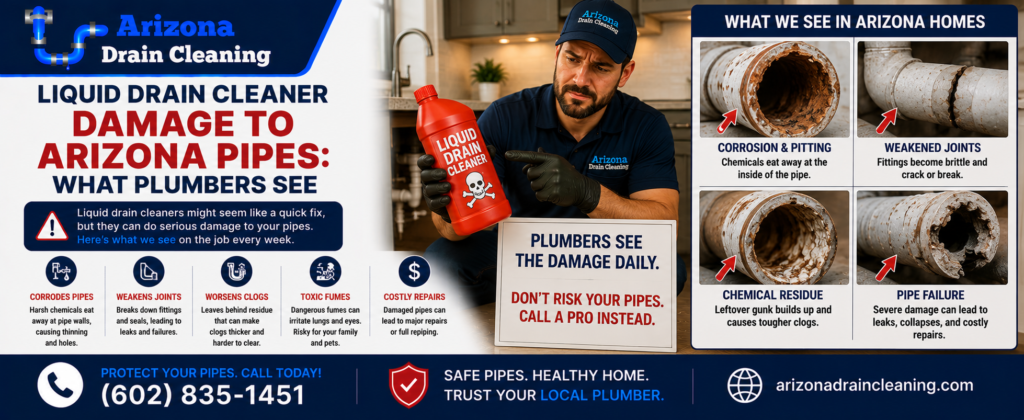
Chemical drain cleaners are not recommended for commercial floor drain applications for several reasons. Commercial drain loads including heavy grease accumulation typically do not respond adequately to chemical cleaners. The heat generated by caustic chemical reactions can damage pipe connections and floor drain body materials in commercial installations. Chemical drain cleaners introduced into commercial waste streams may create reactive situations with other chemicals already present in the drain system. And in Arizona, introducing certain chemical compounds into floor drains connected to municipal sewer systems may create environmental compliance concerns. Professional hydro jetting or mechanical methods are the appropriate approaches for commercial floor drain maintenance.
What should I do if a floor drain backs up during business hours?
For a food service operation, the immediate step is to stop using the backed-up drain and contact a professional drain service for an urgent response. Continuing to pour water into a backed-up drain creates an overflow situation that constitutes both a health code violation and a slip hazard. For manufacturing or industrial operations, the appropriate response depends on what waste stream is backing up and whether it involves regulated substances. An emergency drain cleaning services call to a licensed commercial drain service that can respond promptly is the appropriate action for any commercial floor drain backup that impacts operations.
How do I know if my commercial floor drain needs replacement rather than cleaning?
A drain that flows normally immediately after professional hydro jetting but backs up again within a few weeks despite no unusual production load is typically indicating a structural problem rather than an accumulation problem. This pattern, combined with symptoms like gurgling in connected drains, sewer odors that persist after professional cleaning, or wet spots in the floor surface above the drain line path, suggests a camera inspection is needed to assess the structural condition of the pipe. A pipe inspection with video camera will show whether the problem is continued accumulation in a sound pipe or structural damage that no amount of cleaning will permanently resolve.
Is there a difference between a floor drain trap seal drying out and a drain blockage?
Yes, and this distinction matters for commercial properties in Arizona more than almost anywhere else. Floor drains that are not used regularly can have their water trap seals evaporate in Arizona’s dry climate, allowing sewer gas to enter the space through the dry trap. This produces a persistent foul odor that is often mistaken for a drain blockage. The solution to a dry trap seal is simply to pour water into the drain to re-establish the seal, not to call for a cleaning service. If the odor persists after refilling the trap, the problem is likely biofilm accumulation in the drain body or connected pipe rather than a simple dry trap.
The Bottom Line on Commercial Floor Drain Cleaning in Arizona
Commercial floor drain maintenance in Arizona is a business continuity obligation, a health code compliance requirement, and a property protection investment. The combination of Arizona’s hard water mineral scale, summer heat grease behavior, monsoon season outdoor drain vulnerability, and the high production volumes of commercial operations creates a drain maintenance environment that is more demanding than most property managers initially plan for when they establish their facility maintenance budgets.
The businesses and property managers who handle floor drain maintenance well build a professional service schedule appropriate to their specific facility type, coordinate that schedule with related systems including grease trap cleaning and outdoor drain preparation, and maintain documentation of service visits as part of their compliance record. The ones who handle it poorly call for emergency service during business hours, deal with health inspection violations, and spend significantly more on reactive repairs than they would have spent on prevention.
Arizona Drain Cleaning provides commercial floor drain cleaning services for food service operations, hotels, manufacturing facilities, medical offices, retail centers, and every other commercial property type across Phoenix, Scottsdale, Mesa, Chandler, Gilbert, Tempe, Glendale, Peoria, Surprise, Goodyear, Tucson, Flagstaff, and throughout Arizona. Call Arizona Drain Cleaning at (602) 835-1451 right now to schedule a commercial floor drain assessment or to establish a preventive maintenance program that protects your operations before the next drain failure costs you far more than the service would have.