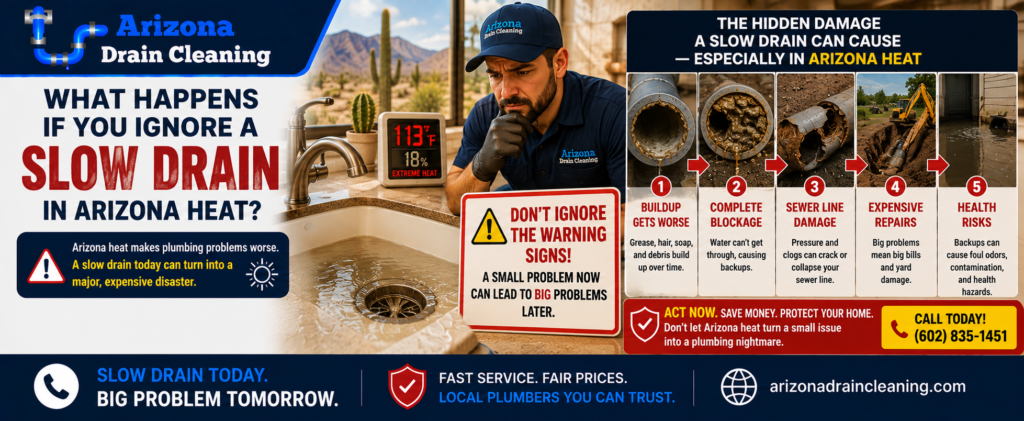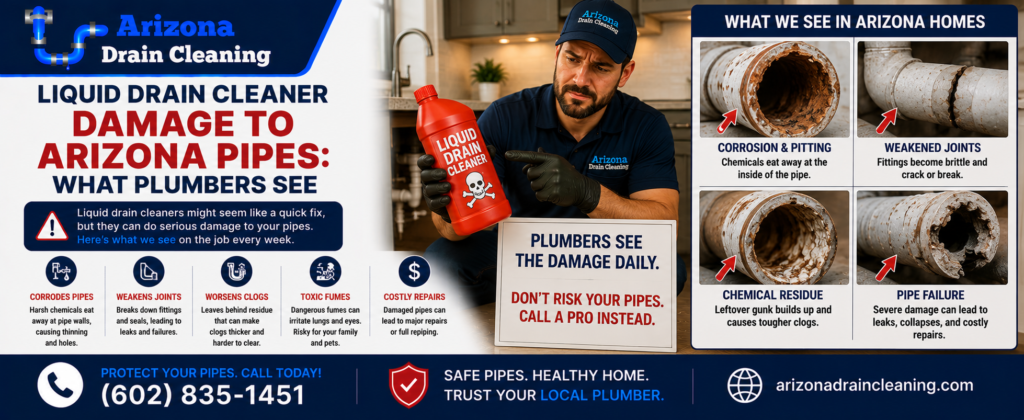

Drain cleaning solves a buildup problem. Drain replacement solves a structural problem. Those are two entirely different things, and confusing one for the other is one of the most expensive mistakes a homeowner can make.
Cleaning vs Replacement: Core Difference
| Factor | Drain Cleaning | Drain Replacement |
|---|---|---|
| Problem type | Blockage or buildup | Structural damage |
| Common causes | Grease, hair, soap scum, mineral scale | Cracks, collapse, corrosion, joint failure |
| Result after service | Restored flow | New or repaired pipe system |
| Longevity | Temporary to long-term depending on maintenance | Long-term structural solution |
| Cost range | Lower | Higher due to labor and excavation |
At Arizona Drain Cleaning, we see this confusion play out regularly, and it almost always costs homeowners more than it should. If your pipes are clogged with grease, mineral scale, hair, or soap scum, cleaning removes that material and restores flow. If your pipes are cracked, collapsed, corroded, or separated at their joints, cleaning does nothing except give you a few weeks of relief before the same problem returns. This guide walks through exactly how to tell the difference, what each option involves, what it costs, how a camera inspection removes all the guesswork, and what Arizona homeowners specifically need to understand about their pipes before making any decision.
What Drain Cleaning Actually Does and When It Is the Right Answer
Drain cleaning is the process of removing material that has accumulated inside a structurally sound pipe. Over time, every residential drain collects deposits from regular household use. Cooking grease coats the interior walls of kitchen drain lines. Soap scum and body oils accumulate in bathroom sink and shower drains. Hair catches and holds other debris near drain openings. Mineral scale from Arizona’s notoriously hard water deposits continuously on pipe walls throughout the Valley, narrowing the usable interior diameter of the line with each passing month.
None of these conditions represent damage to the pipe itself. The pipe is intact. The pipe is doing its job correctly. The problem is what is inside it, and what is inside it can be removed.
The Two Professional Methods That Clean Pipes Effectively
Drain snaking uses a flexible rotating cable with a cutting or hooking head to physically break through or pull out localized blockages. It is the appropriate response to an isolated, first-time clog in a branch line where the obstruction is concentrated at a single point. Snaking is fast, efficient, and cost-effective for the right situation.
Hydro jetting uses pressurized water at 1,500 to 4,000 PSI to scour the entire interior surface of the pipe, removing not just the obstruction but the grease layer, soap scum, mineral scale, and biofilm coating that lines the pipe wall. Where snaking punches a hole through the problem, hydro jetting removes the problem entirely, including the layer of material that gives new debris something to cling to. For recurring clogs, kitchen drains with grease accumulation, and any situation involving hard water mineral buildup, hydro jetting produces results that last significantly longer than snaking alone.
Signs That Cleaning Is the Right Answer
Cleaning is the appropriate service when the issue is material inside the pipe rather than damage to the pipe itself. The following symptoms, particularly when they appear for the first time or respond well to professional service and do not return quickly, point toward a cleaning problem rather than a structural one.
A single slow drain in one fixture that has been gradually getting worse over weeks or months is typically a buildup issue. The gradual onset indicates progressive accumulation rather than a sudden structural event. A first-time clog in a drain that has functioned well for years is almost always a cleaning problem. Mild odors coming from a kitchen drain, particularly after periods of heavy cooking use, indicate grease and organic material accumulation that cleaning resolves. A drain that responded well to professional cleaning and stayed clear for six months or more before slowing down again is a pipe that needs routine maintenance, not replacement.
When drain cleaning is the right solution
Drain cleaning is effective when the pipe is still structurally sound but restricted by buildup.
| Condition | What it usually means |
| Slow drains in one or more fixtures | Localized or partial blockage |
| Recurring clogs that clear temporarily | Buildup returning inside pipe walls |
| Gurgling sounds | Air trapped due to restriction |
| Odors from drains | Organic buildup inside lines |
| Multiple drains affected but no leaks | Possible main line blockage |
Common causes in Arizona include hard water scale, grease buildup, hair accumulation, and soap residue that narrows the pipe over time.
When drain replacement becomes necessary
Replacement is required when the pipe itself is no longer functional.
| Condition | What it usually indicates |
| Frequent backups after cleaning | Structural failure or collapse |
| Persistent sewer odors | Broken or leaking pipe joints |
| Wet spots in yard or foundation | Underground pipe leak |
| Visible pipe corrosion | Advanced deterioration |
| Camera shows cracks or offsets | Structural damage confirmed |
In Arizona, older homes are especially vulnerable due to aging cast iron, clay, or Orangeburg piping that deteriorates over time.
What Drain Replacement Actually Addresses and When It Becomes Necessary
Drain replacement addresses damage to the pipe structure itself. This is a fundamentally different category of problem from material accumulation, and it requires a fundamentally different solution. No cleaning method, regardless of how powerful or thorough, can repair a crack, restore a collapsed section, reconnect separated joints, or correct a pipe belly where waste pools because the line has sagged below horizontal grade.
When a pipe is structurally compromised, cleaning it provides temporary relief by removing whatever material is currently creating the most immediate obstruction. But the structural defect remains and continues to worsen with every use. Within weeks or a few months, the same symptoms return, often with increased severity, because the underlying condition that is actually causing the problem was never addressed.
The Structural Problems That Require Replacement Rather Than Cleaning
Pipe cracks and fractures occur from multiple causes in Arizona properties. The clay and caliche soil beneath Valley homes expands dramatically when wet during monsoon season and contracts hard when it dries. This cyclical movement exerts continuous mechanical stress on underground pipe joints and walls. A pipe that absorbs this stress for decades will eventually develop stress fractures, particularly at joints where two sections connect and where the pipe transitions from one soil layer to another. Tree root intrusion exploits these fractures and cracks, growing inside the pipe until the root mass creates a persistent obstruction that returns rapidly after removal because the entry point remains open.
Pipe collapse is the most severe structural failure and the situation where cleaning is most clearly inadequate. When a section of pipe collapses, the pipe wall folds inward and blocks the flow path entirely or reduces it so severely that the line cannot function. A collapsed section also destabilizes the surrounding soil and can create progressive collapse along adjacent sections if left unaddressed.
Pipe bellies form when sections of the line sag below the correct grade due to soil settling or shifting beneath the pipe. Gravity-fed drain systems depend on a consistent downward slope from the house to the municipal connection. When a belly forms, waste and water pool at the low point of the belly rather than flowing through continuously. Even a perfectly clean pipe with a belly will fill with sediment and organic material at the low point because the water velocity slows to near zero there. Hydro jetting a belly provides temporary relief by flushing the pooled material forward, but the structural condition of the pipe grade is unchanged and the belly will refill.
Severe corrosion in cast iron pipe produces a rough, pitted internal surface that cleaning cannot restore to a functional state. As cast iron corrodes from the inside outward, the pipe wall thins, the interior surface becomes irregular and highly adherent to debris, and eventually sections crack or perforate entirely. When corrosion has reached this stage, cleaning the corroded surface achieves nothing because the surface itself is the problem, not what is sitting on it.
The Symptoms That Tell You Which Problem You Are Actually Dealing With
The challenge for most homeowners is that cleaning problems and replacement problems produce similar surface symptoms. Slow drains, backups, odors, and gurgling sounds can appear in both situations. The difference lies in the pattern of those symptoms, their relationship to professional service, and whether they involve multiple fixtures simultaneously or a single isolated drain.
Symptoms That Point Toward Cleaning
A drain that is slow but has never been professionally cleaned and has no history of structural problems is a cleaning candidate. The symptom is gradual rather than sudden. It affects one fixture rather than multiple. It has no accompanying yard symptoms such as wet patches or depressions above the pipe path. Professional cleaning resolves it completely and the improvement lasts for months. In Arizona specifically, a kitchen drain that slows progressively in a home where cooking is frequent and the drain is in a property with hard water is a textbook cleaning situation.
Symptoms That Point Toward Replacement
The clearest single indicator is a drain that has been professionally cleaned and backs up again within weeks. This pattern is the most reliable signal that structural failure rather than material accumulation is the underlying cause. The cleaning removes whatever obstruction is present at that moment, but the structural defect immediately begins producing a new obstruction at the same location.
Multiple fixtures backing up simultaneously is a main line indicator and strongly suggests structural problems in the primary sewer line rather than isolated branch line buildup. When your toilet backs up at the same time your shower drain fills, or when your laundry drain overflows while running the dishwasher, the problem is downstream of all those fixtures in the main line, and the cause in a home with aging pipe is far more likely to be structural than a simple blockage.
Sewage odors that persist for days or weeks after a professional cleaning indicate a crack or separation in the pipe that is venting sewer gas outside the sealed system. Cleaning the interior of a cracked pipe does not seal the crack. The odor will continue until the structural failure is repaired or replaced.
Wet, soggy, or unusually lush patches in your yard above the sewer line path indicate a pipe that is actively leaking. This is physical evidence of a breached pipe wall that no cleaning service can address. Depressions or sinkholes in the yard above the pipe path are more serious still, indicating that soil has begun falling into a collapsed pipe section.
Gurgling sounds from drains or toilets when other fixtures are in use indicate disrupted air pressure in the drain system, often caused by a partial collapse, a belly, or a separated joint that is interrupting normal flow. A cleared blockage typically resolves gurgling if it was caused by a simple obstruction. Gurgling that persists after a thorough professional cleaning, or that appears in multiple fixtures simultaneously, points toward structural problems that cleaning cannot correct.
Foundation cracks, settling, or unexplained moisture at the base of interior or exterior walls can indicate a leaking sewer line beneath the foundation. In Arizona where clay soil movement amplifies the effect of moisture changes beneath a slab, a leaking sewer line creates the soil saturation and differential expansion conditions that produce foundation cracking and settlement over time.
The Decision Framework: A Practical Way to Think Through Which Service You Need
Rather than trying to diagnose from surface symptoms alone, a structured decision framework helps most homeowners and property owners reach the right conclusion efficiently.
Step One: Ask Whether the Pipe Has Been Professionally Cleaned Before
If the drain in question has never been professionally cleaned, or has not been cleaned in three or more years, the first appropriate step is professional cleaning, not replacement investigation. Many pipes that present with severe buildup symptoms clear completely with hydro jetting and perform well for years. Starting with cleaning when the pipe condition is unknown avoids the risk of recommending replacement for a pipe that simply needed maintenance.
Step Two: Ask How Quickly the Problem Returns After Cleaning
If the drain was professionally cleaned within the past six months and is already showing the same symptoms, the pipe structure needs to be investigated. Rapid recurrence is the most reliable indicator that cleaning is not the appropriate long-term solution and that camera inspection is the necessary next step.
Step Three: Ask Whether the Problem Is Isolated or Widespread
A single slow drain in a property where every other drain functions normally is a branch line issue that cleaning addresses reliably. Slow drains throughout multiple fixtures, or backup events that affect multiple fixtures simultaneously, indicate a main line problem where structural failure is a more likely diagnosis.
Step Four: Run a Camera Inspection Before Making Any Replacement Decision
This is the step that eliminates all remaining uncertainty. A pipe inspection with video camera travels the full length of the drain line and transmits live footage that shows the interior condition of the pipe directly. The camera reveals whether the problem is material accumulation in a structurally sound pipe, in which case cleaning is clearly the right answer, or structural damage in the form of cracks, collapse, root intrusion at broken joints, or pipe bellies, in which case replacement or structural repair is clearly the right answer.
The camera inspection removes guesswork entirely. Without it, a technician is making recommendations based on external symptoms that two very different underlying conditions can produce. With it, the diagnosis is based on direct visual evidence of what is actually happening inside the pipe, and the recommendation follows logically from what the footage shows.
What Drain Replacement Actually Involves
When a camera inspection confirms that structural failure is the issue and that replacement rather than cleaning is the appropriate response, homeowners have several options that vary significantly in cost, disruption, and applicability.
Spot Repair of a Single Failed Section
When the camera identifies damage that is localized to a specific section of pipe while the surrounding pipe remains in sound condition, a spot repair that addresses only the failed section is often the most appropriate and cost-effective approach. This involves excavating the soil above the specific damaged section, removing the failed pipe, and installing a new section of properly bedded PVC or approved material. Spot repair is appropriate when the damage is genuinely isolated and the adjacent pipe is confirmed by camera inspection to be structurally sound.
Cured-in-Place Pipe Lining
Cured-in-place pipe lining, commonly referred to as CIPP, is a trenchless rehabilitation method that creates a new pipe inside the existing one without excavation. A flexible liner saturated with epoxy resin is inserted into the pipe, inflated against the inner surface, and cured with heat or ultraviolet light to create a seamless, hard new pipe lining with a projected service life of 50 years or more. The smooth interior of the cured liner is resistant to corrosion, chemical attack, and root penetration, and provides better flow characteristics than the aged pipe it rehabilitates.
CIPP is applicable when the existing pipe has no complete collapses and maintains a continuous path for the liner to travel. It is one of the most cost-effective solutions for Arizona properties where the sewer line runs beneath concrete driveways, pool decks, patios, or mature desert landscaping where excavation restoration would add substantially to the total project cost. The trenchless drain repair approach is typically 30 to 50 percent less expensive than traditional excavation when restoration costs are factored into the comparison.
Pipe Bursting
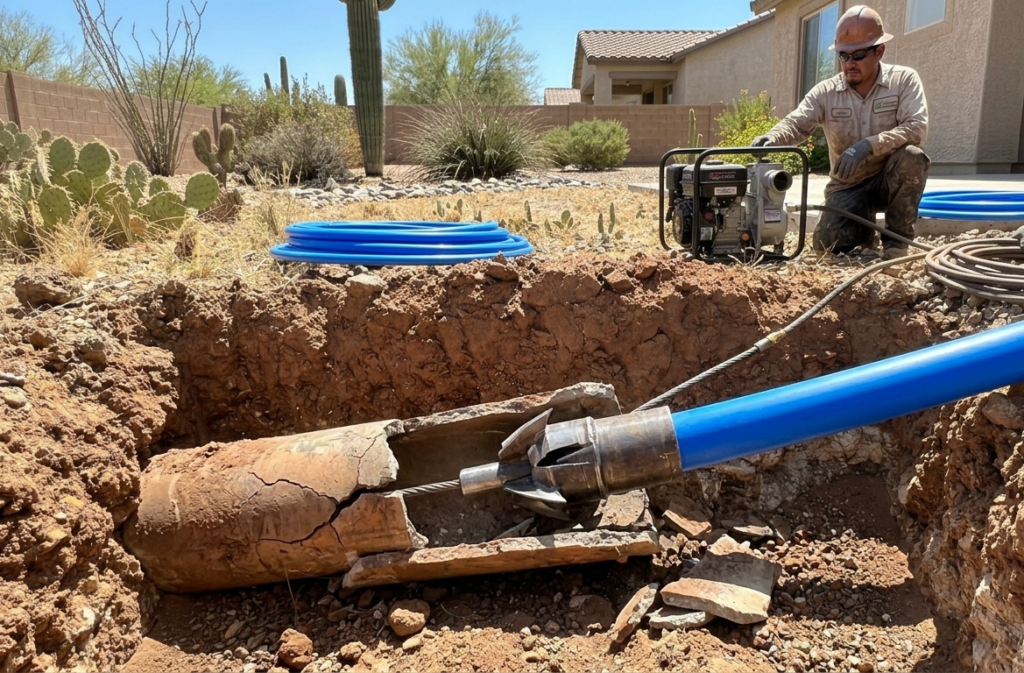
Pipe bursting is a trenchless replacement method that pulls a new pipe through the old one while simultaneously fracturing the existing pipe outward into the surrounding soil. It requires only small access pits at each end of the run rather than a continuous trench. Pipe bursting installs entirely new pipe with a fresh service life and is appropriate for pipes that are too deteriorated for lining but where open excavation is not practical or cost-effective.
Traditional Excavation and Full Replacement
Traditional open-cut replacement involves excavating along the full length of the pipe run, removing the failed pipe entirely, and installing new pipe in correctly graded bedding. This method provides complete access to every inch of the line, allows inspection and remediation of any soil contamination from a leaking pipe, and produces a fully new installation. It is the most disruptive method and carries the highest total cost when surface restoration is included, but it is the appropriate approach when trenchless methods are not applicable due to complete pipe collapse, severely offset joints, or other conditions that prevent a liner or bursting head from traveling the line.
For Arizona properties where drain repair and replacement needs to be scoped, the specific conditions of your property, the depth of the pipe, the soil conditions encountered, and the presence of caliche or other obstructions all influence which method is practical and what the total project cost will look like.
How Drain Cleaning Compares to Drain Replacement on Cost
Understanding the cost relationship between these two options requires looking at both the immediate service cost and the total cost over a realistic timeframe.
The True Cost of Repeated Cleaning on a Pipe That Needs Replacement
A professional drain snaking service for a residential drain typically runs from $150 to $350. Hydro jetting typically runs from $300 to $600 for a residential application. These are the costs per service call.
When a structurally compromised pipe requires a cleaning service call every two to four months, the annual cleaning spend quickly reaches $600 to $2,400 per year. Over three years, that represents $1,800 to $7,200 spent on temporary relief while the structural condition of the pipe continues to deteriorate. At the end of those three years, the pipe needs replacement anyway, often at higher cost because the deterioration has progressed further and because the failure eventually occurs as an emergency that limits your method options and timeline flexibility.
The Cost of Proactive Replacement
Spot repair of a single failed section typically runs from $500 to $3,500 depending on depth, access, and length of the failed section. Trenchless pipe lining for a full residential sewer line typically runs from $3,000 to $12,000 depending on pipe diameter and length. Pipe bursting occupies a similar range. Traditional excavation and replacement runs from $4,000 to $15,000 or more for a full residential line when excavation, materials, labor, and surface restoration are included.
The comparison is not between the cost of one cleaning and one replacement. It is between the cumulative cost of repeated cleanings that never solve the problem, potentially combined with emergency service premiums and water damage costs when the pipe eventually fails catastrophically, versus a single proactive replacement that solves the problem permanently and does not require another service call for the next 50 years.
Why Arizona Pipes Need Earlier Assessment Than Most
Arizona homeowners face a combination of conditions that accelerate the progression from manageable pipe buildup to structural failure more quickly than property owners in most other climates.
Arizona’s municipal water supply is among the hardest in the United States. The calcium and magnesium mineral content deposits continuously on every pipe interior connected to the supply, creating a progressively thickening scale layer that both narrows pipe diameter and creates a rough, adherent surface that accelerates grease and debris accumulation. This process never stops, regardless of how carefully drains are maintained at the surface level.
The clay and caliche soil beneath Phoenix, Scottsdale, Mesa, Chandler, Gilbert, Tempe, Glendale, Peoria, Surprise, and Goodyear expands significantly during monsoon rainfall and contracts hard during Arizona’s long dry periods. Each wet and dry cycle exerts mechanical stress on underground pipe joints and wall sections. Pipes that absorb these cycles for 30 to 40 years show the accumulated effect of that stress in the form of cracked joints, hairline fractures, and in older clay pipe, significant brittleness.
A large proportion of the residential housing built across the Valley during the 1970s and 1980s used cast iron or clay pipe that is now 40 to 50 years old and approaching or at the end of its typical service life. Homeowners in neighborhoods from this era are statistically likely to have pipe that is approaching structural failure regardless of how well it has been maintained, and the combination of aging material and Arizona’s soil conditions means that failure, when it comes, tends to arrive with less warning than in softer soil environments.
For homeowners throughout Phoenix,Scottsdale, Mesa, Chandler,Gilbert, Tempe,Peoria, Surprise, Goodyear, Tucson, and across the Valley, any drain problem that has recurred more than once in a twelve-month period deserves a camera inspection before the next cleaning appointment is scheduled.
Frequently Asked Questions
Q: How do I know if I need drain cleaning or drain replacement without calling a plumber?
The most reliable indicator you can observe yourself is whether the same drain keeps failing after professional service. A drain that was cleaned and stayed clear for at least six months before slowing down again is showing a maintenance pattern, not a structural failure pattern. A drain that was cleaned and backed up again within weeks, a drain that is failing simultaneously with other fixtures in the house, or a drain that is accompanied by yard symptoms such as wet patches or odors are all indicators that structural assessment rather than another cleaning appointment is the appropriate next step.
Q: Can hydro jetting fix a cracked or broken drain pipe?
No. Hydro jetting is a highly effective cleaning method that removes material from inside a structurally sound or mildly compromised pipe. It does not seal cracks, reconnect separated joints, correct pipe bellies, or restore collapsed sections. In a severely damaged pipe, high-pressure jetting can actually worsen existing cracks or further displace already separated sections. This is one of the reasons why a camera inspection before hydro jetting is the professional standard rather than an optional add-on.
Q: Is trenchless drain repair as durable as digging up and replacing the pipe?
Yes, for the applications where it is appropriate. Cured-in-place epoxy lining produces a smooth, seamless pipe interior with a projected service life of 50 years or more that is chemically superior to the original cast iron or clay it replaces. Pipe bursting installs entirely new PVC with a fresh service life equivalent to a traditional open-cut replacement. The key qualification is that trenchless methods require the existing pipe to meet certain conditions confirmed by camera inspection. Not every pipe is a suitable trenchless candidate, but for those that qualify, the durability outcome is equivalent and the total cost including restoration is often significantly lower.
Q: My drain clog comes back every few months. Should I just keep getting it cleaned?
No. Recurring clogs in the same drain on a schedule of weeks to a few months indicate that cleaning is treating a symptom rather than the cause. The cause is either a pipe condition that consistently traps debris at the same location, such as a belly, an offset joint, or a root entry point, or a material that resists complete removal with the cleaning method being used. A camera inspection will show which situation you are dealing with and allow an accurate recommendation. Continuing to pay for repeated cleaning on a structurally compromised pipe is not maintaining the pipe. It is funding a temporary symptom management cycle while the underlying condition worsens.
Q: How long does drain replacement take compared to a cleaning service?
A professional drain cleaning service for a standard residential drain typically takes one to three hours. Trenchless pipe lining or pipe bursting typically takes one to two days including setup, curing, and post-work inspection. Traditional open-cut excavation for a full residential sewer line replacement typically takes two to four days depending on depth, length, and the extent of surface restoration required. For isolated spot repairs of a single failed section, excavation and replacement can often be completed in a single day.
Q: What is the first step if I am not sure whether I need cleaning or replacement?
Schedule a pipe inspection with video camera. This single step removes all ambiguity. The camera shows whether the pipe interior has material buildup in a structurally sound pipe, which points to cleaning, or structural damage in the form of cracks, collapse, root intrusion at broken entry points, or pipe bellies, which points to repair or replacement. It is also the step that protects you from being sold a replacement you do not need or from being sold a cleaning service on a pipe that will fail regardless of how many times it is cleaned.
Q: Does homeowners insurance cover drain replacement in Arizona?
Insurance coverage for sewer and drain line replacement varies by policy and by the cause of the failure. Sudden, accidental damage such as a pipe that cracks due to an unexpected soil event or external construction activity may be covered under some policies. Age-related deterioration, gradual corrosion, and wear-and-tear failures are typically excluded. Tree root damage coverage depends on the specific policy. Reviewing your policy terms with your insurance agent and getting a written assessment from a licensed plumber that documents the cause and nature of the failure is the appropriate approach before assuming coverage exists or does not exist.
Q: Can I prevent needing drain replacement through regular maintenance?
Regular preventive drain maintenance that keeps pipes clean and reduces material accumulation does extend the functional life of drain lines by reducing the stress load on aging pipe materials. It also creates a documented maintenance history and provides regular professional observation opportunities that can catch early-stage structural problems before they progress to failure. However, preventive maintenance cannot reverse corrosion that has already occurred, prevent the mechanical stress of soil movement on underground joints, or extend the service life of a pipe material that has reached the end of its designed lifespan. It reduces the risk of premature failure and extends the interval before replacement is needed, but it does not eliminate replacement as an eventual necessity for any pipe system.
Q: If only part of my drain line is damaged, do I need to replace the whole thing?
Not necessarily. When a camera inspection confirms that damage is localized to a specific section while adjacent pipe is structurally sound, a spot repair or localized trenchless lining of just the affected section is often the most appropriate response. Full replacement is typically recommended when the pipe is at or past its expected service life across most of its length, when damage is present at multiple locations throughout the line, or when the pipe material is inherently unsuitable for rehabilitation such as Orangeburg. For a pipe with a single failed section in an otherwise sound line, addressing that section specifically and monitoring the rest is a reasonable approach.
The Bottom Line: Cleaning or Replacement, Here Is How to Decide
If the drain in question has never been professionally cleaned or has not been serviced in years, start with cleaning. If the problem comes back within a few months, a camera inspection is the next step, not another cleaning appointment. If the camera shows material accumulation in a sound pipe, clean it thoroughly with hydro jetting and establish a maintenance schedule. If the camera shows cracks, collapse, root entry points, pipe bellies, or severe corrosion, the conversation shifts to repair or replacement and the method that best fits your property and budget.
The two situations require different solutions, and the cost of applying the wrong solution, either paying repeatedly for cleaning on a pipe that needs replacement or recommending replacement for a pipe that simply needed a thorough cleaning, is real and avoidable. The camera inspection is what makes the decision accurate rather than a guess.
For homeowners throughout Arizona who are tired of calling a plumber for the same drain problem or who simply want to understand the actual condition of their pipes before the next monsoon season arrives, arizona drain cleaning provides honest camera-based assessments and service recommendations that match what the pipe actually needs. Call Arizona Drain Cleaning at (602) 835-1451 right now to schedule a pipe inspection or professional drain cleaning and get a clear answer about which situation you are actually dealing with.