
If your drain backed up, you called a plumber, they cleaned the line, and it backed up again within a few months, you are not dealing with a cleaning problem. You are dealing with a pipe that has reached the point where no amount of snaking or hydro jetting will produce a lasting fix. Sewer line replacement is one of the most significant home repairs a property owner will ever face, and the single most common mistake homeowners make is spending money on repeated cleaning services when the structural condition of the pipe is what actually needs to be addressed.
Recurring symptoms that point to sewer line failure
| Symptom | What it usually indicates inside the pipe |
|---|---|
| Repeated backups after cleaning | Structural restriction or collapse |
| Multiple drain fixtures backing up at once | Main sewer line issue |
| Sewage odors in home or yard | Broken or leaking pipe joints |
| Gurgling in toilets or tubs | Air trapped due to line restriction |
| Slow drains throughout the house | Reduced pipe capacity or collapse |
| Wastewater appearing in yard | Underground pipe break or leak |
When these issues return quickly after professional cleaning, it usually means the pipe itself cannot maintain proper flow anymore.
The team at Arizona Drain Cleaning has walked through this exact situation with homeowners across the Valley more times than we can count, and the conversation is always the same: another cleaning appointment is not the answer when the pipe itself is the problem. This guide covers every warning sign that your sewer line needs replacement rather than just service, what those symptoms mean physically inside the pipe, how pipe material and age factor into the decision, what your replacement options look like, and what Arizona’s specific conditions add to the picture.
The Difference Between a Cleaning Problem and a Replacement Problem
Before walking through the warning signs, it helps to understand what distinguishes a pipe that simply needs to be cleaned from a pipe that needs to be replaced entirely.
A clog or buildup problem is a condition inside an otherwise structurally sound pipe. Grease accumulates on the pipe wall, hair and soap scum collect near a drain, mineral scale narrows the interior diameter, or tree roots grow into a joint and create a partial obstruction. All of these conditions respond to professional cleaning, whether that is drain snaking for isolated blockages or hydro jetting for more thorough interior cleaning. The pipe structure is intact. The problem is what is inside it.
A replacement problem is a condition in the pipe structure itself. The pipe wall has cracked, collapsed, or corroded through. Sections have separated at joints and are no longer connected. The pipe has sagged and formed a belly where waste pools permanently. The material has deteriorated past the point where it can hold its shape under normal operating conditions. In these situations, cleaning the pipe provides temporary relief because you are removing material from a path that will immediately begin failing again. The structural defect remains and continues to worsen with every use.
The challenge is that these two categories of problems produce similar symptoms on the surface. Slow drains, backups, gurgling sounds, and foul odors can be caused by either a cleaning issue or a structural failure. The only way to definitively tell them apart is a pipe inspection with video camera that shows the actual interior condition of the line. But certain patterns of symptoms point strongly toward structural failure long before a camera is run, and recognizing those patterns can save you from investing in another round of cleaning that will not hold.
Warning Sign 1: The Problem Keeps Coming Back After Professional Cleaning
This is the clearest and most reliable indicator that replacement rather than cleaning is what your system needs.
A professionally cleaned sewer line that backs up again within weeks or a few months is a pipe telling you something a snake or jetting hose cannot fix. When hydro jetting at high pressure scours a pipe clean and the problem recurs that quickly, the pipe interior is not the issue. A section has collapsed, a joint has separated, a belly has formed that traps waste no matter how clean the surrounding pipe is, or the material has deteriorated to the point where new debris immediately adheres to the rough and irregular surface.
The pattern looks like this. The main line backs up. A professional comes out and snakes or jets the line. Everything works normally for a few months. The backup returns. This cycle is not bad luck and it is not an unusually heavy debris load. It is the pipe communicating that it cannot function reliably in its current condition regardless of how many times it gets cleaned.
If you have called a plumber for the same sewer line backup more than once in twelve months, you have already passed the threshold where professional cleaning is the appropriate response. A main sewer line inspection to assess the structural condition of the pipe is the next step, not another cleaning appointment.
Warning Sign 2: Multiple Drains Are Backing Up at the Same Time
When a single drain backs up, the problem is almost always in the branch line serving that fixture. It is a localized issue that cleaning fixes reliably in most cases.
When multiple fixtures back up simultaneously or within a very short time of each other, the problem is in the main sewer line, the single pipe that carries all waste from the house to the municipal connection or septic system. A main line that backs up affects every fixture that drains into it. You may notice toilets backing up when you run a washing machine, kitchen sink water surfacing in a bathtub, or floor drains in the laundry room filling when toilets are flushed.
This symptom alone does not confirm that replacement is needed. A severe main line blockage from roots, grease, or foreign material can produce the same multi-fixture backup and respond to professional cleaning. But when this symptom occurs in combination with any of the other warning signs in this list, particularly in a home with older pipe materials, structural failure is the most likely explanation.
The specific fixture involvement pattern also provides diagnostic clues. Backups that first appear in the lowest fixtures in the house, floor drains, basement toilets, and first floor bathtubs indicate that the blockage or failure point is downstream of those fixtures in the main line. If all fixtures on every level of the house are affected simultaneously, the failure may be near the exit point of the line where it connects to the street.
Warning Sign 3: Sewage Odors That Do Not Go Away After Cleaning
A properly functioning sewer system is sealed. Wastewater and sewer gas move in one direction, away from the house, and the system of traps, vents, and sealed pipe joints prevents any gas from entering the living space or the yard. When you smell sewage, something in that sealed system has opened.
A brief sewer odor following a significant backup can be normal as the plumbing system resettles. An odor that persists for days or weeks after a cleaning, or that appears consistently without any backup event, is a different situation entirely. Persistent sewage smell indicates one of three structural problems: a crack or hole in the pipe that is allowing gas to escape into the soil and eventually into the house or yard, a joint that has separated and is venting sewer gas underground, or a collapse that has broken the sealed system at multiple points.
None of these conditions is solved by cleaning. Removing material from the inside of a cracked pipe does not seal the crack. A camera inspection will show the crack or separation visually, confirming the structural diagnosis. Until the compromised pipe section is repaired or replaced, the odor will continue and worsen.
Sewer gas contains hydrogen sulfide, methane, ammonia, and other compounds. Beyond being deeply unpleasant, persistent exposure is a genuine health concern. A sewage odor that has not resolved after professional cleaning should be treated as an urgent rather than an inconvenient problem.
Warning Sign 4: Wet, Soggy, or Unusually Green Patches in Your Yard
Your yard surface tells you things about what is happening underground if you know how to read it. A localized area of yard that stays wet long after any rain, develops a sunken depression, feels spongy underfoot, or supports noticeably lusher and greener grass than the surrounding area is almost certainly sitting above a leaking sewer line.
Raw sewage acts as a concentrated fertilizer. The nitrogen and phosphorus in waste material cause the vegetation above a leaking pipe to grow more vigorously than the surrounding grass or plants. In Arizona’s desert-adapted landscape, a patch of unusually green or lush growth in a yard that is otherwise brown or dormant is an especially visible red flag. It is the opposite of what you would expect from normal yard conditions and points directly to underground moisture from a failing pipe.
A sunken area or depression in the yard above a sewer line indicates something more serious. When a pipe collapses, the surrounding soil gradually falls into the void. This creates a depression at the surface that slowly expands as more soil is displaced. A yard depression above a sewer line path is not a grading problem or a settling issue. It is the surface expression of a collapsed pipe section underground, and it requires immediate professional attention before the collapse expands further.
These yard symptoms cannot be addressed by cleaning the interior of the pipe. The pipe wall itself is breached. Cleaning a pipe that is actively leaking into the surrounding soil accomplishes nothing. The soil contamination, the ongoing leak, and the vegetation disruption will all continue until the failed section is repaired or replaced.
Warning Sign 5: Gurgling Sounds Coming From Drains and Toilets
Drains and toilets in a properly functioning sewer system operate quietly. Water flows through the pipe, waste moves downstream, and the vent system ensures that air pressure equalizes throughout the line without creating audible disturbances.
Gurgling sounds are the acoustic signature of air being trapped in the wrong part of the system. When a partial blockage, a collapsed section, a pipe belly where waste pools, or a separated joint disrupts the normal flow path, air becomes trapped and displaced as water pushes past the obstruction. That trapped air forces its way back through the nearest available opening, typically the water trap of a drain or toilet, producing the gurgling sound you hear.
The specific pattern matters. Gurgling that occurs in one fixture while another fixture is in use, such as a toilet that gurgles when the washing machine drains, indicates a main line issue rather than a branch line clog. Gurgling that occurs consistently in the same fixture after every use suggests a partial obstruction in that fixture’s branch line. Gurgling that appears randomly throughout multiple fixtures at unpredictable times suggests widespread structural issues in the main line that are causing air pressure disruptions at multiple points.
Occasional gurgling that resolves after a professional cleaning and does not return for a year or more is likely just a buildup issue. Gurgling that returns quickly after cleaning, appears in multiple fixtures simultaneously, or is accompanied by any of the other warning signs in this list is strongly suggestive of structural problems that will require more than clearing the line.
Warning Sign 6: Sewage Backing Up Into Tubs, Showers, or Floor Drains
When wastewater or raw sewage physically surfaces inside your home through a tub drain, shower drain, or floor drain, the main sewer line has failed to carry waste away from the house entirely. This is a health and safety emergency, not simply an inconvenience.
The lowest fixtures in the house are the first to show this symptom because they are the first to be affected when the main line can no longer move material forward. If your ground floor bathtub fills with dirty water when you flush a toilet on the same floor, or if your laundry room floor drain surfaces sewage when you run the dishwasher, the main line is either completely blocked or has collapsed to the point where it cannot pass waste at all.
While a severe main line blockage from root intrusion or extreme grease accumulation can technically produce this symptom without structural failure, the appearance of raw sewage inside living spaces is the point at which emergency professional assessment is mandatory, regardless of what the cause turns out to be. A camera inspection following emergency sewer line cleaning will quickly reveal whether cleaning resolved the problem or whether a structural failure is causing the backup to persist.
Warning Sign 7: Foundation Cracks, Settling, or Interior Water Damage Near Exterior Walls
This is the warning sign that most homeowners do not initially connect to a plumbing problem, which is precisely why it is so dangerous when left unaddressed.
When a sewer line beneath or near the foundation of a home leaks continuously, it saturates the soil around and under the foundation slab. In Arizona, where the predominant clay and caliche soils react dramatically to moisture changes, this saturation causes significant and uneven soil movement. Clay expands when wet, lifting sections of the foundation, then contracts and settles as it dries, creating a cyclical stress on the slab that eventually produces cracks.
Signs to look for include new cracks appearing in interior drywall, particularly diagonal cracks running from the corners of windows and door frames. Doors or windows that previously opened and closed properly but now stick, bind, or no longer latch correctly indicate the door frame has shifted because the floor or wall supporting it has moved. Cracks in tile floors near bathroom or kitchen plumbing, visible gaps opening between baseboards and flooring, and uneven or sloping floor surfaces in previously level areas all warrant investigation for sewer line involvement.
In Arizona specifically, the monsoon season significantly accelerates this process. A sewer line that is already leaking when the first monsoon rain arrives suddenly receives a dramatically increased moisture load in the surrounding soil. The combination of the ongoing sewage leak and monsoon saturation can cause substantial foundation movement in a single wet season that would otherwise take several years to develop.
Warning Sign 8: Pest Activity Concentrated in or Near the Yard
Insects, rodents, and other pests are attracted to the food content and moisture of sewage. A sewer line that is leaking underground creates exactly the conditions that attract rats, cockroaches, and various other insects to establish near the break in the pipe.
If you are noticing unusual cockroach activity inside the house, rodent activity near the yard, or concentrations of flies around specific areas of the yard with no obvious surface explanation, a leaking sewer line is a legitimate suspect. Pests can enter a home through the same cracks and gaps in a deteriorated pipe that allow sewage to escape, working their way through the pipe interior and into the house through drain openings or gaps at fixture connections.
This symptom on its own is not definitive since many factors can contribute to pest activity. But pest problems that appeared suddenly without a clear environmental trigger, that are concentrated in areas above the sewer line path, or that coincide with any of the other warning signs on this list are worth investigating from a plumbing standpoint before spending money on repeated pest control treatments that address the consequence while the source remains active.
Warning Sign 9: Your Pipe Is Made of Clay, Cast Iron, or Orangeburg and Is Over 40 Years Old
Not all warning signs are symptomatic. Some are simply a function of age and material, and they are no less urgent for being predictive rather than reactive.
The sewer line beneath a home built before 1980 in the Phoenix metro area was almost certainly installed using one of three materials: clay, cast iron, or Orangeburg. Each of these materials has a finite lifespan that many Arizona homes have already reached or exceeded.
Clay pipe was the standard material for residential sewer lines installed before the 1960s. It is resistant to chemical corrosion but extremely vulnerable to physical stress. Clay joints, where sections of pipe connect to each other, are the weakest point in the system. Tree roots exploit these joints readily, and the ground movement produced by Arizona’s expansive clay soil can crack individual clay pipe sections that were sound for decades. A clay sewer line that is 50 to 60 years old has reached or is approaching the end of its typical service life even under favorable conditions. Arizona’s soil movement cycles accelerate the degradation of joints significantly.
Cast iron pipe was common in homes built from the 1950s through the 1970s. It is far stronger than clay and can handle physical stress better, but it is highly susceptible to internal corrosion. The iron interior surface gradually oxidizes and roughens, creating a texture to which grease, mineral scale, and debris adhere to far more readily than smooth PVC. As the corrosion advances, the pipe wall thins from the inside, eventually reaching the point where sections crack or collapse under normal use. A cast iron sewer line over 50 years old needs a camera inspection to assess its current internal condition even if no symptoms are present.
Orangeburg pipe is in a category of its own. Made from layers of wood pulp and pitch pressed together, Orangeburg was used extensively from the 1940s through the early 1970s as a cheap alternative to cast iron. It was never intended to be a permanent solution, and it was not. Orangeburg absorbs moisture over time, softening and deforming from its original circular cross section into an oval and eventually collapsing entirely under the weight of the surrounding soil. There is no cleaning, relining, or partial repair that gives Orangeburg a meaningful extension of service life. Any Orangeburg pipe that is still in the ground needs to be replaced. Full stop.
PVC, the standard material for sewer lines installed since the late 1970s, has a projected service life of 50 to 100 years or more and is chemically resistant to corrosion. A PVC sewer line in a home built since 1985 is not approaching end of life and should not be a replacement consideration unless camera inspection reveals damage from physical causes such as soil movement, construction activity, or tree root intrusion that has created structural failure.
What a Camera Inspection Reveals and Why It Is the Required First Step
Every conversation about sewer line replacement should begin with a pipe inspection with video camera. Not because the symptoms are unreliable, but because the camera transforms an informed suspicion into a documented diagnosis.
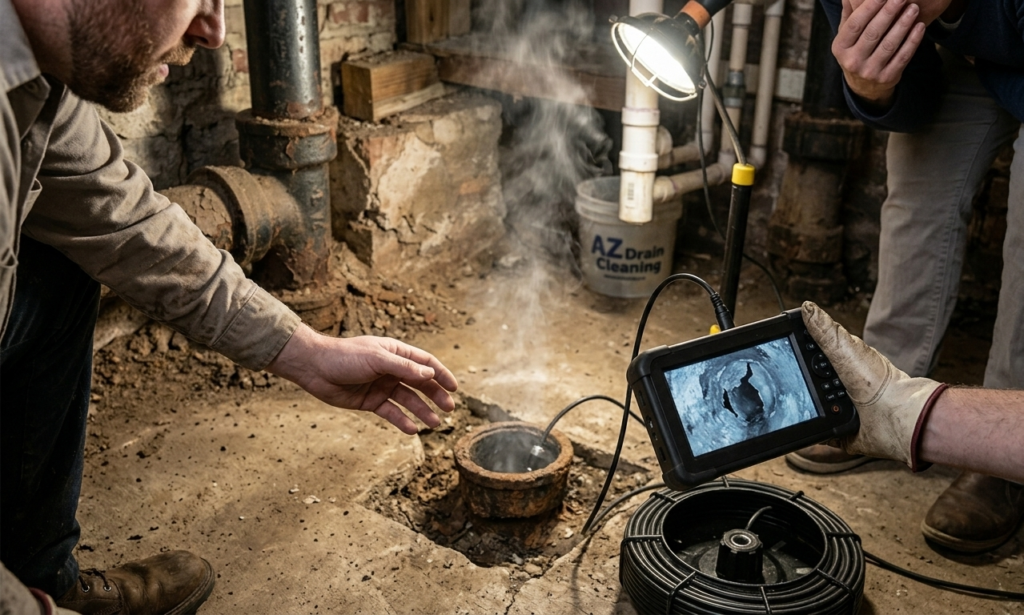
The camera travels the full length of the sewer line from a cleanout access point, transmitting live footage that shows the technician the exact location and nature of every problem in the pipe. The inspection reveals hairline cracks before they become full fractures, root intrusion at joint locations before roots fill the entire pipe diameter, offset joints where sections have shifted out of alignment, pipe bellies where sections have sagged and trap waste permanently, and collapse points where the pipe wall has caved inward.
Critically, the camera inspection also identifies pipe sections that are in sound condition. This matters enormously because it determines whether the appropriate response is spot repair of a single failed section, trenchless rehabilitation of the entire line, or full replacement. Recommending replacement for a pipe that has one damaged section and is otherwise sound is not appropriate. Recommending cleaning for a pipe that has six collapsed sections is equally inappropriate. The camera is what makes the recommendation accurate.
For Arizona homeowners specifically, the camera inspection before any major sewer work also identifies what happens to pipe depth and slope across the line, since Arizona’s clay soil movement during the monsoon season can shift pipe grade over years in ways that create low spots and bellies that trap waste regardless of how clean the pipe walls are.
Your Options When Replacement Is Confirmed
Once a camera inspection confirms that replacement rather than cleaning is the appropriate course of action, you have two primary pathways and the right choice between them depends on your property layout, the condition of existing landscaping and hardscape, and the extent of pipe damage.
Traditional Excavation and Replacement
Traditional open-cut sewer line replacement involves excavating a trench along the full length of the pipe run, removing the failed pipe, and installing new PVC sewer line in its place. The excavation is then backfilled and the surface restored.
This method is the most straightforward approach and is appropriate when the pipe runs through an area that can be excavated without significant damage to major landscaping features, structures, or existing hardscape. It provides complete access to every inch of the line, allows any soil contamination from the failing pipe to be observed and addressed during excavation, and results in a fully new pipe installation with a fresh service life.
The primary drawback in Arizona properties is that many residential sewer lines run beneath pool decks, concrete patios, paved driveways, mature desert landscaping, and in some cases under home additions or outbuildings. Excavating beneath these features is possible but expensive because of the restoration cost on top of the replacement work itself.
Trenchless Sewer Line Replacement
Trenchless methods accomplish sewer line rehabilitation or replacement without the continuous trench. Two primary approaches are used in Arizona residential applications.
Cured-in-place pipe lining, commonly called CIPP, involves inserting a flexible liner saturated with epoxy resin into the existing pipe. The liner is inflated against the inner surface of the old pipe and cured with heat or ultraviolet light, creating a seamless new pipe inside the original shell. The result is a smooth, corrosion-resistant interior with a service life of 50 years or more. CIPP is appropriate when the existing pipe still has a continuous path that the liner can travel, meaning it is not completely collapsed and does not have sections that have pulled entirely apart. It works especially well beneath Arizona driveways, pool decks, and patios where excavation would require significant restoration work.
Pipe bursting is a trenchless replacement method that pulls a new pipe through the old one while simultaneously fracturing the old pipe outward into the surrounding soil. It requires only small access pits at each end of the pipe run rather than a continuous trench. Pipe bursting is appropriate when the existing pipe has deteriorated past the point where lining is suitable but the replacement needs to avoid the disruption of open excavation. It is particularly well suited to the Orangeburg and severely deteriorated clay pipe situations that are common in older Arizona neighborhoods.
The trenchless drain repair option is worth discussing specifically in Arizona where the combination of pool equipment, desert landscaping, paved outdoor living areas, and concrete driveways means that open excavation restoration costs often exceed the pipe work itself. In many Arizona properties trenchless methods deliver a permanent replacement result at a total cost that is significantly lower than the combination of traditional excavation plus the surface restoration required afterward.
Arizona-Specific Factors That Accelerate Sewer Line Deterioration
Arizona homeowners face a set of conditions that wear sewer lines faster than property owners in most other parts of the country.
The clay soil that underlies most of the Phoenix metro area and surrounding Valley communities expands significantly when wet during monsoon season and contracts hard during the long dry periods. This cycling exerts continuous mechanical stress on underground pipe joints and walls. A clay pipe joint that holds firmly during a dry year may crack during the soil movement of a wet monsoon season. Cast iron pipes that are already thinned by internal corrosion are more vulnerable to fracture when the surrounding soil shifts.
Arizona’s groundwater and soil carry high mineral concentrations, particularly calcium and magnesium, the same compounds that cause the hard water scale problems visible in showers and kitchen fixtures. Inside sewer lines, these minerals deposit on pipe walls and contribute to the roughening of the interior surface that promotes buildup adherence. This is less critical in structurally sound pipes but becomes significant in older cast iron pipes where the corrosion and mineral deposits combine to create an interior surface that is barely recognizable as a pipe.
The extreme summer heat in Arizona, with surface temperatures regularly exceeding 110 degrees Fahrenheit, does not directly affect buried sewer lines at normal depths. However, it dramatically accelerates bacterial growth in any sewage that is pooling or leaking outside the pipe due to a crack or joint failure. What might be a manageable localized soil contamination issue in a cooler climate becomes a rapidly spreading and more intensely odorous problem in Arizona’s summer heat, which is one reason that sewer line failures in Arizona tend to produce more noticeable yard symptoms more quickly than in other climates.
Many of the sewer lines installed in Arizona during the significant housing development of the 1970s and 1980s are now 40 to 50 years old and approaching the end of their expected service life. A large proportion of the Phoenix metro housing stock from this era used cast iron pipe that is now showing or approaching significant internal corrosion. Homeowners in neighborhoods built during this period who have not had a recent camera inspection of their sewer line are operating with a significant unknown about the condition of a critical and expensive system.
The Cost of Waiting Versus Acting Proactively
This is where the financial reality of sewer line replacement becomes most important to understand, because the choice between proactive replacement and reactive replacement is actually a very significant economic decision.
Proactive replacement means you had a camera inspection, found a pipe with significant deterioration but not yet complete failure, got estimates, compared trenchless and traditional options, scheduled the work at your convenience, and chose the method that fit your property and budget. You controlled the timeline, the method, and the cost.
Reactive replacement means you are dealing with a sewage backup that has surfaced in your home, you are calling every available plumber at emergency rates, the first team available has no time to evaluate trenchless options before starting excavation, and you are dealing simultaneously with the replacement cost, the emergency service premium, the sewage cleanup and sanitization cost, and potentially the cost of repairing flooring, cabinetry, or wall materials that were damaged before the line was shut down.
The pipe replacement cost can be similar in both scenarios. Everything surrounding the replacement cost is dramatically different. Emergency service premiums, property damage costs, cleanup and sanitization, and the premium for traditional excavation when trenchless options were not planned in advance can collectively add thousands to the project cost.
A proactive main sewer line inspection that reveals a pipe with significant deterioration but not yet failure gives you time, options, and cost control. That same pipe discovered during an emergency backup gives you none of those things.
Frequently Asked Questions
Q: How do I know if my sewer line needs replacement or just cleaning?
The clearest indicator is whether professional cleaning produces lasting results. If a professionally snaked or hydro jetted line backs up again within a few weeks or a few months, the pipe structure itself is the problem rather than removable buildup. Multiple simultaneous drain backups, persistent sewage odors that do not resolve after cleaning, yard depressions or soggy patches above the pipe path, and sewage surfacing inside the home are all signs that point toward structural failure rather than a cleaning issue. The definitive answer comes from a camera inspection that shows the physical condition of the pipe interior.
Q: How often should I have my sewer line inspected if my home is older?
For homes built before 1980 with original cast iron or clay pipe, a camera inspection every three to five years is a reasonable interval. For homes built before 1970, particularly those in neighborhoods with significant tree canopy, annual or biennial inspections are worth considering. Any home with a history of recurring sewer backups, regardless of age, should have a camera inspection as part of each service call to document whether the condition is improving, stable, or deteriorating over time.
Q: What is Orangeburg pipe and how do I know if my home has it?
Orangeburg is a pipe material made from compressed wood pulp and pitch that was used extensively in American housing from the 1940s through the early 1970s as a cost-effective alternative to cast iron. It absorbs moisture, softens, deforms from a circular to an oval cross section, and eventually collapses under soil pressure. If your home was built between 1945 and 1972 and has never had its sewer line replaced, Orangeburg is a strong possibility. A camera inspection will identify the material visually, and if Orangeburg is found in any condition, replacement is the only appropriate response.
Q: Is trenchless sewer line replacement as durable as traditional excavation and replacement?
Yes. Cured-in-place pipe lining using modern epoxy resins produces a seamless, smooth pipe interior with a projected service life of 50 years or more that is chemically superior to the original clay or cast iron it replaces. The lining is resistant to corrosion, root penetration, and the mineral scale that contributes to buildup in older pipes. Pipe bursting installs entirely new PVC pipe with a fresh projected service life. Both trenchless methods deliver durability that matches or exceeds traditional excavation for a significant proportion of applications.
Q: Can I use chemical drain cleaners to address a sewer line that needs replacement?
No. Chemical drain cleaners containing sodium hydroxide or sulfuric acid generate heat and corrosive chemical reactions inside the pipe. In a deteriorating cast iron pipe, these chemicals accelerate the corrosion process. In a cracked clay pipe, the chemical reaction produces no benefit while the structural condition remains unchanged. Chemical cleaners address organic buildup in structurally sound pipes. They cannot repair cracks, close separated joints, restore collapsed sections, or address any of the structural problems that make replacement necessary.
Q: What is the typical cost of sewer line replacement in Arizona?
Costs vary significantly based on pipe length, depth, method, and site conditions. Trenchless lining typically runs from $80 to $200 per linear foot depending on pipe diameter and site access. Traditional excavation and replacement runs from $50 to $150 per linear foot plus restoration costs for any hardscape or landscaping disturbed during excavation. Most residential sewer line replacements fall in the range of $3,000 to $15,000 depending on the method and the distance from the house to the municipal connection. A camera inspection and professional assessment is the starting point for an accurate estimate specific to your property.
Q: Will sewer line replacement increase my home’s value?
Yes, in two ways. A documented sewer line replacement with new pipe and a post-completion camera inspection is a significant positive disclosure during a property sale that removes a major unknown for potential buyers. Homes with aging or failed sewer infrastructure often face price reductions, extended time on market, or failed inspections when the issue is discovered during the buyer’s due diligence. Proactive replacement before listing, or documentation of recent replacement, removes that uncertainty and supports the asking price.
Q: If roots are the cause of my backups, do I need replacement or can cleaning handle them?
It depends on the extent of root intrusion and the condition of the pipe at the entry points. A single root mass at a joint in an otherwise sound PVC or newer clay pipe can be addressed with cutting during a snaking or jetting service, followed by a root inhibitor treatment, and monitored regularly. Repeated root intrusion returning quickly after removal, root intrusion at multiple locations along the line, or root damage in combination with a pipe material that is already at or past its service life indicates that the entry points, the cracks and separated joints that roots exploit, are structural problems that cleaning does not fix. In these cases, trenchless drain repair that seals the entry points along with removing the existing root mass is the appropriate response, not repeated cutting that leaves the entry points open for the next growing season.
Q: How long does sewer line replacement take?
A trenchless cured-in-place lining of a standard residential sewer line typically takes one to two days from setup to completion, including the curing time. Pipe bursting is similarly completed in one to two days. Traditional open-cut excavation for a full residential sewer line replacement typically takes two to four days depending on length, depth, and restoration required. Emergency scheduling may extend timelines during peak demand periods, which is another practical advantage of proactive over reactive replacement planning.
The Bottom Line: When to Stop Cleaning and Start Replacing
If your sewer line has been professionally cleaned and the problem has returned, if multiple fixtures are backing up simultaneously, if you are smelling sewage that will not go away, if your yard has wet patches or depressions above the pipe path, or if your home was built before 1980 and the original pipe has never been replaced, the conversation you need to have is not about the next cleaning appointment. It is about what the camera inspection shows and what replacement method makes the most sense for your property.
Continuing to clean a pipe that needs replacement is not maintaining it. It is postponing a cost that is not going to decrease while allowing the structural condition to worsen toward the point where the choice gets made for you by a sewage backup inside your home rather than by an informed decision on your own timeline.
For homeowners across Phoenix, Scottsdale, Mesa,Chandler, Gilbert, Tempe, Glendale,Peoria, Surprise, Goodyear, Tucson, and throughout the Valley, Arizona drain cleaning specialists offer camera inspection, professional sewer line cleaning, and complete replacement options, including trenchless methods suited to Arizona’s soil and property conditions. Call Arizona Drain Cleaning at (602) 835-1451 right now to schedule a sewer line camera inspection and get a clear picture of what your pipe actually needs.