
Yard drainage solutions for Arizona homes work differently than they do almost anywhere else in the country, and that difference matters enormously when monsoon season arrives. Most of the year Arizona sits dry and baked, so drainage feels like the last thing to worry about. Then June hits, and in the span of ninety minutes your yard can receive two inches of rain that has nowhere to go. The ground beneath your feet is largely caliche and clay, two soil types that absorb water about as effectively as a parking lot. Water has no choice but to pool, rush, and accumulate against the very structures you are trying to protect. This guide covers every yard drainage solution that works in Arizona’s specific conditions, from simple grading corrections to French drains, channel drains, dry creek beds, catch basins, and underground systems, along with the warning signs that tell you something is already going wrong and what each solution actually costs.
Why Arizona Yards Have Unique Drainage Challenges
Before diving into solutions, it helps to understand exactly why Arizona properties face drainage problems that are fundamentally different from what homeowners deal with in wetter climates. The reasons come down to three interconnected factors: soil composition, rainfall intensity, and the way most Valley properties were originally graded.
Caliche and Clay Soil: The Invisible Problem Under Your Yard
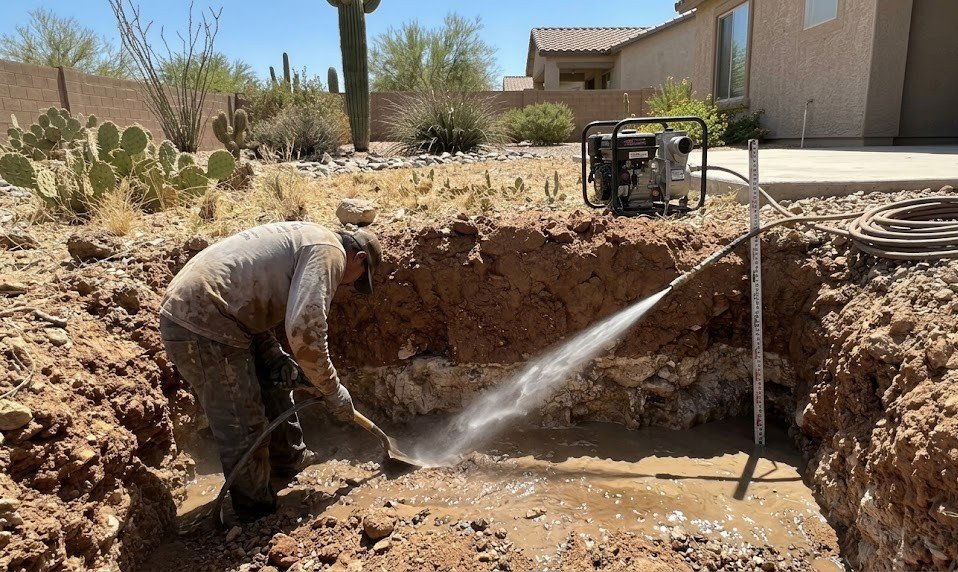
Arizona’s soil is dominated by two water-resistant materials. Caliche is a hardened calcium carbonate layer that sits anywhere from a few inches to several feet below the surface across much of the Phoenix metro area and beyond. It is essentially a naturally occurring concrete slab. When rain saturates the soil above it, the water hits caliche and stops. It cannot percolate down, so it spreads horizontally and surfaces wherever it finds the lowest point, which is usually your patio, your foundation, or a low corner of your yard.
Clay soil compounds the problem. Clay is dense, poorly permeable, and behaves dramatically differently depending on whether it is dry or wet. During Arizona’s dry months the clay bakes hard. When monsoon rain hits that baked surface, the water cannot penetrate fast enough to keep up with rainfall intensity and simply runs off the surface. Once clay does absorb water it expands significantly, a process that can shift underground pipes, crack hardscape surfaces, and destabilize foundations over time.
The combination of caliche beneath and clay above means the ground under a typical Arizona yard has very limited capacity to absorb any meaningful rainfall, regardless of how slowly or infrequently it comes.
Monsoon Intensity: The Drainage Challenge That Defines the Season
Arizona’s monsoon season runs roughly from mid-June through late September. The storms are not long and steady. They are fast, violent, and concentrated. A storm that drops two inches of rain in ninety minutes delivers the same water volume as a rain event that might take a full day in other parts of the country. A drainage system that would handle moderate rainfall perfectly well can be completely overwhelmed in twenty minutes during a monsoon cell.
This intensity is why drainage systems designed for Arizona need to move water fast and move it in volume. A solution that redirects water gradually is not adequate here. The system needs to capture and route high volumes quickly before pooling has time to build against foundations, seep under slabs, or saturate landscaping to the point of root damage and erosion.
Grading Issues in Existing Arizona Homes
A significant number of existing homes across the Valley, particularly those built in the 1970s, 1980s, and 1990s, were graded to a standard that made sense at the time but does not hold up under monsoon conditions or after decades of soil settling. In many properties the yard has shifted gradually toward the house rather than away from it. What was once a barely adequate slope has reversed direction entirely without the homeowner noticing because the change happened incrementally over years.
Homes where mulch has been added repeatedly in the same beds, where pavers or concrete have been installed without adequate attention to drainage slope, or where pools and hardscape additions have altered the natural water flow paths are particularly susceptible to this kind of grade reversal.
Warning Signs Your Arizona Yard Has a Drainage Problem
Most yard drainage problems announce themselves clearly if you know what to look for. Catching these signs early means addressing a manageable issue rather than a foundation repair.
Standing Water That Remains After a Storm
Water that pools in your yard and stays for more than 24 hours after a rain event is a direct indicator that the ground cannot absorb or redirect it adequately. In Arizona’s caliche and clay conditions, some surface puddling immediately after an intense monsoon is normal. Water that is still sitting the next morning or the morning after that is not normal and indicates either a grading problem, a blocked drainage outlet, or saturated soil over a caliche layer that has nowhere to drain.
Erosion Channels and Washed Out Gravel
When water moves across your yard with enough velocity to carry material with it, you will see the evidence afterward. Decomposed granite and decorative rock that has washed into plant beds, across walkways, or against the house is one of the most common post-monsoon sights in Phoenix neighborhoods. Erosion channels carved into soil between plants, along foundation edges, or beneath downspouts indicate concentrated water flow that is actively removing the ground surface that supports your landscaping and structural elements.
Moisture, Staining, or Efflorescence on Foundation Walls
White mineral deposits, dark staining, or damp patches on the exterior of your foundation, stem walls, or block fencing after rain events indicate that water is consistently making contact with those surfaces. Over time, this moisture intrusion promotes mold growth, degrades mortar joints, and in severe cases, contributes to foundation shifting. In Arizona homes with stucco exteriors, water staining often appears at the base of exterior walls when grading has allowed runoff to pond against the structure.
Musty Smells Inside the Home After Rain
If you notice a damp or musty odor inside the house following a monsoon storm, particularly in rooms adjacent to exterior walls or near the slab perimeter, moisture is finding a way in. This is usually a symptom of exterior grading that directs water toward the structure, combined with either inadequate foundation drainage or existing cracks in the stem wall.
Soil Settling and Cracking Around the Foundation
Arizona’s clay soil expands when wet and contracts when it dries. Repeated cycles of expansion and contraction across the monsoon season can cause visible cracking in soil, hardscape, or the foundation itself. Gaps opening at the base of walls, cracks running diagonally from window corners, or doors that begin sticking after the rainy season are all signals worth investigating. Proper yard drainage that removes water from the foundation zone reduces the severity of these soil movement cycles.
Slow or Backed-Up Outdoor Drains
Patio drains, pool deck drains, and driveway drains that fill up during a storm rather than clearing quickly indicate either a blockage in the connected pipe or a drainage system that is undersized for the volume arriving during a monsoon event. A yard drain cleaning service can identify whether the problem is debris buildup inside the pipe, a crushed or separated pipe section, or a system capacity issue.
The Best Yard Drainage Solutions for Arizona Homes
No single solution fits every property. The right approach depends on your specific soil conditions, the location of water problems relative to the house and hardscape, your existing grade, and the volume of water your yard needs to manage. Many properties benefit from a combination of two or more methods working together.
Landscape Regrading
Regrading is often the first and most fundamental solution because it works with gravity rather than trying to engineer around it. Proper grading means the yard surface slopes consistently away from the house in every direction at a rate of roughly one inch of fall for every foot of horizontal distance for at least the first six feet surrounding the structure. Beyond that, a more gradual slope that continues directing water toward a designated outlet, swale, or street is ideal.
In practice, regrading involves adding or redistributing soil to correct low spots, raise areas that have settled, and restore the outward slope around the foundation perimeter. In Arizona homes where decomposed granite and rock landscaping have accumulated against the house over years of additions and topping off, regrading often means removing material and re-establishing the grade before replacing the surface treatment.
Regrading is the most impactful and lowest-tech drainage improvement available. It does not require installing any drainage infrastructure, it does not need ongoing maintenance, and when done correctly it prevents the accumulation problem rather than simply routing accumulated water away after the fact. For many Arizona homes where grading has gradually reversed toward the structure, regrading alone solves the primary drainage complaint.
French Drains
A French drain is a subsurface drainage system consisting of a trench filled with gravel surrounding a perforated pipe. The trench intercepts groundwater or surface runoff and channels it through the perforated pipe to a designated outlet, which may be a street, an alley, a dry well, or a more distant point in the yard that can handle the water safely.
French drains are particularly well suited to Arizona properties where water consistently collects along the same path or in the same low area. Foundation perimeters where monsoon runoff routinely ponds, side yards with no outlet for water flowing from the back yard, and areas between structures where surface drainage is not feasible are all strong candidates for French drain installation.
The design of a French drain in Arizona needs to account for the caliche layer. If the trench is dug only to the level of the caliche and stops, the perforated pipe will still collect surface and near-surface water effectively. However, if the designer assumes the water will percolate down through the trench bottom and into the soil, the caliche will prevent that from happening. The outlet pipe at the end of the system must have a clear path to daylight or to a dry well that sits below the caliche layer, otherwise water simply fills the trench and has nowhere to go.
Filter fabric wrapped around the gravel prevents Arizona’s fine clay and silt particles from migrating into the gravel over time and clogging the system. Without it, a French drain in clay-rich soil will gradually lose its effectiveness as the voids in the gravel fill with fine material.
Channel Drains and Catch Basins
Channel drains are linear drainage grates set into paved or hardscaped surfaces to collect sheet flow water across a wide area and funnel it into an underground pipe. They are commonly installed across the full width of a driveway at the garage apron, along the base of retaining walls, at the edge of pool decks, across patio entries, and at any hardscaped transition where water moves in a sheet and needs to be intercepted before it reaches a door or foundation opening.
Catch basins serve a similar function but collect water from a single point rather than across a linear run. They are installed at low spots in hardscape or at the bottom of concentrated flow paths. The basin collects water through a grate at the surface and routes it through a connected pipe to an outlet. In Arizona yards with decomposed granite surfaces, catch basins capture not just water but the fine material that monsoon flow carries with it, preventing that material from entering and clogging the connected drainage pipe. The basin requires periodic cleaning to remove accumulated sediment, which is exactly the service provided by a professional storm drain cleaning visit before each monsoon season.
Both channel drains and catch basins connect to underground drainage pipes that need to be sized appropriately for the volumes arriving during a peak monsoon event. Undersizing the connected pipe is one of the most common installation errors and results in a system that backs up during the heaviest storms, which is precisely when you need it to work.
Dry Creek Beds and Swales
A dry creek bed is a shallow, rock-lined channel designed to carry water across the property during rain events while appearing as a natural decorative landscape feature during dry periods. It works by concentrating surface flow into a defined path and directing it toward a safe outlet such as a street, an alley, or a point in the yard that can absorb or store the volume.
In Arizona this solution has particular appeal because it suits the desert aesthetic naturally. A dry creek bed lined with river rock, boulders, and desert-adapted plants looks entirely at home in a Sonoran Desert landscape. It does not require any underground infrastructure, it handles very high flow volumes by simply widening and deepening the channel as needed, and it can be routed across a property in a way that works with existing landscaping rather than disrupting it.
Swales are vegetated or gravel-lined depressions that serve the same routing function more gently. They spread water laterally as it flows, slowing its velocity and giving it more opportunity to infiltrate the soil or be redirected to a safe outlet. In Arizona, a swale planted with low water use plants that can tolerate periodic inundation serves double duty as both a drainage feature and a water harvesting element, directing monsoon runoff toward plants that can use it rather than letting it leave the property as wasted runoff.
The key design requirement for both dry creek beds and swales in Arizona is that they must have a defined outlet. A dry creek bed that ends in a low corner with nowhere to go simply creates a concentrated pooling point rather than solving the problem.
Dry Wells
A dry well is an underground chamber, typically a large perforated container or a gravel-filled pit, designed to receive water from a downspout, a French drain, or a catch basin and allow it to percolate slowly into the surrounding soil over time. In the right conditions it is an elegant and nearly invisible solution that eliminates the need to route water to a street or alley outlet.
In Arizona the effectiveness of a dry well depends almost entirely on what the soil looks like below the installation depth. If the dry well can be installed deep enough to reach below the caliche layer and into the more permeable native soil beneath it, it can work very well. If the caliche layer is shallow and the dry well sits entirely within the zone that drains poorly, it will fill during a monsoon and overflow without providing meaningful drainage relief.
A professional site assessment that includes probing or testing for the depth and hardness of the caliche layer is essential before committing to a dry well as the primary drainage solution for any Arizona property.
Underground Drainage Pipe Systems
For properties with complex drainage challenges, multiple problem areas, or significant volumes of water to manage, a connected underground pipe system that routes water from multiple collection points to a single outlet is often the most comprehensive solution. This type of system integrates catch basins, channel drains, and potentially downspout connections into a network of PVC drainage pipe sized to handle monsoon flow rates, with a single clean outlet to the street or an engineered discharge point.
These systems require professional design and installation to ensure correct slope, adequate pipe sizing, proper joint connections, and appropriate outlets. They are the most expensive option but also the most capable, particularly for properties where simpler surface solutions are not feasible due to existing hardscape, structures, or soil conditions.
When underground pipe systems already exist on a property, regular maintenance becomes critical. Debris, silt, and root intrusion accumulate inside drainage pipes just as they do in sewer lines. A pipe inspection with video camera reveals exactly where blockages have formed, where pipes have settled or separated at joints due to caliche soil movement, and whether the system is capable of handling the coming monsoon season before the first storm arrives.
Downspout Extensions and Buried Gutter Drains
A common and underappreciated source of foundation zone water problems in Arizona homes is the downspout. Many properties have downspouts that terminate at the foundation wall or within a foot or two of it, depositing the entire volume of roof runoff directly against the structure. During an intense monsoon a single downspout can deliver dozens of gallons per minute directly to the most sensitive location on the property.
Extending downspouts with surface extensions that carry water at least six feet from the foundation is the most basic correction. For a cleaner and more effective solution, burying a rigid PVC drain pipe from the downspout outlet to a point well away from the house, either to daylight, to a dry well, or into a connected drainage system, eliminates the concentrated roof runoff problem. This is one of the highest return investments available for protecting an Arizona foundation from monsoon season water damage.
Arizona Specific Drainage Considerations by Property Type
Single Family Homes in the Phoenix Metro Area
Properties throughout Phoenix, Scottsdale, Mesa, Chandler, Gilbert, Tempe, Glendale, Peoria, Surprise, and Goodyear share the common challenges of hard-packed caliche soil, intense monsoon flow, and landscape designs that were often installed without adequate drainage planning. The most common drainage failures in these markets are foundation perimeter ponding from grade reversal, driveway apron flooding, and back yard pooling against rear walls and patios.
For most Phoenix metro single family homes, the combination of perimeter regrading around the foundation, catch basins or channel drains at driveway aprons and patio entries, and at least one dry creek bed or swale to move back yard water toward an outlet addresses the majority of drainage complaints at a reasonable cost.
Older Homes With Original Drainage Systems
Homes built before 1990 throughout the Valley often have original drainage pipe that has been in the ground for thirty or more years. In Arizona’s expanding and contracting clay soil, this means pipe joints have been stressed through hundreds of seasonal cycles. Underground drainage pipes on older properties should be camera-inspected before any monsoon season where drainage performance is expected. Separated joints, settled pipe sections with reverse grade, and caliche infiltration through cracked pipe walls are all findings that a pipe inspection with video camera reveals clearly.
Properties where outdoor drains are slow or where water has been backing up at surface grates for more than one season typically need professional yard drain cleaning as an immediate first step before any system assessment or upgrade work can be accurately scoped.
Properties Near Washes and Canals
The Phoenix metro area and surrounding communities have an extensive network of natural washes, engineered drainage channels, and canals. Properties with lot boundaries adjacent to these features face specific drainage obligations and restrictions. Many municipalities regulate what can be placed within certain distances of a wash, what flow can be directed toward a wash during rain events, and how private drainage systems must connect to or separate from public drainage infrastructure.
If your property is near a Maricopa County Flood Control District wash or a Salt River Project canal, confirming local requirements before installing any drainage system that directs water toward those features is an important step that avoids violations and ensures your system does not create liability for downstream properties.
Properties With Pools and Extensive Hardscape
Pools, pool decks, extended patio areas, and outdoor kitchens create large impervious surfaces that shed water rapidly toward their perimeter. In Arizona where outdoor living spaces are expansive and frequently paved with cool deck, travertine, concrete, or pavers, these surfaces generate significant sheet flow during a monsoon. The drainage around a pool and patio complex needs to be specifically designed to capture and route this sheet flow before it reaches the house or saturates adjacent planting areas.
Perimeter channel drains around the outer edge of the pool deck, combined with a catch basin at the lowest point of the deck, connect to an underground drainage pipe that routes to a safe outlet. The slope of the deck surface itself needs to direct water toward these collection points consistently across the entire area. This is an area where professional drainage solutions for landscaping scoped by someone familiar with Arizona’s specific pool and patio drainage requirements produces the most reliable result.
How Much Do Yard Drainage Solutions Cost in Arizona?
Cost varies significantly based on the scale of the problem, the solution selected, and the complexity of the property. Here is a practical overview of what each approach typically costs in the Arizona market.
Landscape Regrading
Simple regrading around the foundation perimeter of a standard single family home typically ranges from $500 to $2,000 depending on how much material needs to be moved and whether the existing landscape requires significant disturbance. Full property regrading that reshapes the entire yard to correct systemic flow direction problems can range from $2,000 to $8,000 or more depending on lot size and the amount of existing hardscape that must be worked around.
French Drain Installation
A basic French drain installation in a residential yard typically costs between $1,500 and $5,000 depending on the length of the trench, the depth required to reach past the caliche layer, the outlet conditions, and whether filter fabric and adequate aggregate are included. Shortcuts that omit filter fabric or inadequate gravel surrounding the pipe produce systems that fail within a few seasons.
Channel Drains and Catch Basins
Individual catch basin installation including the connected pipe run to an outlet typically costs $800 to $2,500. Channel drain installation across a driveway apron or patio edge runs $1,000 to $3,500 depending on the length of the drain and the pipe routing required. Connected systems incorporating multiple basins and channel runs scale accordingly.
Dry Creek Beds and Swales
A professionally designed and installed dry creek bed serving as both a functional drainage channel and a landscape feature typically costs $2,000 to $6,000 depending on length, width, the materials used, and any planting incorporated along the edges. DIY dry creek beds are feasible for simpler applications but require careful attention to inlet, outlet, and slope design to actually function as intended.
Downspout Extensions and Buried Gutter Drains
Surface downspout extensions are a very low cost fix, typically $25 to $75 per downspout including materials. Buried PVC drain lines from downspouts to a distant outlet typically cost $300 to $800 per downspout depending on distance and the complexity of routing through existing landscaping.
Before Monsoon Season: The Arizona Drainage Checklist
Every Arizona homeowner should walk through this checklist before the first June storm arrives. Most of these steps take fifteen minutes and cost nothing. Catching a problem before the storm is always better than discovering it during one.
Walk the perimeter of your home and look at the soil grade against the foundation. Any area where the ground is sloping toward the house rather than away from it needs attention. Pour a bucket of water at the base of the foundation in any questionable area and watch where it goes.
Locate every outdoor drain on your property. This includes patio drains, pool deck drains, driveway drains, and any surface grates visible in the yard. Pour water into each one and watch how quickly it clears. Slow clearing indicates partial blockage in the connected pipe. No clearing at all indicates a full blockage or a separated pipe that needs professional assessment. A professional storm drain cleaning service before monsoon season is the reliable way to confirm every outdoor drain is capable of handling peak flow.
Check downspout outlets and confirm that water exiting your gutters is directed at least six feet from the foundation. If any downspout terminates directly against the house, extend it before the first storm.
Look for erosion evidence from the previous monsoon season, such as channels carved into decomposed granite, rock that has washed into plant beds or against walls, and bare soil exposed where material was removed by water flow. These marks tell you exactly where concentrated flow is occurring and where drainage intervention is needed.
Inspect any existing catch basins or channel drain grates and remove accumulated debris. Desert properties collect significant amounts of wind-blown material in drain grates between storm events, and a grate blocked by leaves, gravel, and debris provides almost no drainage when the water arrives.
Frequently Asked Questions
Q: Why does my Arizona yard flood when we barely get any rain?
Because Arizona’s caliche and clay soil absorbs water extremely slowly, even a modest rainfall can produce significant surface ponding if the grade is not directing water away from your yard efficiently. A storm that delivers half an inch of rain in twenty minutes can generate the same surface pooling as two inches of slow, steady rain elsewhere. The combination of hard soil, high rainfall intensity, and inadequate grading is the most common explanation for yards that flood despite relatively low annual precipitation totals.
Q: What is the most effective yard drainage solution for Arizona specifically?
There is no single answer, but for most Phoenix metro area homes the combination of corrected grading around the foundation and either a French drain or dry creek bed to route back yard water toward an outlet addresses the majority of drainage complaints. For properties with extensive hardscape, channel drains and catch basins are essential additions. The right solution always starts with identifying where water is coming from, where it is going, and what is stopping it from leaving.
Q: How deep does a French drain need to be in Arizona to work properly?
Depth depends on the caliche layer. The perforated collection pipe needs to sit below the depth where surface and near-surface water accumulates, typically twelve to eighteen inches in most Phoenix metro soils. More importantly, the outlet for the system needs to have a clear path to daylight or to a dry well that can receive the collected water. If the outlet is blocked by caliche or has no gravity path to empty, the trench will fill and stay full regardless of depth.
Q: Can I install a dry creek bed myself to fix my drainage problem?
A dry creek bed is one of the more DIY-accessible drainage solutions if the water routing path is straightforward and a clear outlet exists. The critical requirements are a consistent downward slope from inlet to outlet of at least one percent, an inlet that actually captures the water you are trying to manage, and an outlet that disperses or discharges the water safely. Dry creek beds that look beautiful but end at a wall, under a tree, or in another low corner of the yard simply relocate the pooling problem rather than solving it.
Q: How often should outdoor drains be cleaned in Arizona?
At minimum, every outdoor drain should be inspected and cleared of debris before monsoon season begins, typically in May or early June. Properties in areas with heavy decomposed granite landscaping, significant tree canopy, or a history of drain slowness should schedule professional drain cleaning annually. Catch basins that collect sediment should be cleaned at least once a year and inspected immediately after any particularly intense storm that carries significant material across the yard surface.
Q: Will fixing my yard drainage also protect my foundation?
Yes, directly. Standing water against a foundation exposes it to the repeated wet and dry cycles that cause Arizona clay soil to expand and contract, progressively stressing the foundation and any concrete work adjacent to it. Water that infiltrates around the foundation perimeter also increases the risk of slab moisture, interior humidity problems, and in homes with block or stem wall construction, mortar degradation. Proper yard drainage that removes water from the foundation zone is one of the most effective long-term foundation protection measures available.
Q: Should I hire a professional or can I fix yard drainage myself?
Minor regrading and simple downspout extensions are well within DIY capability for most homeowners. French drain installation, underground pipe systems, and catch basin work require more precise grading, adequate pipe sizing, and knowledge of local soil conditions to be done correctly. An improperly installed French drain that lacks filter fabric, has inadequate slope, or terminates in a location that cannot accept the water will fail quickly in Arizona conditions. For anything beyond surface corrections, a professional assessment of your specific soil and grading conditions produces a solution that actually works rather than one that looks finished but fails at the first monsoon.
Q: What happens to underground drainage pipes after a monsoon season in Arizona?
Arizona’s clay and caliche soil moves with each wet and dry cycle. Underground drainage pipes experience the same stress that sewer lines face, including settled sections with reversed grade, separated joints, and caliche infiltration into cracked pipe walls. After a significant monsoon season, any outdoor drain that performed worse than expected, backed up during a storm, or is now draining noticeably more slowly than before should be professionally inspected. A pipe inspection with video camera shows exactly what happened inside the pipe and whether clearing, repair, or replacement is needed.
The Bottom Line on Yard Drainage for Arizona Homes
Yard drainage in Arizona is not a problem you can defer until it becomes an emergency. The combination of caliche soil, monsoon intensity, and the natural tendency of clay soil to shift foundations over time means that water problems compound with each passing season if they are not addressed. What starts as a puddle that takes a day to dry out can become a foundation moisture problem within a few years and a structural repair job within a decade.
The solutions covered in this guide, from regrading and French drains to dry creek beds, channel drains, catch basins, and underground pipe systems, are all proven approaches that work in Arizona’s specific conditions when they are designed and installed correctly. The key is matching the right solution to the actual problem on your property rather than applying a generic fix and hoping it is enough.
For homeowners across Phoenix,Scottsdale,Mesa,Chandler,Gilbert,Tempe,Glendale,Peoria,Surprise,Goodyear,Tucson, and throughout the Valley, a professional drainage assessment before monsoon season is the most valuable investment you can make in your property this year. Arizona drain cleaning specialists who understand local soil conditions, caliche layers, and the specific demands of monsoon season drainage can evaluate your yard, identify what is failing, and recommend the exact combination of solutions your property actually needs.
Call Arizona Drain Cleaning at (602) 835-1451 right now to schedule a pre-monsoon yard drainage inspection or to have an existing outdoor drain cleaned and camera-inspected before the season begins.