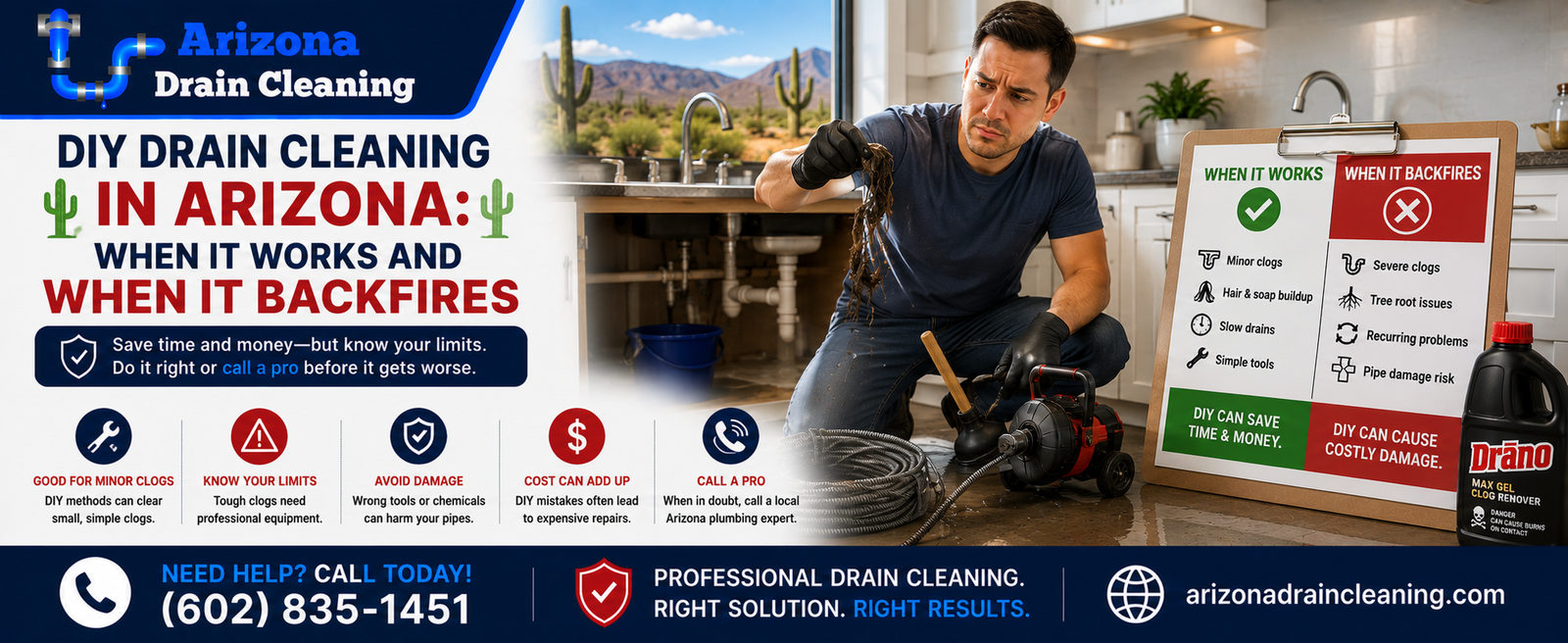
DIY drain cleaning in Arizona is worth trying in the right situations and a complete waste of time and money in others. The problem is that most homeowners do not know which situation they are in until they have already spent two hours on it, poured something down the drain they probably should not have, and ended up in the same place they started, except now they are also dealing with a chemical smell in the bathroom.
This is exactly where Arizona drain cleaning becomes more than just a quick DIY decision. It is not about whether you can try to fix the issue yourself, but whether the clog type, pipe condition, and buildup inside your system actually respond to simple home methods.
This guide is not going to tell you that every slow drain needs professional help. That would not be honest. Some clogs respond perfectly well to a $4 drain tool from the hardware store. But Arizona has specific plumbing conditions that make DIY drain cleaning fail more often than it does in most other states, and knowing where that line is will save you time, money, and in some cases, actual pipe damage.
When DIY Drain Cleaning in Arizona Actually Works
Let’s start with the situations where doing it yourself is genuinely the right call.
Hair Clogs in Shower and Tub Drains
This is the most fixable DIY drain situation in any home, including Arizona homes. A shower drain that is slow because hair has accumulated around the drain screen and in the upper portion of the trap is not a plumbing problem. It is a maintenance task.
A plastic hair removal tool, sometimes called a drain shark or drain claw, costs a few dollars and pulls hair clogs out of shower and tub drains in under five minutes. You insert it into the drain, feel for resistance, and pull up. What comes out is unpleasant, but the problem is solved. This works reliably when the clog is within the first six to twelve inches of the drain opening, which hair clogs almost always are.
If you remove visible hair from the screen and the drain is still slow, the blockage is further down and the plastic tool is not going to reach it. That is the point where the situation changes category.
Minor Slow Kitchen Drains From Recent Grease Buildup
A kitchen drain that started running slowly in the past few weeks, in a home where grease has been going down the drain, can sometimes be addressed with a simple hot water flush combined with a small amount of dish soap. The soap acts as an emulsifier on fresh grease before it has fully hardened. This works when the grease layer is thin and recent. It does not work on grease that has been accumulating for months or on a drain that has been slow for a long time.
To be clear about Arizona specifically: the hard water throughout Phoenix, Scottsdale, Mesa, Tempe, and the broader Valley means grease mixes with mineral deposits inside drain pipes and forms a compound that is significantly harder to break down than grease alone. In Mesa, water hardness averages about 17 grains per gallon, classified as very hard, and every time water flows through drainpipes, it leaves behind a thin layer of calcium and mineral scale. That layer makes grease adhere to pipe walls more aggressively than it would in a soft-water environment. So while the hot water and dish soap approach can work on a very fresh, minor grease issue, it has a much shorter effective window in Arizona than in most other parts of the country.
Where DIY Clogged Drain Solutions in Arizona Fall Short
This is the more important part of the conversation for most Valley homeowners, because this is where people end up spending money on multiple attempts before eventually calling a professional anyway.
Chemical Drain Cleaners: The Arizona Hard Water Problem
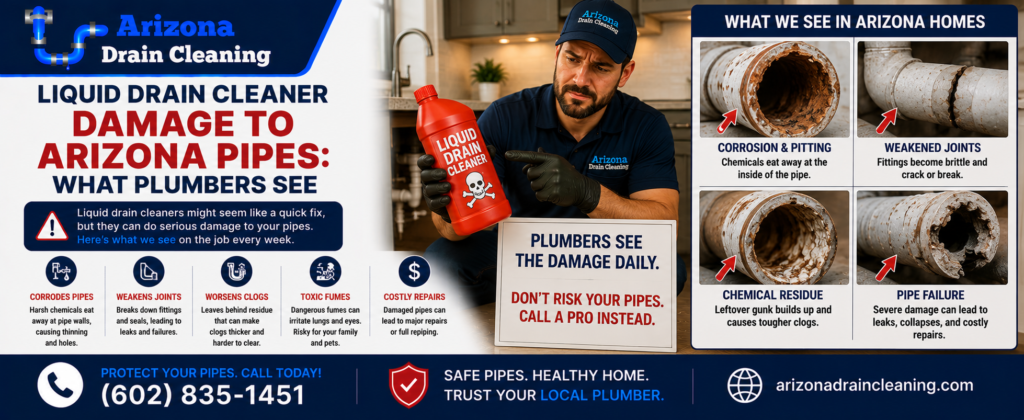
Chemical drain cleaners are the first thing most people reach for, and in most situations in Arizona, they are not the right tool. Commercial drain cleaners are generally only a temporary solution, and they may mask the root cause of the problem by preventing you from getting professional help before the issue escalates. Repeated use can also corrode pipes, especially older pipes, causing cracks that lead to costly damage over time.
Beyond the general limitations, there is an Arizona-specific reason chemical cleaners underperform here. Arizona’s hard water creates mineral scale inside drain pipes that chemical cleaners are not designed to dissolve. Drain cleaners like Drano and Liquid-Plumr use either lye or sulfuric acid to break down organic material such as hair and grease. They have virtually no effect on calcium and magnesium carbonate scale, which is the dominant form of buildup in Arizona pipes after years of very hard water running through them. So when a Phoenix or Scottsdale homeowner pours chemical drain cleaner into a drain that is slow due to hard water scale buildup, the chemical may clear a small amount of organic debris while leaving the primary obstruction completely intact.
The other real concern with chemical cleaners in Arizona is what they do to older pipe materials. Central Phoenix, Tempe, Arcadia, and midtown Tucson neighborhoods have a significant number of homes with cast iron or clay tile drain laterals that are 40 to 60 years old. Overly aggressive drain cleaners can corrode pipes, and repeated use may cause cracks that could lead to costly damage over time. Pouring harsh chemicals repeatedly into an already-compromised older pipe is not a solution. It is an acceleration of an existing problem.
Rental Drain Snakes: Effective Tool, Real Risk in the Wrong Hands
A drain snake rental from Home Depot or a local hardware store gives you access to a more capable tool than a plastic hair puller. A metal drain snake with a long flexible auger on the end is used by feeding it into the drain line while turning a handle to spin the cable inside the pipe. When you feel resistance, you have likely found your blockage. This method has better results than a plastic model, but it can be more dangerous.
The danger is not hypothetical. Several things can go wrong when a homeowner without training uses a rental cable snake on a residential drain.
First, cable snakes can damage pipe walls if they are forced through a bend at the wrong angle or if too much rotational force is applied. In older cast iron pipes with some interior corrosion, a cable that snags and torques can crack or fracture the pipe wall. This is genuinely more likely in Arizona’s older neighborhoods where the pipe material has been compromised by decades of hard water corrosion and soil movement.
Second, a cable snake can get stuck. When this happens to a professional, they have the experience and tools to extract it. When it happens to a homeowner with a rental tool, it can become a significantly more complicated and expensive situation than the original slow drain.
Third, and most importantly, snaking a drain requires caution because excessive force can damage your pipes. In these instances it’s best to call a professional. A cable snake that punches through a soft clog and makes the drain appear to run better has not necessarily cleared the actual blockage. It may have simply opened a small channel through a larger accumulation that will close again within days. If the drain was slow due to hard water scale, the cable physically cannot remove that scale. It can only poke a hole through it temporarily.
Drain snake rental in Arizona is a reasonable option for a soft clog in a drain you can access easily, with a pipe that is in reasonable condition, and where you can feel confident you know what you are doing with the tool. For older pipes, main line situations, or any drain that has been slow for an extended period, the rental snake is more likely to give you a false sense that the problem is solved than to actually resolve it.
DIY Drain Cleaning Phoenix Homeowners Should Never Attempt
Some situations look like drain cleaning jobs but are not. These are the ones where attempting DIY makes the problem worse and the professional repair more expensive.
Anything Involving Multiple Drains at Once
When water backs up in sinks or toilets when you run your washing machine or dishwasher, it is a clear indicator of a blockage that likely requires professional intervention. If your toilet gurgles when you run the shower, if multiple drains are slow simultaneously, or if a main line backup has water surfacing in the lowest fixture in your home when you flush or run water elsewhere, this is a main sewer lateral issue. No retail drain cleaning product and no consumer-grade snake reach the main lateral from inside the house with any meaningful effect. These situations need a professional with the right equipment, specifically hydro-jetting at 3,000 to 4,000 PSI or a commercial-grade cable machine with the correct head for main line work.
Attempting to address a main line blockage with chemical drain cleaner or a short drain snake is not just ineffective. It delays the professional service that the situation actually requires, sometimes long enough that a backup becomes a sewage overflow into the home.
Any Drain That Keeps Coming Back
If your drains keep clogging after DIY attempts or basic snaking, the underlying cause has not been addressed. Recurring blockages in the same drain are not bad luck. They are the drain system telling you that something structural is contributing to the problem, whether that is a bellied section of pipe catching debris at a low point, root intrusion creating a narrowed passage that catches material, or hard water scale that has reduced the effective diameter of the pipe to the point where normal use regularly creates blockages.
In Arizona, recurring drain problems are particularly likely to have an underlying soil-driven cause in older homes. If you have had a professional clean the same drain twice in 12 months and it came back both times, a camera inspection is the right next step. Our post on how to read a sewer camera inspection report in Arizona explains what those inspection findings mean and what action each one actually requires.
Tree Root Situations
You will not know you have root intrusion in your drain line from inside the house until it backs up. By the time a root blockage is serious enough to slow a drain noticeably, the root mass inside the pipe is substantial. A plastic tool does nothing against roots. A rental cable snake can punch through a root mass and create temporary improvement, but without removing the root entry point, the mass regrows within one to three growing seasons. Tree roots search for moisture and can invade sewer lines. If you have had issues before, consider a professional inspection.
In Arizona, where palo verde, mesquite, and African sumac root systems aggressively follow the perched moisture that caliche hardpan creates near sewer lines, root intrusion is a specific and common finding. This is one area where DIY intervention does not just fail to help. It can give you the false impression that the problem is resolved when the root mass is still inside the pipe and growing.
When to Stop DIYing and Make the Call
Here is a plain-language framework for when to stop and call a professional.
Stop attempting DIY and call the same day if: water is backing up into the tub or floor drain when you flush the toilet, multiple fixtures are slow simultaneously, or any drain is producing sewage odor despite normal use. These are not advanced DIY territory. These are situations where delay makes the outcome worse and more expensive.
Schedule professional service within a few days if: a drain you have attempted to clear twice in the past month is slow again, a kitchen drain responded partially to DIY but is still not running freely, or a shower drain that you cleared of visible hair is still draining slowly.
The timing matters in Arizona specifically because of monsoon season. A drain that is marginal heading into June is a drain that backs up in July. Pre-monsoon season, April and May, is the best window to address any drain situation that has not fully responded to DIY efforts before the first storms arrive.
For drain cleaning in Phoenix when the DIY approach has reached its limit, Arizona Drain Cleaning handles everything from standard drain cleaning to hydro jetting and camera inspection for situations that need a real diagnosis rather than another attempted fix.
And if you have been reading about Arizona’s hard water and wondering what it is actually doing inside your pipes over time, the post on summer drain care in Arizona covers how the heat and monsoon cycle compound drain wear in ways that affect how quickly DIY solutions stop being effective.
Frequently Asked Questions
Is it safe to use Drano or Liquid-Plumr in Arizona homes?
For very minor, fresh organic clogs like a small amount of hair in a bathroom sink, chemical drain cleaners can provide temporary relief. However, they are largely ineffective against the hard water mineral scale that accumulates inside Arizona pipes due to the Valley’s very high water hardness levels. They also pose a real risk to older cast iron and clay tile pipes in central Phoenix and Tucson neighborhoods, where repeated chemical exposure can accelerate corrosion in already-compromised pipe walls. If a drain is chronically slow, chemical cleaners are masking the problem rather than solving it, and professional cleaning or a camera inspection is the more appropriate response.
What is the best DIY tool for a slow drain in a Phoenix home?
For bathroom sink and shower drains, a basic plastic hair-removal tool is the most effective DIY option for the most common type of residential clog. For kitchen drains with minor grease buildup, a hot water flush combined with dish soap can work on recent accumulation. A rental drain snake is a more capable tool but carries a real risk of pipe damage in older homes if used without experience, and it is ineffective against hard water scale regardless of how it is used. The right DIY tool depends entirely on what type of blockage you are dealing with, and in Arizona, hard water scale is often a contributing factor that no consumer-grade tool addresses effectively.
My shower drain is still slow after I removed all the visible hair. What now?
If the visible hair at the screen has been cleared and the drain is still running slowly, the blockage is further down the line than the plastic tool reached. In Arizona, the most common cause of persistent shower drain slowness after surface cleaning is a combination of hair deeper in the trap arm and hard water mineral scale that has roughened the pipe interior and is catching debris more aggressively. This situation does not respond to chemical cleaners. It typically responds to professional hydro jetting, which strips the scale and debris from the pipe interior at high pressure rather than just punching a channel through it.
How do I know if my slow drain is a DIY fix or a professional job?
Single fixture, recent onset, and responding partially to basic clearing: probably a DIY situation worth attempting. Multiple fixtures slow simultaneously, recurring problem after previous cleaning, drain that partially cleared but came back within days, or any situation where you hear gurgling in one drain when using another fixture: these are signs the problem is in the shared main drain line or has a structural cause that a consumer-grade tool will not resolve. In Arizona specifically, any slow drain in a home built before 1985 deserves professional assessment because the pipe materials in those homes have been under Arizona soil stress conditions long enough that the drain problem may have a structural component rather than a simple accumulation.
Can I rent a drain snake from Home Depot and safely clear a main sewer line blockage myself?
Technically possible, practically inadvisable for most homeowners. Main sewer line snaking requires a sectional drum machine with the correct cutting head for the type of blockage and the pipe material. The rental equipment at big-box hardware stores is appropriate for branch line work, not main lateral cleaning in most residential applications. Using the wrong cutting head on a main line root intrusion, for example, can push the root mass further down the line rather than removing it. And in Arizona homes with older cast iron or clay tile laterals, main line cable work by someone without experience with those pipe materials carries a meaningful risk of causing a joint separation or fracture that converts a drain cleaning job into a pipe repair. If the main line is the issue, the professional service call is worth the cost.
Sometimes the Honest Answer Is That the DIY Window Has Closed
DIY drain cleaning in Arizona makes sense for the right situations. Hair in the shower, a minor fresh kitchen slow-down, a drain that responds completely to basic cleaning and stays clear. Those situations exist and they do not require a service call.
But Arizona’s hard water, the soil conditions under Valley homes, the age of pipe systems in so many Phoenix and Tucson neighborhoods, and the root intrusion dynamics that come with desert landscaping near sewer lines mean that a meaningful percentage of drain problems in this market do not respond to anything you can buy at the hardware store. Trying to force a solution that is not appropriate for the actual problem costs time, sometimes causes additional damage, and usually results in a professional service call anyway, just later and under worse circumstances.
When the DIY approach has reached its limit, Arizona Drain Cleaning is the call to make. Contact us today (602) 835-1451 or visit our Phoenix drain cleaning service page for straightforward professional service without the upselling or the runaround.