
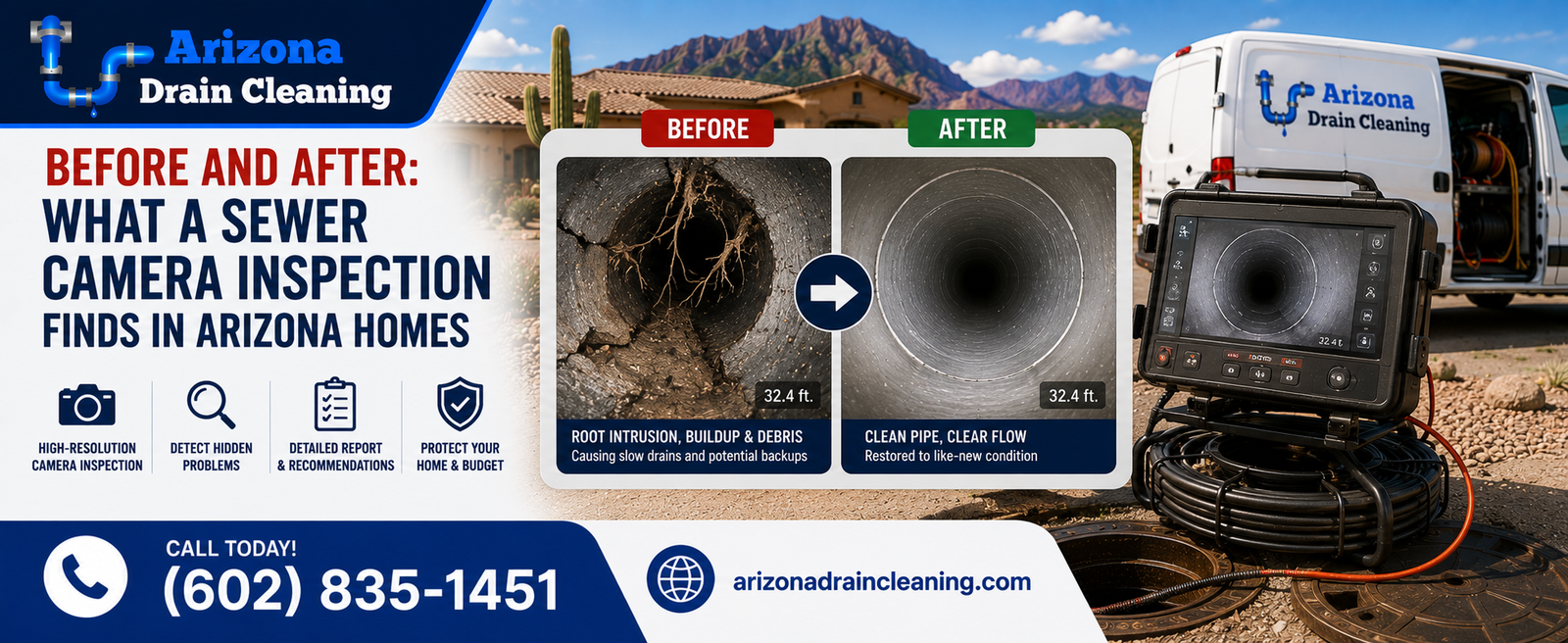
Sewer camera inspection findings in Arizona homes tell a story that no surface symptom can fully communicate. A slow kitchen drain could be a grease clog six inches from the trap, or it could be a root mass 40 feet down a clay sewer lateral that has been building for a decade. A toilet that gurgles when the dishwasher runs could be a partial main line blockage from mineral scale, or it could be a bellied pipe section that has been pooling debris since the slab shifted during the last monsoon season. Without a camera, you are treating the symptom. With one, you are treating the actual problem.
Arizona homes present a specific set of findings that plumbers in other states rarely encounter in the same combination or with the same frequency. The Valley’s very hard water, extreme summer heat, year-round desert tree root activity, aging pre-1980 pipe materials in many Phoenix and Tucson neighborhoods, and the annual stress of monsoon season on underground drain systems create inspection findings that are genuinely different from what a camera reveals in a Pittsburgh or Minneapolis home. This guide walks through six of the most common real inspection findings in Arizona residential sewer lines, describes what the camera sees before and after any intervention, explains what each finding means for your drain system, and outlines exactly what action each situation calls for.
What a Sewer Camera Inspection Actually Shows in Arizona
Before getting into individual findings, it helps to understand what the camera is actually doing and why its results are so definitive compared to any other diagnostic method.
A residential sewer camera is a waterproof, high-definition CCTV camera mounted on a flexible push rod, typically between half an inch and one inch in diameter, that a technician feeds through the sewer lateral from an existing cleanout access point. As the rod advances through the pipe, the camera transmits live video to a monitor at surface level. Modern inspection cameras include LED lighting that illuminates the pipe interior from multiple angles, a distance counter that records how far from the access point any finding is located, and often a locating transmitter that allows surface-level GPS marking of problem spots. Better-equipped companies record the full inspection footage and provide it to the homeowner as documentation.
The findings are classified in the industry under the NASSCO Pipeline Assessment Certification Program (PACP), which is the North American standard for documenting CCTV sewer inspection results. PACP organizes observations into structural findings, operations and maintenance findings, and construction features and assigns a severity grade from 1 (minor observation) to 5 (most significant, immediate action required) to each finding based on the defect type and its measured characteristics. Not every residential drain company uses formal PACP coding for homeowner inspections, but the terminology and classification logic it establishes, cracks, fractures, deformation, root intrusion, deposits, and offset joints are what experienced inspectors use to describe what they see regardless of the documentation format.
What follows are the six findings Arizona Drain Cleaning cameras encounter most frequently in Phoenix metro, Scottsdale, Mesa, Tempe, Chandler, Gilbert, Tucson, and the rest of the state’s residential market, with what the camera sees before and after intervention for each.
Finding 1: Grease and Fat Accumulation in Kitchen Drain Lines
What the Camera Sees Before Cleaning
In a kitchen drain lateral that has accumulated grease over months or years, the camera enters a pipe that is visibly narrowing as it advances. The pipe walls, which should appear smooth and circular, are instead coated in a yellowish-brown or dark brown layer of congealed fat and grease that extends around the full circumference of the pipe interior. In moderate accumulation, this coating reduces the pipe’s effective interior diameter by 20 to 40 percent, leaving a restricted circular opening in the center. In severe cases, the grease layer has merged with mineral scale deposits from Arizona’s very hard water and hardened into a rough, irregular mass that reduces the opening to 10 percent or less of the pipe’s intended capacity. The camera may show sections where the grease has entirely bridged across the pipe in what is called a grease dam, leaving the camera unable to advance further.
The PACP classification for this type of finding falls under the Operations and Maintenance category with a defect code of DAG (Deposits Attached to Pipe Wall, Grease) or DFG (Deposits Flushed to Pipe, Grease) depending on whether the accumulation is bonded to the pipe wall or loosely packed. Severity grades range from 2 (minor restriction, flow largely unaffected) to 5 (significant restriction or complete blockage).
In Arizona homes specifically, grease accumulation moves faster toward higher severity grades than in cooler climates for two reasons. First, Arizona’s very hard water deposits calcium and magnesium scale that bonds to grease and hardens the combined layer into something considerably denser than grease alone. Second, Phoenix’s year-round cooking season (there is no weather-related reduction in kitchen activity in a climate without harsh winters) means the pipe never gets a low-use recovery period.
What the Camera Sees After Intervention
After hydro jetting with a rotating nozzle at 3,000 to 4,000 PSI, the camera re-enters a pipe that looks dramatically different. The walls are clean, showing the original pipe material clearly. In PVC or ABS pipe, the smooth plastic surface is fully visible. In cast iron, the original pipe interior surface is exposed, sometimes with light surface oxidation that is normal for aged cast iron but no longer covered by the accumulated fat layer. The pipe interior is circular and fully open to its intended diameter. Water flows freely ahead of the camera without pooling or restriction.
Mechanical snaking produces a different after-image. The camera typically shows that the central channel has been cleared enough to restore flow, but the pipe walls still carry remnant grease and scale that the snake broke through rather than removed. This visual difference is exactly why a camera inspection after cleaning (not just before) provides meaningful information: it tells you whether the cleaning method used achieved a full result or a partial one.
What action this finding requires: Grease accumulation at grade 2 to 3 calls for professional drain cleaning, ideally hydro-jetting for a more complete result. Grade 4 to 5 accumulation, particularly when hardened with mineral scale, requires hydro jetting with a descaling nozzle and may benefit from an enzyme treatment applied afterward to prevent rapid reaccumulation. Recurrence in the same line within weeks of cleaning suggests the grease layer is bonded to a roughened cast iron surface, which can be addressed through pipe relining that creates a smooth, grease-resistant interior.
Finding 2: Tree Root Intrusion at Pipe Joints
What the Camera Sees Before Intervention
Root intrusion is one of the most visually striking findings a sewer camera produces, and it is among the most common findings in the Phoenix metro, Scottsdale, and Tucson areas given the aggressive root systems of desert-adapted trees, including mesquite, palo verde, ficus, and citrus. The camera approaches a joint in the pipe, typically the bell-and-spigot connection between clay tile sections or the socket connection between cast iron segments, and the joint gap that should be sealed with a rubber gasket or joint compound reveals instead a mass of root material that has grown inward.
Early-stage root intrusion, classified in PACP as RFR (Root Fine, Roots Covering All or Part of Pipe Circumference), looks like a fringe of white or light tan root hairs extending from one or multiple points around the joint circumference. The roots are thin, almost hair-like, and the pipe interior beyond them is still visible. Water can still flow, but the root mass is beginning to catch debris.
Intermediate-stage intrusion, classified as RMR (Root Medium), shows denser root mass, multiple root strands of varying thickness extending into the pipe interior, and often weaving together into a partial curtain. Flow is restricted and debris is visibly accumulating on the upstream side of the root mass.
Advanced intrusion, classified as RBA (Root Ball), which carries the highest PACP severity grade of 5, shows a root mass that has grown into a dense, impenetrable ball filling the pipe interior. The camera cannot advance through it. Roots may have grown from multiple joint entry points and merged into a single combined mass. The pipe walls at the entry points show visible cracking or joint separation where the growing root mass has physically forced the pipe material apart.
In Arizona, the absence of a winter dormancy period means roots at all three stages continue growing through what would be a pause period in colder climates, making the progression from early to advanced intrusion faster than in most of the country.
What the Camera Sees After Intervention
After mechanical root cutting with a spinning cutter head, the camera shows a cleared pipe interior with the original circular cross-section restored. However, close inspection at the joint surfaces reveals the root entry points: gaps, cracks, or joint separations where the roots entered, now empty of root mass but still structurally open. The pipe walls immediately surrounding those gaps often show visible stress fractures from the physical force the roots exerted as they thickened inside the pipe. This is the visual evidence that mechanical cutting, while restoring flow, has not addressed the structural entry points the roots will regrow from.
After hydro jetting following root cutting, the camera shows a thoroughly cleaned pipe interior with root debris flushed completely clear. The entry point gaps are still present and visible, but the pipe condition is documented in its clearest possible state for a follow-up structural assessment.
After CIPP pipe lining that permanently seals the entry points, the camera shows a pipe whose interior surface is now covered by the smooth, jointless epoxy liner. The former joint locations are visible on the camera as slight thickness changes in the liner but present no gap or opening. No root entry point exists anywhere in the lined section.
What action this finding requires: Early-stage root intrusion calls for hydro-jetting or mechanical cutting to remove the immediate mass, followed by an assessment of whether the entry point pipe condition justifies lining. A grade 2 to 3 finding with intact pipe walls can be managed on a cleaning cycle, though CIPP lining is the permanent solution. Grade 4 to 5 with visible structural damage at entry points calls for lining or replacement of the affected section rather than repeated clearing.
Finding 3: Mineral Scale Buildup from Arizona Hard Water
What the Camera Sees Before Cleaning
Scale accumulation is the Arizona-specific finding that consistently surprises homeowners who assumed their slow drains were caused by something they could see and feel in the drain opening. The camera enters what looks to the technician like a clearly different pipe depending on the material. In a cast iron line from a pre-1975 Phoenix home, the pipe interior is encrusted with a rough, uneven layer of calcium carbonate and magnesium scale that gives the pipe wall a bumpy, rock-like texture rather than the smooth original cast iron surface. In some cases this layer has built to a thickness of half an inch or more, reducing the pipe’s interior diameter from its original four inches to an effective two and a half inches or less.
PACP classifies this type of finding as DAM (Deposits Attached to Pipe Wall, Mineral/Calcite) with severity grades determined by the percentage of the original diameter that the deposits have eliminated. At grade 3, deposits have narrowed the pipe by 25 to 50 percent. At grade 4, the effective diameter is reduced by more than 50 percent. At grade 5, the scale layer has created a near-complete blockage.
The visual appearance on the camera monitor is distinctive: the pipe interior appears much smaller than its rated diameter, the walls are rough and irregular with a yellowish-white or gray-white mineralized surface, and in severe cases the scale layer has created a series of concentric rings that make the pipe interior look almost like a cave formation. Water flowing through this section appears on the camera as a thin stream in the center of what should be a much larger, open pipe.
What the Camera Sees After Descaling and Hydro Jetting
After descaling treatment followed by hydro jetting, the camera reveals the most dramatic visual transformation of any cleaning procedure. Where the scale-covered pipe previously appeared narrow, irregular, and rough, the post-cleaning camera shows the original pipe walls with their natural material visible. In cast iron, the dark gray metal surface is visible, often with light surface oxidation but genuinely clear of the mineral crust that had been narrowing the pipe for years. The effective diameter is restored to its original dimension. The pipe appears as it should: round, open, and flowing.
In older cast iron specifically, descaling sometimes reveals thinned pipe walls beneath the scale layer, where internal corrosion has progressed alongside the scale accumulation. The scale was simultaneously narrowing the pipe and partially concealing the wall thickness loss beneath it. Removing the scale makes the post-cleaning camera inspection important because it reveals the true structural condition of the pipe that the scale was covering.
What action this finding requires: Grade 2 to 3 mineral scale calls for professional hydro jetting with a descaling nozzle, which is a different tool configuration than standard jetting and requires specific equipment. Grade 4 to 5 scale, particularly in cast iron with thinned walls beneath the buildup, warrants a pipe condition assessment for CIPP relining after descaling rather than simply returning to normal use. The lining creates a smooth interior surface that resists future mineral adhesion far better than the original cast iron surface.
Finding 4: Pipe Belly (Sagged Pipe Section)
What the Camera Sees
A belly, also called a sag or low spot, is a section of pipe that has dropped below the proper slope gradient due to soil movement, foundation settlement, or in Arizona’s case, the combination of expansive clay soil movement during monsoon season and caliche layer shifting during extreme temperature cycles. The camera approaches the belly and the pipe interior ahead of it visually tilts downward, then levels, then rises back up on the far side. Standing water in the belly is almost always visible: the camera approaches the low point and the bottom of the pipe is wet or pooled while the top and sides appear dry, indicating that water is sitting in this section rather than flowing through it.
PACP classifies pipe bellies under the structural deformation category. A minor belly is visible as a slight pooling with no significant flow restriction. A moderate belly shows consistent standing water occupying 20 to 50 percent of the pipe diameter, with debris and organic material accumulating in the low point. A severe belly has standing water filling 50 percent or more of the pipe height at the low point, creating a permanent collection zone where debris builds progressively regardless of upstream cleaning.
In Arizona, pipe bellies are more common than in most states for several interconnected reasons. The expansive clay-rich soil that underlies much of the Phoenix metro and the broader Maricopa County area swells when wet during monsoon events and contracts during the long dry season. That cycle creates differential movement under slab-on-grade foundations, the most common construction type in the Valley, that can produce vertical pipe displacement of half an inch or more over five to ten years. Additionally, Phoenix’s abundant mesquite and palo verde root systems can displace soil beneath buried pipe sections, creating localized settlement that produces a belly at the root contact point.
What the Camera Shows After Intervention
Here is the critical distinction that makes the belly finding different from every other finding in this guide: cleaning cannot fix a belly. A hydro jetting pass through a bellied pipe removes the debris pooled in the low point and restores temporary flow. The camera after jetting shows a clean pipe interior in the belly section, but the physical geometry of the pipe has not changed. The low point is still there. Water will pool in it again, debris will accumulate again, and the camera 90 days later will show the same or similar conditions to what it showed before cleaning.
The only camera result that shows a genuine before-and-after improvement for a belly is one taken after repair of the belly, either through pipe relining that smooths over the low point while maintaining some flow improvement or through excavation and pipe replacement where the affected section is removed, properly re-graded, and new pipe installed with correct slope.
What action this finding requires: A minor belly that produces no current blockage but is documented on the inspection calls for monitoring on an annual inspection schedule. A moderate belly that is producing recurring debris accumulation and slow drainage calls for either CIPP lining of the affected section as a damage limitation measure, or excavation and replacement of the bellied section with properly sloped pipe. A severe belly with standing water more than half the pipe diameter is typically treated as a structural problem requiring excavation and replacement, as the degree of slope loss is beyond what lining can effectively compensate for.
Finding 5: Offset and Displaced Pipe Joints
What the Camera Sees Before Repair
A pipe offset occurs when two sections of pipe have shifted out of alignment at their joint connection, so that instead of the pipe ends meeting flush and circular, one end is displaced vertically or horizontally relative to the other. The camera approaches an offset joint and the visual is immediate and dramatic: the pipe interior ahead of the camera appears to shift upward, downward, or to one side, with the far pipe end visible off-center from where the near end terminates. In minor offsets, the misalignment is small and the effective pipe opening at the joint is still mostly intact. In significant offsets, the displacement is substantial enough that the joint gap is open on one side, allowing soil to enter and pipe flow to be severely restricted.
PACP classifies offsets under the structural category with a defect code of SJO (Structural Joint Offset), with severity grades based on the magnitude of the displacement and the percentage of the pipe cross-section that the offset affects. Grade 5 offsets involve a displacement exceeding 50 percent of the pipe diameter, effectively creating a partial internal obstruction at the joint location.
In Arizona, offset joints occur most commonly in clay tile sewer lines in the older Phoenix and Tucson neighborhoods where these pipes were installed 50 to 70 years ago. The same soil movement dynamics that create pipe bellies, monsoon-season clay expansion and contraction combined with caliche layer shifting, also drive lateral displacement at the bell-and-spigot joints of clay tile pipe. Because clay tile joints rely on packed joint compound or rubber gaskets that have long since deteriorated in 50-year-old installations, there is nothing resisting the lateral displacement once soil forces act on the pipe sections.
An important secondary finding almost always accompanies a significant offset: the open side of the joint gap is typically filled with soil or root material that has migrated in from the surrounding ground. The camera shows the offset itself and, adjacent to it, a wedge of compacted soil or tangled root mass that has entered through the gap created by the displacement.
What the Camera Shows After Intervention
For minor offsets that are documented but not yet causing significant flow restriction, the before-and-after camera result typically shows the same physical configuration, because minor offsets in functional pipe are often monitored rather than immediately repaired. The camera after a cleaning pass shows the joint area cleared of any debris that had accumulated at the displacement point, but the geometric offset is unchanged.
For significant offsets repaired through CIPP lining, the after-camera shows a pipe interior where the transition through the former offset location is smoothed by the epoxy liner. The liner bridges the misalignment, creating a continuous, smooth interior surface that flows water without the obstruction the raw offset created. The exterior geometry of the pipes is unchanged, but the interior flow path is fully restored.
For offsets repaired through excavation and joint replacement, the after-camera shows a properly aligned, flush joint connection at the repaired location, with the pipe interior continuous and circular throughout the section.
What action this finding requires: A grade 1 to 2 offset with minimal displacement and no soil intrusion requires monitoring, typically annual inspection. A grade 3 to 4 offset with visible soil or root material entry requires CIPP lining or, if structural integrity is significantly compromised, excavation and section replacement. A grade 5 offset with more than 50 percent displacement, active soil intrusion, or associated pipe collapse requires excavation and replacement of the affected section.
Finding 6: Pipe Cracks, Fractures, and Structural Deterioration
What the Camera Sees Before Repair
Structural deterioration encompasses a range of camera findings from hairline surface cracks through to full pipe collapse, and the spectrum of severity within this category is wider than any other inspection finding. The camera reveals these conditions along a visual gradient that corresponds directly to the action each requires.
A longitudinal crack runs along the length of the pipe, visible as a thin, dark line against the pipe interior surface. In clay tile pipe, longitudinal cracks often appear where the pipe material has dried and shrunk differentially across its cross-section. In cast iron, they appear where hydrogen sulfide acid attack from microbially influenced corrosion has penetrated the pipe wall thickness. PACP classifies these as SCL (Structural Crack, Longitudinal) with severity grades based on the crack width: a hairline crack (less than 0.5mm width) is grade 2, a crack wide enough to show visual opening is grade 3 or 4.
A circumferential crack wraps around the pipe cross-section and typically indicates soil loading stress at a specific point. In older Phoenix slab construction, circumferential cracks in cast iron often appear near slab penetration points where differential thermal expansion between the concrete slab and the pipe creates cyclic stress. PACP code is SCC (Structural Crack, Circumferential).
A pipe fracture is a break that has separated the pipe material through its full wall thickness, creating an opening between the pipe interior and the surrounding soil. The camera shows visible daylight or soil visible through the fracture point, and in active leaking conditions, groundwater infiltration entering through the fracture gap may be visible as water dripping or seeping into the pipe from outside. PACP classifies fractures as SFB (Structural Fracture, Broken) or SFS (Structural Fracture, Split) depending on the geometry.
Full or partial pipe collapse, the most severe structural finding, appears on the camera as an abrupt wall of debris and displaced pipe material blocking further camera advance. The pipe ahead is either partially crushed inward or has completely separated from its alignment. PACP grade 5 is assigned, indicating immediate repair is required.
In Arizona, structural deterioration in the cast iron lines of pre-1975 homes in Phoenix, Arcadia, South Mountain, Maryvale, and older sections of Mesa and Tempe progresses through a specific mechanism: microbially influenced corrosion from hydrogen sulfide acid attack eats the pipe wall from the inside, thinning it progressively until external soil loading produces fracture or collapse. The scale accumulation from hard water that was discussed in Finding 3 above sometimes partially obscures early-stage wall thinning, which is why scale removal through descaling before structural assessment gives a more accurate picture of actual pipe wall thickness.
What the Camera Shows After Repair
After CIPP lining of cracked but structurally continuous pipe, the camera shows a smooth, uniform liner surface at the previously cracked sections. The cracks themselves are sealed by the resin and are no longer visible as openings, though the liner surface in those areas may show slight discoloration from the resin curing process. The structural integrity of the section is restored by the liner’s own wall strength, rated for 50 or more years of service.
After excavation and replacement of fractured or collapsed sections, the camera enters at the new pipe and shows clean, undamaged PVC or HDPE pipe material with properly sealed joints. The contrast between the new pipe sections and any remaining original pipe adjacent to the repair is visible on the camera as a clear material and surface condition change.
What action this finding requires: Hairline surface cracks without full-thickness penetration call for CIPP lining on an accelerated timeline given the progressive nature of the underlying corrosion. Full-thickness cracks and fractures require CIPP lining or excavation and replacement depending on the extent of structural compromise. Active collapse requires immediate excavation and replacement; this finding cannot wait for a scheduled repair timeline.
How to Read Your Sewer Camera Inspection Report in Arizona
When a technician hands you a report after a camera inspection, several elements should be present for the document to be genuinely useful.
The report should identify the pipe material (cast iron, clay tile, PVC, ABS, or Orangeburg), the pipe diameter (typically 4 inches for residential sewer laterals), and the total length inspected in feet. It should document each finding with its location measured in feet from the access point, a description of the finding using standard terminology aligned with PACP categories, a severity assessment, and a photograph or video timestamp that allows you to review the corresponding footage.
The action recommendation section should be specific: not “possible repair recommended” but “CIPP lining of the root intrusion sections at 23 and 38 feet” or “hydro jetting required for grade 3 grease accumulation; post-cleaning camera re-inspection recommended.” ” Vague recommendations that do not connect specific findings to specific actions are not useful documentation.
In Arizona specifically, the report should acknowledge which findings are consistent with the home’s age and local conditions. Finding grade 2 mineral scale in a 1970s Phoenix home with cast iron pipe is expected and manageable. Finding the same grade 2 scale in a 2005 Phoenix home with PVC pipe is less expected and may indicate a different water chemistry issue worth investigating.
Frequently Asked Questions About Sewer Camera Inspection Findings in Arizona
What are the most common sewer camera inspection findings in Phoenix area homes?
The five most common findings in Phoenix metro homes are grease accumulation in kitchen drain lines (particularly in homes with older cast iron pipe where grease bonds to mineral scale), root intrusion at pipe joints from mesquite, palo verde, ficus, and citrus trees; mineral scale deposits from the Valley’s very hard water (12 to 20 grains per gallon), pipe belly sections caused by Arizona’s expansive clay soil movement and monsoon season ground shifting, and structural deterioration including cracks and fractures in cast iron pipe from microbially influenced corrosion. Pre-1975 homes in Arcadia, South Mountain, and older sections of Tempe and Mesa are most likely to present the full range of these findings simultaneously.
How do I know if what the camera shows is serious or minor?
The PACP grading system assigns severity on a scale of 1 to 5 for each finding, where grade 1 is a minor observation requiring no immediate action and grade 5 is a critical finding requiring immediate repair. Grade 1 to 2 findings are typically monitored through annual inspections. Grade 3 findings are addressed on a planned maintenance or repair timeline, typically within 6 to 12 months. Grade 4 findings require repair on a priority basis, ideally within weeks. Grade 5 findings require immediate action before the failure becomes an emergency. Your inspection report should specify the severity grade for each finding, not just describe what was seen.
What does a healthy pipe look like on a camera inspection?
A healthy sewer lateral appears on the camera as a round, smooth-walled tube with a consistent interior diameter throughout its length. The pipe walls are uniform in color, with no roughening, scale accumulation, visible cracks, or organic material clinging to the surface. Joints between pipe sections are flush and sealed with no visible gaps, soil intrusion, or root material. The pipe maintains a consistent slight downward slope throughout its run, and water ahead of the camera flows freely without pooling or resistance. After hydro jetting a previously problematic pipe, seeing these conditions on the camera is the confirmation that the cleaning achieved a full result.
How long does a sewer camera inspection take in an Arizona home?
A standard residential sewer camera inspection in a typical Phoenix or Valley home takes between 30 minutes and one and a half hours, depending on the length of the sewer lateral, the number of cleanout access points, and how many drain lines are included in the inspection scope. Main sewer lateral inspections of 40 to 60 feet are typically completed in under an hour. Full-system inspections that include branch drains from multiple bathrooms and the kitchen take longer. The technician should review findings with you at the monitor as the inspection proceeds, so you see the footage in real time rather than just receiving a report afterward.
Can a camera inspection miss anything in an Arizona pipe?
Yes, in specific circumstances. Pipes that are fully blocked with debris or root mass may prevent the camera from advancing past the blockage point, leaving the downstream section uninspected. Hydro jetting to clear the blockage before the camera inspection, rather than after, produces a more complete inspection. Camera inspection also cannot assess pipe condition outside the pipe itself, such as the condition of the surrounding soil, the degree of soil erosion around a leaking joint, or the condition of a septic tank. For external soil assessment, ground-penetrating radar is a separate diagnostic tool. Finally, very short hairline cracks in early formation may not be visible on standard residential camera resolution, though this limitation is primarily relevant at grade 1 severity where no immediate action would be warranted regardless.
Should I get a sewer camera inspection before buying an Arizona home?
Yes, particularly for pre-1980 homes anywhere in the Phoenix metro, Scottsdale, Mesa, Tempe, or Tucson areas. A pre-purchase sewer camera inspection of $150 to $500 documents the condition of the sewer lateral before you close on the property. Findings of significant scale buildup, root intrusion, offset joints, or structural deterioration in a pre-purchase inspection are negotiating points: either the seller addresses the condition, the price is adjusted to account for the repair cost, or you make an informed decision about the purchase with full knowledge of the plumbing system’s actual condition. Arizona real estate transactions have no statutory requirement for seller disclosure of underground sewer conditions, which means a camera inspection is the only reliable way to know.
Is a camera inspection worth it if the drain is already flowing normally?
Yes. Several of the most significant camera findings, including pipe belly sections, grade 3 mineral scale, minor offset joints, and early-stage root intrusion, exist in pipes that are still draining at near-normal speed. These conditions are developing toward a failure point rather than already at one, and identifying them proactively allows for planned, budgeted repair at a time you choose rather than emergency repair at a time the pipe chooses. In Arizona, where the combination of hard water, tree roots, aging pipe materials, and monsoon season creates multiple simultaneous stressors on residential drain systems, a proactive camera inspection every two to three years is genuinely different from the same practice in a lower-stress plumbing environment.
See What Is Inside Your Arizona Drain System Before It Becomes an Emergency
Every finding described in this guide was discovered in a real Arizona home after the homeowner noticed symptoms that seemed minor: a slow kitchen drain, a toilet that gurgled occasionally, a drain that backed up once and then seemed fine. The camera told a different story in each case.
Arizona Drain Cleaning performs high-definition sewer camera inspections across the Phoenix metro and surrounding communities, with real-time footage reviewed with you on-site, written documentation of every finding, and honest recommendations that connect what the camera shows to the specific action each situation actually requires.
Call Arizona Drain Cleaning at (602) 835-1451 to schedule a sewer camera inspection, get a second opinion on inspection findings from another company, or discuss what the right next step is for your specific pipe condition. Transparent pricing before work begins, ROC-licensed technicians, and camera inspection available as a standalone service or combined with drain cleaning at a reduced total cost.