
Most Phoenix homeowners think about their drains twice: when something backs up and when they call for help. That reactive approach might work in parts of the country where plumbing systems experience relatively stable conditions throughout the year. In Arizona, it is a much more expensive strategy.
The reason is simple: Phoenix homeowners face two distinct drain stress seasons every year, and each creates its own set of problems. One occurs during the extreme summer heat, when grease, soap residue, and hard water minerals accumulate inside pipes. The other arrives with monsoon season, when sudden heavy rainfall exposes existing blockages and overwhelms drainage systems that are already partially restricted.
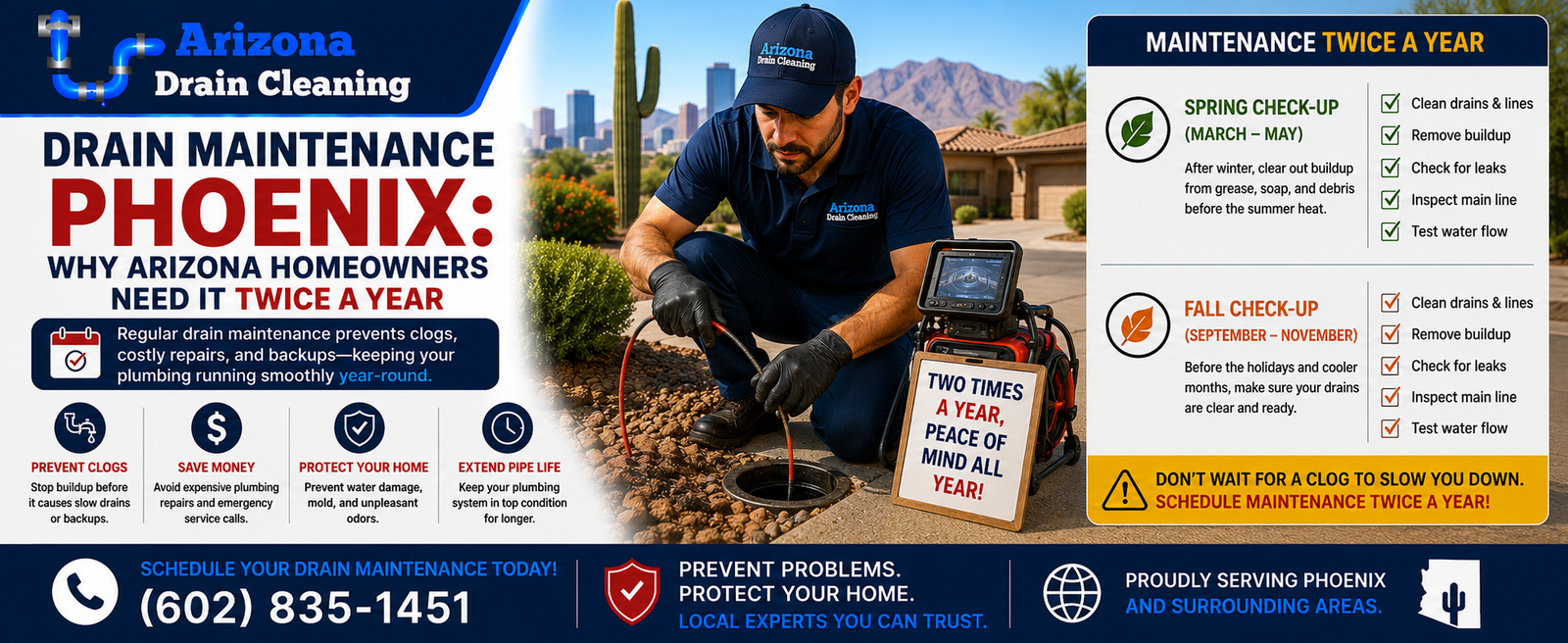
Here is why twice-yearly maintenance makes sense in Arizona:
| Season | What Happens to Your Drains | Potential Result |
|---|---|---|
| Spring / Early Summer | Hard water scale, grease, and debris build up inside drain lines | Slow drains, recurring clogs, reduced pipe capacity |
| Monsoon Season | Heavy rainfall puts maximum demand on drainage systems | Backups, flooding, sewer line issues, emergency repairs |
A drain system that seems perfectly functional in May can become a serious problem by August if hidden buildup is already restricting flow. Likewise, a drain that survives monsoon season may still carry debris and buildup into the following year if it is never cleaned.
That is why many Arizona homeowners schedule preventative maintenance twice annually: once before summer buildup becomes severe and once before monsoon storms arrive. The cost of routine maintenance is almost always lower than the cost of emergency drain cleaning, water damage restoration, or sewer repairs.
Arizona Drain Cleaning provides drain maintenance Phoenix homeowners can rely on throughout the metro area. Call (602) 835-1451 to schedule a maintenance visit before either high-stress season arrives.
The Two Cycles That Drive Phoenix Drain Problems
Phoenix drain systems do not degrade evenly across the year. Two predictable seasonal conditions drive the majority of residential blockages and service calls, and both are tied to Arizona’s climate rather than to household habits alone.
Hard water mineral buildup is a year-round process, but its effects accumulate steadily and become most visible in the late spring when hot water use peaks and mineral scale in pipe walls has had months to thicken. Phoenix water is among the hardest in the United States, with calcium and magnesium concentrations that leave deposits in pipes the same way they coat faucets, showerheads, and water heaters. In drain lines, mineral scale narrows the effective pipe diameter and gives grease, soap, and organic material a rough surface to cling to. A drain that runs fine in January may drain noticeably slowly by May without any change in household habits.
Monsoon season, which runs roughly from mid-June through September, introduces the second cycle. Phoenix receives the majority of its annual rainfall in a matter of weeks, delivered in intense storms that can drop an inch or more in an hour. Yard drains, patio drains, and exterior drain connections that have accumulated desert dust, decomposed granite, and plant debris over the preceding dry months receive the full volume of that rainfall all at once. Drains that were partially restricted going into storm season frequently go fully blocked during the first significant storm event.
Addressing both cycles with scheduled preventive drain cleaning in Phoenix, AZ, is more cost-effective than addressing either one after it causes a backup.
Spring Service: Clearing Mineral Scale and Grease Before the Heat
A spring drain maintenance visit targets the accumulation that builds up over the winter and early spring months. In a typical Phoenix household, this means clearing grease and soap buildup from kitchen drain lines, addressing scale accumulation in bathroom drain connections, and inspecting the main line for any restriction that developed during the cooler months when hot-water use was lower and grease moved less freely through the system.
Kitchen drains are the most common source of spring service calls. Cooking grease cools and solidifies in the drain line between the fixture and the main sewer lateral. In Phoenix’s hard water environment, mineral deposits form on the interior of that grease layer, creating a compound restriction that is harder to clear than grease alone. Hydro-jetting removes both the grease and the mineral deposits in a single service visit, restoring full pipe capacity before summer heat and increased household water use put the system under heavier load.
Bathroom drains accumulate soap scum, hair, and mineral scale at a rate that varies with water hardness and usage patterns. In hard water markets like Phoenix, soap scum and calcium deposits build up faster than they do in softer water regions. A spring cleaning of bathroom drain lines, combined with inspection of the p-trap and stopper assembly, keeps bathroom drains moving without the partial backups that become noticeable when summer water use increases.
Pre-Monsoon Service: Preparing Exterior Drains for Storm Season
The pre-monsoon window, from May through mid-June, is the critical period for exterior drain maintenance. Yard drains, patio drains, pool deck drains, and any surface drainage connected to underground laterals need to be inspected and cleared before monsoon season begins.
The reason timing matters is accumulation. Phoenix’s dry spring leaves months of desert dust, decomposed granite, and wind-blown debris sitting undisturbed in drain openings and drain bodies. When the first monsoon storm hits, that material gets pushed into the drain system simultaneously with a high volume of water. A drain opening that was partially restricted by sediment becomes a blocked drain when the monsoon adds force and volume to the equation.
Decomposed granite is one of the most common contributors to pre-monsoon drain restriction in Phoenix. DG is used as a landscaping surface throughout the metro area, and it washes toward drain openings with any slope and any rainfall. Over the dry season, it packs into drain grates and the drain body below them. Clearing DG accumulation before monsoon season gives the drain system the capacity to handle storm volume without backing up onto the patio, into the yard, or toward the foundation.
Pool deck drains require the same pre-monsoon attention. Phoenix pools are in active use most of the year, and pool deck drains accumulate sunscreen residue, organic matter, and fine debris continuously. A blocked pool deck drain during a monsoon storm creates standing water that is a slip hazard and can direct runoff toward the equipment pad or the structure.
Hard Water and Grease: The Year-Round Combination
The interaction between Phoenix’s hard water and normal household grease output creates a drain restriction dynamic that does not take a season off. Grease from cooking adheres to pipe walls. Mineral scale from hard water adheres to the grease. Each layer provides a surface for the next one, and the compound buildup narrows the drain line gradually over months.
This process is most advanced in the kitchen drain lateral between the sink and the main sewer connection. In a home without regular maintenance, that lateral can develop significant restriction within 12 to 18 months of the last cleaning, particularly in Phoenix, where water hardness accelerates the scale component of the buildup. Twice-yearly hydro-jetting of the kitchen line keeps the restriction from reaching the point where a full backup is the first visible symptom.
Bathroom drains follow a similar pattern, though typically on a slower timeline. Hair and soap scum in the p-trap and drain body combine with mineral scale to create partial blockages that reduce drain speed before they cause standing water in the shower or tub. Twice-yearly clearing of bathroom drain connections keeps that restriction from building to the point of visible backup.
What a Twice-Yearly Maintenance Schedule Covers
| Service Visit | What It Covers |
| Spring (March to May) | Kitchen drain hydro-jetting, bathroom drain clearing, main line inspection, scale and grease removal |
| Pre-Monsoon (May to June) | Exterior and yard drain clearing, pool deck drain inspection, patio and surface drain flushing, sediment removal from drain bodies |
Homeowners on a recurring maintenance plan with Arizona Drain Cleaning receive priority scheduling, documented service records for each visit, and the option to add camera inspection if the technician identifies a restriction that warrants further evaluation.
The Cost Comparison: Maintenance vs. Emergency Service
Emergency drain service in Phoenix costs significantly more than a scheduled maintenance visit, and that difference does not account for any collateral damage a backup may cause. A kitchen backup that overflows onto a hardwood floor or a yard drain backup that pushes water toward a foundation introduces repair costs that dwarf the price of two maintenance visits per year.
For homeowners considering whether twice-yearly service is necessary, the practical question is whether their drain system is more likely to develop a problem in a climate with hard water and monsoon season than in one without those conditions. Phoenix’s combination of hard water, grease buildup in kitchen lines, and pre-monsoon sediment accumulation in exterior drains makes twice-yearly maintenance a reasonable baseline rather than an optional upgrade.
To schedule drain maintenance in Phoenix or a preventive drain cleaning Phoenix, AZ plan for your home, contact Arizona Drain Cleaning at (602) 835-1451. Spring and pre-monsoon appointment windows fill early. Schedule before the season starts.
FAQs
Why is drain maintenance important in Phoenix, AZ?
Drain maintenance in Phoenix, AZ helps prevent grease buildup, hard water scale, and monsoon-related blockages. Regular service keeps drains flowing properly and reduces the risk of emergency backups and expensive plumbing repairs.
How often should drains be cleaned in Phoenix homes?
Most Phoenix homeowners benefit from drain maintenance twice a year. Spring cleaning removes grease and scale buildup, while pre-monsoon service prepares outdoor drains for heavy seasonal rainfall and debris accumulation.
What problems does preventive drain cleaning help avoid?
Preventive drain cleaning helps avoid slow drains, sewage backups, standing water, pipe restrictions, and emergency plumbing issues caused by grease, mineral deposits, roots, and outdoor debris inside drain systems.
Is hydro jetting included in drain maintenance services?
Hydro jetting is commonly included in professional drain maintenance because it removes grease, sludge, mineral buildup, and debris from pipe walls more effectively than standard snaking or temporary drain cleaning methods.
When should outdoor drains be cleaned in Phoenix?
Outdoor drains should be cleaned before monsoon season begins. Clearing yard drains, patio drains, and pool deck drains before heavy storms helps prevent flooding, standing water, and property damage during summer rainfall.