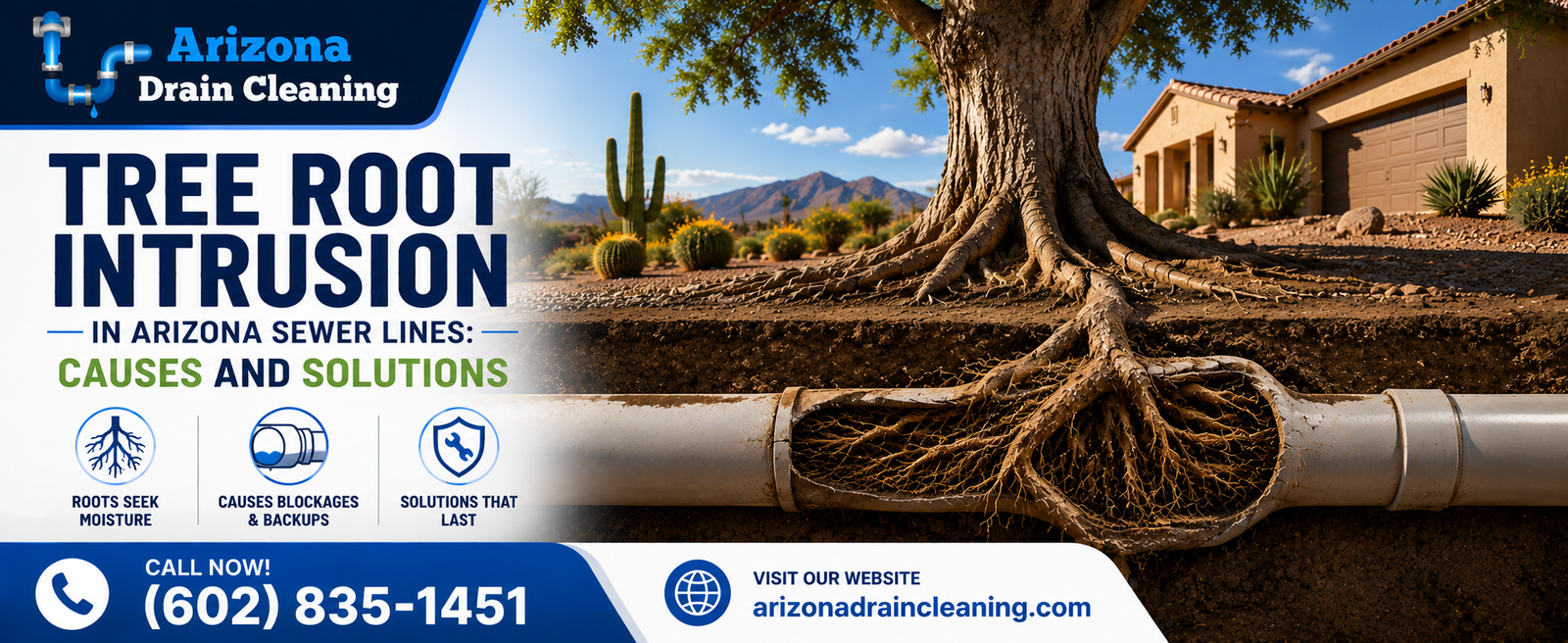
Tree root intrusion in sewer lines in Arizona is one of the most underdiagnosed causes of recurring drain problems across the Phoenix metro, Scottsdale, Tempe, Mesa, Chandler, and the wider Valley. According to US Forest Service research on sewer infrastructure, tree roots are responsible for more than 50 percent of all sewer blockages nationwide, and in Arizona the problem takes on a specific character that most homeowners do not fully understand until a camera goes into the pipe and shows exactly what is happening.
If your main line backs up every few months, if a professional snake clears it and the problem returns within weeks, or if you notice slow drains across multiple fixtures at the same time, there is a reasonable chance that tree roots are involved. This guide covers the full picture: which Arizona trees are the biggest culprits, exactly how roots find and enter your sewer pipe, what warning signs tell you the problem is active, how a camera inspection confirms the diagnosis, and every solution available from mechanical cutting and hydro jetting through to pipe relining and full replacement, with real cost numbers for the Phoenix market.
To understand why this keeps happening in Arizona homes, it helps to first see what’s actually getting into your sewer lines and where it comes from:
| Common Arizona Trees & Plants | Why They Cause Sewer Intrusion | Typical Problem Pattern |
|---|---|---|
| Ficus (Fig trees) | Aggressive, fast-spreading root system | Rapid re-clogging after cleaning |
| Mesquite trees | Deep water-seeking roots | Long-term pipe infiltration and cracking |
| Palm trees | Fibrous root clusters | Partial blockages and buildup traps |
| Arizona Ash | Large lateral root spread | Joint penetration in older clay pipes |
| Oleander shrubs | Dense root networks near foundations | Localized blockages near cleanouts |
| Lawn irrigation zones | Constant moisture attraction | Roots converge toward sewer moisture leaks |
How to Fix Tree Root Intrusion in Sewer Lines for Good (Not Just Temporarily)
Once tree roots are inside your sewer line, the key misunderstanding most homeowners have is thinking it’s a “cleaning problem.” In reality, it’s a structural entry problem. Cutting the roots clears the blockage for now but unless the entry point is sealed or the pipe is restored, the roots will come back because the moisture source is still there.
That’s why in Arizona plumbing systems, especially in older clay and cast iron lines across Phoenix, Mesa, and Scottsdale, long-term solutions are about eliminating re-entry, not just removing debris.
Here’s how the real fix options compare:
| Method | What It Does | How Long It Lasts | When It’s Used |
|---|---|---|---|
| Mechanical Root Cutting (Auger/Snake) | Physically cuts roots inside pipe | Weeks to months | Emergency clearing only |
| Hydro Jetting | High-pressure water blasts roots + buildup | 3–12 months | Heavier blockages or grease + roots |
| Chemical Root Treatment (Foaming Root Killers) | Slows root regrowth inside pipe | 6–18 months (maintenance) | Preventive follow-up after clearing |
| Camera Inspection First | Locates exact intrusion points | N/A | Always step 1 before repair decisions |
| Pipe Lining (CIPP) | Creates new “pipe inside pipe” seal | 25–50 years | Best long-term fix for cracked pipes |
| Pipe Bursting | Replaces old pipe by breaking it apart | 50+ years | Severely damaged or collapsed lines |
| Full Excavation Replacement | Removes and replaces entire sewer line | 50+ years | Worst-case structural failure |
Why Arizona Is Particularly Vulnerable to Tree Root Drain Damage
Most homeowners think of root intrusion as a problem for humid, wet climates where trees have abundant surface water and grow aggressively in every direction. The reality in Arizona is almost the opposite, and that is exactly what makes the problem so serious here.
Desert Trees Are Engineered to Find Water Underground
In a climate where rainfall is scarce and surface moisture evaporates within hours, desert trees have evolved root systems that are specifically designed to go deep and go far in search of underground water sources. A mature mesquite tree in the Phoenix metro area can extend its root system two to three times the width of its crown in every direction, and in extreme drought conditions, mesquite taproots have been documented reaching depths of 160 feet or more to access water. Even under normal conditions, mature mesquite root systems commonly spread 30 to 50 feet horizontally from the trunk.
Palo verde trees, which are ubiquitous across Phoenix neighborhoods and are the Arizona state tree, have similarly aggressive lateral root systems adapted to the desert. Citrus trees, which are planted in enormous numbers across Valley residential properties for their fruit; oleander, used widely as privacy hedging; and ficus trees, planted as shade trees in older neighborhoods, all produce root systems that extend well beyond their visible canopy and actively seek moisture with an efficiency that water-rich climate trees simply do not need to develop.
Your sewer lateral is filled with exactly what these root systems are hunting: warm, humid, nutrient-rich water moving through a pipe that often leaks small amounts of moisture at every joint. In an environment where surface water is scarce, that underground pipeline looks like the most reliable water source in the entire neighborhood to a root that has been searching for months.
Older Arizona Neighborhoods Have the Most Vulnerable Pipe Materials
The combination of aggressive desert tree root systems and aging sewer pipe infrastructure creates conditions in many Phoenix neighborhoods that are considerably worse than either factor alone would produce.
Homes built before approximately 1980 in neighborhoods across Arcadia, Encanto, Central Phoenix, South Mountain, Tempe, and older parts of Mesa commonly have sewer laterals made from clay tile or Orangeburg pipe. Clay tile pipe was the standard material for residential sewer construction through much of the mid-twentieth century. Its defining vulnerability is its construction: clay pipe is made in short sections, typically two to four feet long, joined together with bell-and-spigot connections that rely on a rubber gasket or packed joint compound. Those joints, even when properly installed, develop micro-gaps over decades of soil shifting, thermal cycling from Arizona’s extreme temperature swings, and the cumulative movement produced by monsoon season soil expansion and contraction.
Each of those micro-gaps becomes a moisture emission point. Each moisture emission point becomes a root magnet. Arizona’s desert trees find those gaps with the efficiency of a system shaped by millions of years of water-scarcity selection. The Arizona Daily Star has noted that mesquite and palo verde trees near older clay sewer lines in Tucson and Phoenix should be considered an active risk, with roots commonly found 30 or more feet from the tree trunk inside sewer pipes.
Orangeburg pipe, which was manufactured from compressed wood pulp and pitch and used in some Arizona homes built between the 1940s and 1970s, has even lower structural integrity than clay and is particularly prone to deformation, cracking, and root invasion.
Which Arizona Trees Cause the Most Root Intrusion Damage
Not all trees are equally aggressive toward underground sewer infrastructure. Understanding which species are the most problematic helps Arizona homeowners assess their specific risk and make more informed decisions when adding trees to their landscaping.
Mesquite
Mesquite is the single most significant tree root threat to Arizona sewer lines. Native to the Sonoran Desert, mesquite trees are specifically adapted to tap deep and distributed water sources underground. Their roots are extensive, fast-growing relative to their aboveground size, and capable of exerting significant physical force as they thicken inside a pipe once a root fiber has made entry through a joint or crack.
The added complication with mesquite is its prevalence. It grows wild throughout the Valley, it is planted intentionally for shade and as a landscaping tree, and it self-seeds readily, meaning many properties have mesquite trees they are not fully aware of as a sewer risk. Mature mesquite trees within 30 to 50 feet of a sewer lateral should be treated as an active root intrusion risk and inspected accordingly.
Palo Verde
Palo verde, Arizona’s state tree, is somewhat less aggressive than mesquite but still produces extensive lateral root systems that commonly reach sewer pipes in properties where the tree was planted within 20 to 30 feet of the sewer line. Blue palo verde, the more commonly planted ornamental variety, is the more aggressive of the two common types. Palo verde is particularly common in newer Valley developments and master-planned communities across Chandler, Gilbert, Scottsdale, and Peoria, where it was widely chosen as a shade tree during the suburban expansion of the 1990s and 2000s. Trees planted in those developments in 1995 are now 30 years old with well-established root systems that are actively approaching the depth and spread where sewer line contact becomes likely.
Citrus Trees
Citrus, including orange, lemon, grapefruit, and tangerine, is among the most common fruit trees planted in Phoenix metro backyards. Most homeowners do not think of citrus as a sewer line threat because the trees look compact and manageable aboveground. Below ground, citrus root systems extend well beyond the visible canopy in search of reliable water, and in Arizona’s dry climate they are particularly motivated to find underground moisture sources. The combination of citrus irrigation creating a nearby reliable water source and sewer pipe moisture creates a gradient that actively draws roots toward the line.
Citrus trees planted within 15 to 20 feet of a sewer lateral in older neighborhoods with clay or cast iron pipe should be included in any sewer camera inspection assessment.
Ficus and Block Ficus
Ficus trees, particularly the block ficus used widely as privacy hedging and shade trees in older Phoenix neighborhoods like Arcadia, Paradise Valley, and central Scottsdale, are among the most aggressive root systems in any Arizona landscape. The Roto-Rooter Phoenix service area documentation specifically calls out ficus root intrusion in the Arcadia and Encanto neighborhoods as among the most severe root-related sewer damage they encounter in the Valley. Ficus roots are notorious for their diameter and the physical force they exert as they grow inside confined spaces, and a ficus root system that has been inside a clay sewer pipe for several years can produce crack propagation and joint separation that requires pipe replacement rather than cleaning.
Oleander and Other Shrubs
Oleander is planted ubiquitously across Arizona residential properties as a privacy screen. While its root system is less aggressive than mesquite or ficus, oleander planted directly over or within a few feet of a sewer lateral can still contribute to blockage over time, particularly in older properties where the pipe already has compromised joints. Custom Plumbing of Arizona includes oleander alongside mesquite and palo verde in its list of Arizona plants with documented sewer lateral intrusion histories.
How Tree Roots Actually Find and Enter Your Sewer Pipe
Understanding the mechanism of root intrusion demystifies why it happens so predictably and why certain prevention and treatment approaches work better than others.
The Moisture Signal Every Sewer Pipe Broadcasts
Every sewer pipe, regardless of age or material, emits a small amount of moisture into the surrounding soil through its joints and any micro-cracks that develop over time. This moisture carries warmth from the wastewater moving through the pipe, dissolved organic nutrients, and oxygen that exists in the air space above the waterline inside the pipe. To a root system searching for water in the soil, this combination is an extraordinarily precise signal.
Microscopic root hairs, which are far thinner than the roots visible to the naked eye, can detect soil moisture gradients at very small scales. They follow that gradient toward the source. When they reach the surface of the pipe, they exert physical pressure against any irregularity, joint gap, or crack. They do not need a large opening. Research from Morton Arboretum, one of the leading botanical research institutions in North America, confirms that roots can enter sewer pipes through gaps that are too small to see with the naked eye, because the initial root hairs are microscopic in diameter. Once inside, the conditions inside the pipe, warm, moist, nutrient-rich, and oxygen-present, are dramatically better than the conditions in the dry Arizona soil outside. The roots respond to those conditions by growing rapidly.
The Growth and Blockage Progression
Once inside the pipe, root mass grows in phases that correspond roughly to the warning signs a homeowner notices over time.
In the early phase, fine root hairs expand into a thin mat inside the pipe. Water still flows through, but there is slight resistance and early slow-down. Most homeowners notice nothing at this stage.
In the intermediate phase, the root mass thickens and begins trapping debris. Toilet paper, grease, and organic material moving through the sewer catch on the root mass the way a net catches material in a stream. Partial blockages develop, producing slow drains across multiple fixtures simultaneously. Gurgling sounds begin when flushing toilets or running sinks. These are the signs that most Phoenix homeowners are experiencing when they call for a drain cleaning that clears the line temporarily.
In the advanced phase, the root mass fills enough of the pipe interior that flow is severely restricted or completely blocked. Root pressure inside the pipe has begun forcing crack propagation in clay or cast iron material, widening the original entry point and allowing additional root mass to enter. At this stage, mechanical cleaning temporarily restores flow, but the structural damage to the pipe is already present, meaning the problem returns reliably and eventually requires structural repair.
Why Arizona’s Climate Makes This Worse Year-Round
In climates with cold winters, root growth slows dramatically during the dormant season, giving homeowners a period each year when root-related drain problems are less severe. Arizona does not have that built-in pause. The Phoenix metro averages fewer than a dozen nights per year with below-freezing temperatures, and the soil temperature at sewer lateral depth remains warm enough for root activity throughout most of the year. Root intrusion that would slow or pause during winter in other states continues to develop through Arizona’s mild winters. This is why recurring root-related clogs in Arizona sewer lines can develop faster than homeowners who have dealt with the problem in other states might expect.
Warning Signs of Tree Roots in Drain Pipes in Arizona
Root intrusion rarely announces itself all at once. It builds in a pattern, and recognizing that pattern early is what separates a manageable maintenance cleaning from a structural pipe repair.
Multiple Slow Drains at the Same Time
When the blockage is in an individual fixture drain, only that fixture drains slowly. When multiple drains across the house are slow simultaneously, the problem is in the main sewer line, not in any individual fixture. This pattern is one of the most reliable indicators of a mainline obstruction, which in Arizona homes with mature trees is frequently root-related.
Gurgling Sounds from Toilets and Floor Drains
A gurgling or bubbling sound coming from a toilet, floor drain, or shower when you run water elsewhere in the house indicates that air is being displaced by a partial blockage in the main line. The water trying to drain is pushing air backward through the system, and that air exits through the lowest available fixture. In the Phoenix metro’s slab-on-grade homes, floor drains in laundry rooms and bathrooms are common locations to hear this sound.
Drain Backups That Clear Temporarily and Return Reliably
The classic root intrusion pattern is a mainline backup that responds to snaking, clears completely, and then returns within weeks or a few months. The snake punches through the root mass, restores flow, but leaves the root structure in place because a mechanical snake is not designed to remove or cut roots to the pipe wall. The remaining root structure regrows quickly in the favorable conditions inside the pipe, and the blockage returns on a predictable cycle. If your drain line is on this cycle, a camera inspection is the appropriate next step rather than another round of snaking.
Wet or Unusually Green Patches in the Yard
In Arizona’s arid landscape, an unexpectedly lush or green patch of grass, a soft spot in the yard, or damp soil in an area not receiving irrigation can indicate a leaking sewer lateral below the surface. When root intrusion has progressed to causing structural cracks in the pipe, sewage leaks into the surrounding soil and the nutrients it carries promote plant growth in a visible band above the pipe. Yard patches that are greener than surrounding areas, particularly those that follow a linear pattern from the house toward the street, warrant a camera inspection.
Sewer Gas Odors
A crack or joint separation in the sewer lateral large enough to allow root entry is also large enough to allow sewer gas to escape into the surrounding soil and potentially into the home through floor-level openings. Intermittent sewer gas odors, particularly those that appear or intensify during warm months when root activity and soil expansion are highest, can indicate structural damage in the lateral that accompanies advanced root intrusion.
Camera Inspection: The Only Way to Know for Certain
Every symptom listed above is consistent with root intrusion but also consistent with other main line problems including grease buildup, mineral scale narrowing from Phoenix’s extremely hard water, bellied pipe sections, or pipe collapse. Treating a root intrusion problem as a grease buildup problem produces temporary results at best. Treating a collapsed pipe section as a root intrusion problem produces no results at all.
A sewer camera inspection is the only diagnostic tool that definitively identifies root intrusion, locates the entry points, documents the extent of root mass inside the pipe, and assesses the structural condition of the pipe walls around the intrusion sites. This information is not optional when making treatment decisions. It is the foundation on which every other decision rests.
How a Camera Inspection Works
A licensed plumber or drain cleaning technician inserts a waterproof CCTV camera mounted on a flexible rod into the sewer lateral through an existing cleanout access point. The camera transmits live video to a monitor that the technician watches as the rod advances through the line. High-quality inspection cameras also record the footage, which provides a documented baseline for comparison during future inspections.
The inspection typically identifies the location of root entry points measured in feet from the access point, the species and density of root growth visible inside the pipe, the pipe material and its condition, any structural cracks or joint separations present, the presence of any bellied sections where root-related soil erosion has caused sagging, and the approximate diameter restriction at the worst blockage point.
In Phoenix, a residential sewer camera inspection typically costs between $150 and $400 depending on the line length and access conditions. Many companies apply the inspection cost toward the service total if cleaning or repair work is performed during the same visit.
What the Camera Findings Determine
Camera findings directly dictate which treatment approach is appropriate. A line with early-stage root intrusion and intact pipe structure calls for a different solution than a line with advanced roots and cracked clay sections. Skipping the camera inspection and proceeding directly to treatment means choosing a treatment approach without knowing what the pipe actually needs, which consistently produces either over-treatment, under-treatment, or treatment that addresses the symptom while missing the actual structural problem.
Solutions for Tree Root Intrusion in Arizona Sewer Lines
Once a camera inspection confirms root intrusion and documents the pipe condition, the solution depends on how severe the intrusion is and what structural condition the pipe is in. There are four distinct approaches, each appropriate for a different scenario.
Mechanical Root Cutting
Mechanical root cutting uses a motorized auger equipped with a blade or cutter head specifically designed to cut root mass rather than simply push through it. The cutting head spins at high speed and shears roots at the pipe wall, restoring flow through the section. This method is most appropriate for early to intermediate stage root intrusion where the root mass is present but the pipe structure is still intact.
The limitation of mechanical cutting is that it removes the root mass without addressing the entry points or the root structure outside the pipe. The roots that were cut will regrow from those entry points, and the cleared line will typically need retreatment in six to eighteen months depending on the species and season. For homeowners who want to preserve a mature tree they cannot remove, scheduled mechanical cutting on a regular maintenance cycle is a viable long-term approach, particularly when combined with hydro jetting.
Hydro Jetting for Root Intrusion
Hydro jetting uses high-pressure water delivered through a specialized nozzle that rotates as it moves through the pipe, scouring the pipe interior with water pressure typically ranging from 3,000 to 4,000 PSI. For root intrusion, hydro jetting is more effective than standard mechanical snaking because it not only cuts through root mass but also flushes the debris out of the pipe, cleans mineral scale and grease from the pipe walls, and provides the clearest possible surface for a follow-up camera inspection to assess structural condition.
In Phoenix, hydro jetting for mainline root intrusion typically costs between $350 and $800, depending on line length and access. Hydro jetting is also a mandatory preparatory step before pipe relining because the resin liner requires a clean pipe surface to bond properly. A company that recommends lining without performing hydro jetting first should be asked to explain why that step is being skipped.
Like mechanical cutting, hydro jetting alone does not address the root entry points in the pipe structure. The roots will return. Hydro jetting is most effective when it is either part of a regular maintenance schedule or the preparatory step before a structural repair that seals the entry points permanently.
Cured-in-Place Pipe Lining (CIPP)
CIPP, also called pipe relining or epoxy lining, is the solution that addresses root intrusion at its source by creating a new pipe surface inside the existing pipe that seals all joint gaps and cracks that roots were using as entry points. A resin-saturated liner is inserted into the cleaned and inspected sewer lateral, inflated to press against the existing pipe walls, and then cured using heat, steam, or UV light until the resin hardens into a smooth, jointless tube.
The result is a structurally sound pipe within the old pipe, with no joints or seams for roots to penetrate. The new liner has an expected service life of 50 years or more according to most manufacturer specifications, and it eliminates root intrusion at treated sections permanently rather than managing it on a cleaning cycle.
CIPP is appropriate when the existing pipe has root intrusion at multiple joints, moderate cracking, or early structural compromise but still has enough structural continuity to hold the liner in place during installation. A pipe that has collapsed sections or severe bellying may not be compatible with lining and may require pipe bursting or excavation instead.
In the Phoenix market, CIPP lining costs between $80 and $250 per linear foot for residential sewer laterals. A typical 40-foot residential lateral runs $3,500 to $8,500 depending on pipe diameter, access conditions, and whether the line runs under the slab or through the yard. Under-slab repairs carry higher costs due to access requirements. Phoenix-specific data from Plumber of Phoenix notes that exterior sewer line repairs generally run $3,500 to $8,500, while under-slab repairs run $3,500 to $6,500 using trenchless methods.
Pipe Bursting and Full Replacement
For sewer laterals where the pipe has suffered severe structural damage from root intrusion, including collapsed sections, extensive cracking, or complete joint separation, relining may not be an option. Two approaches apply in these cases.
Pipe bursting is a trenchless method in which a bursting head is pulled through the existing pipe, fracturing it outward into the surrounding soil while simultaneously pulling a new pipe into its place. The replacement pipe is typically high-density polyethylene (HDPE), which is seamless, highly flexible, and virtually impervious to root intrusion due to its fused joints. Pipe bursting costs between $60 to $200 per linear foot in the Phoenix market, or approximately $3,500 to $8,500 for a typical residential lateral. It requires two access pits rather than the full trench that traditional excavation requires, which reduces landscaping and hardscape disruption significantly.
Traditional excavation and replacement is the most disruptive approach but remains the only option when the pipe has completely collapsed, when the line runs in a configuration that does not allow trenchless access, or when significant site-specific obstacles make bursting impractical. Full replacement costs in Phoenix range from $2,000 to $10,000 or more depending on the length of the line, the soil conditions including whether caliche layer excavation is required, and what surface restoration is needed after the work is complete. Maricopa County Department of Transportation right-of-way permits cost $150 and are required if the work crosses a public sidewalk or street.
Chemical Root Treatment: What It Can and Cannot Do
Copper sulfate and foaming root killers are commercially available products marketed as root intrusion treatments. They are worth understanding clearly because they are sometimes presented as an alternative to mechanical or structural repair, which they are not.
Copper sulfate crystals, when flushed into the drain system, are toxic to root tissue and can kill feeder root hairs inside the pipe. This may slow the growth rate of early-stage root intrusion. However, copper sulfate does not remove existing root mass, does not address the structural entry points the roots used to enter the pipe, and does not kill the root system outside the pipe (which extends back to the tree itself). The copper sulfate concentration that reaches the pipe interior is generally too low to penetrate into the root mass more than a few centimeters.
Foaming root killers work on a similar principle and have similar limitations. They are most appropriate as a supplementary maintenance treatment between scheduled mechanical cleanings, not as a standalone solution for active root intrusion.
Chemical treatments also carry an environmental caution. Copper sulfate introduced into the sewer system reaches wastewater treatment plants and can, in sufficient concentrations, disrupt the biological treatment processes those plants rely on. Many Arizona municipalities have restrictions on chemical root killer use in connected sewer systems. Check with your local utility before using these products.
Preventing Future Root Intrusion in Arizona Yards
Once you have addressed existing root intrusion, the goal is preventing recurrence. For Arizona homeowners, that prevention strategy has to account for the specific trees and landscape conditions of the Sonoran Desert environment.
Maintain a planting distance from sewer lines. For mesquite, palo verde, ficus, and citrus, a minimum distance of 20 feet from the sewer lateral is a reasonable general guideline. Thirty feet or more is better for mesquite and ficus. When landscaping, ask your plumber to mark the approximate path of the sewer lateral before you plant anything with a significant root system.
Install root barriers near existing trees that are too close to the lateral. Physical root barriers made from heavy-duty plastic sheeting or metal panels can be installed vertically in the soil between a tree and the sewer line to redirect root growth. This is a practical option for established trees you do not want to remove.
Schedule annual or biannual camera inspections if mature trees are within 30 feet of the line. For homes with root intrusion history, homes with mature mesquite or ficus within 30 feet of the sewer lateral, or homes with clay or cast iron drain lines over 30 years old, annual camera inspection is the most cost-effective prevention available. Early-stage root detection caught during an inspection is a $500 to $800 cleaning job. Late-stage detection after a backup is a $5,000 to $10,000 structural repair job.
Consider pipe relining proactively for old clay lines with nearby mature trees. If your home has clay or Orangeburg pipe, is located in an older Phoenix neighborhood with mature landscaping, and has not had a camera inspection in several years, a proactive lining evaluation may cost significantly less than waiting for the pipe to fail during a monsoon surge.
Frequently Asked Questions
Which trees cause the most sewer damage in Phoenix and the Valley?
Mesquite is the single most problematic tree for sewer lines in the Phoenix metro due to the extraordinary reach and depth of its root system. Block ficus, palo verde, citrus trees, and oleander are also significant contributors. All of these species are extremely common in Valley residential landscaping, which is why root intrusion is one of the most frequently cited causes of recurring mainline clogs in Arizona. Mesquite and ficus roots growing inside clay sewer pipes are among the most commonly documented findings during camera inspections in older Phoenix neighborhoods.
How do tree roots get into a sewer pipe that looks intact from the outside?
Roots enter through micro-gaps at pipe joints, hairline cracks that develop as pipes age and soil shifts, and areas where pipe joint compound or rubber gasket seals have deteriorated. In clay pipe, which is commonly found in Phoenix homes built before 1980, each joint between pipe sections is a potential entry point. Microscopic root hairs can enter through gaps too small to see with the naked eye, then grow rapidly in the warm, moist, nutrient-rich environment inside the pipe. The entry point expands as the roots thicken, eventually producing the wider cracks and joint separations visible on a camera inspection.
How do I know if my drain problem is tree roots or just a grease clog?
The pattern matters. A grease clog that builds slowly will produce consistently slow drains that do not clear suddenly, then recur on a consistent cycle timed to snaking intervals. Root intrusion also produces recurring blockages after snaking, but the pattern tends to be faster recurrence, and the gurgling sounds from toilets and floor drains that accompany root blockages are less common with simple grease accumulation. The only definitive answer is a sewer camera inspection, which shows exactly what is inside the pipe rather than requiring guesswork from symptoms.
Can I remove the tree causing the problem to fix my sewer line permanently?
Removing the tree eliminates future root growth toward the pipe but does not remove the roots already inside the pipe or repair the structural damage they may have caused. After tree removal, the existing root mass inside the pipe will slowly decompose over years, but during that decomposition period it continues to trap debris and cause blockages. Mechanical cleaning or hydro jetting after removal clears the immediate blockage. If the roots caused structural damage to the pipe, a camera inspection will reveal whether CIPP lining or repair is needed regardless of whether the tree remains standing.
How long does pipe relining last in Arizona’s climate?
CIPP lining materials are rated for 50 years or more of service life under normal conditions. Arizona’s specific conditions, including hard water, elevated soil temperatures, and the mineral-heavy wastewater common in the Valley, are generally within the design parameters for modern epoxy resin liner materials. A properly installed CIPP liner creates a seamless, jointless pipe interior that eliminates the entry points that roots use, which is why it is considered a permanent solution to root intrusion rather than a maintenance approach. The 50-year service expectation is widely cited by manufacturers, including NuFlow, which operates in the Phoenix market.
What does a sewer camera inspection cost in Phoenix, and is it worth it?
A residential sewer camera inspection in Phoenix typically costs $150 to $400 depending on the line length and access point location. Many drain cleaning companies apply the inspection fee toward the cost of any cleaning or repair work performed during the same visit. The inspection is absolutely worth the investment when you have recurring mainline clogs, when your home has mature trees near the sewer lateral, or when you are purchasing a home built before 1990 in an older Phoenix neighborhood. The alternative, treating symptoms without knowing their cause, consistently produces repeated service calls that cost more in aggregate than a single camera inspection would have cost upfront.
My drain clears after snaking but backs up again within a month. Is that definitely roots?
It is the most common pattern for root intrusion, but it is not definitive without a camera inspection. Recurring blockages on a short cycle after snaking could also indicate a bellied pipe section where debris accumulates in a low point, a severely scale-narrowed line where only a small opening exists, or a combination of root intrusion and grease buildup. A camera inspection after clearing the blockage, not before, gives you the clearest possible view of what is inside the pipe. What a camera typically reveals after a recurring-clog pattern in a Phoenix home with mature landscaping is precisely what you would expect: root mass at one or more joint locations, often accompanied by some degree of structural damage at those joints.
Do Not Let Roots Write the Story of Your Sewer Line. Call Arizona Drain Cleaning Today.
Tree root intrusion in Arizona sewer lines is a problem that gets progressively more expensive the longer it goes undiagnosed. A camera inspection that costs a few hundred dollars today identifies the problem at a stage where a cleaning or straightforward relining resolves it. The same problem discovered after a monsoon-season backup or a complete line collapse becomes a $5,000 to $10,000 repair conversation.
Call Arizona Drain Cleaning at (602) 835-1451 for sewer camera inspections, root intrusion cleaning, hydro jetting, and pipe repair referrals across the Phoenix metro and surrounding communities. Upfront pricing, licensed technicians, and honest assessments before any work begins.