Drain cleaning for rental properties is one of the most consequential maintenance tasks a landlord can either stay on top of or dangerously ignore. When drains back up in a rental unit, the first question is rarely “how do we fix this?” It is “Who is responsible for paying for it?” The answer depends on how the clog formed, what your lease says, and what Arizona state law actually requires of you as a property owner. This guide walks through every dimension of drain cleaning as it applies to rental properties, including your legal obligations under the Arizona Residential Landlord and Tenant Act, how to determine responsibility, what professional drain cleaning actually involves, why Arizona’s hard water makes routine maintenance especially critical, and how a proactive maintenance strategy protects both your investment and your relationship with tenants.
Who Is Responsible for Drain Cleaning in a Rental Property?
This is the question every landlord eventually faces, and the honest answer is that responsibility is divided and the dividing line is not always clean.
What Arizona Law Requires of Landlords
Under Arizona Revised Statutes Section 33-1324, landlords are required to maintain in good and safe working order all electrical, plumbing, sanitary, heating, ventilating, air-conditioning, and other facilities supplied or required to be supplied to tenants. That language is broad and intentional. It means the plumbing system you hand over to a tenant must work, and it must continue to work throughout the tenancy. A drain that backs up because of underlying pipe deterioration, tree root intrusion, collapsed lines, mineral scale accumulation, or a structural defect in the sewer system is the landlord’s problem to fix, not the tenant’s.
Arizona landlords must ensure the property’s plumbing system is free from leaks and clogs, providing tenants with access to clean water and proper waste disposal. This is part of the broader obligation to maintain a safe and habitable rental unit that complies with all applicable building codes.
Failure to maintain functional plumbing is not just a service issue. If a landlord fails to address a noncompliance that materially affects health and safety, a tenant may deliver written notice and, if the issue is not remedied within five days of receiving that notice, proceed with lease termination or other legal remedies under Arizona law. A completely blocked sewer line that causes sewage backup in a rental unit almost certainly meets the threshold of affecting health and safety.
What Arizona Law Requires of Tenants
Tenants carry their own set of obligations. Arizona Revised Statutes Section 33-1341 addresses the tenant’s duty to keep plumbing fixtures clean, remove waste cleanly and safely, use facilities and appliances in a reasonable manner, and refrain from destroying, defacing, damaging, or impairing any part of the premises.
In practical drain terms, this means tenants are responsible for the clogs they cause. Tenants are usually liable when clogs result from negligence or misuse, such as flushing non-flushable items down the toilet or pouring grease down kitchen drains. If a tenant consistently rinses cooking oil down the kitchen sink, jams food scraps into a drain without a strainer, or flushes wet wipes and cotton products down the toilet, the resulting blockage is attributable to their conduct.
The Tricky Middle Ground
Blocked drains and clogged sewers in rental properties are among the most common areas of dispute between landlords and tenants, precisely because it can be very difficult to apportion blame or responsibility when the cause of the blockage is not immediately obvious. More often than not, the property owner will not have sufficient evidence to prove that the breakdown was caused by the tenant and will end up covering the repair cost.
This is the reality most landlords learn the hard way. Without documentation, without a pipe inspection with video camera, and without a pre-tenancy baseline on record, proving that a tenant caused a specific blockage is extremely difficult. The proactive answer to this problem is not to try harder to prove fault, but to build documentation and preventive maintenance into your property management process from the start.
The Most Common Drain Problems Landlords Encounter in Rental Properties
Kitchen Drain Grease Buildup
The kitchen sink is the single most problematic drain in any rental unit. Tenants vary enormously in their awareness of what should and should not go down a kitchen drain. Cooking grease, fats from meat, cooking oils, and food particles that bypass the strainer all accumulate on the interior walls of the drain line. In the Phoenix metro area, summer temperatures exceeding 110 degrees cause grease inside kitchen drain lines to cycle between a liquefied state during the day and a hardened, waxy consistency at night. Over time this builds dense deposits that require hydro jetting rather than standard snaking to remove effectively.
In a rental property with multiple tenants over several years, this kind of grease accumulation becomes a compounding problem. Each tenant adds another layer. By the time the drain fails, the buildup can stretch across a significant length of pipe. Scheduling routine kitchen drain cleaning at every tenant turnover is the most effective way to break that cycle before it becomes a costly emergency.
Bathroom Hair and Soap Scum Accumulation
Shower and bathtub drains in rental units clog with hair and soap scum consistently. This type of blockage is slower-forming and usually begins as a minor slow drain before eventually backing up completely. Many tenants ignore a slow drain for months before reporting it, by which point the accumulation is substantial. Professional bathroom drain cleaning and shower drain cleaning between tenancies prevents this buildup from compounding across occupancy cycles.
Hard Water Mineral Scale
The Valley’s water supply is measurably harder than most major American cities, depositing mineral scale continuously inside every drain line. This is a relentless process that never stops, regardless of how carefully drains are maintained at the surface. Calcium and magnesium deposits build up along pipe walls, gradually narrowing the interior diameter. Once mineral scale coats the interior of a pipe, it creates a surface that grease, hair, and debris adhere to far more readily, accelerating the formation of full blockages.
This is a structural issue, not a behavioral one. No tenant can prevent hard water scale from forming because it is a consequence of the local water supply chemistry. As the property owner, addressing mineral scale through preventive drain maintenance is squarely your responsibility.
Tree Root Intrusion
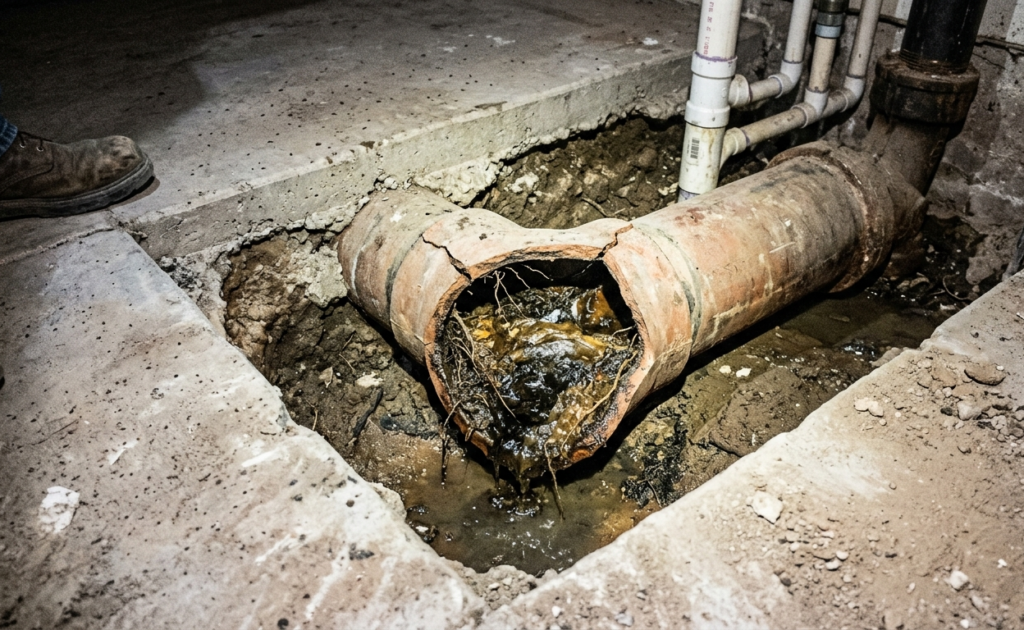
Properties with mature landscaping, particularly in established Phoenix neighborhoods, face the ongoing risk of tree root intrusion into underground drain and sewer lines. Roots are drawn toward the moisture inside sewer pipes and will exploit any existing crack, deteriorated joint, or gap to grow inside the line. Once roots establish inside a pipe, they continue to grow, catching debris and eventually causing a full blockage or structural failure. This is entirely the landlord’s responsibility to address and has nothing to do with tenant conduct. When root intrusion is severe, trenchless drain repair offers a minimally invasive solution that avoids costly excavation of the property.
Main Sewer Line Blockages
Any blockages or damage in the main sewer line are the landlord’s responsibility. These issues can cause severe sanitation problems and must be promptly addressed. When a main sewer line blocks, every fixture in the property backs up simultaneously. Sewage can surface in the lowest drain in the building, typically a floor drain, bathtub, or laundry drain. This constitutes a health and safety emergency and requires immediate emergency drain cleaning services. A main sewer line inspection before the situation reaches this point is always the better path.
Drain Cleaning Between Tenants: Why It Should Be Non-Negotiable
The period between one tenant moving out and the next moving in is the single most important window for getting the drain system inspected and professionally cleaned. Many landlords focus their turnover attention on cosmetic repairs, fresh paint, carpet cleaning, and appliance checks while completely overlooking the plumbing system. This is a costly oversight.
What a Professional Pre-Tenancy Drain Inspection Reveals
A licensed plumber running a video camera inspection through your drain lines before a new tenant moves in will show you the current interior condition of every drain line in the property. You will see grease accumulation from the previous occupant, mineral scale that has been building for years, any early-stage root intrusion, and the structural condition of the pipe walls themselves.
This inspection serves two purposes. First, it allows you to resolve any issues before they become emergency calls from your new tenant. Second, it creates a documented baseline record of pipe condition at the start of each tenancy. If a clog develops later and there is a dispute over responsibility, you have photographic and video evidence of what the drains looked like when the new tenant took possession.
The Cost Comparison Is Clear
A professional drain camera inspection and a hydro jetting service between tenancies typically costs between $200 and $500, depending on property size and the extent of buildup. Compare that to an emergency drain cleaning call at premium rates, potential water damage from a backup, a dispute over security deposit deductions that ends in small claims court, or a tenant who breaks their lease citing uninhabitable conditions. The preventive service is the dramatically cheaper option in nearly every scenario.
Professional Drain Cleaning Methods: What Landlords Should Know
Understanding what professional drain cleaning actually involves helps landlords communicate clearly with service providers and make informed decisions about which method is appropriate for each situation.
Video Camera Inspection
A waterproof drain camera travels through the pipe on a flexible cable, transmitting live footage to a monitor. The technician can see exactly where buildup is concentrated, whether any structural damage exists, the location and severity of any root intrusion, and the overall condition of the pipe walls. For landlords managing rental properties, requesting a recording of this footage is worth asking for. It becomes part of your property documentation. Learn more about what this service covers on the pipe inspection with video camera page.
Drain Snaking and Augering
A drain snake, also called a plumber’s auger, uses a rotating metal cable with a cutting or hooking tip to break through or physically remove a localized blockage. Drain snaking is appropriate for isolated clogs caused by hair, soap, or small debris accumulation near the drain opening. It is a fast, effective solution for the type of minor blockage a tenant might experience after a few months in a unit.
The limitation of snaking is that it addresses the obstruction without cleaning the pipe wall. A snake that breaks through a blockage leaves the scale coating intact, and the next blockage forms faster because the pipe diameter has continued narrowing. For rental properties with a history of recurring clogs, snaking is a temporary measure rather than a lasting solution.
Hydro Jetting
Hydro jetting is the professional drain cleaning method that delivers the most thorough and lasting results. It uses powerful streams of water released in multiple directions through a specialized hose inserted into the pipe. Unlike traditional drain snaking, this process does more than punch through a clog. It removes grease, mineral buildup, debris, tree roots, and biofilm that have adhered to the interior surface of the pipe.
For Arizona rental properties specifically, hydro jetting is particularly valuable. The immense water pressure chips away and breaks down hardened calcium and magnesium mineral scale that dramatically reduces pipe flow. A rooter cable simply cannot touch this scale. Hydro jetting also eliminates grease and soap scum at a level a snake cable merely passes through, removing the foundation for future clogs and keeping the pipe interior slick and resistant to new buildup.
For multi-unit properties, rental homes with heavy kitchen use, or any property that has experienced recurring drain problems, hydro jetting during the turnover period is the professional standard that protects your investment most effectively.
Sludge Removal
In rental properties with older plumbing or a long history of minimal maintenance, pipes often carry a thick layer of accumulated organic matter along their interior walls well beyond what grease alone would explain. Sludge removal addresses this deeper level of buildup, restoring internal pipe capacity and eliminating the foul odors that often accompany long-neglected drain systems.
Bio-Enzymatic Treatments
Bio-enzymatic drain treatments use live bacterial cultures and natural enzymes to digest organic material inside pipes. They are non-toxic, safe for PVC and metal pipe materials, septic-safe, and entirely biodegradable. They work slowly over days rather than immediately, making them unsuitable for clearing an active blockage. However, they are an excellent maintenance tool for landlords to provide to tenants as part of a routine drain care program, particularly in kitchen drains where grease accumulation is the primary concern. Properties with septic systems benefit especially from this approach since harsh chemical alternatives can disrupt the bacterial balance that the septic system depends on.
Building a Drain Maintenance Schedule for Rental Properties
A structured maintenance schedule removes guesswork and gives you a defensible record of ongoing property care. Here is a practical framework organized by timing and trigger.
At Every Tenant Turnover
Run a video camera inspection through all main drain lines and the sewer line. Schedule hydro jetting for any drain with visible grease, scale, or biofilm accumulation. Document the condition of all pipes with timestamped video footage. Address any structural issues, including root intrusion or cracked pipe sections, before the new tenant moves in. If damage is found, drain repair and replacement should be completed before occupancy begins, not deferred.
Annually, During Active Tenancies
For most residential properties, scheduling hydro jetting once per year is a sufficient maintenance interval, though properties with heavy kitchen use, older pipe systems, or Phoenix’s particularly hard water conditions benefit from semi-annual service. An annual preventive drain maintenance visit keeps accumulation from reaching the point where an emergency develops. It also allows a licensed technician to identify any developing issues in the pipe system before they become urgent repairs.
Seasonally in Arizona
Drain lines that are already partially restricted by mineral scale or grease have almost no tolerance for the sudden increased load that comes with seasonal weather shifts. Clearing outdoor area drains, floor drains, and downspout connections before Arizona’s monsoon season is a straightforward way to avoid flooding and water intrusion from overwhelmed drains. Storm drain cleaning before the first monsoon storm is one of the most cost-effective pre-season tasks available to a landlord with outdoor drainage on the property. For properties with landscaping that could direct runoff toward the building, exploring drainage solutions for landscaping is worth discussing with a professional.
In Response to Tenant Reports
Any tenant report of a slow drain, gurgling noise, or foul odor from a drain should be treated as an early warning and addressed within a reasonable timeframe, not deferred until the drain fails. A slow drain is almost always much cheaper to resolve than a backed-up drain that has overflowed and caused water damage to flooring or cabinetry. For any situation that escalates to a full backup or sewage surfacing in the unit, the emergency drain cleaning services line is the appropriate first call.
What to Include in Your Lease Regarding Drain Cleaning
A well-written lease clause covering drain maintenance protects both parties and reduces the likelihood of disputes.
Specify Tenant Obligations Clearly
Your lease should state explicitly that tenants are responsible for keeping drain strainers in place in all sinks, tubs, and showers. It should prohibit the disposal of cooking grease, oil, fat, coffee grounds, produce stickers, and any non-biodegradable material through the kitchen drain. It should prohibit flushing anything other than toilet paper through the toilet, including wet wipes marketed as flushable, paper towels, cotton products, and hygiene items.
Establish a Reporting Requirement
Include a specific obligation for tenants to report any slow drain, backup, or unusual plumbing behavior within a defined timeframe, such as 48 hours of first noticing it. Tenants who delay reporting a worsening problem bear greater responsibility for the damage that results from that delay. Having the reporting obligation written into the lease supports your position in any subsequent dispute.
Reserve the Right to Charge Back Proven Tenant-Caused Damage
If a drain blockage is definitively caused by tenant misuse, such as a camera inspection that reveals a toilet filled with wet wipes, grease solidified in the kitchen drain after less than two months of occupancy, or hair accumulation clearly beyond what normal wear would produce, your lease should clearly state that the cost of professional clog removal may be charged against the security deposit or billed directly to the tenant.
Why Arizona Rental Properties Face Greater Drain Maintenance Demands
If you own rental properties anywhere in the Phoenix metropolitan area, the Tempe, Scottsdale, Mesa, Gilbert, or Chandler markets, or anywhere else in the Valley, your drain system faces conditions that are measurably more demanding than properties in most other parts of the country.
The combination of hard water mineral deposits, extreme summer heat that causes grease to cycle between liquid and hardened states inside drain pipes, and caliche soil movement beneath older properties creates a set of drain stressors that compound over time. Unlike a rental property in a soft-water city where mineral scale is a minor concern, an Arizona rental property will experience meaningful mineral buildup inside every drain line connected to the local water supply continuously throughout the year.
This means the window between professional cleanings matters more here. A drain line that would stay clear for two years in many cities may narrow significantly within twelve months in Phoenix. For landlords managing multiple properties or properties with higher occupancy turnover, building more frequent professional maintenance into your operating budget is not excessive. It is the appropriate response to local conditions. Landlords in Goodyear, Peoria, Surprise, and Tucson face the same hard water reality and benefit from the same proactive maintenance approach.
Frequently Asked Questions
Q: Is a landlord always responsible for paying for drain cleaning in a rental property?
Not in every case. The responsibility depends on what caused the blockage. Landlords are generally responsible for major plumbing issues, structural problems, and clogs caused by normal wear and tear. Tenants are usually liable when clogs result from negligence or misuse, such as flushing non-flushable items or pouring grease down drains. The critical factor is documentation and the ability to establish cause. A pipe inspection with video camera is often the most reliable way to settle the question.
Q: Can a landlord deduct drain cleaning costs from a tenant’s security deposit?
Yes, under Arizona law, if the landlord can demonstrate that the tenant’s conduct caused a drain blockage that required professional cleaning beyond normal wear and tear. Arizona law allows landlords to deduct the cost of damages caused by the tenant from the security deposit. The key is having evidence, ideally a camera inspection report, showing that the cause was tenant misuse rather than system deterioration.
Q: How often should a landlord schedule professional drain cleaning for a rental property?
At a minimum, a drain inspection and cleaning should occur at every tenant turnover. For properties in Arizona’s hard water environment, annual preventive drain maintenance during active tenancy is strongly recommended. High-traffic rental units, properties with known grease accumulation in kitchen drains, and older homes with original pipe systems benefit from semi-annual service.
Q: What should a landlord do when a tenant reports a clogged drain?
Respond promptly, assess whether the issue is likely the result of tenant conduct or a systemic plumbing problem, and schedule a professional evaluation if the cause is unclear. Arizona landlords have ten days after written notice to address issues, reduced to five days when the problem materially affects health and safety. A sewage backup qualifies as a health and safety matter and requires urgent response via emergency drain cleaning services.
Q: Can a tenant hire their own plumber for a clogged drain?
A tenant can call a plumber, particularly in urgent situations where the landlord is unresponsive. However, tenants should review the lease first, notify the landlord in writing before taking unilateral action, and retain all receipts if they intend to seek reimbursement. Arizona law provides specific procedures for tenants to follow when landlords fail to make necessary repairs.
Q: What is the most effective drain cleaning method for Arizona rental properties?
For routine maintenance and turnover cleaning, hydro jetting combined with a camera inspection is the most thorough and lasting approach. Hydro jetting removes hard mineral scale, grease, biofilm, and debris from the pipe wall entirely, restoring full interior diameter rather than simply creating temporary clearance through the center of accumulated buildup. In Arizona’s hard water environment, this distinction matters enormously because the mineral layer that store-bought products leave behind is precisely what causes drains to re-clog rapidly.
Q: Do landlords need to clean drains in common areas of multi-unit properties?
Yes. Arizona landlords are required to keep all common areas of rental premises in a clean and safe condition. For multi-unit buildings, shared laundry room drains, utility room floor drains, parking area drains, and any plumbing that serves communal spaces is entirely the landlord’s maintenance responsibility.
Q: How does hard water in Arizona affect drain maintenance for rental properties?
The Phoenix metro water supply deposits mineral scale continuously inside every drain line connected to it, a process that never stops, regardless of how carefully drains are maintained at the surface. For landlords, this means drain pipes narrow progressively between professional cleanings regardless of tenant behavior. Regular hydro jetting is the only method that removes this mineral accumulation rather than simply punching through the center of it.
Q: Is it worth scheduling a drain camera inspection before purchasing a rental property?
Absolutely. A main sewer line inspection before purchase can reveal tree root intrusion, pipe deterioration, collapsed sections, illegal connections, and years of grease and mineral accumulation that will need immediate professional attention. The cost of a pre-purchase camera inspection is negligible compared to the cost of discovering a failing sewer line after closing.
Q: What happens if a landlord ignores drain maintenance in a rental property in Arizona?
The consequences escalate quickly. Neglected drains fail at the worst possible times, creating sewage backups that constitute health and safety violations under Arizona law. Tenants have the legal right to pursue remedies, including rent reduction, repair and deduct, and lease termination when landlords fail to maintain habitable plumbing conditions. Beyond legal exposure, untreated plumbing failures cause water damage to structural elements, flooring, cabinetry, and adjacent units in multi-family properties, turning a preventable maintenance issue into a significant financial loss. If a drain has already reached the point of failure, drain repair and replacement or trenchless drain repair are the appropriate next steps.
The Bottom Line for Arizona Landlords
Drain cleaning for rental properties is not an optional maintenance item. It is a legal obligation, a financial protection strategy, and one of the most direct levers you have over the long-term condition of your investment. Arizona’s hard water, extreme heat, and aging pipe stock in many Valley neighborhoods make proactive professional drain maintenance more important here than almost anywhere else in the country.
The landlords who manage drain maintenance well do four things consistently: they inspect and professionally clean drains at every tenant turnover, they build annual hydro jetting into their operating budget, they document everything, and they educate tenants at move-in rather than chasing disputes after the fact.
For rental property owners across the Phoenix metro area, the East Valley cities of Mesa, Gilbert, and Chandler, the West Valley communities of Goodyear, Buckeye, and Surprise, and throughout the rest of Arizona, connecting with an experienced arizona drain cleaning service that understands local water and soil conditions is the most practical step toward protecting your properties and eliminating the costly pattern of reactive emergency repairs. Contact us to schedule a property drain inspection or request same-day service today.