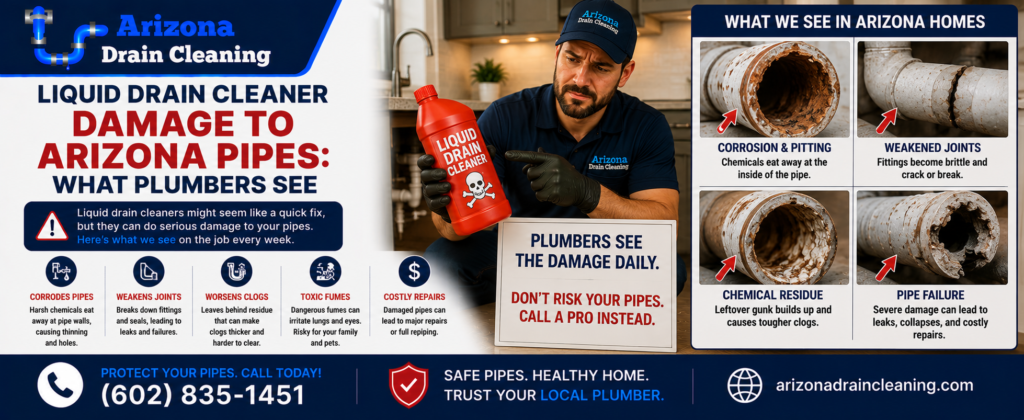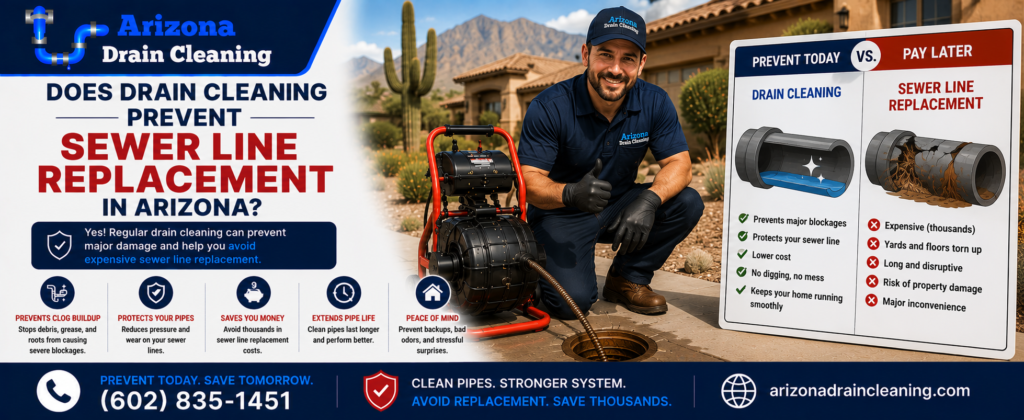
Drain cleaning for churches and non-profit facilities in Arizona is a genuinely distinct maintenance challenge, and the organizations that handle it well are the ones that understand exactly why their plumbing systems behave differently from a standard office building or a residential property. Arizona’s religious congregations, food banks, community service organizations, charitable shelters, and social service centers operate buildings that sit in a unique category: they experience intense, concentrated periods of high occupancy followed by stretches of low or no use, they often operate commercial-grade kitchen facilities on budgets that were never designed to cover major infrastructure emergencies, and they serve communities that depend on them being operational without interruption.
At Arizona Drain Cleaning, we work with houses of worship, non-profit service organizations, and community-based facilities across Phoenix, Mesa, Scottsdale, Tempe, Glendale, Chandler, and Peoria. This guide is written for the facilities managers, church administrators, executive directors, and volunteer maintenance leads who carry the responsibility of keeping these buildings functional on behalf of the people they serve.
Why Church and Non-Profit Plumbing Systems Are Different From Other Commercial Properties
Before getting into the specifics of drain cleaning methods and maintenance schedules, it is worth understanding what makes the plumbing infrastructure at a church, mosque, synagogue, temple, food bank, or community service center structurally different from a restaurant, an office building, or a retail space. The differences matter because they directly determine what drain problems these facilities are most likely to face and when.
The Surge and Idle Pattern of Use
Most commercial properties run their plumbing systems at a relatively consistent daily volume. Employees arrive, use the facilities, and leave. The drain system sees steady, predictable throughput.
A church or congregation center operates on a fundamentally different pattern. On a typical weekday, the building may be nearly empty. On Sunday morning, or during a Friday evening service, a holiday observance, a community dinner, or a major event, hundreds or even thousands of people are using the restrooms simultaneously, the kitchen is running at full capacity to prepare and serve meals, and every drain in the building is handling a volume of use it has not seen in days.
This surge and idle pattern creates two specific problems for drain systems. During the idle periods, standing water in infrequently used p-traps can evaporate, allowing sewer gases to migrate back into the building through floor drains and unused fixture connections. In Arizona’s dry desert climate, where low humidity accelerates evaporation, this problem is more pronounced than in other parts of the country, and the sewage odors that result are particularly unwelcome in a space where congregants and guests are supposed to feel welcomed and cared for.
During the surge periods, the drain system suddenly has to handle what amounts to a commercial-volume load in a building that may have older plumbing infrastructure that was sized for a more modest use pattern or that has accumulated months of restricted flow from scale and organic buildup. The sudden surge is when slow drains and partial restrictions reveal themselves as complete blockages, typically at the worst possible time.
Older Buildings With Decades of Infrastructure Accumulation
A significant portion of Arizona’s established churches, synagogues, mosques, and non-profit community centers occupy buildings that were constructed between the 1950s and the 1980s, a period of rapid development across the Phoenix metropolitan area and Tucson. These buildings were built with the pipe materials standard at the time: cast iron sewer lines, galvanized steel supply lines, and in some cases clay tile sewer laterals. In many of these properties, the drain infrastructure has never received professional cleaning in its entire operational life.
Add to that the specific challenges that Arizona’s environment creates, particularly the Phoenix Valley’s very hard water which consistently deposits calcium and magnesium scale on interior pipe walls, and the soil movement caused by Arizona’s expansive clay soils shifting through monsoon season wet and dry cycles, and you have an aging infrastructure under compounding stress that faces periodic high-demand surges without the benefit of regular professional maintenance.
Budget Constraints and Deferred Maintenance
Non-profit organizations and religious institutions operate with budget realities that for-profit businesses do not face in the same way. Funds are raised through donations, grants, and tithes, and those funds are understandably directed toward mission and programming rather than facility infrastructure. Drain cleaning and plumbing maintenance are easy to defer when the drains are still technically flowing, even if slowly. The deferred maintenance builds quietly for months or years until a blockage forces an emergency response at the highest possible cost and worst possible timing.
The organizations that break out of this cycle are the ones that understand that a modest scheduled maintenance investment prevents expensive emergency costs, protects the facility from the reputational and operational damage of a sewage backup during a service or community event, and extends the useful life of the building’s plumbing infrastructure. This is not an abstract financial argument. It is a practical reality that any facilities manager at a large congregation or active non-profit can confirm from experience.
The Most Common Drain Problems in Arizona Churches and Non-Profit Facilities
High-Volume Restroom Drain Failures During Services and Events
The restrooms in a church or community center are typically the busiest rooms in the building during services and events, and they are designed for higher-than-residential use. However, even commercial-grade restroom fixtures and drain lines develop restrictions over time, and Arizona’s hard water accelerates that process by depositing mineral scale on pipe interiors.
When hundreds of people are using the restrooms in a 90-minute window, a drain line that has been running at 70 percent of its original capacity because of mineral scale and soap scum accumulation can tip into a full blockage under that volume. Floor drains in restroom areas, which may see little use between events and are therefore prone to trap evaporation and dry seal failures, suddenly need to handle overflow conditions they are not prepared for.
The fixtures that fail first in these high-surge situations are almost always the ones closest to the end of the branch line, or the ones that share a common drain connection with the highest number of other fixtures. A church with a row of restroom stalls that all share a single drain line running toward the main stack is particularly vulnerable to this pattern of failure.
Kitchen and Fellowship Hall Grease Accumulation
A church kitchen or non-profit food service operation presents grease accumulation challenges that rival a small commercial restaurant, even though the kitchen may only operate once or twice per week. The issue is that grease does not simply pass through a drain line and disappear. It coats the interior walls of the pipe, cools and solidifies in Arizona’s air-conditioned facility environments, and builds up layer by layer over months and years of operation.
Churches that operate weekly fellowship meals, monthly community dinners, or regular food distribution events through programs affiliated with organizations like the Arizona Food Bank Network or local Feeding America member agencies are consistently putting cooking oils, food debris, and cleaning product residue into their kitchen drain lines. For facilities that serve hot meals to large groups, the volume of grease entering the drain system from a single event can rival what a busy restaurant generates in several service periods.
Without regular professional cleaning of the kitchen drain lines and proper maintenance of any grease interceptor in the system, this accumulation grows until it creates a blockage that happens during food service, when a kitchen shutdown creates the most disruptive possible scenario for the people depending on that meal program.
Floor Drain Failures From Trap Evaporation
Floor drains in Arizona churches and non-profit facilities are among the most neglected components of the drain system, and they create a specific problem that is far more common in Arizona than in more humid climates. The p-trap beneath each floor drain holds a small amount of water that creates a seal against sewer gases rising from the drain system into the occupied space. In a facility that is not actively using its floor drains between weekly services, and particularly in Arizona’s low-humidity desert environment, that water evaporates. Once the trap seal fails, sewer gases travel directly into the fellowship hall, restrooms, or kitchen.
The smell is noticeable and unpleasant, and it is particularly damaging to the environment that churches and non-profits work hard to create for their visitors and clients. The fix is straightforward, a proper trap primer or regular water introduction into the drain, but the problem needs to be identified and addressed before the gas migration becomes a regular occurrence. A professional drain cleaning visit that includes a floor drain inspection and trap check catches this issue and resolves it before it becomes a complaint at Sunday service.
Root Intrusion in Established Church Campus Landscaping
Many established church campuses in Arizona communities like Tempe, Phoenix’s Arcadia neighborhood, central Scottsdale, and older Mesa neighborhoods were developed alongside mature landscaping trees that provide shade and a welcoming campus environment. These trees, which may include Eucalyptus, Chinese Elm, Ash, Ficus, and other large species, have root systems that actively seek moisture in Arizona’s dry soil. Underground sewer lines running beneath the campus provide exactly the moisture these roots seek, and they will penetrate aging pipe joints given enough time.
For churches and non-profits occupying campuses built in the 1960s through the 1980s, root intrusion in the main sewer line is not a remote possibility. It is a probability that increases with every year the pipe system goes without a camera inspection. Root masses that begin as small tendrils at a joint grow over time into dense obstructions that trap waste and create recurring blockages. Early-stage root intrusion identified during a camera inspection can be addressed through hydro jetting with a root-cutting nozzle. Advanced root intrusion that has been developing for years requires a more significant intervention.
Outdoor Drain and Parking Lot Drain Problems From Monsoon Season
Church campuses and non-profit facility grounds in Arizona face outdoor drainage challenges that are directly tied to the monsoon season, which typically runs from mid-June through mid-September. Intense monsoon rainfall events can deliver more rain in a single afternoon than some Arizona communities see in several months, and the outdoor drainage infrastructure on a church campus, including parking lot drains, patio drains, and surface runoff channels, must be able to handle that volume without flooding.
Outdoor drains that have accumulated sand, sediment, decomposed organic material, and debris from landscaping maintenance between events can fail under monsoon rainfall loads, causing standing water in parking areas, at building entrances, and against foundation walls. For non-profit organizations that maintain food distribution areas, outdoor service lines, or community gathering spaces, flooding during a storm event creates immediate operational and safety problems.
Pre-monsoon clearing of outdoor drains and catch basins is one of the most cost-effective maintenance investments an Arizona church or non-profit can make given the volume of rainfall these systems must handle each summer.
Drain Cleaning Methods That Work Best for Church and Non-Profit Facilities in Arizona
Hydro Jetting for Main Lines and Kitchen Drains
Hydro jetting is the most thorough and longest-lasting drain cleaning method available for the main sewer lines and kitchen drain systems in Arizona church and non-profit facilities. Using high-pressure water delivered through a specialized nozzle, hydro jetting scours the interior walls of the pipe and flushes accumulated mineral scale, grease, biofilm, organic debris, and root fragments completely out of the line rather than simply punching a path through a blockage.
For Arizona facilities dealing with the Valley’s hard water mineral scale accumulation, hydro jetting is the only method that physically removes the scale coating from pipe walls. Mechanical snaking clears a path through a blockage but leaves the scale and grease coating on the pipe walls intact, meaning the next blockage forms more quickly than if the walls were clean. Hydro jetting delivers a result that stays clean significantly longer between service visits, which is particularly valuable for facilities operating on maintenance budgets that cannot afford frequent reactive service calls.
The kitchen drain lines at any church or non-profit operating a food service program should be hydro jetted at minimum annually, and semi-annually for facilities operating high-volume meal programs on a regular weekly schedule.
Video Camera Inspection for Diagnosis and Planning
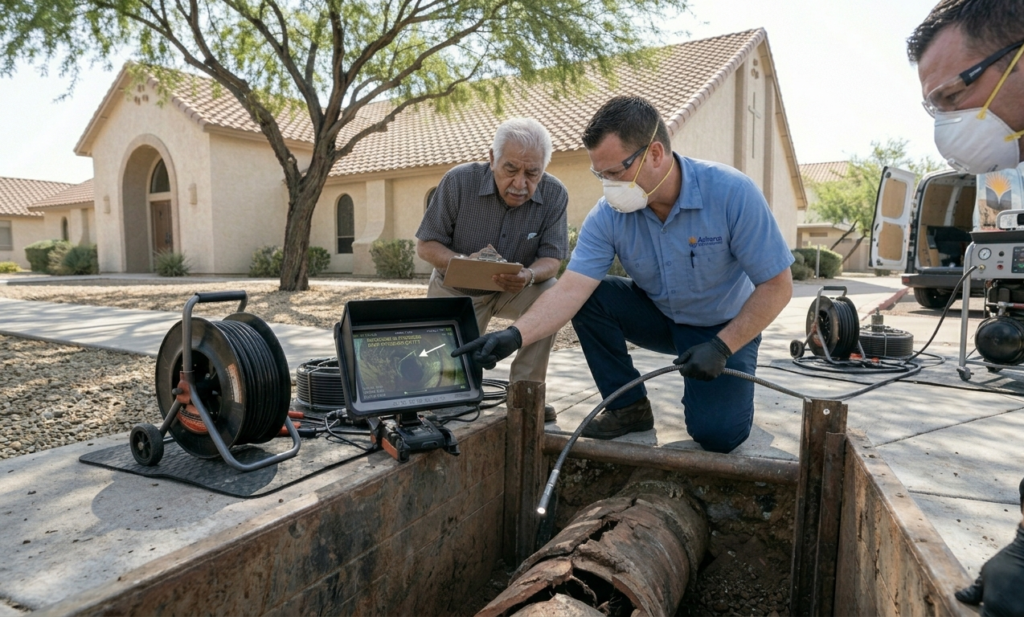
A video camera inspection of the main sewer line serving a church or non-profit facility is one of the highest-value diagnostic investments an Arizona facilities manager can make, particularly for older buildings that have never had their underground pipe system professionally evaluated. The camera inspection reveals the pipe material, the interior condition of the line, any structural damage from soil movement or age, the presence and extent of root intrusion, joint conditions, and whether the line has developed any bellies or low spots where wastewater pools instead of flowing toward the municipal connection.
For organizations working within tight maintenance budgets, a camera inspection is particularly valuable because it provides accurate, documented information that allows leadership to make informed decisions about maintenance priorities. Rather than spending money reactively on emergency service calls that address symptoms without diagnosing root causes, a camera inspection tells the facilities manager what the pipe system actually needs, in what order of priority, and at what cost level. This information directly supports better budget planning for facility maintenance.
Mechanical Drain Snaking for Localized Fixture Clearing
For routine clearing of individual fixture blockages in restrooms, kitchens, and utility areas, professional mechanical drain snaking provides fast, targeted relief at a lower cost point than a full hydro jet service. When a single restroom sink drains slowly before a service, or a kitchen drain slows down during a community meal, a mechanical clearing gets the fixture functional quickly without requiring a full-scale service deployment.
Mechanical snaking is appropriate as a first response to acute localized blockages. It is not a substitute for periodic hydro jetting of the main line and kitchen drain system, and facilities that rely exclusively on snaking to respond to recurring problems will find the problems returning more quickly than if the underlying pipe wall accumulation were addressed directly.
Enzyme and Biological Drain Maintenance Treatments
For Arizona churches and non-profits that want to slow the rate of accumulation in their drain lines between professional service visits, enzyme-based and bacterial drain treatment products offer a practical complement to scheduled professional maintenance. These products introduce beneficial bacteria that digest organic material in the pipe, reducing the rate at which grease, biofilm, and organic debris accumulate on pipe walls.
These treatments are particularly useful for kitchen drain lines between annual professional cleaning visits, and for floor drains in intermittently used areas where biological growth can develop in stagnant conditions. They are not a replacement for professional hydro jetting, but they are a cost-effective tool for extending the intervals between professional service visits.
Building a Drain Maintenance Program That Works for a Non-Profit Budget
The practical challenge for most Arizona churches and non-profit organizations is not understanding why drain maintenance matters. It is figuring out how to fit that maintenance into a budget that is already stretched across competing priorities. A structured approach to drain maintenance that prioritizes the highest-risk components and schedules service during the most operationally convenient windows is the answer to that challenge.
Identifying the Highest-Risk Drain Zones in Your Facility
Not all drains in a church or non-profit facility carry equal risk or require the same frequency of professional maintenance. Start by identifying the zones where a drain failure would cause the most immediate operational impact.
The kitchen and food service drain lines sit at the top of the risk profile for any facility operating a regular food program. A kitchen drain failure during a community meal service is an immediate operational emergency with direct impact on the people being served. These lines deserve the most frequent professional attention and a consistent scheduled service program.
The restroom drain lines serving the sanctuary, fellowship hall, and main public areas are the second highest-priority zone. These are the drains that will fail under surge conditions during services and events if they have been allowed to accumulate restriction. A pre-event professional check and annual cleaning of these lines is a sound investment given the reputational cost of a restroom failure during a Sunday service.
The main sewer line serving the entire campus is the foundation of all of the above. A main line failure affects every drain in the facility simultaneously. A camera inspection of the main line followed by hydro jetting if accumulation warrants it should be part of the facility’s annual maintenance calendar.
Scheduling Service During Operationally Quiet Periods
The most cost-effective and least disruptive time to schedule professional drain cleaning at a church or non-profit facility is during the building’s operationally quiet periods. For most congregations, this means weekday mornings or early afternoons when the building is not in active use for services or programs. For facilities with heavy weekday programming, scheduling during summer months when attendance and activity typically slow down, or during the week following a major holiday observance, allows service to be performed without disrupting any active programs.
Arizona Drain Cleaning works directly with church and non-profit facility administrators to schedule service in windows that align with the organization’s calendar rather than imposing service windows that create operational conflicts. For kitchen drain cleaning that requires the kitchen to be out of service for a portion of the service period, scheduling a weekday that falls between regular kitchen operation days ensures no active program is disrupted.
Building a Multi-Year Maintenance Budget
For non-profit organizations with annual budget cycles, incorporating drain maintenance into a multi-year plan rather than treating it as a reactive line item transforms the budget conversation. A facility manager who can present leadership with a three-year maintenance schedule showing annual kitchen drain cleaning, bi-annual main line hydro jetting, and a camera inspection every two years, with realistic cost estimates for each, is in a much stronger position to secure the necessary funds than one who can only ask for emergency repair budget after a backup has occurred.
The total annual cost of a proactive drain maintenance program for an Arizona church or non-profit facility of moderate size is genuinely modest compared to the cost of a single emergency sewage backup cleanup, which combines the emergency service premium, potential water damage remediation costs, and the operational disruption of having the facility or portions of it unusable during a cleanup and repair period.
What to Look for When Hiring a Drain Cleaning Company for Your Arizona Facility
Churches and non-profit organizations deserve the same standards of service accountability as any commercial client, and in some respects they should ask for more given that their facilities serve vulnerable community members and operate with donated funds.
Arizona ROC License Verification
Any contractor performing drain cleaning or plumbing work at an Arizona non-profit or church facility should hold an active license with the Arizona Registrar of Contractors. The AZ ROC license is publicly verifiable at roc.az.gov in under two minutes by searching the company name or license number. This verification confirms that the company is operating legally, that their license is current and in good standing, and that no unresolved complaints have been filed against them. For non-profit organizations with fiduciary responsibility to donors and boards, hiring an unlicensed contractor creates liability exposure that is simply not worth accepting.
Service Documentation and Written Estimates
Every professional drain cleaning visit should result in a written estimate before work begins and a written service report after work is completed. The service report documents what was found, what was done, what method was used, and any recommendations for follow-up. For a non-profit organization, this documentation supports accountability to leadership and boards, provides records that can inform future budget planning, and creates evidence of a proactive maintenance program if questions about facility management are ever raised.
Experience With Institutional and Community Facility Environments
A drain cleaning company serving a church or non-profit facility should understand the operational environment without needing it explained. They should be willing to schedule service at times that accommodate the facility’s program calendar, communicate clearly with facilities staff about what will be disrupted and for how long, and approach the work with the level of professionalism appropriate to a community-serving environment. A company that treats a food bank kitchen or a congregation’s fellowship hall with the same respect and courtesy as any commercial client is the right partner for this type of facility.
How Arizona Drain Cleaning Serves Churches and Non-Profit Organizations Across the Valley
Arizona Drain Cleaning provides professional commercial drain cleaning services to churches, mosques, synagogues, temples, food banks, shelters, community service centers, and other non-profit organizations throughout the Phoenix metropolitan area. We understand the specific operational patterns, budget realities, and scheduling constraints that define how these organizations use and maintain their facilities.
Our team brings licensed commercial expertise, professional-grade hydro jetting equipment, high-definition camera inspection technology, and a service approach built around minimizing disruption to the programs and people these organizations serve. Every service visit is documented with a written report that supports accountability to organizational leadership and provides the maintenance records needed for responsible long-term facility management.
We also offer scheduled preventive maintenance programs that provide Arizona churches and non-profits with predictable, budgetable drain maintenance on a calendar that fits their operational year rather than reactive emergency calls that arrive at the highest cost and worst possible timing.
Frequently Asked Questions
How often should a church in Arizona schedule professional drain cleaning?
The appropriate frequency depends on the size of the congregation, how often the kitchen and fellowship hall are in active use, the age of the building’s pipe infrastructure, and the presence of mature trees near the sewer line on the campus. As a general baseline, kitchen drain lines at churches operating weekly or bi-weekly food service programs warrant professional cleaning at least annually, and semi-annually for high-volume kitchens. Main sewer line hydro jetting is appropriate every one to two years for most established Arizona church campuses. Buildings with pre-1980 pipe materials or known root intrusion history benefit from a shorter service interval.
Why does our church’s drain smell bad only on Sunday mornings?
The most common cause of this pattern is floor drain trap evaporation during the week when the building has minimal foot traffic and low water use. Arizona’s dry desert climate accelerates trap evaporation, and a floor drain that is not receiving regular water flow can lose its p-trap water seal within a few days to a week. When the building fills with people and air movement on Sunday morning, the sewer gas that has been migrating through the dry trap becomes noticeable. Pouring a small amount of water into floor drains at the start of each week resolves the immediate symptom, and a trap primer installation provides a longer-term solution.
Can Arizona Drain Cleaning work around our service and program schedule?
Yes. Scheduling service to avoid disruption to active programs and services is a standard part of how we work with church and non-profit facilities. Our team coordinates directly with facilities staff or administrators to identify service windows that fall between program activity. For kitchen drain service requiring temporary kitchen shutdown, we schedule during days that fall between regular kitchen operation. For main sewer line work requiring water to be briefly shut off to portions of the facility, we time the service to minimize any impact on the people being served.
What happens if our church has a drain backup during a service or event?
Contact Arizona Drain Cleaning immediately. We provide emergency drain cleaning service for commercial and institutional properties across the Phoenix metro area. An active main line backup during a church service or community event is a situation that needs professional response as quickly as possible to minimize the disruption, address the sanitation concern, and get the facility’s plumbing functioning again. Our commercial emergency response is equipped to handle main line blockages and sewer backups in institutional facilities with the urgency and professionalism the situation requires.
Is drain cleaning more expensive for a church than for a regular commercial business?
No. Professional drain cleaning service for a church or non-profit facility is priced on the same basis as any comparable commercial property, based on the scope of work, the method required, the length of the line being serviced, and the access conditions on the property. The size of the building, the number of drain lines being serviced, and the condition of the system are the relevant factors, not the type of organization occupying the facility. Non-profit organizations do not pay a premium for professional drain service.
Our church building is from the 1960s and has never had the drain lines professionally inspected. Where should we start?
Start with a video camera inspection of the main sewer line. For a building from the 1960s that has never had its underground drain infrastructure professionally evaluated, the camera inspection is the most important first step because it tells you exactly what condition the system is actually in rather than requiring you to make decisions based on guesswork or surface-level symptoms. The camera footage will identify the pipe material, any structural damage, the extent of any root intrusion, the condition of joints and connections, and whether the line has any sections that need repair before cleaning would be appropriate. Armed with that information, a responsible maintenance plan can be built around what the pipe system actually needs.