Commercial grease trap cleaning in Phoenix is not optional maintenance that a restaurant owner can defer to a slow week. It is a legal requirement enforced by the City of Phoenix, the Arizona Department of Environmental Quality, and the regional wastewater pretreatment authority, and the consequences of falling behind range from kitchen drain backups during dinner service to fines, compliance citations, and in serious cases, a forced closure until the violation is corrected. If you operate a food service establishment anywhere in the Phoenix metro area, including Scottsdale, Mesa, Tempe, Chandler, Glendale, or Peoria, understanding your grease trap obligations is as fundamental to running your operation as managing your food cost and keeping your health inspection score clean.
To understand what “proper compliance” actually looks like in practice, here’s a simplified breakdown of how grease trap obligations translate into real operational requirements:
| Area of Responsibility | What Phoenix Regulations Expect | What Happens If You Don’t Comply |
|---|---|---|
| Cleaning Frequency | Regular pumping based on kitchen load (often monthly to quarterly) | Grease overflow, drain backups, violations |
| Record Keeping | Service logs and disposal manifests | Failed inspections or citation risk |
| Trap Capacity Maintenance | Must stay below allowable grease level threshold | Reduced efficiency, system blockage |
| Waste Disposal | Approved disposal through licensed haulers | Environmental fines and penalties |
| Health & Wastewater Inspections | Must pass city and pretreatment checks | Possible warning, fines, or closure |
Most restaurants don’t fail because they ignore grease traps completely they fail because they stretch service intervals too far, assuming everything is fine until it visibly isn’t. By the time symptoms appear, the trap is usually already over capacity and grease is entering the main sewer line.
At Arizona Drain Cleaning, we service commercial grease traps and kitchen drain systems across the Valley, and the situations we are called into most often are ones that could have been prevented with a consistent maintenance schedule. This expanded guide covers everything a Phoenix restaurant owner, commercial kitchen manager, or food service operator needs to know about grease traps: how they work, why Phoenix’s climate makes the maintenance stakes higher, what the regulations actually require, how to read the signs that your trap needs service, what a professional cleaning includes, and how to build a maintenance program that protects your business year-round.
What a Grease Trap Actually Does and Why It Matters in Phoenix
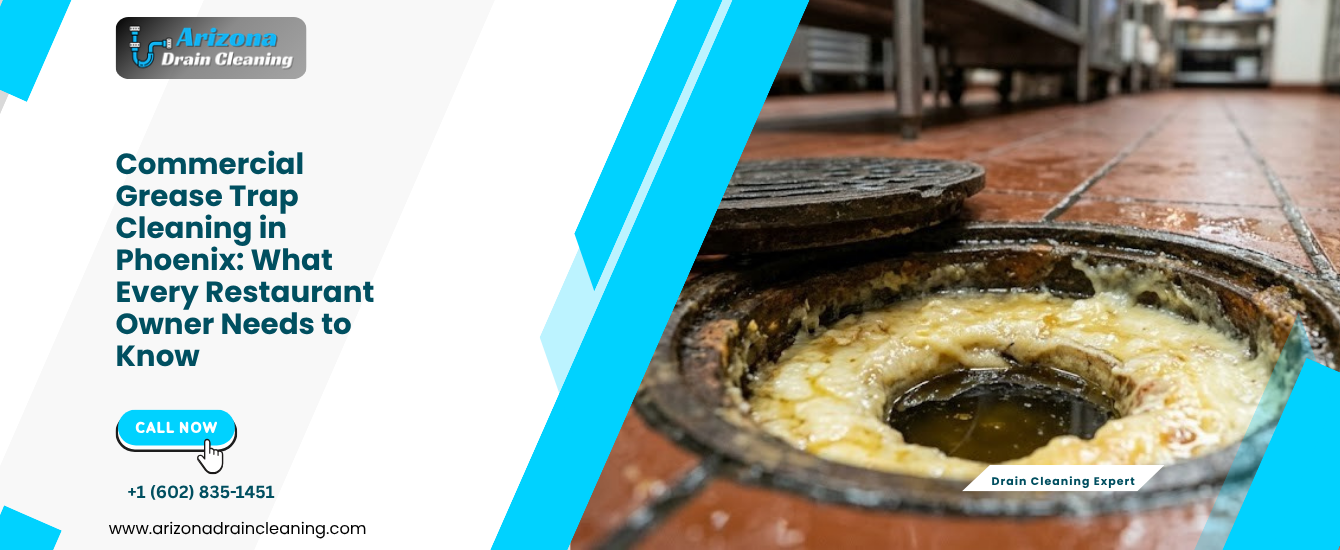
A grease trap, also called a grease interceptor depending on its size and installation type, is a plumbing device installed in the wastewater line between your commercial kitchen’s drain outlets and the municipal sewer system. Its fundamental job is to capture fats, oils, and grease, universally referred to in the regulatory world as FOG, before that material can enter the public sewer infrastructure where it causes extensive and expensive damage.
The physics behind a grease trap are straightforward. Hot, greasy wastewater from commercial cooking operations enters the trap through the inlet. As the water slows and cools inside the trap chamber, FOG naturally separates from the water and rises to the surface because it is less dense than water. The cleaner wastewater below is then discharged through the outlet to the sewer. The FOG remains captured in the trap until the trap is pumped and cleaned professionally.
Why FOG Is Such a Serious Problem in the Phoenix Sewer System
FOG is not simply messy. It is destructive to sewer infrastructure in ways that accumulate over time until entire sections of public sewer line require emergency repair or replacement. When FOG bypasses a poorly maintained or completely absent grease trap and enters the Phoenix municipal sewer system, it cools as it moves through underground pipes and begins to solidify on pipe walls. Combined with the calcium and magnesium mineral deposits already present in Phoenix’s very hard water environment, this grease-mineral combination creates a concrete-like accumulation inside sewer lines that progressively narrows and eventually blocks the pipe entirely.
The City of Phoenix Water Services Department and the regional wastewater authority have an active FOG Control Program specifically because the cost of cleaning FOG from city sewers and repairing damage caused by grease-related blockages runs into the millions of dollars annually across the metro area. Restaurants are the single largest commercial source of FOG entering the system, which is why the regulatory focus on commercial food service operations is as intense as it is.
Phoenix’s Heat Accelerates Grease Trap Problems
One factor that makes grease trap maintenance in Phoenix genuinely different from the same task in most other American cities is the desert climate. Phoenix’s extreme summer temperatures, which regularly reach 110 degrees Fahrenheit and above, accelerate the biological breakdown of organic material inside a grease trap in ways that colder or more temperate climates simply do not produce. The warmer the ambient temperature, the faster the FOG inside a trap breaks down, releases gases, and generates the odors that customers notice in a dining room, a kitchen, or even a parking area near a kitchen exhaust vent.
The accelerated breakdown also means that an overfull trap in a Phoenix summer is producing unpleasant odors far more quickly than an equivalent trap in a northern city. For restaurant operators who care about the dining experience their guests have, this environmental reality makes staying ahead of grease trap maintenance not just a regulatory obligation but a direct quality-of-service consideration.
The Two Types of Grease Traps Phoenix Restaurants Use
Understanding the difference between the two main categories of grease trap is important because their installation requirements, maintenance schedules, cleaning methods, and cost structures differ meaningfully.
Indoor Grease Traps
Indoor grease traps are smaller units, typically ranging from 8 to 100 gallons in capacity, that are installed inside the commercial kitchen, either under a sink, in the floor beneath a kitchen drain connection, or in a utility area adjacent to the kitchen. Because of their smaller capacity, indoor traps fill up relatively quickly and require more frequent cleaning than outdoor interceptors.
Indoor traps are typically found in smaller food service operations: quick service restaurants, food trucks with permanent commissary kitchen connections, small cafes, coffee shops with limited food prep, and similar lower-volume operations. Some Phoenix municipalities and building configurations allow indoor traps as the compliant solution for lighter-volume kitchens, while others require outdoor interceptors based on the volume of food preparation and the anticipated FOG output of the operation.
The cleaning process for an indoor trap is more accessible physically but generates regulated waste that must be disposed of properly. It cannot be emptied into the kitchen drain or the trash, which is a point that catches some first-time restaurant operators off guard. Professional grease trap service companies handle proper disposal as part of the service.
Outdoor Grease Interceptors
Outdoor grease interceptors are large in-ground units, typically ranging from 500 gallons to 2,000 gallons or more in capacity, installed outside the building in the parking area, loading dock area, or utility corridor of the property. They are designed for high-volume commercial kitchens and are required by Phoenix city code for food service operations above certain volume thresholds.
Full-service restaurants, hotel and resort kitchens, hospital cafeterias, school food service operations, large fast food operations, and grocery store delis typically fall into the category requiring outdoor interceptors. The larger capacity of these units allows for longer intervals between pump-outs compared to indoor traps, but the volume of grease and solid waste they accumulate when they do need service is proportionally larger, and the cleaning process is more involved.
Phoenix and Scottsdale’s FOG Control Program requirements specify which type of interceptor is appropriate for a given operation based on the type of food service, the number of meals prepared per day, the type of cooking equipment in use, and the calculated FOG output from those operations. A new food service tenant in a Phoenix commercial space should confirm what type of grease trap infrastructure is already in place and whether it meets current code requirements for the intended operation before signing a lease.
The Regulatory Framework: FOG Rules in Phoenix and the Broader Arizona Market
The regulatory framework governing grease trap maintenance in Phoenix involves multiple authorities whose requirements layer on top of each other. Understanding each one and how they interact is essential for operating in compliance.
Federal Clean Water Act Foundations
The obligation on commercial food service operations to manage their FOG output traces back to the federal Clean Water Act, which establishes national standards for wastewater discharge into public sewer systems. Under the Clean Water Act’s pretreatment program, local publicly owned treatment works, the treatment facilities that process municipal wastewater, are authorized to enforce pretreatment standards on commercial and industrial dischargers, including food service operations. Grease trap installation and maintenance requirements are a direct application of these pretreatment standards at the local level.
Arizona Department of Environmental Quality
The Arizona Department of Environmental Quality, known as ADEQ, implements Arizona’s wastewater pretreatment regulations and administers the state’s Aquifer Protection Permit program. ADEQ regulates and monitors businesses for grease trap compliance across the state and works with local municipal pretreatment authorities to enforce FOG control standards. Food service operations in Phoenix that discharge excessive FOG can face ADEQ enforcement actions in addition to city-level citations, and the documentation required for ADEQ compliance includes maintenance records that must be retained for a minimum of three years.
City of Phoenix FOG Control Program
The City of Phoenix Water Services Department operates an active FOG Control Program that applies to all food service establishments within Phoenix city limits connected to the Phoenix municipal sewer system. The program requires commercial food service operations to install approved grease interceptors or traps, maintain them on a schedule that keeps FOG accumulation below the 25 percent threshold, and document all cleaning service with records available for inspection.
Phoenix inspectors actively conduct FOG compliance inspections of commercial food service operations, and violations are documented and escalated for repeat offenders. The City of Phoenix’s code establishes that grease trap maintenance records must be retained on site and made available to inspectors on request. Facilities that cannot produce documentation of recent service are in a disadvantaged position during any compliance inspection regardless of whether the trap itself is currently within acceptable accumulation limits.
Mesa, Scottsdale, Tempe, Chandler, and Glendale FOG Programs
Phoenix, Tucson, and Mesa are specifically identified by regional regulatory authorities as operating robust FOG Control Programs that require interceptor installation, scheduled cleaning, and maintenance log retention for a minimum of three years. Scottsdale and Chandler have active pretreatment programs administered through their respective water and wastewater utilities that apply equivalent requirements to food service operations within their jurisdictions.
For restaurant operators with multiple locations across the Phoenix metro area, it is worth noting that each municipality’s specific requirements can vary slightly in terms of cleaning frequency mandates, documentation formats, and inspection protocols. Working with a grease trap service provider who understands the specific requirements of each municipality where your locations operate simplifies compliance management across your portfolio.
The 25 Percent Rule: Understanding When Your Trap Needs Service
The regulatory standard that most Phoenix-area municipalities use as the threshold for required grease trap cleaning is the 25 percent rule. This standard specifies that when the combined depth of floating FOG at the surface and settled solids at the bottom of the trap together equal or exceed 25 percent of the trap’s total liquid depth, the trap must be cleaned.
This threshold exists because a trap that is approaching 25 percent capacity is losing its ability to effectively separate FOG from wastewater before it reaches the outlet. As the floating grease layer deepens and the settled solids layer rises, the effective separation zone in the middle of the trap becomes narrower. Once the combined depth exceeds the 25 percent threshold, FOG begins bypassing the trap through the outlet and entering the sewer system, which is exactly the outcome the trap is designed to prevent.
What 25 Percent Looks Like in Practice
For most full-service Phoenix restaurants doing regular lunch and dinner service with a standard commercial kitchen, the 25 percent accumulation threshold is typically reached within 30 to 90 days of the previous cleaning, depending on the volume of cooking, the types of food being prepared, and the capacity of the trap. High-volume kitchens with heavy frying operations, large quantities of meat preparation, or continuous cooking throughout the day often reach the threshold in 30 days or less. Fast-casual operations with lighter cooking activity and smaller portion sizes may reach 90 days or slightly beyond before hitting the threshold.
The practical implication of this is that there is no single universal cleaning schedule that applies to every Phoenix restaurant equally. The appropriate service interval for your specific operation depends on your kitchen’s actual FOG output, and the most reliable way to determine that interval is to have a professional service provider track your accumulation rate across multiple cleaning cycles and establish a data-driven schedule rather than guessing based on general industry averages.
What Happens When a Phoenix Restaurant Skips Grease Trap Cleaning
The consequences of deferred grease trap maintenance in Phoenix are predictable, progressive, and consistently more expensive than the cost of staying current on scheduled service. Understanding the full consequence spectrum is useful for any restaurant operator who has been tempted to push a cleaning back by a few weeks to manage cash flow during a slow period.
Drain Backup During Service
The most immediate and operationally disruptive consequence of an overfull grease trap is kitchen drain backup. When the trap can no longer accept additional wastewater inflow efficiently because it is at or beyond capacity, wastewater begins to back up into the kitchen drain lines. During service, this means sinks that will not drain, floor drains that back up with greasy wastewater, and potentially a kitchen that must be partially or fully shut down during your busiest hours.
A kitchen drain backup during dinner service is simultaneously an operational emergency, a health code violation, and a customer experience problem if the backup extends to areas visible or accessible to guests. Emergency drain cleaning service is available for exactly these situations, but the premium charged for emergency response is substantially higher than scheduled maintenance, and the disruption to service is entirely avoidable with a consistent maintenance program.
FOG Compliance Citations and Fines
The City of Phoenix and ADEQ both have enforcement authority over FOG compliance violations. A facility found to be operating with a grease trap at or beyond the 25 percent capacity threshold, or unable to produce maintenance documentation showing current service, is subject to fines and formal compliance citations. Repeat violations escalate to compliance schedules, which require the facility to submit to additional oversight and demonstrate corrective action within defined timeframes.
In the most serious repeat-violation scenarios, facilities discharging excessive FOG may face permit revocation or surcharges from the Phoenix Water Services Department, creating an ongoing financial penalty on top of the initial fine. The cumulative cost of enforcement actions and surcharges consistently exceeds the annual cost of a well-managed preventive cleaning program by a significant margin.
Health Inspection Consequences
Phoenix Maricopa County Environmental Services conducts regular health inspections of food service operations, and grease trap condition and documentation are within the scope of what an inspector may examine. A health inspection that identifies a grease trap in violation creates a documented record on your establishment’s inspection history that is publicly accessible and that can affect customer confidence. A serious or repeat violation can result in a required re-inspection, a lower score posting, or in extreme situations, a temporary closure order.
Environmental and Sewer System Damage
When FOG bypasses an overfull trap and enters the Phoenix sewer system, it contributes to the accumulation problem in the public infrastructure. If FOG discharge from your operation causes or contributes to a sewer overflow or blockage, the wastewater authority has the ability to seek cost recovery from the discharging facility. FOG that reaches natural waterways through sewer overflows also creates environmental consequences in the fragile desert ecosystem, including harm to the Salt and Gila River systems that are part of Arizona’s protected natural environment.
What a Professional Grease Trap Cleaning Service in Phoenix Includes
A professional grease trap cleaning from a qualified Phoenix service provider is not simply pumping out the trap and leaving. A thorough service includes several steps that together ensure the trap is restored to full operating capacity and that the surrounding drain system is in condition to support it.
Full Pump Out of All Accumulated Material
The primary step in every grease trap cleaning is complete removal of all accumulated FOG, settled solids, and wastewater from the trap interior. This requires a pump truck with sufficient capacity for the trap size being serviced and a technician who ensures all accumulated material is removed rather than simply reducing the level. A partial pump-out that leaves residual solids and grease at the bottom of the trap reduces the trap’s effective capacity and shortens the interval before the next service is needed.
Scraping and Cleaning of Interior Surfaces
After the liquid and semi-liquid material is pumped out, the interior surfaces of the trap, including the walls, the bottom, and the inlet and outlet baffles, require scraping and cleaning to remove the grease film and compacted solid material that adheres to these surfaces. Baffles are the internal flow-control structures that direct water through the trap in a way that maximizes separation time, and they must be clean and intact to function correctly.
A trap that is pumped out but not scraped and cleaned on the interior surfaces returns to accumulation faster than one that is thoroughly cleaned because the residual grease film on the walls provides a head start for new accumulation to adhere to.
Inspection of Baffles and Structural Condition
Every professional service visit should include a visual inspection of the trap’s inlet and outlet baffles for damage, deterioration, or displacement. A damaged or missing baffle allows FOG to bypass the separation process and pass directly through the trap to the sewer line, rendering the trap largely ineffective even when it has been recently cleaned. Identifying baffle damage during a routine cleaning visit allows it to be repaired before it creates a compliance problem or a sewer line issue.
For outdoor interceptors, the inspection should also cover the condition of the access risers, the integrity of the lid seals, and any visible evidence of structural deterioration in the tank body. Outdoor interceptors in Phoenix’s climate face ongoing exposure to temperature cycling and UV degradation that can affect lid and riser conditions over time.
Kitchen Drain Line Assessment
A thorough service visit goes beyond the trap itself and includes an assessment of the kitchen drain lines that feed into it. Grease accumulation does not only occur inside the trap. It also builds up in the drain lines between the kitchen fixtures and the trap inlet, and significant buildup in these lines can restrict flow into the trap, create odor problems in the kitchen, and contribute to the slow-drain conditions that kitchen staff often notice before a trap-related backup occurs.
Service Documentation for FOG Compliance
Every cleaning visit must result in documented service records that include the date of service, the volume of material removed, the condition of the trap and baffles, and any observations or recommendations from the technician. These records serve multiple compliance purposes. They demonstrate to Phoenix FOG inspectors, ADEQ auditors, and Maricopa County health inspectors that your operation is maintaining its grease management equipment on a documented schedule. Most Arizona municipalities require these records to be retained for a minimum of three years and made available on request.
Arizona municipalities may also require a waste manifest documenting that the removed FOG was transported and disposed of in compliance with applicable regulations. Your service provider should issue this manifest as a standard part of the service and provide you with a copy for your compliance file.
Commercial Grease Trap Cleaning Cost in Phoenix: What to Realistically Expect
Understanding the realistic cost range for grease trap cleaning in Phoenix helps restaurant operators budget appropriately and evaluate service quotes from different providers.
Indoor Grease Trap Cleaning Costs
For smaller indoor grease traps typically found in lighter-volume food service operations, professional cleaning in Phoenix generally runs between $150 and $500 per service visit under normal conditions. The lower end of that range applies to smaller capacity traps cleaned on a consistent regular schedule where accumulation has not progressed beyond normal levels. The higher end applies to larger indoor traps or those requiring additional degreasing and cleaning because the service interval was extended beyond the recommended frequency.
Outdoor Interceptor Cleaning Costs
Outdoor grease interceptors, because of their much larger capacity, the pump truck equipment required, and the greater volume of material removed during service, carry a higher cleaning cost. Professional outdoor interceptor service in Phoenix typically ranges from $300 to $1,500 or more per visit depending on the interceptor’s capacity in gallons, the volume of material pumped, the condition of the trap, and whether any additional degreasing or structural inspection work is required.
Emergency service, which is required when a trap overflows or a kitchen drain backs up due to an overfull trap, carries a significant premium over scheduled maintenance pricing. That premium, combined with the operational disruption of a service emergency during business hours, is one of the clearest financial arguments for maintaining a consistent scheduled program.
The True Cost Comparison: Scheduled Maintenance vs Emergency Response
A full-service Phoenix restaurant operating with a 1,000-gallon outdoor interceptor cleaned quarterly on a scheduled program might invest roughly $1,200 to $2,400 annually in grease trap maintenance. The same restaurant that defers cleaning until a backup forces an emergency response might face a single emergency service bill that approaches or exceeds that annual total, compounded by the lost revenue from a kitchen shutdown during service, the cost of any drain line clearing required to address the backup condition, and any regulatory fine that follows. The economics consistently favor preventive scheduling over reactive emergency response.
Setting Up a Grease Trap Maintenance Program That Works for Your Phoenix Operation
The most effective grease trap management approach for a Phoenix food service operation is a structured recurring service agreement that removes the decision about when to schedule service from the daily operational environment and puts it on an automatic, documented schedule.
Establishing Your Baseline Service Frequency
The starting point for establishing the right service frequency for your specific operation is an initial cleaning combined with a professional assessment of your trap’s condition and your kitchen’s FOG output rate. A service provider who tracks your accumulation data across multiple visits can identify whether your current interval is appropriate or whether adjustments are needed based on actual performance rather than general industry estimates.
Operations that change their menu significantly, add high-volume cooking equipment, increase their meal counts, or add new daypart service should revisit their cleaning frequency schedule because any of these changes can meaningfully increase FOG output above what the current service interval was calibrated for.
Working With a Service Provider Who Understands Phoenix Compliance
The service provider you choose for your Phoenix grease trap maintenance program should be familiar with the specific documentation requirements of the City of Phoenix FOG Control Program, the ADEQ record-keeping standards, and the Maricopa County Environmental Services health inspection expectations. A provider who delivers service records in a format that meets these requirements, who tracks your cleaning history over time, and who proactively reaches out when your next service is due is a genuine operational asset for your food service business.
Arizona Drain Cleaning works with Phoenix-area restaurant operators, hotel kitchens, food halls, school and hospital cafeterias, and other commercial food service facilities to deliver grease trap maintenance programs that keep operations in compliance, drain lines clear, and documentation files ready for any inspection. Our service includes full pump-out, interior scraping and baffle inspection, kitchen drain line assessment, and compliant service record documentation on every visit.
Signs Your Phoenix Restaurant’s Grease Trap Needs Service Right Now
Even with a scheduled maintenance program in place, knowing the operational warning signs that a grease trap is approaching or past its service threshold allows kitchen managers and restaurant operators to request service before a situation becomes a kitchen emergency.
Slow Drains Throughout the Kitchen
When multiple kitchen drains are running slowly at the same time, including prep sinks, dish machine connections, and floor drains, the cause is often an overfull grease trap that can no longer accept inflow at the normal rate. A single slow drain usually points to a localized branch line restriction. Slow drains across multiple kitchen fixtures simultaneously point to the common downstream point, which is the grease trap.
Persistent Grease Odors in the Kitchen or Dining Area
A grease trap that is at or beyond its capacity generates strong, persistent odors from the biological breakdown of accumulated FOG. In Phoenix’s warm climate, these odors develop faster and are more pronounced than in cooler environments. If your kitchen team is noticing a smell they cannot attribute to normal cooking activity, or if guests in seating areas near the kitchen or with a view to kitchen exhaust vents are experiencing unpleasant odors, an overfull trap is one of the first conditions to investigate.
Wastewater Backing Up Around Floor Drains
Wastewater appearing around kitchen floor drains or backing up into sink basins is a clear sign that the grease trap has reached a point where it can no longer accept inflow efficiently. This is the stage immediately before a full kitchen drain backup, and it is the moment to stop kitchen operations temporarily and call for emergency service rather than attempting to continue service through a drain system that is on the verge of a complete failure.
It Has Been More Than 90 Days Since Your Last Service
If your operation has not had a professional grease trap cleaning in more than 90 days and you do not have data confirming your specific kitchen’s accumulation rate justifies a longer interval, scheduling service promptly is the most straightforward protective action available. For high-volume kitchens, 90 days is already at the longer end of the appropriate range. Waiting beyond that without a data-supported reason creates compliance exposure and operational risk that is simply unnecessary given the relatively modest cost of a scheduled cleaning visit.
Frequently Asked Questions
Is grease trap cleaning legally required for Phoenix restaurants?
Yes. The City of Phoenix FOG Control Program, administered by the Phoenix Water Services Department, requires commercial food service operations to install, maintain, and regularly clean grease traps and interceptors. ADEQ reinforces these requirements through its statewide wastewater pretreatment standards. Non-compliance results in fines, compliance citations, and in serious or repeat cases, permit actions that can affect the ability to operate.
How often does a Phoenix restaurant need its grease trap cleaned?
The regulatory standard is the 25 percent rule: when combined FOG and solids reach 25 percent of the trap’s liquid depth, cleaning is required. In practice this translates to service every 30 to 90 days for most full-service Phoenix restaurants, with high-volume kitchens typically falling at the 30 to 60-day end of that range and lighter-volume operations potentially extending to 90 days. Mesa, Phoenix, and Tucson FOG programs commonly reference a 90-day maximum cleaning interval as a baseline standard, with more frequent service required based on actual accumulation rates.
What documentation do I need to keep for FOG compliance in Phoenix?
You must retain written service records for each grease trap cleaning, documenting the date of service, the volume of material removed, the condition of the trap, and the service provider’s information. Arizona municipalities generally require these records to be retained for a minimum of three years and made available during FOG compliance inspections or health department visits. A waste manifest documenting proper disposal of the removed FOG may also be required by your local municipality.
How much does commercial grease trap cleaning cost in Phoenix?
Indoor grease trap cleaning in Phoenix typically runs between $150 and $500 per service. Outdoor interceptor cleaning ranges from $300 to $1,500 or more depending on the interceptor’s capacity, the volume pumped, and whether additional degreasing work is required. Emergency service carries a premium over scheduled maintenance pricing. A recurring scheduled service agreement generally provides the most cost-effective per-visit rate.
Can I clean a grease trap myself?
Small indoor traps can physically be manually cleaned by a kitchen operator, but the waste generated is a regulated material that cannot be disposed of in a kitchen drain, a floor drain, or regular solid waste. It must be handled by a licensed waste hauler with proper disposal documentation. In practice, professional service that handles compliant waste disposal and provides the documentation needed for regulatory compliance is the appropriate approach for any commercial food service operation.
What happens if my grease trap overflows in Phoenix?
A grease trap overflow means FOG is bypassing the trap entirely and entering the municipal sewer system, which is a direct regulatory violation. Stop kitchen operations immediately to reduce additional inflow, contain the overflow condition within the kitchen if possible, and contact an emergency grease trap service provider. Most professional commercial drain and grease service providers offer 24-hour emergency response and can typically arrive within two to four hours of contact. After the emergency is resolved, expect a follow-up from your Phoenix FOG compliance inspector, and have your service documentation ready.
Do you provide grease trap cleaning alongside kitchen drain line cleaning?
Yes. Arizona Drain Cleaning provides both grease trap pump-out service and commercial kitchen drain line cleaning across the Phoenix metro area, including hydro jetting of the drain lines between kitchen fixtures and the grease trap. In many kitchens, the drain lines between the prep sinks, dish machine, and the trap inlet accumulate their own grease buildup independent of the trap itself, and addressing both the trap and the lines in a coordinated service visit delivers the most thorough result. Contact Arizona Drain Cleaning at (602) 835-1451 to discuss your kitchen’s specific setup and schedule a service visit.
Call Arizona Drain Cleaning at (602) 835-1451 right now to schedule a drain cleaning before the next stage of that escalation arrives. Same-day availability for urgent situations, upfront pricing before any work begins, and ROC-licensed technicians who understand what Arizona’s specific conditions do to drain systems that are not maintained.