
A sewer camera inspection in Phoenix, AZ gives you real-time visual evidence of exactly what is happening inside your drain and sewer lines, and that evidence is worth more than any amount of guessing, snaking, or hoping the problem resolves on its own. Most sewer problems give you small warnings before they turn into emergencies. A drain that is slightly slower than it used to be. A gurgling sound from the toilet when the washing machine drains. A smell you cannot quite trace. The camera inspection takes the guesswork out of what is actually happening inside your lines and replaces it with footage you can see, share, and act on. In Phoenix specifically, where the combination of aging pipe materials in a large proportion of the Valley’s housing stock, hard water mineral scale that deposits continuously in every pipe, and caliche soil movement that stresses underground joints creates sewer conditions that are genuinely more demanding than most other American cities, camera inspection has become standard practice, not just for diagnosing problems after they appear but for home buyers who want to know what they are purchasing and homeowners who want to stay ahead of expensive surprises. Arizona Drain Cleaning performs sewer camera inspections throughout the Phoenix metro area, and this guide covers what the camera shows, why it matters specifically in Phoenix, what the service costs, when you need it, and what happens after the footage is reviewed.
| What the Camera Shows | What It Looks Like on Video | What It Actually Means |
|---|---|---|
| Pipe Condition | Smooth / rough interior walls | Overall health of your sewer line |
| Cracks or Fractures | Visible breaks in pipe wall | Entry points for roots or leaks |
| Root Intrusion | White/brown web-like growth | Roots entering through joints or cracks |
| Scale Buildup | Hard white or brown coating | Mineral deposits reducing flow capacity |
| Bellied Pipe | Water pooling in low section | Pipe has sunk or shifted underground |
| Offset Joints | Pipe sections no longer aligned | Ground movement or poor original installation |
| Full Blockage | Camera stops moving forward | Severe clog or collapse requiring immediate action |
How a Sewer Camera Inspection Actually Works
The process is less complicated than most homeowners expect, and understanding each step helps you know what the technician is doing and why.
The Equipment Used in Professional Inspections
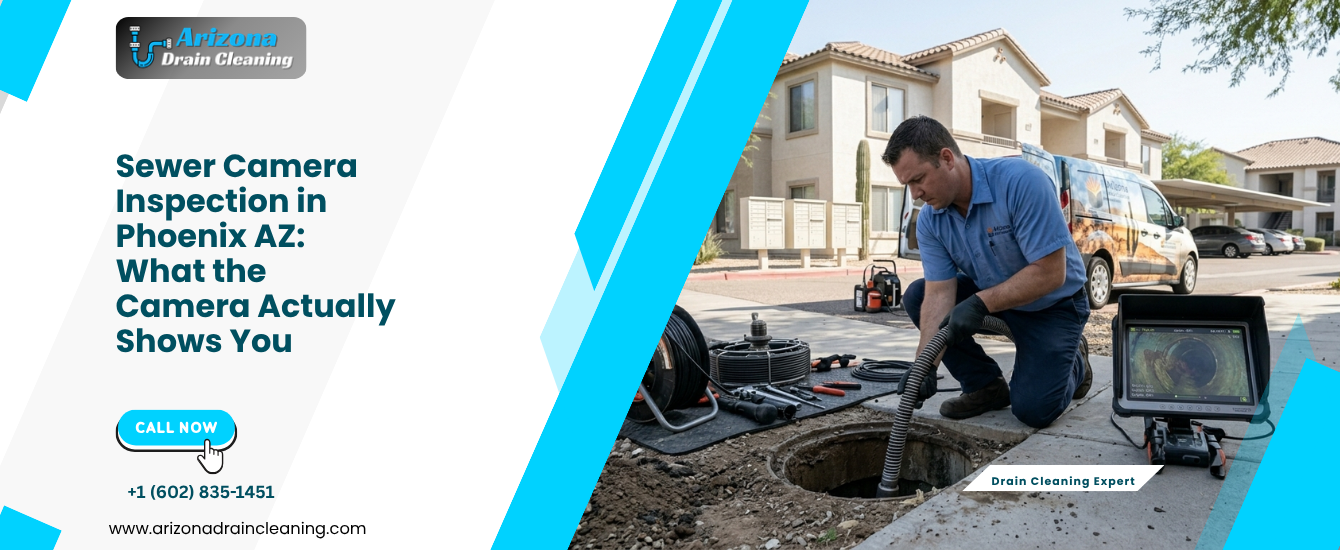
A professional sewer camera inspection uses a specialized waterproof camera mounted on a flexible cable or self-propelled crawler, depending on the pipe diameter and length being inspected. The camera is attached to a drain snake and inserted into the sewer line through a cleanout or other access point, with a light source to enhance visibility, and transmits real-time video footage to a monitor as it travels through the entire length of the sewer line.
For standard residential sewer lines in Phoenix, which are typically four to six inches in diameter, a push camera on a flexible rod is the appropriate equipment. The camera head contains a high-resolution lens, LED lighting, and in many professional systems, a locating transmitter that allows the technician to determine the precise underground location and depth of any point along the camera’s path. This locating capability is what allows a technician to tell you not just that there is a problem but exactly where it is, measured in feet from the access point, and at what depth below the surface.
The footage is displayed on a monitor in real time and is recorded for review after the inspection. You should receive either a digital copy of the footage or still images from the relevant sections, and this record becomes your documentation of the pipe condition at the time of the inspection.
The Access Point Question
The first step in a camera inspection is identifying the appropriate access point. Most Phoenix homes have a cleanout, a capped pipe fitting that provides direct access to the sewer line without requiring disassembly of fixtures. If your property has a conveniently located cleanout, access is straightforward and adds no time or cost to the inspection.
Many older Phoenix homes, particularly those built before 1980, were constructed without a dedicated main line cleanout or with a cleanout that has been buried, paved over, or is otherwise inaccessible. If there is no cleanout access, the line can often be accessed through the roof vent stack or by pulling a toilet. Roof vent access requires the technician to work from the roofline, which adds some setup time. Toilet removal and reinstallation is a standard plumbing procedure that takes fifteen to twenty minutes and adds modestly to the service cost. In some cases where cleanout installation would make future service significantly easier and less expensive, a technician may recommend adding a cleanout as part of the visit.
What the Technician Reads During the Inspection
Running the camera through the pipe is only half of what happens during a professional sewer inspection. The other half is what a trained technician reads from the footage in real time. Tree root invasion, pipe cracks and collapses, grease and debris buildup, and misaligned or offset joints are among the specific conditions a skilled technician identifies from live camera footage.
The technician is observing the pipe wall surface condition, the shape of the pipe cross-section, the flow conditions visible in any standing water, the presence and nature of any intrusions or protrusions into the pipe interior, and the condition of joints and connections throughout the line. This requires experience reading camera footage and familiarity with Phoenix’s specific pipe materials and failure patterns, which is exactly why who performs your camera inspection matters as much as the equipment they use.
What a Sewer Camera Inspection Reveals in Phoenix Homes
This is the specific and practically useful information that the camera shows, and understanding what each finding means in terms of required action is what makes the inspection valuable rather than just interesting.
Root Intrusion
Root intrusion is one of the most common camera inspection findings in Phoenix neighborhoods with mature landscaping. Roots penetrate pipes searching for water, causing blockages or breaks as they grow inside the line. In Phoenix, oleander hedges, citrus trees, mulberry trees, and various desert-adapted species with aggressive root systems grow in close proximity to underground sewer lines throughout established neighborhoods in Arcadia, central Phoenix, North Scottsdale, Tempe, and Mesa.
The camera shows root intrusion with remarkable specificity. Early-stage intrusion appears as fine root wisps entering through a joint gap, identifiable but not yet causing significant restriction. Established intrusion shows as a mat of roots occupying a portion of the pipe interior diameter. Advanced intrusion fills the pipe and creates a solid barrier that backs up the entire system. Each stage requires a different response, and the camera tells you exactly which stage you are dealing with before any service decision is made.
Grease and Mineral Scale Buildup
Accumulated grease hardens and clogs lines, and camera inspections reveal exactly where and how severely grease buildup has narrowed the pipe interior. In Phoenix, the grease accumulation picture is complicated by hard water mineral scale, which coats the pipe wall in a continuous calcium carbonate layer that grease then adheres to more readily than it would on a smooth surface. The camera shows this composite buildup as a narrowed pipe interior with a rough, irregular surface, and the footage makes clear whether the restriction is mild, moderate, or severe enough to be causing the drainage problems you are experiencing.
For Phoenix homeowners who have never had their main sewer line professionally cleaned, camera inspection footage of a main line that has been in service for ten or more years typically shows a dramatically different interior than the original pipe specification, with the mineral and organic composite buildup visibly reducing the available flow area.
Pipe Offsets, Belly Sections, and Grade Problems
A pipe belly is a section of the underground drain line that has sagged below the correct grade, creating a low point where waste and water pool rather than flowing continuously toward the sewer connection. The camera reveals belly sections clearly: the footage shows standing water in the low point of the belly, and the camera must travel uphill out of the belly on the downstream side, which is the opposite of the downhill direction that a correctly graded pipe should always maintain.
Pipe offsets occur when two sections of pipe have shifted out of alignment at a joint, creating a ledge or step inside the pipe where debris catches. Older pipes can become misaligned, causing leaks and flow obstructions. In Phoenix’s clay and caliche soil environment, where underground pipe joints experience the stress of seasonal soil expansion and contraction with every wet and dry cycle, pipe offset at joint locations in aging clay and cast iron sewer lines is a genuinely common camera inspection finding. The camera shows the specific offset location, the severity of the misalignment, and whether the gap at the joint is admitting root intrusion or soil infiltration.
Cracked, Deteriorating, or Collapsed Sections
The camera reveals structural pipe failure in its various stages. Hairline cracks appear as thin lines in the pipe wall, visible under the camera’s lighting but not yet causing functional problems. Longitudinal cracks running along the pipe length indicate stress fractures from soil movement. Circumferential cracks that circle the pipe wall indicate areas approaching structural failure. Partial and complete collapse, where the pipe wall has caved inward, creates obvious visual obstructions in the footage and explains why no cleaning service has produced lasting results at that location.
Older properties in Phoenix often have clay or cast iron sewer lines that are prone to cracking, corrosion, and tree root invasion. For homeowners of pre-1985 Phoenix properties, camera inspection footage showing cracked or deteriorating cast iron or clay pipe sections is not an unusual finding. The footage provides the documentation needed to understand whether the appropriate response is cleaning, spot repair, or full replacement, and it eliminates the guesswork that leads to expensive decisions made without adequate information.
Foreign Objects and Specific Blockage Material
The camera shows exactly what type of material is creating a specific blockage, which matters because the appropriate removal method differs depending on what the obstruction consists of. A dense mat of roots at a joint requires cutting equipment. A grease blockage responds to hydro jetting. A foreign object such as a child’s toy, a piece of jewelry, or a broken pipe fitting requires retrieval rather than clearing. A solidified mass of non-flushable wipes and paper towels requires mechanical removal. Knowing what is in the pipe before sending a technician in with the wrong equipment is exactly the efficiency value that camera inspection provides.
Why Sewer Camera Inspection Matters More in Phoenix Than Most Cities
Arizona’s dry climate, hard water, and invasive desert tree roots create a perfect storm for sewer pipe damage, and cities like Phoenix, Tucson, Mesa, and Scottsdale have many older homes whose underground plumbing is prone to failure. Understanding why Phoenix is a particularly high-need camera inspection market helps property owners calibrate their maintenance approach rather than applying generic national guidance that was not developed for these specific local conditions.
Phoenix’s Aging Sewer Infrastructure Stock
The Phoenix metropolitan area experienced its most significant residential development during the 1960s through the 1980s, producing a large proportion of the Valley’s current housing stock with original sewer infrastructure that is now 40 to 60 years old. Phoenix has a large stock of homes built in those decades with original clay tile or cast iron sewer lines that are at or past their expected lifespan.
Clay pipe has a typical service life of 50 to 60 years under favorable conditions. Cast iron pipe lasts 50 to 80 years but is highly susceptible to internal corrosion in Arizona’s hard water environment. Orangeburg pipe, used in some Valley construction through the early 1970s, has an effective service life of 30 to 50 years and many installations are well beyond that range. Any Phoenix property in this age range whose sewer line has never been camera-inspected is operating with an unknown condition on a pipe that may be at, near, or past structural failure.
Caliche Soil and Joint Stress
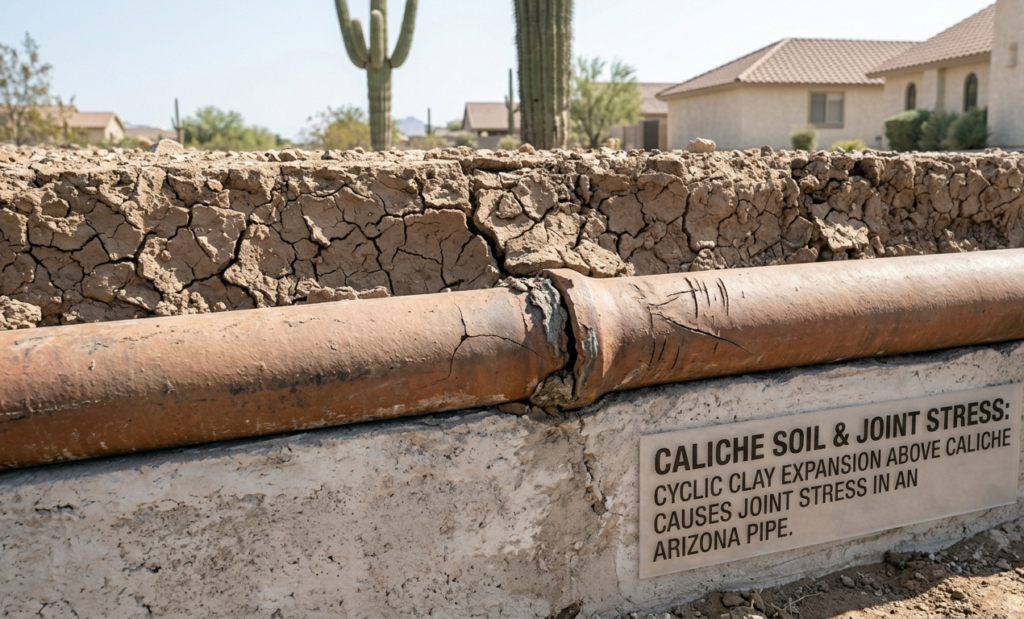
Arizona’s caliche layer creates underground pipe stress conditions that significantly accelerate joint deterioration compared to properties in softer-soil environments. The expansion of clay soil above the caliche layer during monsoon season saturation and its contraction during Arizona’s long dry periods applies cyclic mechanical stress to every underground pipe joint on every property in the Valley. Forty or fifty cycles of this seasonal stress on original clay or cast iron joints that were not designed to absorb it creates cumulative deterioration that does not announce itself at the surface until it has progressed to a functional failure.
Hard Water’s Role in Accelerating Pipe Interior Degradation
Phoenix’s water supply consistently measures 15 to 20 grains per gallon hardness, placing it among the hardest municipal water supplies of any major American city. The continuous mineral scale deposition from this water onto every pipe interior connected to the supply creates an accelerating accumulation problem that interacts with root intrusion and organic buildup to create composite pipe conditions that are meaningfully more challenging than any single type of accumulation alone. Camera inspection of Phoenix pipes reveals this composite condition and allows it to be addressed specifically and completely.
When to Get a Sewer Camera Inspection in Phoenix
There are specific situations where a camera inspection is the appropriate first step rather than something to schedule after other options have been tried and failed.
Before Buying a Phoenix Home
A pre-purchase sewer camera inspection is one of the highest-return inspections a buyer can commission in the Phoenix real estate market. A camera inspection before closing costs $150 to $350 and can reveal conditions that cost $5,000 to $15,000 to fix, making it one of the most cost-effective inspections a buyer can complete. These inspections are crucial in Phoenix, where desert soil can shift and impact a home’s sewer line.
The standard home inspection that buyers arrange through a licensed inspector covers visible and accessible plumbing but does not include a camera inspection of the underground sewer line. The gap between what a standard home inspection reveals and what a camera inspection shows is precisely where the most expensive plumbing surprises hide. A home that passed a standard inspection with no noted plumbing concerns may have a main sewer line with significant root intrusion at multiple joint locations, a pipe belly trapping waste, or aging cast iron approaching the point of structural failure. None of these conditions produce visible surface symptoms that a standard inspection would catch.
For buyers purchasing any Phoenix property built before 1990, a sewer scope inspection during the inspection period is not optional due diligence. It is the minimum responsible approach to understanding what a property’s most critical underground infrastructure actually looks like before closing.
When Drains Keep Backing Up Despite Cleaning
If a drain has been professionally cleaned and keeps backing up within weeks or a few months, the pipe structure rather than the material accumulation alone is causing the problem. A pipe belly traps waste permanently regardless of how clean the surrounding pipe sections are. A joint that has admitted significant root intrusion will grow roots back to the cutting point within a season regardless of how many times the roots are removed without addressing the entry point structurally. A collapsed section cannot be cleaned past. When drains keep backing up even after snaking or jetting, a camera inspection can identify stubborn blockages like roots, collapsed pipes, or grease buildup that is causing the recurrence.
The camera inspection breaks the cycle of repeated service calls without lasting results by providing the specific diagnosis that explains the recurrence and enables the appropriate structural or cleaning response.
Before Major Renovations and Home Additions
Adding a bathroom, converting a garage, building an accessory dwelling unit, or any renovation that adds drain fixtures or increases the load on the existing sewer line requires understanding the current condition and capacity of that line before committing to the project. A main sewer line that is already operating at restricted capacity due to mineral scale and partial root intrusion cannot be expected to handle additional fixture load without risk of operational failure. Discovering this after a bathroom has been roughed in is a significantly more expensive problem than discovering it before construction begins.
After a Significant Root-Clearing Service
When a technician has cut roots from your sewer line, a follow-up camera inspection confirms that the cutting was thorough throughout the affected length and allows visual assessment of the entry points that roots exploited to enter the pipe. This post-clearing inspection informs the decision about whether pipe rehabilitation to close those entry points is warranted before root regrowth recreates the obstruction, or whether monitoring and periodic clearing is the appropriate approach given the severity of the entry points observed.
For Homes Over 30 Years Old Without Prior Inspection History
Any Phoenix home built before 1990 whose sewer line has never been camera-inspected has an infrastructure unknown that is worth resolving proactively rather than discovering reactively during a drain failure. The camera inspection of a 40-year-old sewer line in a Phoenix home may reveal a pipe that is in surprisingly good condition, which provides peace of mind and a documented baseline. Or it may reveal conditions that need prompt attention before a failure event occurs. Either way, the information is more valuable than the alternative of not knowing.
Suspicious Symptoms in the Yard or Foundation Area
Wet, soggy patches in the yard above the sewer line path, unusually green or lush grass in an otherwise dry desert landscaping scheme, depressions or sinkholes in the yard surface, or persistent sewage odors in the yard without an obvious source all indicate that the sewer line beneath the surface may be leaking. Camera inspection combined with the location transmitter feature confirms whether the sewer line is the source of the observed yard symptoms and where along the line the leak point is located.
Sewer Camera Inspection Cost in Phoenix: A Realistic Breakdown
On average in Phoenix, a plumbing camera inspection can cost between $250 and $500, but larger-scale inspections can run as high as $3,000 depending on the difficulty of accessing the system and how far the inspection needs to extend. Here is a more specific breakdown that helps Phoenix homeowners evaluate quotes. LeaseRunner
Standard Residential Main Line Inspection
For a standard Phoenix single-family home with an accessible cleanout and a main sewer line of 50 to 100 feet, a camera inspection runs from $150 to $350 depending on the provider and whether the footage recording and written report are included. A sewer line camera inspection in Phoenix costs $245 to $350 for under 50 feet of pipe. Properties with longer main lines, multiple branch lines to inspect, or access challenges that require roof vent or toilet removal to access the line fall toward the middle and upper end of the residential range.
When Camera Inspection Is Included in a Cleaning Service
When a camera inspection is performed as part of a hydro jetting or drain cleaning service call, many providers include it in the overall service price rather than billing it as a separate line item. This bundled approach reflects the professional standard that camera inspection should precede any significant cleaning or repair recommendation and reduces the total cost compared to scheduling inspection and cleaning as separate visits. Asking upfront whether camera inspection is included in a quoted cleaning service prevents invoice surprises.
Commercial Property Inspections
Commercial inspections generally command a higher price point, often starting around $450 and up. High-volume businesses like restaurants or HOAs require inspections of larger diameter pipes and more complex systems with multiple branch lines. Commercial sewer inspection pricing reflects the greater complexity of commercial drain systems, the larger pipe diameters requiring appropriate camera equipment, and the multiple access points and branch line inspections that a complete commercial system assessment requires.
The Inspection Process From Start to Finish: What to Expect on Service Day
Access and Setup
The technician arrives, locates or confirms the cleanout access point, and sets up their equipment. If a cleanout requires locating and exposing, or if access through a roof vent or toilet removal is needed, this setup phase takes the most time in the visit. For properties with an accessible main cleanout, setup is typically fifteen to twenty minutes.
Camera Travel and Live Footage Review
The camera is inserted into the line and travels through the pipe while the technician monitors the live footage. The technician calls out specific observations as they are observed in the footage, noting footage measurements when features of interest appear so the location of any finding is documented relative to the access point. For a standard residential main line of 75 to 100 feet, the camera travel itself takes twenty to forty minutes depending on the pipe condition and how many areas warrant closer examination.
Technician Assessment and Explanation
After the camera travel is complete, the technician reviews any flagged sections with you and explains in plain language what each finding means and what the options are. A pipe in good condition with no significant findings produces a straightforward explanation and peace of mind. A pipe with specific findings produces a specific explanation of each issue, its likely cause, the implications for drain function, and the options for addressing it with associated cost estimates.
You Own the Footage
The footage recording is yours. If the findings suggest expensive repair or replacement work, you have every right to obtain a second opinion from another licensed contractor and share the footage with them rather than starting from scratch with a new inspection. Any professional drain service provider should support this practice. Reluctance to provide the footage or pressure to commit to expensive follow-up work before you have reviewed the findings independently is a flag worth paying attention to.
What Happens After the Inspection
If the Pipe Is in Good Condition
A clean inspection with no structural issues, manageable accumulation, and functional flow throughout the line is the outcome that sends you home with documented peace of mind and a baseline for future reference. If the footage shows mild grease or mineral scale accumulation that is not yet causing performance problems but is beginning to develop, the technician may recommend a preventive hydro jetting service to clean the pipe before the accumulation becomes service-impacting.
If Cleaning Is Recommended
When camera footage shows significant grease, mineral scale, or organic accumulation that is restricting flow without structural failure, professional hydro jetting is the appropriate follow-up service. The footage from the pre-cleaning inspection guides the technician’s approach to the cleaning service, including nozzle selection and the specific sections requiring the most attention. A post-cleaning camera pass confirms the cleaning result and provides documentation of the pipe condition after service.
If Structural Repair Is Needed
When camera footage reveals structural defects including cracked sections, collapsed pipe, significant pipe belly, or severely offset joints, the repair options depend on the specific findings, the pipe material, and the property conditions above the pipe. Trenchless drain repair using cured-in-place pipe lining is appropriate for pipes with continuous structural integrity that can support a liner. Drain repair and replacement through traditional excavation or pipe bursting is appropriate for pipes with complete collapse or conditions beyond the range that relining can address. The camera footage is the document that explains and supports whichever repair recommendation the technician makes.
If Root Intrusion Is Found
Root intrusion findings from the camera inspection inform a two-part decision: clearing the existing roots and then deciding whether to address the entry points structurally. A drain snaking service with a cutting head or hydro jetting with a root-cutting nozzle removes the existing root mass. The camera footage showing the severity and location of the entry points then informs whether a trenchless lining that seals those entry points permanently is warranted before roots regrow.
Frequently Asked Questions
Can the camera inspect every drain in my house?
The main sewer line inspection covers the primary line that all drain fixtures connect to. Individual branch lines, such as the line under a specific bathroom or the kitchen drain branch, can also be inspected but typically require separate access points. Most diagnostic situations are resolved by the main line inspection, but when a specific fixture branch is the suspected problem location, branch line camera work is available.
How long does a sewer camera inspection take in Phoenix?
For a typical Phoenix single-family home, a main line inspection takes 30 to 60 minutes from setup to footage review. Longer lines, multiple access points, or lines requiring roof vent or toilet access may extend the service to 90 minutes or more. Adding a branch line inspection or a post-cleaning verification pass adds proportionally to the total visit time.
Does camera inspection tell me if I need to replace my entire sewer line?
The camera footage combined with a trained technician’s assessment gives you a reliable basis for a repair versus replacement decision. We never guess. We verify problems with video so you know exactly what you are paying for, with no unnecessary digging or upsells. Complete pipe replacement is only warranted when the camera reveals conditions that are beyond the range that cleaning or structural repair can address, which is a specific and documentable finding rather than a general assessment.
What if my older Phoenix home has no cleanout?
Access through the roof vent stack or by pulling a toilet is typically possible when no dedicated cleanout exists. In some cases, the technician will recommend installing a cleanout as part of the service, which makes every future service significantly easier and less expensive. Cleanout installation is a straightforward procedure that pays for itself in reduced access costs over the lifetime of the property.
Is a sewer camera inspection required before hydro jetting?
It is required by professional standards and by the practical safety concern of applying high-pressure water to a pipe whose structural condition is unknown. Severely deteriorated pipe sections that cannot withstand high-pressure jetting can be ruptured by the service rather than cleaned by it. The camera inspection confirms the pipe is suitable for jetting and identifies any sections where pressure adjustment is warranted.
How do I schedule a sewer camera inspection in Phoenix?
Call Arizona Drain Cleaning at (602) 835-1451. Same-day and next-day scheduling is available throughout the Phoenix metro area including Scottsdale, Mesa, Chandler, Gilbert, Tempe, Glendale, Peoria, Surprise, Goodyear, and surrounding Valley communities. The pipe inspection with video camera service can be scheduled as a standalone diagnostic visit or combined with a hydro jetting or drain cleaning service.
Call Arizona Drain Cleaning at (602) 835-1451 right now to schedule a drain cleaning before the next stage of that escalation arrives. Same-day availability for urgent situations, upfront pricing before any work begins, and ROC-licensed technicians who understand what Arizona’s specific conditions do to drain systems that are not maintained.