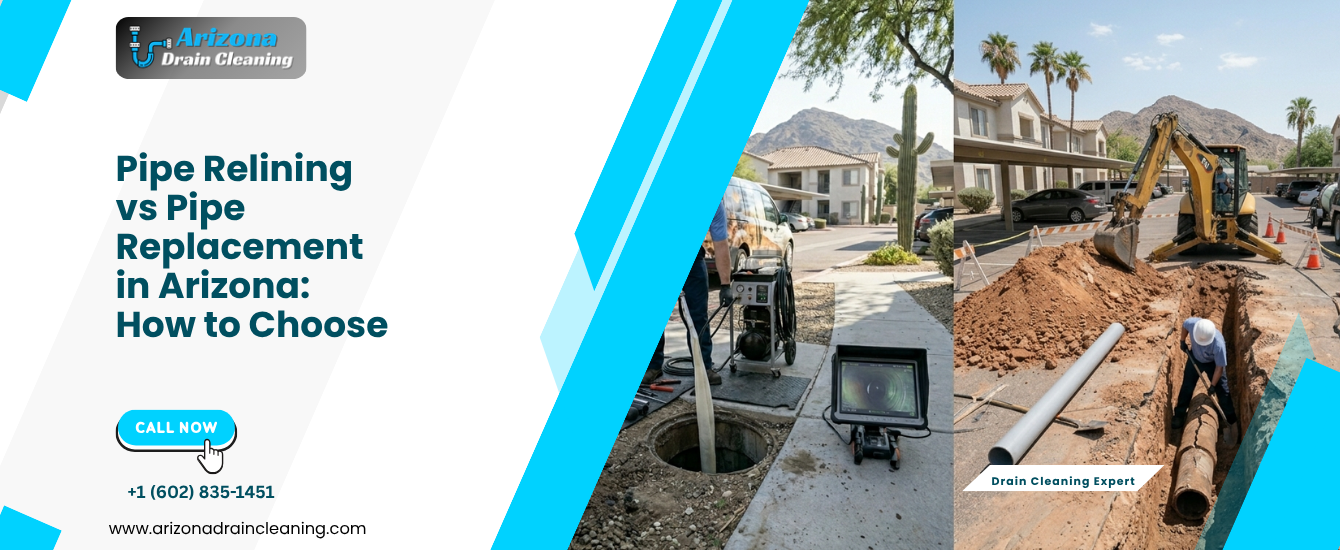
Pipe relining vs pipe replacement in Arizona is ultimately a decision about one thing most homeowners don’t see directly: the structural condition of what’s underground. Both solutions fix damaged sewer lines, but they do it in completely different ways and choosing the wrong one can mean paying twice or solving the problem only temporarily.
Pipe relining is essentially a “pipe inside a pipe” solution. A resin-saturated liner is inserted into the existing sewer line and cured in place, sealing cracks, gaps, and minor breaks from the inside. Pipe replacement, on the other hand, involves physically excavating and removing the old pipe and installing a brand-new line in its place. One preserves the existing structure; the other eliminates it entirely.
In Arizona, especially across Phoenix, Mesa, Chandler, and Scottsdale, the decision is heavily influenced by three local realities: shifting caliche soil, aging clay/cast iron infrastructure in older neighborhoods, and aggressive root intrusion caused by desert landscaping. These conditions don’t just create blockages—they determine whether a pipe still has enough structural integrity to be repaired or whether it has already failed beyond rehabilitation.
Here’s a clear side-by-side breakdown to make the choice easier to understand:
| Factor | Pipe Relining | Pipe Replacement |
|---|---|---|
| Method | Inserts epoxy liner inside existing pipe | Removes and installs new pipe |
| Digging Required | Minimal (access points only) | Full excavation along pipe route |
| Best For | Cracks, root intrusion, minor offsets | Collapsed, crushed, or severely misaligned pipes |
| Durability | 25–50 years | 50+ years (new infrastructure) |
| Property Disruption | Low | High |
| Cost Range (AZ typical) | Lower upfront, moderate overall | Higher upfront, higher labor cost |
| Ideal Arizona Conditions | Stable but damaged pipes | Old clay/Orangeburg or collapsed lines |
Arizona Drain Cleaning works with property owners across the Phoenix metro area and throughout the state on both pipe relining and pipe replacement projects, and this guide covers everything you need to make a genuinely informed decision rather than a default to whichever option the first contractor you call happens to prefer.
What Pipe Relining Actually Is and How It Works
Pipe relining, specifically cured-in-place pipe lining, is a trenchless rehabilitation method that creates a new pipe inside your existing damaged pipe without removing the original pipe and without excavating the soil above it. The process begins with a thorough cleaning of the existing pipe to remove accumulated grease, scale, debris, and root material from the interior surface. Then a pipe inspection with video camera confirms the pipe’s suitability for lining and documents the specific condition of every section to be relined.
The Cured-In-Place Pipe Lining Process
Once the pipe is confirmed suitable for relining, a flexible liner made from polyester or fiberglass felt is saturated with a two-part epoxy resin and inserted into the existing pipe through an access point, typically a cleanout or a small excavation pit at one end of the pipe run. The saturated liner is inverted or pulled into position and then inflated against the interior surface of the host pipe using pressurized air or water. In this inflated state, the liner conforms precisely to the interior profile of the host pipe, including any irregular sections, bends, or diameter changes within reasonable parameters.
The resin is then cured using hot water, steam, or ultraviolet light depending on the liner system and the contractor’s equipment. As the resin cures it hardens from a flexible saturated liner into a rigid, seamless new pipe inside the old one. The inflating bladder is then removed, leaving the cured liner bonded to the host pipe interior. The result is a smooth, continuous new pipe with no joints, no seams, and no root entry points, with a wall thickness and structural integrity defined by the liner specification chosen for the application.
What Pipe Relining Produces
The cured liner is made from an epoxy resin matrix that is chemically resistant to the compounds found in residential and commercial sewer waste streams. It does not corrode. It does not develop the rough interior surface that cast iron pipe develops as it ages. It does not provide the adhesive surface for grease and mineral scale that an aging pipe interior creates. The smooth, continuous interior of a properly installed cured-in-place liner improves flow characteristics compared to the corroded host pipe it sits inside. The industry-accepted service life for correctly installed CIPP lining is 50 years or more, which makes it a genuinely long-term solution rather than a temporary patch.
The liner slightly reduces the interior diameter of the pipe because it occupies a portion of the pipe’s interior cross-section. In a four-inch pipe, a standard liner typically reduces the interior diameter by three to six millimeters. For most residential and standard commercial applications, this slight diameter reduction has no meaningful effect on hydraulic capacity because the improved smoothness of the liner interior more than compensates for the marginal diameter reduction in terms of actual flow performance.
What Pipe Replacement Actually Involves
Pipe replacement involves physically removing the existing failed pipe from the ground and installing new pipe in its place. The method of accessing the existing pipe determines most of the cost and disruption difference between replacement options.
Traditional Open-Cut Excavation Replacement
Traditional pipe replacement involves excavating a trench along the full length of the pipe run, removing the damaged pipe, preparing the trench bottom with appropriate bedding material, installing new pipe with correctly specified slope and jointing, backfilling the trench, and restoring the surface above the trench to its pre-excavation condition.
This method is the most complete form of pipe replacement because it provides full access to the entire pipe run, allows visual confirmation of the surrounding soil condition, permits any contamination from a leaking pipe to be identified and addressed during the work, and installs entirely new pipe with a fresh service life. PVC pipe installed in a correctly prepared trench with appropriate bedding has a projected service life of 50 to 100 years and is the material standard for new residential and commercial sewer installation throughout Arizona.
The cost of traditional replacement is dominated by three components: the excavation labor, the new pipe and fittings materials, and the surface restoration required above the trench. For a pipe running beneath a concrete driveway, a patio, a pool deck, or mature desert landscaping, the surface restoration cost can equal or exceed the pipe work cost itself, which is why traditional replacement is most cost-effective when the pipe runs beneath areas that are either already disturbed or that can be restored at low cost.
Pipe Bursting: Trenchless Replacement
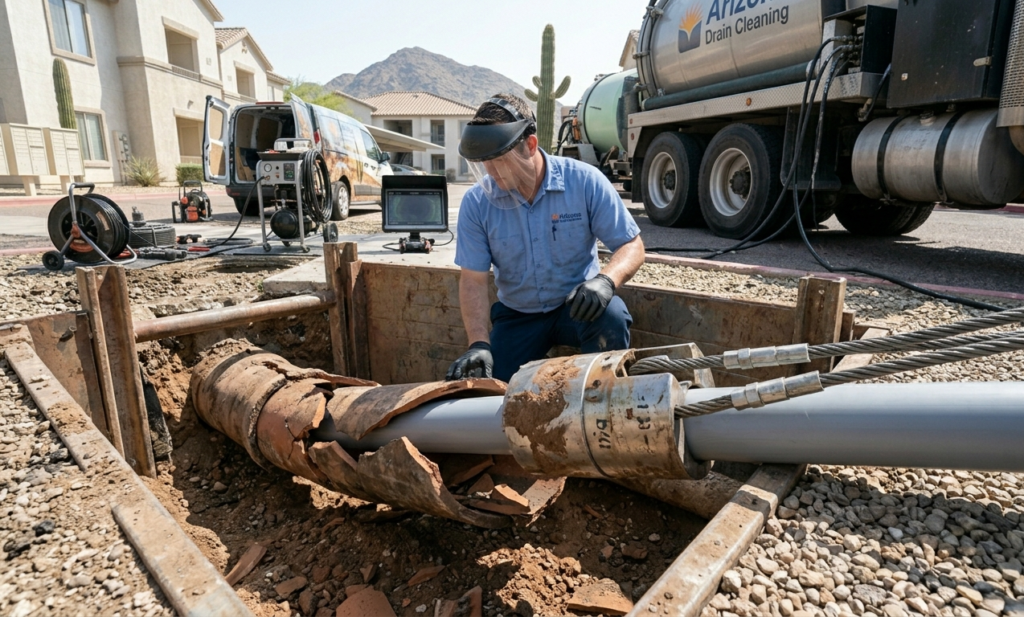
Pipe bursting is a trenchless replacement alternative to open-cut excavation that installs new pipe through the old pipe without excavating along the pipe run. The process uses a bursting head pulled through the existing pipe by a hydraulic or pneumatic machine at the downstream end. As the bursting head travels through the host pipe, it fractures the old pipe outward into the surrounding soil while simultaneously pulling the new pipe in behind it.
Pipe bursting requires only small access pits at each end of the pipe run rather than a continuous trench. It installs entirely new pipe with a fresh service life. Unlike relining, pipe bursting can install a larger-diameter pipe than the original because the old pipe is fractured outward into the soil rather than being lined from inside. This makes pipe bursting applicable when the existing pipe diameter needs to be increased, which relining cannot accomplish.
Pipe bursting is appropriate when the existing pipe has deteriorated too far to support a liner, when the pipe material creates concerns about liner adhesion, or when a diameter increase is needed. It is not applicable when the pipe runs through conditions where the outward fracturing of the old pipe would create problems, such as proximity to other utilities or in soil conditions where fracture debris could cause issues.
The Critical Decision Factors: What Determines Relining vs Replacement
Pipe Structural Condition as the Primary Determinant
The condition of the existing pipe is the single most important factor determining whether relining is applicable. Cured-in-place pipe lining requires the host pipe to meet specific structural criteria: the pipe must have sufficient structural integrity remaining to support the liner during installation and curing, the pipe must have a continuous pathway from end to end that the liner can travel, and the pipe must not have complete collapses that would prevent the liner from conforming to the pipe interior.
Early to moderate structural deterioration, including longitudinal cracking, circumferential cracking that has not caused displacement, joint infiltration, root intrusion that has been cleared, and general wall deterioration that has not progressed to complete loss of pipe wall sections, are all conditions that cured-in-place lining can address effectively. The liner bridges across cracks, seals joint infiltration points, and creates a structurally independent pipe that does not rely on the integrity of the host pipe once the liner has cured.
Conditions that exceed the capability of relining include complete pipe collapse where a section of the pipe wall has fully caved inward and blocked the pipe pathway, severely offset joints where pipe sections have shifted so far out of alignment that the liner cannot navigate the transition, and pipe sections that have been completely crushed by vehicle loading or soil movement to the point where no usable pipe profile remains. These conditions require replacement because the pipe no longer has the structural profile or the continuous pathway that relining depends on.
Pipe Material and Its Effect on the Choice
The material of the existing pipe matters both for assessing whether relining is appropriate and for understanding the urgency of the repair decision.
Cast iron pipe is an excellent candidate for cured-in-place lining when internal corrosion has created significant surface roughness and flow restriction but the pipe wall has not deteriorated to the point of complete perforation. The liner adheres to the corroded interior surface, seals any perforations that exist, and creates a smooth interior that the original cast iron never had. For Arizona properties with cast iron sewer lines from the 1960s through the 1980s, relining extends the functional service life of infrastructure that would otherwise require full replacement at significantly higher cost.
Clay pipe is similarly suitable for relining when the pipe body is intact and the deterioration is primarily at joints that have cracked, separated, or admitted root intrusion. Relining seals all of these joint conditions simultaneously along the entire lined length. Clay pipe that has deteriorated to the point where the pipe body itself is crumbling, brittle, or fragmented requires replacement because there is insufficient structural integrity remaining to support the liner.
Orangeburg pipe, the compressed wood pulp and pitch material used in Arizona residential construction from the 1940s through the early 1970s, is not suitable for relining. Orangeburg absorbs moisture and deforms over time, and a pipe that has already changed shape from its original circular cross-section to an oval or irregular profile cannot reliably support a liner that depends on the host pipe’s structural stability. Any property with Orangeburg pipe requires replacement, and attempting to reline Orangeburg creates a false solution that will likely fail as the Orangeburg continues to deform beneath the liner.
PVC pipe in a residential or commercial sewer line that has been damaged by external mechanical causes such as construction activity, extreme soil movement, or vehicular loading may be suitable for relining if the damage is localized and the surrounding pipe sections are structurally sound, or may require replacement if the damage is extensive.
Property Conditions and Surface Restoration Cost
The conditions above the pipe are the second major determinant of the relining versus replacement decision, and they directly affect the total cost comparison between the two options.
For a pipe that runs beneath an open lawn area with no significant landscaping, a concrete driveway can be saw-cut and restored, or a simple unpaved surface needs only minimal disturbance, traditional excavation and replacement may be entirely cost-competitive with relining once all costs are considered. The excavation itself is the main cost driver, and in accessible open areas the excavation cost is manageable.
For a pipe that runs beneath a mature desert landscaping installation with specimen cacti and agave that took years to establish, beneath an existing concrete pool deck that would require significant removal and replacement, beneath a recently installed paver driveway, beneath a home addition or outbuilding that was constructed over the original pipe route, or beneath any other surface whose restoration cost would be substantial, relining’s ability to rehabilitate the pipe from within without disturbing the surface becomes economically decisive. The total project cost of relining, including all liner materials and installation labor, is frequently thirty to fifty percent lower than the total project cost of traditional replacement when meaningful surface restoration is included in the comparison.
Access Requirements for Each Method
Cured-in-place pipe relining requires access at one or both ends of the pipe run to insert the liner and the inflation equipment. For most residential sewer lines, existing cleanouts provide adequate access. When cleanouts are not available or are not located appropriately, small excavation pits to expose pipe access points are created at strategic locations. These access pits are dramatically smaller than the full trench required for traditional replacement, typically two to four feet wide and deep enough to expose the pipe, compared to a continuous trench the full length of the pipe run.
Pipe bursting requires access pits at each end of the run, similar to or slightly larger than the access pits required for relining, because the receiving machine for the bursting head must be positioned in an excavated pit at the downstream end.
Traditional replacement requires a continuous excavated trench along the full pipe length, which is the source of both the higher disruption and the higher surface restoration cost that make it less competitive than trenchless options in many Arizona property situations.
Pipe Diameter Considerations
Cured-in-place relining slightly reduces the interior diameter of the lined pipe because the liner occupies wall thickness within the existing pipe. For most standard residential sewer pipe diameters of four inches and larger, this reduction is within the acceptable range and does not meaningfully affect hydraulic capacity. For pipes at the minimum serviceable diameter, the additional wall thickness of the liner may create flow capacity concerns that need to be evaluated against the specific application.
If the existing pipe is already undersized for the drainage load it serves, or if the project requires upgrading the pipe diameter as part of the repair, relining is not the appropriate solution because it cannot increase the effective diameter beyond the existing pipe’s interior. Pipe bursting can install a larger-diameter pipe than the original host pipe because it fractures the host pipe outward, creating room for the new pipe. Traditional replacement can install any specified pipe diameter and is the only option when a significant diameter increase is required.
How Arizona’s Specific Conditions Affect the Relining vs Replacement Decision
Caliche Soil and Excavation Cost
Arizona’s caliche layer, the hardened calcium carbonate cementation present at varying depths throughout the Valley’s soil profile, significantly affects the cost of traditional pipe excavation and replacement. Excavating through caliche requires specialized equipment, takes longer than excavation in standard soil, and in severe cases requires mechanical breakers rather than standard trenching equipment to penetrate the hardpan. This elevated excavation cost in caliche-rich soils makes trenchless options economically more attractive in Arizona than in regions without this soil condition.
A traditional pipe replacement that would cost $6,000 in standard sandy soil may cost $9,000 or more in a location where the trench must pass through dense caliche, because the additional equipment time and the extended labor for caliche removal adds directly to the excavation cost. This cost differential makes relining or pipe bursting more financially competitive in Arizona’s caliche-rich soil than it would be in softer-soil markets.
Hard Water Mineral Scale and Liner Performance
One of the practical advantages of cured-in-place lining in Arizona’s hard water environment is that the smooth epoxy resin interior of the installed liner is significantly more resistant to mineral scale accumulation than the aged cast iron or clay pipe interior it replaces. Hard water mineral scale deposits preferentially on rough and irregular surfaces. A corroded cast iron pipe interior provides ideal conditions for mineral scale accumulation. A smooth epoxy liner interior provides conditions where scale has substantially less adhesion, meaning the lined pipe stays cleaner longer and requires less frequent maintenance than the host pipe did in its degraded condition.
This long-term maintenance reduction is a genuine operational benefit for Arizona property owners choosing between relining an aging pipe and replacing it with new PVC. Both the liner and new PVC provide smooth, scale-resistant interiors, but the liner does so without the excavation cost and disruption of replacement.
Arizona’s Pool and Patio Coverage Reality
A disproportionate number of Arizona residential properties have significant concrete hardscape coverage because outdoor living is central to the lifestyle in the Valley’s climate. Pool decks, covered patios, outdoor kitchens, decorative concrete, and paver installations cover areas that may directly overlie sewer lines. In a property where the main sewer line runs beneath a concrete pool deck and then beneath a paver driveway before reaching the municipal connection, traditional excavation and replacement requires removing, storing, and reinstalling hundreds of square feet of concrete and pavers, plus the pool deck demolition and reconstruction, in addition to the actual pipe work. This surface restoration cost in an Arizona property with extensive hardscape can easily double the total project cost compared to the pipe work alone.
For exactly this reason, cured-in-place relining has become the preferred pipe rehabilitation method for many Arizona residential property owners. The liner restores the pipe from within, the pool deck stays intact, the driveway pavers stay in place, and the total project cost is a fraction of what traditional replacement would require in the same property configuration.
The Real Cost Comparison for Arizona Properties
What Pipe Relining Costs in the Phoenix Metro Area
Cured-in-place pipe relining for a residential sewer line in the Phoenix metro area typically ranges from $80 to $250 per linear foot of pipe lined, with the total cost for a standard residential sewer line running from $3,000 to $12,000 depending on pipe length, diameter, liner specification, access conditions, and the extent of the existing damage. This cost range includes the pre-lining cleaning, the camera inspection, the liner material and installation, and the post-lining camera verification inspection.
The per-foot cost of relining is higher than the per-foot cost of new pipe materials alone, which is sometimes used to argue that replacement is cheaper. That argument is only valid when the excavation cost and surface restoration cost are excluded from the comparison, which produces a misleading result. The appropriate comparison is total project cost, not pipe-only material cost.
What Pipe Replacement Costs in the Phoenix Metro Area
Traditional open-cut pipe replacement for a residential sewer line in the Phoenix metro area typically runs from $50 to $150 per linear foot for the pipe work itself, with total project costs ranging from $4,000 to $20,000 or more depending on pipe length, excavation difficulty, pipe depth, and the extent of surface restoration required above the trench. Caliche soil conditions add meaningfully to the excavation cost. Significant concrete, tile, or paver restoration above the trench adds to the surface restoration cost. A project that involves excavating through dense caliche beneath a concrete pool deck and restoring the deck to its original condition can reach the upper end of this cost range or exceed it.
Pipe bursting typically costs between $80 to $200 per linear foot for residential applications, with total project costs similar to or slightly higher than relining depending on site conditions. The primary cost advantage over traditional replacement is the elimination of the continuous trench and the associated surface restoration.
The Ten-Year Total Cost of Ownership Perspective
Looking at the choice over a ten-year window rather than just the point-of-service cost provides a more complete picture. A properly installed cured-in-place liner requires no structural maintenance for the life of the liner, which manufacturers project at 50 years or more. New PVC installed through traditional replacement has a similar projected service life. Both methods, when correctly executed for the applicable conditions, provide long-term solutions rather than temporary fixes.
The legitimate ten-year cost comparison is not between relining and replacement at the point of installation. It is between relining that preserves your pool deck, driveway, and landscaping intact and traditional replacement that requires you to restore all of those surfaces at significant additional cost. When that surface restoration cost is correctly included in the comparison, relining is typically the more economical total cost option for any Arizona property where meaningful hardscape or landscaping is located above the pipe run.
When Each Method Is Clearly the Right Answer
When Pipe Relining Is Clearly the Right Choice
Relining is clearly the right answer when the pipe has continuous structural integrity that will support the liner, when camera inspection confirms a complete and navigable pipe pathway, when the surrounding property has hardscape, landscaping, or structures above the pipe run whose restoration would add substantial cost to traditional excavation, when the property owner wants to minimize construction disruption, and when the pipe diameter is adequate for the existing drainage load.
Specific situations where relining is the clear choice include a sewer line running beneath an Arizona pool deck with joint infiltration and root intrusion at multiple points along the line, a cast iron drain stack in a multi-family building with significant internal corrosion but intact pipe wall sections, a main sewer line beneath a recently installed paver driveway that experienced joint separation due to caliche soil movement, and any pipe situation where the camera inspection confirms multiple cracked joints and early to moderate wall deterioration without complete collapse.
When Pipe Replacement Is Clearly the Right Choice
Replacement is clearly the right answer when camera inspection confirms complete pipe collapse in one or more sections, when the pipe material is Orangeburg that cannot support a liner regardless of its structural appearance, when the pipe has deteriorated to the point where no continuous navigable pathway exists for the liner, when a diameter increase is needed, or when the pipe run is beneath an accessible surface whose excavation and restoration cost is modest.
Specific situations where replacement is the clear choice include a sewer line with confirmed Orangeburg pipe regardless of its current apparent condition, a pipe with one or more sections where the pipe wall has completely caved inward and blocked the line, a pipe run beneath an open unpaved rear yard where excavation is straightforward and restoration is simply replacing displaced soil, and any situation where pipe bursting has been determined more appropriate than relining and the conditions support its use.
When the Choice Requires Professional Assessment
Many situations fall between these clear cases and require professional judgment based on the specific camera inspection findings, the pipe material and condition, the property layout, and the total cost comparison for each option in the specific project context. A pipe with significant corrosion and occasional perforations in a cast iron line beneath a concrete driveway may be a borderline case where the camera footage, the liner specification options, and the driveway restoration cost estimate all need to be evaluated together before the most appropriate choice is clear.
The appropriate professional process for reaching the right decision includes a camera inspection that documents the pipe condition in detail, a written assessment from the contractor explaining why they recommend the specific method for the specific conditions observed, and a total project cost estimate for both applicable options that includes all surface restoration costs so the comparison is accurate and complete.
The Camera Inspection: Non-Negotiable Before Either Decision
No legitimate contractor should recommend pipe relining or pipe replacement without first performing a pipe inspection with video camera that documents the actual interior condition of the pipe. This is not an optional diagnostic step that some contractors perform and others skip. It is the foundational information that makes the relining-versus-replacement decision accurate rather than a guess.
A camera inspection before a repair recommendation serves three essential functions. First, it confirms whether the pipe condition falls within the applicable range for relining, whether the pipe requires replacement, or whether the situation requires further evaluation. Second, it provides the documentation that supports the contractor’s recommendation and gives the property owner a basis for evaluating that recommendation independently. Third, it creates a record of the pipe condition before any work is performed, which is useful for insurance purposes, for real estate disclosure, and for confirming the quality of the repair work through a post-completion inspection using the same camera.
For Arizona property owners who receive a recommendation for either relining or replacement without an accompanying camera inspection, the appropriate response is to request the inspection before agreeing to any work. A contractor confident in their diagnosis of the pipe condition will have no objection to that request.
Frequently Asked Questions
How long does pipe relining last compared to replacement?
A correctly installed cured-in-place epoxy liner has a manufacturer-projected service life of 50 years or more and is backed by industry testing that supports this projection. New PVC installed through traditional open-cut replacement has a similar projected service life. Both methods, when properly executed for appropriate conditions, are long-term solutions. The service life of either method depends more on correct installation practice than on the inherent material durability, which is why hiring a licensed contractor with verified experience in the specific method chosen is important.
Can pipe relining fix tree root intrusion permanently?
Yes, when the roots are cleared from the pipe before lining and the liner is installed correctly. The epoxy resin liner has no joints or seams for roots to exploit, which is the fundamental reason root intrusion does not recur in a properly lined pipe the way it recurs in an unlined pipe where the joint infiltration points remain. The roots must be removed before lining using hydro jetting with a root-cutting nozzle. Attempting to line over existing root intrusion without clearing the pipe first will produce an incomplete liner installation that fails at the root location.
Is pipe relining approved for Arizona residential plumbing applications?
Yes. Cured-in-place pipe lining using materials that comply with ASTM F1216 for sewer applications and similar standards is approved for residential and commercial sewer pipe rehabilitation in Arizona. The work must be performed by a licensed Arizona Registrar of Contractors licensee in the appropriate classification. Liner materials and installation must comply with applicable code requirements for the specific application. A permit may be required depending on the specific municipality and the scope of the work.
Will my homeowners insurance cover pipe relining or pipe replacement?
Coverage depends on your specific policy terms and the cause of the pipe failure. Sudden, accidental damage such as pipe rupture from an unexpected external cause may be covered under some policies. Age-related deterioration and gradual corrosion are typically excluded. Tree root damage coverage varies by policy. The method of repair, relining versus replacement, is generally not a factor in coverage determination. The cause of the failure and the policy terms determine whether the repair is covered, regardless of which repair method is chosen.
How is the pipe cleaned before relining?
The pipe must be thoroughly cleaned of all accumulated material before liner insertion. For Arizona pipes with hard water mineral scale, grease accumulation, and root intrusion, professional hydro jetting at appropriate pressure is the standard cleaning method before relining. The cleaning removes grease, scale, debris, and root material from the pipe wall surface to create the clean substrate that the epoxy resin liner bonds to and conforms against. Inadequate pipe cleaning before lining installation is one of the most common causes of liner installation failure.
Does pipe relining reduce water flow?
In most residential and standard commercial applications, a correctly installed liner does not meaningfully reduce flow capacity despite the slight reduction in interior pipe diameter. The smooth epoxy liner interior actually improves flow characteristics compared to the rough, corroded interior of an aging cast iron pipe. The hydraulic capacity improvement from the smoother interior compensates for the marginal diameter reduction in practical flow performance. For pipes that were already at or below minimum adequate diameter, the diameter reduction from lining may be a consideration that warrants discussion with the contractor before selecting the liner specification.
Can pipe relining be inspected after installation to confirm quality?
Yes, and it should be. A post-installation camera inspection that travels the full length of the lined pipe confirms that the liner is fully cured, fully adhered to the host pipe interior, free of wrinkles or voids, and covers the full intended length. This post-completion inspection is the contractor’s quality confirmation and provides the property owner with documented evidence of the installation quality. Arizona Drain Cleaning performs post-installation camera inspection as a standard component of every relining project.
The Bottom Line on Pipe Relining vs Pipe Replacement in Arizona
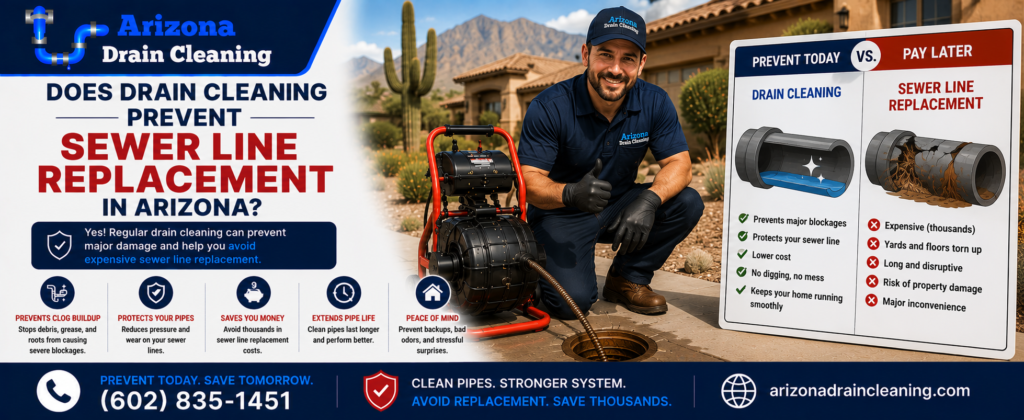
The right choice between pipe relining and pipe replacement is determined by the actual condition of the pipe as revealed by camera inspection, the material of the existing pipe, and the total project cost comparison that correctly includes surface restoration costs. In Arizona, where extensive hardscape coverage over sewer lines is common, where caliche soil makes excavation more expensive than in most states, and where aging cast iron and clay pipe from the Valley’s major development decades is approaching or has exceeded its service life, relining is the correct choice for a large proportion of pipe rehabilitation projects. Replacement is clearly correct when the pipe condition is beyond the range that relining can address.
The camera inspection is what makes this decision accurate rather than a guess, and it is where every pipe rehabilitation evaluation should start. Arizona Drain Cleaning provides pipe inspection with video camera, hydro jetting pipe preparation, trenchless drain repair including cured-in-place pipe lining, drain repair and replacement through traditional excavation, and sewer line cleaning for property owners throughout Phoenix, Scottsdale, Mesa, Chandler, Gilbert, Tempe, Glendale, Peoria, Surprise, Goodyear, Queen Creek, Tucson, Flagstaff, and all of Arizona. Call Arizona Drain Cleaning at (602) 835-1451 right now to schedule a camera inspection and get an honest assessment of which option is right for your specific pipe and your specific property.