Drain cleaning for healthcare facilities in Arizona is not a routine maintenance task that can be treated the same way as servicing a retail store or an office building. The moment a drain in a hospital, outpatient clinic, dialysis center, urgent care facility, or skilled nursing home fails, the consequences ripple outward in ways that go far beyond operational inconvenience. Patient safety, regulatory compliance, infection control, and the uninterrupted delivery of care all depend on plumbing systems that function correctly around the clock.
At Arizona Drain Cleaning, we work with healthcare facility managers, hospital maintenance teams, and clinic administrators across the Phoenix metro, including facilities in Scottsdale, Mesa, Tempe, Chandler, Glendale, and Peoria, to build drain maintenance programs that meet the specific demands of medical environments. This guide covers everything Arizona healthcare facility operators need to understand about professional drain cleaning, why it matters more in medical settings than anywhere else, and how to approach it correctly.
Why Healthcare Facilities Have More Complex Drain Cleaning Needs Than Other Commercial Properties
Every commercial property has drains, but not every commercial property has patients whose immune systems may be severely compromised, operating rooms where sterile conditions are non-negotiable, or regulatory bodies that can suspend operations over sanitation failures. Healthcare facilities sit at the intersection of all three, which makes their drain and sewer systems far more consequential than those in almost any other type of building.
The Volume and Variety of Waste Entering the Drain System
A hospital or large outpatient facility generates a range and volume of waste that flows through its drain lines every single day that no restaurant, hotel, or office building comes close to matching. Patient care areas produce wastewater containing bodily fluids, blood, pharmaceuticals, contrast agents, cleaning chemicals, and tissue. Surgical suites drain fluids from procedures. Laboratories dispose of chemical reagents and biological samples. Central sterile departments run continuous wash cycles. Cafeterias generate grease and food waste. All of this material enters the same underlying drain infrastructure, and each category creates its own challenge for pipe maintenance.
The pharmaceutical compounds and enzymatic cleaners common in medical settings can, over time, create chemical deposits inside drain lines that are distinctly different from the grease and soap scum accumulation typical of residential or commercial kitchen drains. Plaster and casting compounds from orthopedic care units are notorious for hardening inside drain lines and causing severe restrictions. Embalming facilities and pathology departments generate waste that accelerates biofilm development. Each zone within a healthcare facility essentially requires its own drain maintenance consideration rather than a one-size-fits-all approach.
Biofilm and Healthcare-Associated Infections
One of the most serious and least visible drain-related risks in any healthcare setting is biofilm. Biofilm is a community of microorganisms, including bacteria and fungi, that attaches to the interior surfaces of drain pipes, p-traps, and sink drains and encases itself in a protective layer of organic material that makes it extraordinarily resistant to standard cleaning and disinfection methods. In healthcare environments, the pathogens that establish themselves in drain biofilm include some of the most dangerous organisms in clinical medicine.
Contaminated sink drains and floor drains in patient care areas have been repeatedly linked in published clinical literature to outbreaks of healthcare-associated infections, particularly in intensive care units, neonatal units, burn units, oncology wards, and transplant units. The organisms involved include multidrug-resistant strains of Pseudomonas aeruginosa and carbapenem-resistant Enterobacterales, which are capable of causing serious, difficult-to-treat infections in immunocompromised patients. The transmission mechanism is disturbingly mundane: water from a faucet strikes a contaminated sink drain or strainer, generating aerosol splash that can travel several feet from the sink onto surrounding surfaces, patient care items, and staff hands.
Regular professional drain cleaning that physically removes biofilm-harboring buildup from the interior walls of drain lines is a meaningful part of a broader infection prevention strategy. Keeping pipes clear, clean, and free from the organic accumulation that feeds biofilm development reduces the load of potential pathogens present in the immediate patient care environment.
Regulatory and Accreditation Requirements
Healthcare facilities operating in Arizona are subject to oversight from multiple regulatory bodies, each of which has expectations related to facility maintenance and sanitation. The Centers for Medicare and Medicaid Services sets Conditions of Participation that hospitals must meet to receive Medicare and Medicaid reimbursement, and these conditions include standards for the physical environment that encompass plumbing and sanitation. The Joint Commission, which accredits hospitals and other healthcare organizations nationwide, includes environment-of-care standards that require documented maintenance programs for facility infrastructure, including plumbing systems.
At the state level, the Arizona Department of Health Services licenses hospitals, outpatient surgical centers, nursing care institutions, and behavioral health facilities, and its licensing standards include physical plant requirements related to sanitation and waste disposal. The Arizona Department of Environmental Quality, known as ADEQ, governs the handling and disposal of regulated medical waste and wastewater with infectious potential.
A documented, scheduled drain cleaning program with service records from a licensed commercial plumbing provider is the kind of evidence that surveyors and inspectors look for when evaluating whether a facility’s maintenance practices meet the standard of care expected in a licensed healthcare environment. Facilities that cannot demonstrate a proactive maintenance approach to their plumbing systems face a harder conversation during accreditation surveys than those that can show a clear service history.
The Most Common Drain Problems in Arizona Healthcare Facilities
Understanding the specific types of drain failures that occur most frequently in medical environments helps facility managers prioritize maintenance resources and recognize warning signs before a minor issue becomes a regulatory or clinical problem.
Main Line Accumulation and Restriction
Healthcare facilities run their plumbing systems at significantly higher volumes than most commercial buildings. A hospital with hundreds of inpatient beds and multiple procedure areas sends water through its main sewer lines constantly throughout the day and night. The sheer volume of use, combined with the variety of waste materials entering the system, accelerates accumulation inside the main line. Over months and years without professional cleaning, the effective interior diameter of the pipe narrows, flow slows, and the risk of a main line backup increases substantially.
In Arizona, this challenge is compounded by the state’s exceptionally hard water. Phoenix and the surrounding Valley communities consistently rank among the areas with the highest water hardness levels in the country, driven by the high concentrations of calcium and magnesium in the regional water supply. These minerals deposit on the interior surfaces of drain pipes over time, creating a rough, narrowed surface that traps other organic debris and accelerates blockage formation. For high-volume healthcare facilities, mineral scale accumulation adds another layer of restriction on top of the organic waste buildup generated by daily operations.
Floor Drain Failures in Patient Care and Procedure Areas
Floor drains in operating rooms, procedure rooms, soiled utility rooms, shower areas, and laundry facilities are among the most infection-sensitive components of a healthcare facility’s plumbing system. These drains receive wastewater from cleaning activities, equipment rinsing, and procedure-related drainage, and they are required by facility design standards to be functional and accessible. A slow or blocked floor drain in any of these areas creates standing water that represents both a slip hazard and an infection control concern, since standing water in a patient care environment is an ideal environment for microbial growth.
Floor drains in healthcare facilities also have a tendency to develop biofilm in the drain body and the trap below, particularly in areas where the drain may not receive continuous flow. Arizona’s hot, dry climate can accelerate trap evaporation in infrequently used drains, which causes the water seal in the p-trap to diminish or disappear entirely. A dry trap allows sewer gases to migrate back into the facility through the drain opening, creating odor problems and potentially introducing airborne contaminants from the sewer system into areas where patients are present.
Grease Accumulation in Food Service and Cafeteria Lines
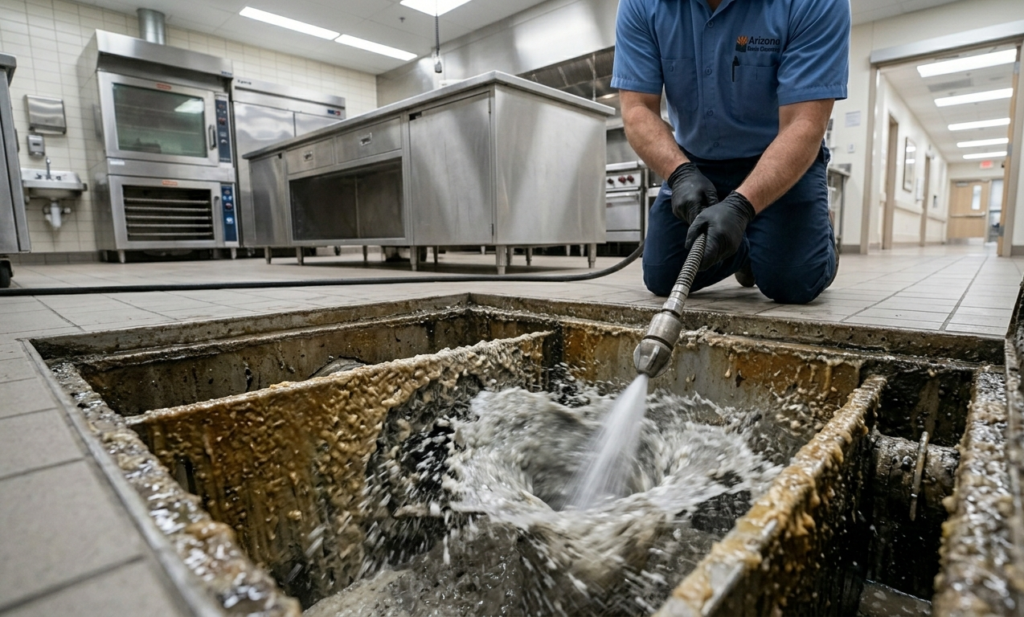
Hospitals and large healthcare campuses typically include cafeterias, employee dining areas, and dietary kitchens that prepare meals for patients and staff. These food service operations generate grease and oil waste that enters the drain system with every cleaning cycle and every meal preparation. Without regular cleaning of the kitchen drain lines and maintenance of grease interceptors, grease accumulation progresses steadily until it either creates a blockage or generates the kind of drain odors that are inappropriate in any food preparation setting and particularly unacceptable in a healthcare environment.
Kitchen drain lines in healthcare facilities require the same level of attention that any high-volume commercial kitchen demands, but with the added consideration that the cafeteria is typically connected to the same building drain system that serves patient care areas. A main line backup originating from a grease-blocked kitchen drain has the potential to create sewage backflow conditions that affect areas of the facility far removed from the kitchen itself.
Plaster and Compound Buildup in Orthopedic and Cast Rooms
Facilities that include orthopedic services, physical therapy departments, or cast rooms generate plaster and fiberglass resin waste during the application and removal of casts and splints. These materials are dense and harden quickly once they enter a drain line. Even small quantities of casting plaster that consistently enter a drain over weeks and months can build up into a concrete-like obstruction that is extremely difficult to clear with standard drain cleaning equipment. Facilities that do not have adequate plaster traps installed in their casting room plumbing, or that have plaster traps that are infrequently serviced, face a particularly challenging drain maintenance situation.
Drain Backflow and Cross-Contamination Risk
Healthcare facilities are required to install backflow prevention devices throughout their plumbing systems to prevent contaminated wastewater from reversing direction and entering potable water supplies or clean water distribution lines. A main sewer line blockage severe enough to cause backflow conditions in a healthcare setting is one of the most serious plumbing failures a facility can experience because of the potential for wastewater containing pharmaceutical compounds, biological waste, and drug-resistant pathogens to reach areas of the facility where patient care occurs.
Regular drain cleaning that prevents the progressive accumulation responsible for main line restrictions and backups is one of the most effective upstream measures a facility can take to reduce the risk of ever reaching a backflow event.
Professional Drain Cleaning Methods Used in Healthcare Environments
The approach to drain cleaning in a healthcare facility must account for the sensitivity of the environment in ways that differ meaningfully from standard commercial drain service.
Hydro Jetting for Complete Line Cleaning
Hydro jetting is the gold standard method for professional drain cleaning in commercial environments, including healthcare facilities, and it is particularly well-suited to the Arizona market because of its effectiveness against mineral scale. The process uses a specialized nozzle attached to a high-pressure water line, typically operating between 1,500 and 4,000 PSI, depending on the pipe diameter and the nature of the obstruction, to scour the interior walls of the drain pipe and flush accumulated material completely out of the line rather than simply pushing it further down.
Unlike mechanical snaking, which pokes a path through an obstruction without addressing the buildup coating the pipe walls, hydro jetting restores the pipe to something close to its original interior diameter. For healthcare facilities that need clean pipes, not just temporarily cleared pipes, hydro jetting delivers a result that lasts meaningfully longer between service intervals. In Arizona’s hard water environment, hydro jetting also addresses the mineral scale that forms on pipe walls in ways that mechanical cleaning cannot replicate.
Hydro jetting is most appropriate for pipes that have been confirmed to be structurally sound. A professional drain cleaning company will typically perform a camera inspection of the line before running a jetter through it to confirm that the pipe can handle the pressure and that no existing structural damage would be worsened by the process.
Video Camera Pipe Inspection
Before any professional drain cleaning service is performed in a healthcare facility, and as a regular component of an ongoing maintenance program, video camera inspection of the drain lines gives facility managers accurate, documented information about the condition of their underground pipe system. A high-definition waterproof camera fed through the drain line via a push rod transmits real-time footage of the pipe interior, revealing accumulation levels, root intrusion if trees are present on campus, pipe material conditions, joint alignment, and any structural issues that require attention.
In a healthcare environment, camera inspection serves a dual purpose. It confirms that the pipe system is in appropriate condition for the types of service the facility depends on, and it generates documentation that can support regulatory compliance conversations by demonstrating that the facility’s maintenance program is based on actual system knowledge rather than guesswork.
Mechanical Drain Snaking for Localized Blockages
For straightforward blockages in individual fixture lines, branch drains, or floor drains where a complete line cleaning is not warranted, mechanical drain snaking with a professional-grade cable machine provides fast, targeted relief. In a healthcare facility, localized drain blockages in patient rooms, restrooms, or utility areas need to be resolved quickly to minimize disruption to operations and prevent the environmental contamination risk that comes with a backed-up fixture. Professional mechanical cleaning gets the line flowing again in the shortest possible timeframe.
Enzyme and Biological Drain Maintenance Treatments
For ongoing maintenance between professional cleaning visits, particularly in drain lines that are prone to biofilm accumulation because of the organic waste they regularly receive, enzyme-based and bacterial drain treatment products can help keep buildup in check. These products introduce bacteria that digest organic matter in the pipe, slowing the rate at which biofilm and waste accumulation develops. They are not a replacement for professional mechanical or hydro jetting service, but they are a useful complement to a scheduled professional maintenance program for high-risk drain locations in patient care areas.
Building a Preventive Drain Maintenance Schedule for Your Arizona Healthcare Facility
The most effective approach to drain management in any healthcare environment is a documented, scheduled preventive maintenance program rather than reactive service. Waiting until a drain backs up in a clinical area before calling for service is the most expensive and highest-risk approach to drain maintenance, both in terms of the immediate disruption and the potential patient safety implications of a plumbing failure in a care environment.
Assessing Your Facility’s Drain Risk Profile
Not all drains in a healthcare facility carry the same level of risk or the same maintenance requirements. A systematic approach begins with mapping the facility’s drain system and categorizing areas by their volume of use, the type of waste they receive, and the consequences of a drain failure in that location.
High-priority areas that warrant the most frequent professional attention include operating rooms and procedure suites, intensive care units, neonatal units, the central sterile processing department, laboratory and pathology areas, dietary kitchens, soiled utility rooms, and laundry facilities. These locations combine high use volumes, sensitive patient populations, and significant consequences if a drain failure occurs. Lower-priority areas like administrative offices, conference rooms, and staff lounges can be maintained on a less frequent schedule without meaningful risk to operations or patient safety.
Recommended Service Frequencies for Arizona Healthcare Settings
The specific service intervals appropriate for any facility depend on its size, patient volume, and the age and condition of its pipe infrastructure. As a general framework, main sewer line hydro jetting for a medium to large Arizona healthcare facility typically warrants professional service at least once annually, with some high-volume facilities benefiting from semi-annual cleaning. Individual drain lines in high-use clinical areas should be inspected and serviced based on observed performance rather than a fixed calendar alone, with any sign of slowed drainage treated as an immediate service trigger rather than something to monitor over time.
Floor drains in clinical areas should receive regular preventive treatment and professional inspection more frequently than their infrequent appearance of use might suggest, precisely because their low or intermittent use makes them vulnerable to trap evaporation and biofilm development in the absence of regular flow. Grease interceptors and kitchen drain lines connected to dietary operations should be cleaned on a frequency determined by the volume of meals prepared, with professional grease trap service typically required more often for larger operations.
Camera inspection of the main sewer lines serving the facility is most valuable on a two to three year cycle for facilities with aging pipe infrastructure, or on a longer cycle for facilities with newer PVC pipe systems that have demonstrated consistent reliable performance.
Scheduling Service to Minimize Disruption to Patient Care
One of the unique challenges of drain cleaning in a healthcare environment is that many areas of the facility simply cannot be taken out of service during normal operating hours to accommodate maintenance work. An operating room cannot be shut down for drain service during a day when surgical cases are scheduled. A patient care floor cannot have its plumbing access interrupted during visiting hours or when patients are receiving treatment.
Professional drain cleaning in healthcare facilities requires close coordination between the service provider and the facility’s maintenance and operations team to identify windows when individual areas can be safely accessed, water flow to fixtures can be temporarily interrupted, and any access needed to above-ceiling spaces or utility corridors can be arranged safely. Early morning hours before clinical operations begin, overnight windows between shift changes, and scheduled maintenance periods during low-census times are the typical service windows that work best for most Arizona healthcare facilities.
A drain cleaning provider with genuine commercial healthcare experience understands these constraints without needing them explained from scratch, and plans service accordingly. A provider who proposes to show up during peak clinical hours without accounting for facility operations is a provider without meaningful healthcare facility experience.
What to Look for When Selecting a Drain Cleaning Provider for Your Arizona Healthcare Facility
Not every commercial drain cleaning company is equipped to serve a healthcare environment appropriately. The stakes are different in a medical facility, and the provider you select should demonstrate an understanding of those stakes through their practices, their equipment, and their approach to service.
Arizona ROC Licensing and Commercial Experience
Any drain cleaning or plumbing contractor performing work in an Arizona healthcare facility must hold an active license with the Arizona Registrar of Contractors. The AZ ROC licenses and regulates over 45,000 residential and commercial contractors in the state, and its records are publicly searchable at roc.az.gov. A facility manager hiring a drain cleaning provider without verifying their ROC license number is taking on unnecessary compliance risk, since unlicensed contractors working in a licensed healthcare facility can create liability exposure for the facility itself if problems arise from the work.
Beyond licensing, look for a provider with demonstrated experience working in commercial healthcare environments rather than one whose client base is primarily residential. Commercial healthcare drain work requires familiarity with the types of waste that flow through medical facility drain lines, the infection control expectations that govern how service is performed in patient care areas, and the scheduling and access coordination requirements that are standard in hospital and clinic environments.
Documented Service Reports
Every professional drain cleaning visit to a healthcare facility should result in a written service report that documents what was serviced, what methods were used, what conditions were observed, and any recommendations for follow-up work. This documentation serves multiple purposes. It provides a maintenance history that can be reviewed internally, shared with facility engineers, and presented to accreditation surveyors or regulatory inspectors as evidence of a proactive maintenance program. It also establishes a baseline that allows the facility and the service provider to track whether drain conditions are improving, stable, or deteriorating over time, which informs decisions about service frequency adjustments or pipe rehabilitation investments.
After Hours and Emergency Response Capability
A drain cleaning provider serving a healthcare facility must be available to respond outside of normal business hours. Healthcare facilities operate continuously, and drain failures do not wait for convenient times. A main line backup in a hospital at 2 a.m. on a weekend is an emergency that requires an immediate professional response, not a callback during the next business day. Confirm before establishing a service relationship that the provider has genuine after-hours emergency response capability for commercial clients, not just a phone line that routes to a voicemail.
Arizona-Specific Considerations for Healthcare Facility Drain Maintenance
Arizona’s climate, geology, and water chemistry create conditions that affect drain performance in healthcare facilities in ways that differ from facilities in other regions of the country.
Hard Water Scale Accumulation
As mentioned earlier, the Phoenix metro and most of the broader Arizona healthcare facility market sits in one of the hardest water regions in the United States. The calcium and magnesium content of Arizona’s water supply creates scale deposits inside drain lines that narrow pipe interiors over time and create rough surfaces that trap organic debris. For high-volume healthcare facilities whose drain lines receive constant flow, this scale accumulation happens faster than it would in a lower-volume commercial environment. Hydro jetting is the most effective tool for addressing existing mineral scale, and its inclusion in the maintenance program for Arizona healthcare facilities is more important than in regions with softer water.
Monsoon Season and Outdoor Drainage
Arizona’s monsoon season, which typically runs from mid-June through mid-September, brings intense, concentrated rainfall events that challenge outdoor drainage infrastructure across the Phoenix metro. Healthcare campuses with large parking areas, surface drainage systems, and outdoor patient drop-off and emergency access zones rely on storm drains and surface drainage infrastructure that can become clogged with the sand, sediment, and debris monsoon storms carry. Pre-monsoon clearing of outdoor drains and catch basins ensures that facility approaches remain passable and that storm water does not pool in areas where patient transport or emergency vehicle access must remain unobstructed.
Desert Landscaping and Root Intrusion on Healthcare Campuses
Large healthcare campuses in Arizona often include mature landscaping with substantial trees that provide shade and contribute to an environment intended to support patient comfort and healing. These trees, commonly including varieties such as Mesquite, Palo Verde, Eucalyptus, and large shade trees like Chinese Elm or Ash, can develop root systems extensive enough to reach and penetrate aging sewer lines running beneath the campus. Campus buildings constructed several decades ago may have older clay tile or cast iron sewer lines with multiple joints that provide entry points for root intrusion. A camera inspection program that checks campus sewer laterals on a regular schedule catches root intrusion early, when it can be addressed through targeted rooter service and pipe lining rather than emergency excavation.
The Real Cost of Reactive Drain Management in a Healthcare Setting
Healthcare facility administrators who approach drain maintenance reactively, addressing problems only after they manifest as visible backups or failures, consistently pay more in both direct costs and indirect consequences than those who invest in scheduled preventive maintenance programs.
The direct cost comparison is straightforward. Emergency drain service, particularly after hours or on weekends, carries a premium over scheduled service. Significant blockages that could have been prevented through regular cleaning require more extensive service to resolve than blockages caught early. Pipe damage discovered only during an emergency, such as a cracked line or a severely root-invaded section, requires more disruptive and expensive repair than damage identified during a scheduled camera inspection when options can be evaluated and planned work can be scheduled at a convenient time.
The indirect costs are harder to quantify but potentially much more significant. A drain backup in an operating room or a procedure suite that forces the cancellation of scheduled cases creates direct revenue loss and affects patient scheduling in ways that ripple forward for days. A documented drain failure in a patient care area that is cited during a Joint Commission survey becomes part of the facility’s accreditation record. A drain-related sanitation event in a high-acuity patient care area that is associated with a healthcare-associated infection creates consequences that no financial calculation adequately captures.
The investment in a structured, scheduled professional drain cleaning program for an Arizona healthcare facility is one of the more straightforwardly justifiable maintenance expenses in any facility manager’s budget when measured against the full spectrum of risks it addresses.
How Arizona Drain Cleaning Serves Healthcare Facilities Across the Valley
Arizona Drain Cleaning provides professional commercial drain cleaning services to healthcare facilities throughout the Phoenix metropolitan area and surrounding communities. Our team works directly with facility managers, plant operations directors, and hospital maintenance departments to develop customized drain maintenance programs that account for each facility’s specific layout, patient volume, pipe infrastructure age, and regulatory environment.
We bring licensed commercial plumbing expertise, professional-grade hydro jetting equipment, high-definition camera inspection technology, and the scheduling flexibility that healthcare environments require. Our service documentation provides the written maintenance records that support compliance conversations with regulatory and accreditation bodies. And our after-hours emergency response capability means that a drain problem at your facility at any hour receives a professional response rather than a voicemail.
Final Thoughts on Drain Cleaning for Healthcare Facilities in Arizona
Drain cleaning for healthcare facilities in Arizona demands a level of planning, expertise, and consistency that most commercial drain service conversations do not reach. The combination of high-volume use, medically sensitive waste streams, infection control obligations, regulatory compliance requirements, and Arizona-specific environmental factors creates a maintenance challenge that is genuinely distinct from servicing any other type of commercial property.
The facilities that manage this challenge best are those that treat drain maintenance as a proactive, scheduled program with a licensed and experienced commercial service provider rather than a reactive expense triggered by visible failures. Scheduled professional service, documented with written reports, adjusted based on observed system performance, and coordinated to minimize disruption to patient care operations, is the standard that protects patients, staff, facility operations, and the accreditation status that every Arizona healthcare organization works to maintain.
If your facility is ready to build or improve a professional drain maintenance program, contact the Arizona Drain Cleaning team to discuss your facility’s specific needs, service options, and scheduling requirements.
Frequently Asked Questions
How often should healthcare facility drains be cleaned?
High-use areas like procedure rooms and clinical sinks should be inspected and cleaned at least quarterly. Grease traps in food service areas follow standard restaurant-level schedules. Annual camera inspection of main lines is a minimum.
Can drain biofilm in healthcare facilities cause patient infections?
Drain biofilm has been associated with healthcare-associated infections in clinical literature. While transmission from drains to patients is complex, drain hygiene is part of a comprehensive infection control strategy.
Do healthcare facilities need a specialized drain cleaning contractor?
Not necessarily specialized exclusively in healthcare, but the contractor should understand the regulatory environment, be capable of providing documentation, and be available for emergency calls with short response times.
What is the biggest drain risk in an Arizona hospital?
Floor drain backups in high-use clinical areas are typically the highest immediate risk because they can contaminate surfaces and disrupt procedures. Main line backups are more catastrophic but rarer with proper maintenance.
Can drain work be done during active patient care hours?
Routine maintenance in non-patient-care areas can often be scheduled during operating hours. Work in clinical areas typically needs to be coordinated with facility management to minimize disruption and infection risk.
Call Arizona Drain Cleaning at (602) 835-1451 right now to schedule a drain cleaning before the next stage of that escalation arrives. Same-day availability for urgent situations, upfront pricing before any work begins, and ROC-licensed technicians who understand what Arizona’s specific conditions do to drain systems that are not maintained.