

Pipe descaling in Phoenix is not a niche plumbing service; it is a response to a slow, continuous chemical process happening inside nearly every home in the Valley. Every time water flows through your drains, it leaves behind microscopic mineral deposits. Over months and years, those deposits don’t wash away; they harden, layer by layer, until the inside of your pipe stops looking like a smooth channel and starts behaving more like a narrowed, roughened tunnel.
What makes Phoenix different is the intensity of that buildup. With water hardness often in the 15–20 grains per gallon range, minerals like calcium and magnesium accumulate far faster than in many other U.S. cities. That means pipes don’t just clog from debris; they gradually lose diameter from the inside out, increasing pressure, slowing flow, and creating ideal surfaces for grease, soap scum, and even roots to latch onto.
To understand what this actually does to your plumbing system over time, here’s a simple breakdown of the progression:
| Time Frame | What Minerals Are Doing Inside Pipes | What You Notice at Home |
|---|---|---|
| 0–1 year | Thin, invisible scale layer begins forming | No visible symptoms |
| 1–3 years | Noticeable narrowing of pipe interior | Slightly slower drains |
| 3–5 years | Rough, hardened scale traps debris | Frequent partial clogs |
| 5–10 years | Severe buildup reduces pipe diameter significantly | Recurring backups, gurgling sounds |
| 10+ years | Flow restriction + blockage hotspots form | System-wide drainage issues |
Unlike a simple clog that can be cleared with snaking, mineral scale is bonded to the pipe wall. It behaves more like a coating than a blockage, which is why repeated drain cleaning alone often provides only temporary relief. Each new layer of buildup makes the pipe rougher, which accelerates future accumulation.
This is where professional pipe descaling becomes necessary. Instead of simply pushing through the blockage, descaling uses specialized mechanical or high-pressure methods to strip hardened mineral deposits from the interior walls of the pipe, restoring it closer to its original diameter and flow capacity. In severe cases, this process is combined with hydro jetting to fully clear both scale and trapped debris.
In Phoenix conditions, this service is especially important because mineral buildup rarely exists in isolation. It often interacts with grease from kitchens, soap residue from bathrooms, and existing pipe irregularities caused by age or soil movement. The result is a layered problem that worsens silently until symptoms become unavoidable.
This is why companies like Arizona Drain Cleaning typically recommend camera inspection before and after descaling. The footage confirms not only how severe the buildup is, but also whether the pipe has underlying damage that needs attention once the scale is removed.
What Hard Water Actually Is and Why Phoenix Has Some of the Worst in the Country
Most people know the term “hard water” but have only a vague sense of what makes water hard and why it matters for plumbing. The precise chemistry is what explains the specific damage you see in Phoenix pipes, and understanding it makes the descaling process make intuitive sense.
The Chemistry of Phoenix Hard Water
Water hardness is a measurement of dissolved mineral content, specifically the concentration of calcium and magnesium ions that the water carries in solution. These minerals enter the water supply as it travels through limestone, dolomite, chalk, and other mineral-rich geological formations. At its most basic, hard water is water that has a lot of dissolved minerals, meaning there is more than just water in the liquid. In most cases, those dissolved minerals include calcium, magnesium, and potassium, and hard water may also contain traces of copper, iron, and other minerals.
These minerals are dissolved in tap water, and when heated or pressurized as in water heaters and pipes, they crystallize into hard mineral scale. The crystallization process is what converts the dissolved minerals from an invisible component of water into a solid deposit on every surface the water contacts. The scale that forms is primarily calcium carbonate, with magnesium compounds and various other mineral precipitates mixed into the matrix depending on the specific mineral profile of the local water supply.
Phoenix Water Hardness in Numbers
Phoenix water hardness often exceeds 15 to 20 grains per gallon, which converts to approximately 257 to 342 parts per million of total dissolved calcium and magnesium. The standard water hardness classification considers anything above 10.5 grains per gallon to be very hard. Phoenix at 15 to 20 grains per gallon is in the extremely hard category, meaningfully above the threshold for what the industry considers hard enough to cause significant plumbing system impacts.
For context that makes this number concrete: New York City’s water measures approximately 2 to 7 grains per gallon, which is soft to moderately hard. Denver measures around 3 to 5 grains per gallon. Chicago measures around 7 to 8 grains per gallon. Los Angeles, which has its own hard water reputation, typically measures 10 to 14 grains per gallon depending on the supply blend. Phoenix at 15 to 20 grains per gallon has two to ten times the mineral content of most major American city water supplies.
The practical consequence is that a Phoenix pipe accumulates mineral scale at a rate that would be two to ten times faster than the same pipe in the cities listed above, even under identical water use patterns and pipe configurations. The Phoenix homeowner who moved from any of those cities and assumes their drain maintenance needs are similar is systematically under-maintaining their pipes.
What Hard Water Minerals Do to Your Drain Pipes Over Time
The process of mineral scale accumulation inside drain pipes is not a single event or a linear accumulation of a single compound. It is a multi-phase, multi-compound process that changes the interior environment of the pipe progressively over years and decades.
Year One Through Three: The Foundation Layer Forms
In the first one to three years of a drain pipe’s service in Phoenix, the mineral accumulation is thin, relatively smooth, and has minimal impact on flow capacity. The pipe wall develops a fine deposit of calcium carbonate that slightly roughens what may have originally been a smooth interior surface in PVC or the moderately rough surface of a newer cast iron pipe. At this stage, the scale is not causing measurable drain performance problems and would not be visible to the naked eye through a drain opening.
However, this initial thin scale layer is consequential because it changes the adhesion characteristics of the pipe interior. When minerals build up inside pipes and on faucets and fixtures, it creates a chalky, white deposit that consists primarily of calcium carbonate and this residue is often unsightly and hard to clean. The rough surface of the initial scale provides far more adhesion for grease, hair, soap residue, and organic material than the smooth pipe wall did before scale formed. The pipe is now significantly more receptive to the accumulation of every other drain waste material than it was when new.
Year Three Through Eight: The Composite Buildup Phase
By three to eight years of service in Phoenix’s hard water environment, the drain pipe interior has developed what is effectively a composite layer of mineral scale and organic accumulation that is qualitatively different from either type of accumulation alone. The mineral scale framework provides the structural foundation. Cooking grease from the kitchen drain adheres to the scale surface and accumulates in layers. Soap scum from the reaction of soaps with Phoenix’s calcium-rich water adds to the coating. Hair and debris catch on the irregular surface and bind to the composite layer. Biofilm colonies develop within the organic material, further thickening the layer and producing drain odors.
Each component of this composite accelerates the accumulation of the others. The scale creates surface area for grease to adhere. The grease creates a sticky matrix for debris to collect. The debris creates a surface for more scale to deposit. The cycle is self-reinforcing and the composite layer grows thicker with each passing month. In a Phoenix kitchen drain that has received moderate to heavy cooking use over this period, the interior diameter may have decreased by a meaningful percentage compared to the original design specification, and the drain may be slowing noticeably.
Year Eight Through Fifteen and Beyond: Significant Restriction and Structural Interaction
In Phoenix homes with drain pipes that are eight to fifteen or more years old and have never been professionally descaled, the composite mineral and organic layer inside drain pipes has typically reached a thickness that is having a measurable effect on drain performance. The reduction in interior diameter from accumulated scale is not uniform: it varies with temperature changes in the pipe, with the specific waste stream each section of pipe has received, and with the pipe material’s own interaction with the mineral deposits.
In cast iron pipes, which are present in a significant portion of Phoenix homes built before 1985, the interaction between mineral scale and pipe material is particularly damaging. Calcium buildup, also known as limescale, can be dissolved by acids, and mineral deposits can cause serious issues to plumbing if not prevented or removed. The rough, pitted interior surface of a corroding cast iron pipe accumulates mineral scale faster than smooth pipe materials because the irregular surface provides substantially more adhesion points. The combined effect of internal corrosion and mineral scale accumulation in aging cast iron drain pipes throughout Phoenix’s older housing stock creates interior conditions that are dramatically different from the original pipe specification.
For Phoenix properties with clay sewer lines from the pre-1970 era, the scale accumulation occurs not just inside the pipe but at and around joint locations where the pipe sections connect. Mineral deposits infiltrate the joint gaps and in some cases create a cementitious buildup at joints that contributes both to scale restriction and to stress on the joint itself during soil movement events.
How Phoenix’s Specific Conditions Accelerate Scale Formation Beyond What Most Plumbers Expect
Summer Heat and Mineral Precipitation Rate
The relationship between water temperature and mineral precipitation rate is direct and significant. Calcium carbonate and other mineral compounds that cause scale become less soluble in water as temperature increases, meaning that they leave solution and deposit as solid scale more readily when water is warmer. Phoenix’s summer temperatures, with outdoor ambient temperatures regularly exceeding 110 degrees Fahrenheit, mean that water sitting in exposed pipes during summer months is at temperatures that accelerate mineral precipitation compared to the same water in a cooler climate.
Hot water lines obviously experience this effect throughout the year. But in Phoenix, even cold water lines in pipes that run through attic spaces, under-slab pipes that have been pre-heated by the summer-warmed soil above, and any pipe in a poorly ventilated crawl space or mechanical area experiences elevated temperatures during summer months that meaningfully increase the rate of mineral precipitation compared to what the same pipe would experience in a temperate climate.
Evaporative Cooling Systems and Concentrated Mineral Loads
Arizona has the highest concentration of evaporative cooler usage of any state in the country, and evaporative coolers create a specific pipe descaling challenge that homeowners in other climates do not encounter. Evaporative coolers continuously introduce water into the system and exhaust that water through evaporation. As water evaporates, the mineral content of the remaining water in the cooler pan and the connected lines becomes progressively more concentrated. The bleed-off line that removes this concentrated water from the cooler pan discharges a mineral-rich waste stream directly into the drain system, introducing calcium and magnesium concentrations significantly higher than the incoming municipal water supply into the drain pipes that receive the discharge.
For Phoenix homes with evaporative coolers connected to the household drain system, the drain lines receiving cooler discharge accumulate scale faster than other drain lines in the same property because they receive a higher mineral concentration load rather than the already-hard but undiluted municipal supply.
Caliche Beneath the Surface: A Compounding Factor
Arizona’s caliche soil, the hardened calcium carbonate layer present at varying depths throughout the Phoenix metro area and across the Valley, creates an indirect but real contribution to the mineral load that drain pipes manage. When irrigation water and rainfall infiltrate the caliche layer, they dissolve small amounts of calcium carbonate and carry this dissolved mineral load into the soil water surrounding underground drain pipes. This creates a slightly elevated calcium environment around the pipe exterior that can contribute to external scale formation at joint locations and at any point where the pipe material is porous or cracked enough to allow contact between the soil water and the pipe interior.
For underground drain lines in Phoenix properties with shallow, dense caliche layers, this external mineral contribution adds to the internal scale accumulation from normal drain use, creating a more demanding descaling challenge than the water quality data alone would suggest.
Recognizing the Signs That Your Phoenix Pipes Need Descaling
The signs of significant mineral scale accumulation in Phoenix drain pipes are specific and recognizable once you know what to look for. Most Phoenix homeowners are experiencing at least some of these signs but attributing them to different causes.
Progressively Slower Drain Performance
A drain that has been getting slower over a period of months or years, rather than slowing suddenly following a specific event, is the classic presentation of mineral scale accumulation combined with organic buildup. The progressive nature of the slowdown reflects the progressive narrowing of the pipe interior over time. Unlike a sudden blockage caused by a foreign object or a large acute grease accumulation, mineral scale restriction develops so gradually that it can reduce drain flow rate by 50 percent or more before a homeowner registers that something is wrong.
In Phoenix homes, this pattern of progressive drain slowdown affecting kitchen sinks, bathroom sinks, showers, and tubs across multiple fixtures simultaneously is a clear indicator that mineral scale is the primary contributing factor rather than isolated organic accumulation in a single branch line. When multiple drains in the house have been getting slower over the same timeframe, the condition is systemic and reflects the hard water mineral accumulation that is affecting every pipe connected to the same supply.
White or Grey Deposits Visible at Drain Openings
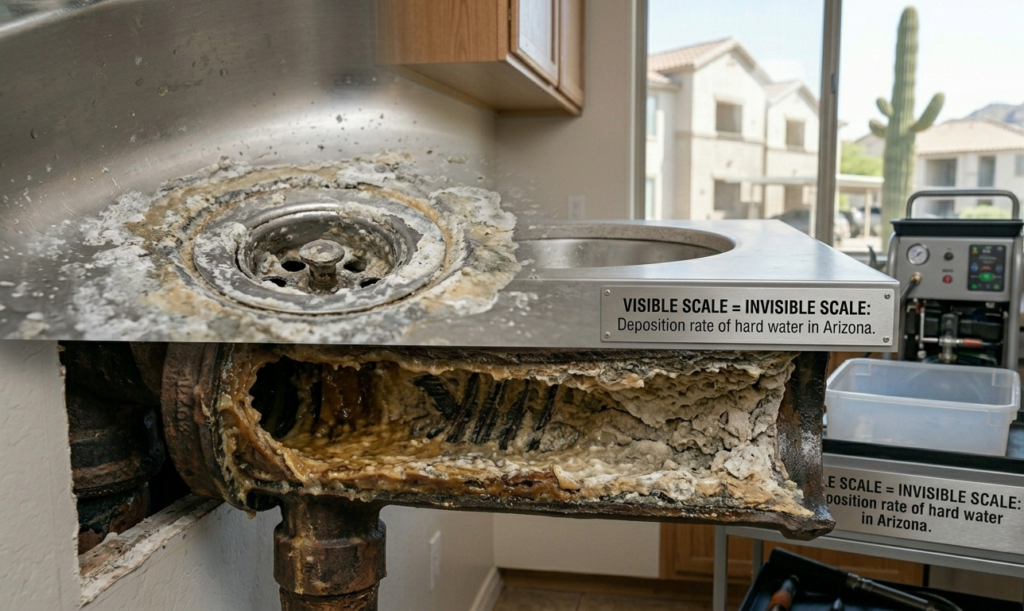
When minerals build up inside pipes and on faucets and fixtures, they create a chalky, white deposit that is often unsightly and hard to clean. Visible white, grey, or tan crusty deposits at drain openings, around drain body edges, on drain strainers, and at the waterline of sinks and tubs are surface expressions of the same mineral precipitation process that is occurring invisibly inside the drain pipes. If you can see mineral scale on the accessible surfaces around your drains, the same process has been occurring inside the pipes for the entire period that the scale has been building on the visible surfaces, typically longer because the pipe interior is continuously wet while the visible surfaces dry between uses.
The visible mineral deposits are diagnostically useful precisely because they are forming at the same rate as the internal pipe scale. A heavy visible scale accumulation at a drain opening after one year of occupancy in a Phoenix property is telling you that the pipes behind that drain have experienced the same deposition rate for the entire time the house has been occupied.
Recurring Clogs Returning Faster After Each Clearing
When a drain that has been snaked or cleared with a chemical product clogs again faster after each successive treatment, mineral scale is almost certainly the primary explanation. The scale on the pipe wall is providing an increasingly adhesive and irregular surface that new organic accumulation adheres to faster each time the most recent blockage is cleared. The obstruction is cleared, but the surface condition that accelerates re-accumulation is unchanged by snaking or by most chemical drain cleaners. The result is a progressively shorter interval between service calls, from every six months to every three months to every six weeks, as the pipe wall condition continues to deteriorate between incomplete cleanings.
Foul Odors That Persist After Cleaning
Persistent drain odors in Phoenix homes, particularly the sulfur or sewage-like smell that seems to come back within days of cleaning the visible drain components, indicate active bacterial colonies established within the composite organic and mineral accumulation layer inside the pipe. The biofilm living within this layer produces hydrogen sulfide and other odorous compounds continuously. Surface cleaning of the drain opening and trap does not reach the bacteria living deeper in the pipe wall coating, which is why the odors return so quickly after surface treatment.
Professional pipe descaling that removes the organic and mineral composite layer from the pipe wall removes the substrate that supports the bacterial colony and produces lasting odor resolution rather than the temporary improvement that surface cleaning provides.
Reduced Flow Pressure at Fixtures
When supply pipes rather than drain pipes are affected by mineral scale accumulation, the consequence is reduced water pressure at fixtures. In Phoenix homes where supply lines in addition to drain lines have accumulated significant scale, noticeably reduced pressure at showers, kitchen faucets, and bathroom fixtures indicates mineral restriction in the supply side of the plumbing. Supply line descaling is a more complex and specialized intervention than drain line descaling because supply lines carry potable water and require chemical treatments that are safe for drinking water contact.
For drain lines, reduced flow velocity rather than pressure is the relevant performance indicator, and it manifests as the progressive drain slowness described earlier in this section.
Professional Pipe Descaling Methods for Phoenix Properties
Video Camera Inspection as the Starting Point
Before any professional descaling service, a pipe inspection with video camera of the affected drain lines is the appropriate diagnostic first step. The camera reveals the actual thickness and distribution of scale accumulation inside the pipe, identifies the pipe material and its condition, confirms whether any structural issues exist alongside the scale problem, and provides the pre-service documentation that allows the post-service camera inspection to confirm the effectiveness of the descaling treatment.
For Phoenix properties where multiple drains are showing signs of scale restriction and the main sewer line condition is unknown, a main sewer line inspection combined with branch line camera inspection provides a comprehensive picture of the property’s entire drain system condition before any cleaning is performed.
High-Pressure Hydro Jetting for Mineral Scale Removal
Professional hydro jetting is the most effective primary method for removing mineral scale from drain pipe interiors in Phoenix residential and commercial applications. The high-pressure water delivered at 1,500 to 4,000 PSI through specialized nozzle configurations chips and dislodges hardened calcium carbonate scale from pipe walls with a mechanical action that no chemical treatment alone can replicate for established, thick scale deposits.
The specific nozzle configuration used for scale removal differs from standard jetting for grease or organic accumulation. Scale-appropriate nozzles deliver high-impact water jets at angles calculated to chip the hardened mineral deposits from the pipe wall surface rather than simply washing over them. Multiple passes through the pipe from different angles may be needed to achieve thorough scale removal when the accumulation is dense and well-established. For major calcium and mineral buildups, professional water jetting equipment is needed because the mechanical energy required to chip hardened calcium carbonate scale from pipe walls is not achievable with consumer-grade equipment.
After the jetting process strips the scale from the pipe walls, the dislodged mineral material and the now-exposed organic material that was embedded in the scale layer are flushed through the system to the outlet. A post-service camera inspection confirms the extent of scale removal and identifies any sections where additional service may be needed.
Chemical Descaling as a Complement to Mechanical Removal
For drain pipes where the mineral scale has built to a thickness that makes pure mechanical removal impractical in a single service visit, or where scale has formed in configurations that make physical access by jetting nozzles difficult, chemical descaling agents applied before or after hydro-jetting improve the total scale removal outcome. Running a calcium, lime, and rust remover down drain lines can help remove some of the buildup, as drainpipes are slightly easier to descale than potable water pipes.
Professional-grade acid-based descaling compounds in formulations appropriate for drain pipe materials dissolve the calcium carbonate matrix of the scale layer, converting the hardened mineral deposit into a more fluid form that can be flushed from the pipe. The chemical treatment is most effective when applied after an initial mechanical jetting pass that removes the outer organic material layer and exposes the mineral scale to direct chemical contact, rather than having the chemical treatment attempt to penetrate through accumulated organic material to reach the scale below.
The selection of descaling chemical must account for the pipe material. Muriatic acid-based compounds that are highly effective at dissolving calcium carbonate are not appropriate for use in pipes with specific material vulnerabilities, and professional service providers familiar with Phoenix’s residential plumbing history, including the cast iron, clay, PVC, and in some cases Orangeburg and early CPVC materials present in the Valley’s diverse housing stock, will select the appropriate chemical formulation for the specific pipe condition.
Sludge Removal of the Composite Organic and Mineral Layer
In Phoenix drain pipes with significant composite accumulation combining mineral scale with organic material, the removal process addresses both components in sequence. The organic material, including the biofilm, grease deposits, soap scum, and embedded debris, is removed first through the combination of hydro jetting mechanical action and the enzymatic activity of biofilm disruption. Once the organic layer is removed, the underlying mineral scale is exposed and addressed through the scale-specific jetting and chemical treatment described above.
For drain pipes in Phoenix commercial kitchens, laundry facilities, and high-occupancy residential buildings where both components of the composite layer are substantial, the complete descaling process may require more time and multiple treatment passes than a simple scale-only or organic-only drain cleaning would. Professional service providers who understand the composite nature of Phoenix pipe accumulation produce more thorough and lasting results than those who approach it as a single-component problem.
DIY Approaches and Their Real Limitations in Phoenix’s Hard Water Environment
Phoenix homeowners searching for scale removal solutions will find extensive information about home remedies, including vinegar flushes, baking soda and vinegar combinations, CLR products, and various commercial descaling agents available at hardware stores. A realistic assessment of these approaches helps Phoenix homeowners understand what they can reasonably accomplish at home and when professional service is the appropriate response.
What Vinegar and Baking Soda Can Actually Do
Vinegar is the best solution for minor mineral buildup, and cleaning certain fixtures is a do-it-yourself afternoon project. This is accurate for surface-level mineral deposits on fixtures, faucet aerators, showerheads, and the visible portions of drain openings. You could use vinegar in pipes, but it would take a lot of vinegar and you would have to leave it in the pipes at least 24 hours and remove all of the water in the pipes and replace it with vinegar, and the vinegar taste may be in the pipes for some time afterwards.
In practical terms, the acidity concentration in household vinegar is adequate to dissolve fresh, thin mineral deposits at accessible drain surfaces. It is not adequate to penetrate and dissolve established mineral scale deposits inside underground or within-wall drain pipes where the contact time and chemical concentration needed to attack hardened calcium carbonate matrix cannot be maintained long enough with diluted household acid.
Commercial CLR and Descaling Products
Commercial calcium, lime, and rust removers including CLR contain more concentrated acid formulations than household vinegar and can address more established surface deposits on fixtures and accessible drain hardware. Running a calcium, lime, and rust remover down drain lines can help remove some of the buildup for a short-term solution. The limitation for underground pipe scale treatment is the same as for vinegar: contact time and concentration are insufficient to penetrate and dissolve thick, established scale deposits that have formed over years of Phoenix hard water service, and the dilution that occurs as product moves through a drain pipe with standing water further reduces the concentration available at the deposit surface.
The Professional Service Threshold
The practical threshold between home remedy effectiveness and professional service necessity in Phoenix’s hard water environment is approximately one to two years of unaddressed mineral accumulation in a high-use drain. Below this threshold, periodic home maintenance with appropriate products can manage the surface-level and early-stage accumulation. Above this threshold, the hardened, thick composite scale deposits in Phoenix drain pipes require the mechanical energy of professional hydro jetting and the professional-grade chemical treatments to remove effectively. For major mineral buildups, professional water jetting equipment will likely be needed.
Building a Pipe Descaling Maintenance Program for Phoenix Properties
Annual Hydro Jetting as the Core Maintenance Standard
For most Phoenix residential properties, annual hydro jetting of the main sewer line and periodically of high-use branch lines is the maintenance standard that prevents mineral scale from accumulating to the level that causes service-impacting drain restriction. The annual service removes the previous year’s mineral and organic accumulation before it can harden and compact into a denser, more difficult-to-remove composite layer, and it resets the pipe interior to a condition of full flow capacity at the start of each maintenance cycle.
This frequency is calibrated to Phoenix’s specific hard water conditions and would be considered conservative or even excessive in soft-water markets. It is appropriate here because the accumulation rate in Phoenix’s 15 to 20 grain per gallon water is two to five times the rate in soft-water cities, and the annual cleaning interval matches the accumulation rate rather than being based on national average maintenance guidelines that do not account for Phoenix’s specific water chemistry.
Property Age and Pipe Material Considerations
For Phoenix properties over 20 years old, the appropriate starting point before establishing a maintenance program is a camera inspection that documents the current state of the drain infrastructure. Properties with original cast iron or clay drain lines that have never been professionally descaled may have accumulation that requires multiple service visits to address fully before a regular maintenance program can be established.
The combination of decades of mineral scale accumulation and internal pipe material deterioration in these older Phoenix properties creates conditions where a single hydro jetting service may not achieve full scale removal. A systematic approach that performs the initial cleaning, documents the remaining condition by camera, and schedules the follow-up service needed to complete the scale removal before establishing the ongoing annual maintenance program produces the best long-term outcome.
Coordinating Descaling With Other Drain System Maintenance
Pipe descaling service should be coordinated with any other scheduled drain system maintenance to maximize the value of each service visit. Kitchen drain grease trap cleaning, shower drain cleaning, and floor drain cleaning for commercial properties can all be scheduled within the same service visit or program. For rental property owners managing Arizona properties, integrating descaling service into the unit turnover drain maintenance program through preventive drain maintenance scheduling provides the most efficient and comprehensive drain system care.
Frequently Asked Questions: Pipe Descaling in Phoenix
How do I know if my Phoenix pipes need descaling versus just cleaning?
The most reliable indicators are progressive drain slowdown affecting multiple fixtures over months or years, visible white or grey mineral deposits at drain openings and around fixture hardware, recurring clogs that return faster after each clearing, and persistent drain odors that come back within days of surface cleaning. A camera inspection confirms the diagnosis by showing the actual scale thickness inside the pipe. If the camera reveals a thick, rough-surfaced interior coating that is visibly narrowing the pipe, professional descaling is what the pipe needs.
Is pipe descaling different from regular drain cleaning?
Yes. Regular drain cleaning using snaking addresses organic blockages, hair, and grease at specific obstruction points without removing the mineral scale from the pipe wall. Pipe descaling specifically targets the mineral scale coating using high-pressure mechanical action and where appropriate, chemical descaling compounds that dissolve calcium carbonate deposits. The most thorough professional pipe cleaning in Phoenix addresses both components: the organic accumulation and the mineral scale, because they exist together in the composite layer that forms in Phoenix’s hard water environment.
How long does professional pipe descaling take for a Phoenix home?
A standard residential drain line descaling service including camera inspection, hydro jetting, and post-service camera verification typically takes two to four hours depending on the pipe length, the scale severity, and the number of drain lines being treated. Main sewer line descaling combined with branch line service for a standard single-family Phoenix home typically requires a half-day service visit. Properties with severe scale accumulation that requires multiple jetting passes may require a full day or a follow-up service visit to complete.
Can pipe descaling damage my pipes?
Professional descaling performed after camera inspection confirming the pipe’s suitability for the selected treatment method does not damage pipes in sound or even moderately deteriorated condition. The risk of pipe damage from descaling arises when high-pressure jetting is applied to pipes with severe structural deterioration, perforated walls, or conditions that make the pipe unsuitable for the applied pressure, which is precisely what the camera inspection identifies and prevents. Professional service providers familiar with Phoenix’s specific pipe materials and conditions apply appropriate pressure settings and techniques for each situation.
What happens to the mineral scale that gets removed from the pipes?
The dislodged mineral scale, along with the organic material that was embedded in the scale layer, is flushed through the drain system to the municipal sewer connection by the water flow during the jetting process. The material exits the property through the sewer connection and is handled by the municipal wastewater treatment system. There is no special disposal requirement for the mineral and organic material removed from residential drain pipes during a standard descaling service.
Does installing a water softener eliminate the need for pipe descaling in Phoenix?
The only way to protect your entire water supply from limescale today and years into the future is by installing a water softener, which uses a process called ion exchange that swaps calcium and magnesium minerals with sodium ions that have no aesthetic effects. A correctly specified and maintained water softener dramatically reduces the rate of new scale formation in the pipes connected to the treated supply. However, it does not remove scale that has already accumulated before the softener was installed. Properties installing a water softener after years of Phoenix hard water service still need professional descaling of the existing pipe scale before the softener’s protective benefit is fully realized. Most Phoenix homeowners benefit from both approaches, using water softeners for daily protection and professional descaling for annual maintenance.
How much does professional pipe descaling cost in Phoenix?
Professional pipe descaling for a residential drain line in Phoenix, combining camera inspection, hydro jetting, and post-service verification, typically runs within the range of $350 to $650 for standard residential applications. Main sewer line descaling for a full residential property service runs in the same range as standard hydro jetting, between $400 and $700, with pricing reflecting the pipe length, scale severity, and access conditions. Properties with severe or long-neglected scale accumulation requiring multiple treatment passes are priced based on the scope of the actual work required rather than a fixed service rate.
Call Arizona Drain Cleaning at (602) 835-1451 right now to schedule a drain cleaning before the next stage of that escalation arrives. Same-day availability for urgent situations, upfront pricing before any work begins, and ROC-licensed technicians who understand what Arizona’s specific conditions do to drain systems that are not maintained.