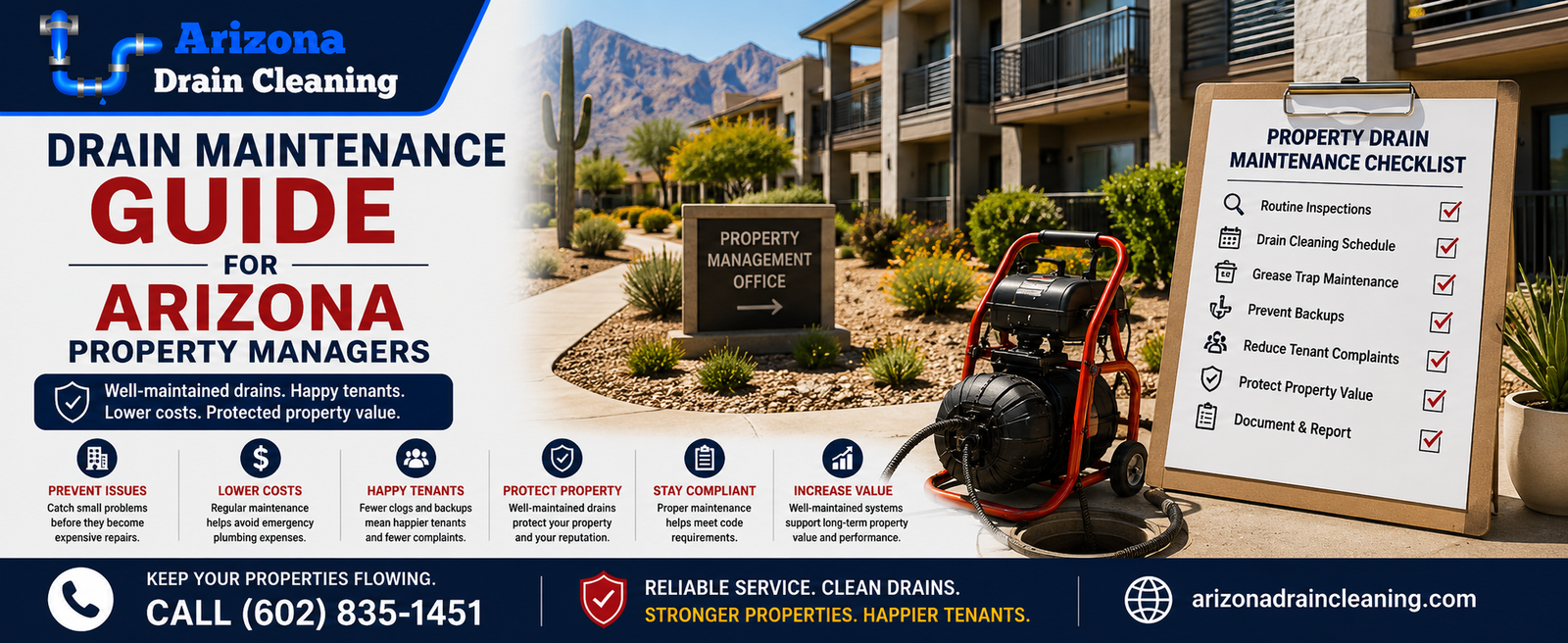
Managing drain systems across dozens or hundreds of rental units is not the same as maintaining plumbing in a single home. For Arizona property managers, drain maintenance is an operational issue that directly affects tenant satisfaction, maintenance budgets, emergency response costs, and legal risk.
The challenge is that Arizona creates plumbing conditions that many national property management resources simply do not account for. Hard water scale gradually restricts pipe flow, expansive clay soils can stress underground lines, caliche hardpan complicates repairs, and monsoon season can expose drainage weaknesses across multiple properties at the same time.
For professional property managers, the goal is not just fixing drain problems. The goal is preventing them from disrupting operations in the first place.
| Arizona Challenge | Impact on Managed Properties | Potential Consequence |
|---|---|---|
| Hard Water Scale | Gradual pipe restriction across multiple units | Recurring service calls and tenant complaints |
| Monsoon Storms | Increased stress on storm and sewer systems | Flooding, backups, and emergency repairs |
| Aging Infrastructure | Higher likelihood of pipe deterioration | Costly repairs and unexpected downtime |
| Expansive Soil Movement | Underground pipe stress and shifting | Cracks, offsets, and drainage issues |
| High Occupancy Turnover | Increased misuse and drain loading | Frequent blockages and maintenance requests |
Unlike individual landlords, professional property managers must think in terms of portfolios, maintenance schedules, vendor relationships, risk management, and long-term asset protection. A drain issue affecting one resident can quickly become a reputation issue affecting an entire property.
Recommended Drain Maintenance Schedule
| Property Type | Recommended Service Frequency |
| Single-Family Rental Portfolio | Annual inspection and cleaning as needed |
| Small Multifamily Properties | Every 6–12 months |
| Large Apartment Communities | Every 3–6 months for main lines |
| HOA Common Areas | Before and after monsoon season |
| Commercial Mixed-Use Properties | Quarterly inspections and maintenance |
Regular maintenance helps identify developing issues before they affect tenants, damage property, or require emergency intervention.
What Arizona Law Requires From Property Managers on Plumbing and Drain Maintenance
Before covering operational strategy, the legal baseline matters. Arizona’s habitability requirements for rental properties are established under the Arizona Residential Landlord and Tenant Act, codified primarily in Arizona Revised Statutes Title 33, Chapter 10.
Under ARS 33-1324, landlords and by extension their property managers are required to make all repairs necessary to keep the premises in a fit and habitable condition, and to maintain all electrical, plumbing, sanitary, heating, ventilating, and air-conditioning facilities in good and safe working order. That language is not qualified by whether the plumbing problem was caused by tenant behavior or by normal wear. It establishes a maintenance obligation that falls on the property side of the relationship.
Under Arizona law, if a landlord fails to make repairs after written notice within a reasonable period, typically five to ten days for non-emergency situations, tenants may use the repair and deduct remedy for minor repairs up to $300 or half a month’s rent, whichever is greater, under ARS 33-1364.
The practical implication for property managers is significant. A tenant with a documented slow drain who has submitted a written maintenance request, received no response for ten days, and then hired their own plumber and deducted the cost from rent is in a legally defensible position under Arizona law. The property manager who failed to respond is not. Systematic drain maintenance documentation is therefore not just an operational best practice. It is a legal liability management tool.
On the tenant side, ARS 33-1341 establishes that tenants are obligated to keep plumbing fixtures clean and to use facilities and appliances in a reasonable manner. This creates the legal basis for charging tenants for drain problems demonstrably caused by their own misuse, provided that the charge is documented and supported. The distinction between owner-responsibility maintenance and tenant-caused damage is something every professional property manager in Arizona needs to be able to demonstrate in writing.
The Three-Level Responsibility Framework for Arizona Rental Drain Maintenance
Professional property managers managing portfolios in Phoenix, Scottsdale, Tempe, Mesa, and the surrounding Valley communities benefit from a clear operational framework that distinguishes three levels of drain maintenance responsibility.
Level One: Owner Responsibility (System-Wide and Structural)
Main sewer lateral condition, drain stack integrity in multifamily buildings, shared line blockages affecting multiple units, and any drain problem caused by soil movement, pipe aging, or system-wide scale accumulation in an Arizona hard water environment are owner-side maintenance responsibilities under Arizona law. These are the items that a property manager addresses proactively through scheduled service contracts, annual camera inspections, and pre-monsoon drain cleaning.
In multifamily drain maintenance in Arizona, shared drain stacks and common area lines deserve particular attention. A building where six units share a drain stack that has not been professionally cleaned in two years is not just accumulating scale. It is accumulating liability. One main stack backup affecting multiple units simultaneously in a Phoenix apartment complex is a habitability emergency, a multi-tenant complaint event, and a potential news story in a market where tenant advocacy is increasingly visible on social media.
Level Two: Gray Zone Responsibility (Determined by Documentation)
Drain problems in individual units that fall somewhere between system-level maintenance and clear tenant damage occupy a gray zone that Arizona property managers encounter regularly. A unit bathroom drain that is slow when a new tenant moves in is an owner maintenance issue. The same drain running slowly after six months of occupancy, with no documented prior complaints and a history of hair accumulation at every previous inspection, is a situation where the documentation trail determines who pays.
This is the responsibility level where between-unit inspection protocols and written maintenance logs earn their value. A property manager who can show a camera inspection of that unit’s drain line at move-in showing a clear pipe, no maintenance request from the tenant during their occupancy, and a post-occupancy inspection showing significant hair-and-grease accumulation, has the documentation basis to assess a drain cleaning charge against the security deposit. A property manager without that documentation is likely absorbing the cost as an owner expense regardless of how the blockage actually occurred.
Level Three: Tenant Responsibility (Documented Misuse)
Drain blockages caused by documented tenant misuse, specifically flushing non-flushable items, pouring grease down kitchen drains despite written notice in the lease, or any foreign object blockage where the tenant’s behavior is clearly the cause, are chargeable to the tenant under Arizona law as damages beyond normal wear. The documentation requirements are the same: written evidence of the cause, a written record of the prior condition of the drain before the tenant’s occupancy, and a professional plumber’s assessment of the blockage cause when the situation is in dispute.
Most leases that professional property managers use in Arizona include a drain misuse clause that prohibits flushing wipes, sanitary products, and other non-flushable items and makes tenants responsible for drain cleaning costs when misuse is demonstrated. That clause is enforceable under Arizona law as long as it does not attempt to waive tenant rights under ARLTA in a way that the statute prohibits.
Key Areas Property Managers Should Monitor
| System Component | Common Issues |
| Main Sewer Lines | Root intrusion, scale buildup, blockages |
| Kitchen Drain Systems | Grease and food-related buildup |
| Bathroom Lines | Hair, soap residue, and foreign objects |
| Storm Drains | Sediment, debris, and monsoon-related blockages |
| Exterior Drainage Systems | Flooding and standing water concerns |
The most successful property management companies treat drain maintenance as part of a broader asset management strategy rather than a repair expense.
This guide explains how Arizona’s unique environmental conditions affect managed properties, how maintenance schedules should be structured across different property types, and why proactive drain care is one of the most cost-effective ways to reduce tenant complaints, emergency service calls, and long-term infrastructure costs.
Property Manager Drain Maintenance in Arizona: The Recommended Service Schedule
A professional drain maintenance schedule for an Arizona property management portfolio should be tiered by property type and by the specific risk factors that Arizona’s environment creates. Here is a practical framework by property category.
Single-Family Rental Portfolio
For a scattered-site single-family portfolio in Phoenix, Scottsdale, Chandler, or Gilbert, the following schedule reflects both the operational reality of Arizona’s plumbing environment and the requirements of responsible property management.
At move-in: Camera inspection of the main sewer lateral if the property is more than 15 years old or if no inspection record exists in the property file. This produces a documented baseline of the drain system condition before the tenant’s occupancy begins, which is the foundational document for any future responsibility dispute. For older properties in central Phoenix or north Scottsdale neighborhoods with cast iron or clay tile laterals, this inspection is not optional. It is the property manager’s primary liability protection.
Annually, before monsoon season (April or May): Main drain cleaning service for every single-family rental in the portfolio. Arizona’s monsoon season runs from mid-June through late September, and the first heavy storms produce the surge conditions that expose any accumulated blockage in residential drain systems. Clearing those systems before monsoon hits, while the booking of service can be planned rather than reactive, is the most cost-effective maintenance intervention available to Arizona property managers. It prevents the more expensive emergency service calls that arrive during monsoon season from tenants with backed-up main lines.
At tenant move-out: Drain inspection and cleaning as part of the standard unit turn process, with documentation of findings for the move-out accounting file.
Multifamily and Apartment Complex Portfolio
Multifamily drain maintenance in Arizona requires a more layered schedule because the consequences of a failure affect multiple tenants simultaneously and the building systems are more complex than single-family residential plumbing.
Monthly: Visual inspection and operational check of all common area drain fixtures, floor drains in laundry rooms, pool equipment drain points, and parking structure drains. Monsoon season requires this check to increase in frequency during storm months, as pooling surface water that reaches building drain infrastructure puts shared systems under surge stress that individual unit plumbing does not experience.
Quarterly: Professional hydro jetting of kitchen drain lines serving common areas and laundry facilities. High-use shared kitchen and laundry facilities in Arizona apartment complexes accumulate grease and lint scale at a rate that quarterly cleaning prevents before it produces emergency backups. Industry data indicates that buildings on a consistent preventive maintenance cycle experience significantly fewer plumbing-related tenant complaints and lower insurance exposure than those managing plumbing reactively.
Semi-annually: Camera inspection of shared drain stacks in multifamily buildings. The industry standard for multifamily plumbing maintenance includes semi-annual camera inspections of drain stacks as part of a complete preventive maintenance cycle. In Arizona, where caliche and expansive clay soil stress underground shared lines specifically, this inspection interval is appropriate for buildings of any age with any pipe material.
Annually: Full camera inspection of building main sewer connection lines and any underground shared drain infrastructure. This is the inspection that identifies the Arizona-specific conditions discussed throughout this guide: root intrusion at caliche-driven moisture zones, bellied sections from expansive clay soil movement, and joint separations in older shared pipe systems.
How to Set Up a Drain Maintenance Service Contract in Arizona
A formal service contract with a qualified Arizona drain cleaning company is the operational infrastructure that converts a drain maintenance schedule from a policy document into a reliably executed program. Here is what a professional property management service contract should include.
Defined scope of work by property and frequency. The contract should specify which properties are covered, what drain cleaning service is performed at each property, and at what scheduled intervals. Vague scope language like “drain maintenance as needed” is not a service contract. It is an on-call arrangement that will be priced at on-call rates every time.
Response time commitments by urgency tier. A professional drain maintenance contract for an Arizona property management portfolio should distinguish between scheduled maintenance visits, urgent but non-emergency requests (response within 24 to 48 hours), and true emergency situations (response within two to four hours). Tenant-occupied properties with a complete main line backup or a sewage backup into a living space are genuine emergencies that require same-day response.
Clear pricing for both scheduled and emergency service. After-hours, weekend, and holiday drain service in Arizona carries premium pricing that typically runs 1.5 to 2 times the standard service rate. A property management portfolio that generates consistent scheduled volume for a service contractor is in a position to negotiate a predetermined emergency rate as part of the contract rather than absorbing the full retail emergency premium on every after-hours call. Establishing this rate in writing before the monsoon season begins, rather than negotiating it at 10pm during a storm event, protects both the management company’s budget and the owner’s maintenance fund.
Documentation deliverables. Every service visit should produce a written service record that includes the property address, unit number if applicable, the specific drain or line serviced, the finding, the service performed, and the technician’s assessment of the drain’s condition post-service. These records feed the property management system and build the documentation infrastructure that protects the management company in tenant disputes and owner reporting conversations.
ROC license verification. Any drain cleaning contractor holding a service contract for a professional property management portfolio in Arizona must hold a current, active Arizona Registrar of Contractors license for the relevant classification. The ROC’s complaint process, investigative team, and Recovery Fund protections are only available to property owners and managers who hired licensed contractors. This is not a minor administrative detail. It is the foundational legal protection for every owner whose property is under the management company’s care.
Cost-Per-Unit Budgeting for Drain Maintenance in Arizona
Professional property managers presenting maintenance budgets to owners need a defensible cost-per-unit framework for drain maintenance that reflects Arizona’s actual market conditions. Here is a practical benchmark structure.
Single-family rentals: Budget $150 to $250 per property per year for scheduled preventive drain maintenance, covering annual main line cleaning before monsoon season and periodic unit drain service. Camera inspections add $150 to $300 per inspection and should be budgeted every two to three years for properties built after 1985 and annually for properties with older pipe systems. Emergency service calls average $300 to $600 during business hours and $450 to $900 at after-hours premium rates in the Phoenix metro market.
Multifamily units: Budget $40 to $75 per unit per year for a complete preventive drain maintenance program, inclusive of the quarterly common area cleaning, semi-annual stack inspections, and annual main line inspection. This per-unit figure amortizes the fixed costs of building-level maintenance across the unit count and typically presents well to owners as a cost-per-door maintenance line when compared against the alternative: reactive emergency service at $800 to $2,000 per call for events that affect multiple tenants simultaneously.
The comparison that resonates most clearly with owners reviewing maintenance budgets is the cost of one avoided emergency against the cost of a year of scheduled prevention. A monsoon-season main line backup in a 20-unit Phoenix apartment building that requires emergency service, produces a habitability notice to affected tenants, and generates a documented complaint to the Arizona Department of Housing or the Phoenix Housing Department is not a $300 drain cleaning. It is a $2,000 to $5,000 event when all costs are counted. Annual preventive maintenance that prevents that event costs a fraction of that figure per door.
Documentation for Liability Protection: What Every Arizona Property Manager Should Keep
The documentation infrastructure for drain maintenance serves three distinct purposes in professional property management: operational tracking, owner reporting, and legal protection.
The property drain maintenance log is a property-level record, maintained in the management system, that tracks every drain service event chronologically. Date, service provider, line or drain serviced, finding, and service performed. This log is the primary evidence document if a tenant submits a habitability complaint, if an owner questions a maintenance expense, or if a dispute goes to an Arizona Justice Court small claims proceeding.
Move-in and move-out drain inspection records document the condition of the drain system at the beginning and end of each tenancy, including camera footage for main laterals on older properties. Without this baseline documentation, the gray zone responsibility disputes described earlier in this guide resolve in the tenant’s favor by default, because there is no evidence of what the drain condition was before the tenant’s occupancy.
Written maintenance request records and response documentation create the paper trail that establishes a management company’s responsiveness to reported drain issues. Under ARS 33-1324, the obligation to maintain plumbing in good working order is ongoing and enforceable. A management company that responds to written maintenance requests within the legally appropriate timeframe and documents that response is protected. One that does not is exposed.
Service contractor compliance documentation should include a current copy of the service contractor’s Arizona ROC license, their certificate of insurance, and the executed service contract. This file protects the management company and the owner in the event that a contractor-related incident generates a liability claim against the property.
Arizona-Specific Drain Risks That Professional Property Managers Must Address
Professional property managers who learned property management in other states and moved their practice to Arizona consistently underestimate how specifically Arizona’s environment affects drain system performance and maintenance requirements. Two risk factors deserve particular attention at the portfolio management level.
Pre-monsoon preparation is not optional. Arizona monsoon season is a predictable, annual stressor on residential and multifamily drain systems throughout the Phoenix metro and the Tucson basin. The first heavy storms arrive in mid to late June and can put more water onto Valley properties in a single evening than the previous three months combined. Any drain system that has accumulated partial blockage from the preceding dry season becomes a backup candidate during the first significant monsoon event. Scheduling annual drain cleaning for the entire portfolio in April and May, before the monsoon window opens, is the single most effective preventive action Arizona property managers can take at a portfolio level.
Older properties need special soil-aware attention. Properties built before 1985 in Phoenix, Scottsdale, and the surrounding Valley communities have cast iron or clay tile sewer laterals that have been under Arizona’s expansive clay and caliche soil stress conditions for four or more decades. Root intrusion at caliche-driven moisture zones, bellied pipe sections from clay soil movement, and joint separations at transition points between soil types are common findings in camera inspections on these properties. Managing these assets responsibly means budgeting for camera inspection on a regular basis and being prepared to have a frank conversation with owners about the condition of their underground pipe systems when the footage warrants it.
For a detailed explanation of what those camera inspection findings mean and how to interpret them for owners, our post on how to read a sewer camera inspection report in Arizona provides a plain-language breakdown of every major finding category
Frequently Asked Questions
Who is legally responsible for drain cleaning in an Arizona rental property, the landlord or the tenant?
Under the Arizona Residential Landlord and Tenant Act, specifically ARS 33-1324, the landlord and their property manager are responsible for maintaining all plumbing and sanitary facilities in good working order. This covers system-level maintenance including main drain lines, shared drain stacks in multifamily buildings, and drain problems caused by aging pipes or soil conditions. Tenants are responsible under ARS 33-1341 for keeping plumbing fixtures clean and using facilities in a reasonable manner. Drain problems demonstrably caused by tenant misuse, such as foreign object blockages from non-flushable items, are chargeable to the tenant as damages beyond normal wear, provided the cause is documented by a professional assessment.
How often should an Arizona property manager schedule professional drain cleaning for a multifamily building?
For actively occupied multifamily properties in the Phoenix metro area, a complete preventive drain maintenance program includes monthly common area drain checks, quarterly hydro jetting of high-use shared kitchen and laundry drains, semi-annual camera inspection of shared drain stacks, and an annual inspection of main building sewer connection lines. The annual inspection should be scheduled in April or May to complete before Arizona’s monsoon season begins in mid-June. Properties with older pipe systems or located in neighborhoods with known expansive clay or caliche soil conditions warrant more frequent inspection intervals.
What should a property management drain service contract in Arizona include?
A professional drain service contract for an Arizona property management portfolio should specify the covered properties and service scope for each, the scheduled service frequencies, response time commitments by urgency tier (routine, urgent, and emergency), pricing for both scheduled service and emergency calls including after-hours premium rates, documentation deliverables for every service visit, and the contractor’s Arizona ROC license number. Negotiating a predetermined emergency rate as part of the contract rather than absorbing retail emergency premium pricing on every after-hours call is a meaningful cost control measure for portfolios with multiple properties.
How does Arizona’s monsoon season affect property management drain maintenance planning?
Arizona’s monsoon season, running from approximately mid-June through late September, creates an annual surge condition that exposes any partial drain blockage or system vulnerability in residential and multifamily properties throughout the Valley. Heavy monsoon storms can deliver more rainfall in a single hour than a Phoenix property typically receives in a month, and that water volume backs up through any compromised section of the drain system immediately. Scheduling annual drain cleaning for the entire managed portfolio in April and May, before the monsoon window opens, is the most effective preventive measure available to Arizona property managers. It converts what would be a reactive emergency service pattern during monsoon season into a predictable, scheduled maintenance program.
What documentation should Arizona property managers maintain for drain maintenance and why?
Three categories of documentation matter most for liability protection and operational management. A chronological property-level drain maintenance log documenting every service event protects the management company in tenant habitability complaints and owner reporting conversations. Move-in and move-out drain inspection records, including camera footage for older properties, establish the baseline condition documentation that determines whether drain problems during a tenancy are owner maintenance responsibility or tenant damage. Written maintenance request and response records demonstrate that the management company fulfilled its legal obligation to respond to reported plumbing issues within the timeframe required under ARS 33-1324. All contractor compliance documentation, including ROC license copies and insurance certificates, should be maintained in a vendor file accessible to the management company’s principal broker.
How should a property manager handle an after-hours drain emergency in an occupied Arizona rental?
True after-hours drain emergencies in occupied Arizona rentals, meaning a complete main line backup, a sewage backup entering living space, or a drain failure affecting multiple units in a multifamily building, require immediate professional response regardless of the time or day. After-hours drain cleaning in the Phoenix metro carries premium pricing of 1.5 to 2 times standard rates, and that cost is an owner expense that should be approved under the management agreement’s emergency maintenance authorization threshold. The cost of that emergency service call is always lower than the compounding liability of an unresolved habitability condition: a documented tenant complaint, a potential repair and deduct action under Arizona law, and the reputational and legal exposure that follows a habitability event that was reported and not addressed.
A Service Partner That Understands What Property Management in Arizona Actually Requires
Arizona Drain Cleaning works with professional property managers throughout the Phoenix metro, the East Valley, and the surrounding communities. We understand the documentation requirements, response time expectations, and Arizona-specific drain conditions that portfolio-level property management demands. Our service contracts are built for the operational reality of managing multiple properties, not for one-off residential calls.
We hold active Arizona ROC licensing, carry current commercial insurance, provide written documentation on every service visit, and offer portfolio pricing for management companies with consistent volume. When a monsoon-season emergency comes in at 9pm, we answer and we respond because we understand that your tenants’ habitability and your management company’s liability do not operate on a business-hours schedule.
Contact Arizona Drain Cleaning today (602) 835-1451 to discuss a service contract for your Arizona property management portfolio, or visit our Phoenix drain cleaning service page to get started. Let us be the vendor you scheduled before the emergency, not the one you searched for during it.