You’ve tried the plunger. You’ve run the snake. The drain is still slow, still backing up, still a problem. At some point, your plumber mentions hydro jetting, and suddenly, you’re wondering whether that’s a real solution or just an upsell.
It’s real. For the right situation, it’s the most thorough drain cleaning method available. Here’s an honest breakdown of how it works, what it costs, and just as importantly, when you should not use it.
If you already have a serious blockage that needs clearing today, our hydro-jetting service team is available same day. But read on if you want to understand exactly what you’re getting and whether it’s the right call for your situation.
| What You’re Experiencing | Hydro Jetting Needed? |
|---|
| First-time minor sink clog | Probably not |
| One slow shower drain with hair buildup | Probably not |
| Drain was snaked and clogged again within weeks | Possibly |
| Multiple drains backing up at once | Often yes |
| Frequent kitchen drain clogs from grease | Often yes |
| Recurring sewer line problems | Usually yes |
| Heavy sludge, scale, or root intrusion | Often yes |
Hydro jetting blasts years of buildup in minutes — is it right for your pipes?
Our experts will tell you honestly whether you need it — no upselling, just solutions.
What Is Hydro Jetting?
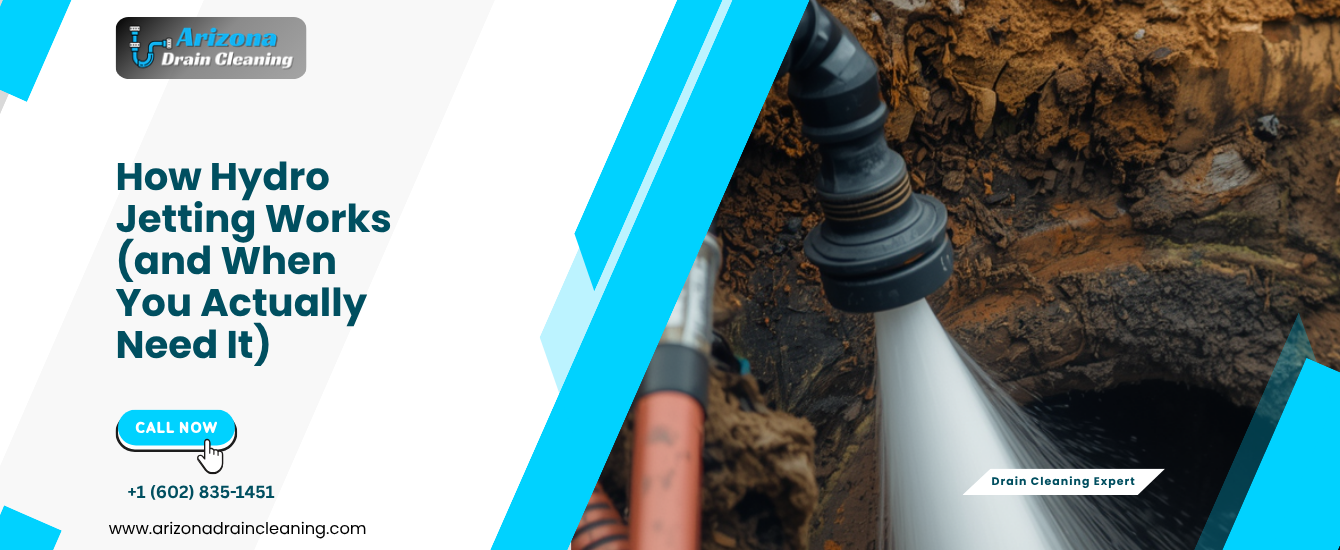
Hydro jetting is a drain cleaning method that blasts pressurized water through your pipes to break up and flush out blockages, grease buildup, mineral scale, and debris. A technician inserts a flexible hose with a specialized nozzle into the drain or cleanout access point. The nozzle faces both forward and backward, allowing water to cut through obstructions ahead while simultaneously scouring the pipe walls on the way out.
The water pressure involved is substantial, typically between 3,000 and 8,000 PSI for residential lines and up to 60,000 PSI for heavy industrial applications. For context, a standard garden hose runs at about 40–60 PSI. That difference is why hydro jetting removes what nothing else can.
What Hydro Jetting Removes
This is where hydro jetting outperforms every other drain cleaning method. It doesn’t just punch a hole through a clog; it removes the clog completely and cleans the pipe wall itself. A professional hydro-jetting service can clear:
- Grease and fat buildup: the greasy film that coats kitchen drain lines over the years of use, slowly narrowing the pipe until flow stops
- Tree root intrusions: roots that have worked their way into sewer lines through cracks or joints (hydro jetting cuts them; a follow-up camera inspection confirms the damage level)
- Mineral scale and calcium deposits: common in areas with hard water, these harden inside pipes and reduce the diameter over time
- Soap scum and hair accumulation: the slow-draining bathroom sink that never fully clears
- Sand, silt, and debris: common in older municipal connections or properties that have experienced flooding
- Stubborn food particles, especially in commercial kitchens, where grease trap lines see heavy daily use
Because the high-pressure water physically removes material from the pipe wall, not just from the center of the line, the results last significantly longer than snaking alone.
Hydro Jetting vs. Snaking: What’s the Difference?
A drain snake, also called a plumber’s auger, is a long, coiled cable that a technician feeds into the drain until it reaches the blockage. It then either breaks the clog apart or hooks it so it can be pulled out.
Snaking is fast, affordable, and effective for simple clogs. But it has clear limits:
| Drain Snake | Hydro Jetting | |
| Cost (residential) | $100–$250 | $300–$600 |
| Clears soft clogs | Yes | Yes |
| Removes grease buildup | Partial | Complete |
| Cleans pipe walls | No | Yes |
| Handles tree roots | Partial | Yes |
| Results last | Weeks to months | 1–3 years |
| Safe for older pipes | Yes | With inspection first |
Stubborn clogs that keep coming back? Regular snaking isn’t enough.
Hydro jetting clears drains completely — call now and get it done right the first time.
The honest answer: snaking is the right first move for a standard clog. Hydro jetting is the right move when the problem is chronic, recurring, or caused by buildup rather than a single obstruction.
How Much Does Hydro Jetting Cost?
Residential hydro jetting typically runs $300–$600 for a standard drain line. Sewer line jobs or severe blockages can reach $1,000 or more. Commercial accounts, restaurants, apartment buildings, and retail properties often pay $500–$2,500, depending on line length and condition.
That sounds like a lot compared to a $150 snake job. But consider the math: if you’re calling a plumber every few months for the same slow drain, a one-time hydro jet cleaning often pays for itself within a year and ends the cycle entirely.
When You Actually Need Hydro Jetting
You’re a good candidate for hydro jet drain cleaning if any of the following apply:
Signs you need hydro jetting, not just a snake:
•The same drain keeps clogging. Recurring blockages in the same line are almost always a buildup, not a one-time problem
• Multiple drains are slow at once. This points to an issue in the main sewer line, not individual fixture drains
•You’ve noticed sewage odors, grease, and organic buildup inside pipes, which creates strong odors that snaking doesn’t fully resolve
•You’re in a commercial property; restaurants and food service businesses typically need hydro jetting every 6–18 months as routine maintenance
•You’re buying or selling a home: a pre-sale hydro jet and camera inspection gives buyers confidence and can prevent surprises after closing
•There has been a sewage backup. Hydro jetting is the proper reset before resuming normal use
When NOT to Use Hydro Jetting
This is the part most plumbing companies skip. Hydro jetting is powerful — and that power can cause real damage if applied to the wrong pipes.
Do NOT use hydro jetting on:
•Damaged, cracked, or corroded pipes. The water pressure that clears a blockage can also split an already-compromised pipe
•Very old clay or cast iron pipes: these materials become brittle over decades, and high-pressure water can worsen existing cracks or dislodge joints
•Pipes with bellies or sag sections that have settled and dipped collect water and debris; hydro-jetting doesn’t fix the slope issue
• Any pipe that has not been inspected first: Reputable plumbers run a camera scope before jetting to confirm pipe condition; if a company wants to hydro jet without a prior inspection, that is a red flag
A good plumber recommends the method that actually fits your situation, not the most expensive one.
What to Expect During a Hydro Jetting Service Call
1. Camera inspection: A small waterproof camera goes into the line to assess the condition and confirm the location of the blockage
2. Access point identification: The technician locates the best cleanout access to introduce the jetting hose
3. Jetting the pressurized water nozzle moves through the line, clearing material as it goes (typically 30–90 minutes for residential jobs)
4. Flush and confirm the line is flushed, and a final camera pass confirms the blockage is gone and the pipe wall is clean
5. Report: Most companies provide a summary of what was found and any follow-up recommendations
Frequently Asked Questions
Is hydro jetting safe for old pipes?
Yes, when performed by a trained technician who first inspects the pipe condition with a camera. Hydro jetting uses high-pressure water, no chemicals, and does not damage pipes in good structural condition. If the camera reveals significant corrosion or cracking, a responsible technician will recommend a different approach before proceeding.
How long do hydro jetting results last?
For most residential drain lines, hydro jetting results hold for one to three years. Kitchen grease lines in commercial properties may need service every six to eighteen months, depending on volume. Main sewer lines with no root intrusion and no structural issues typically need jetting every two to three years as preventive maintenance.
Can hydro jetting remove tree roots?
Yes, hydro jetting cuts through root intrusions effectively. However, it does not repair the crack or gap in the pipe that allowed roots to enter in the first place. After jetting, a camera inspection confirms the extent of root intrusion and whether a pipe repair or relining is also needed to prevent roots from returning.
How do I know if I need hydro jetting or just a snake?
If a drain is clogging for the first time and you can identify a single cause, such as a wad of hair near the drain, for example, snaking is the right first step. If the drain keeps coming back, if multiple drains are slow simultaneously, or if snaking has already been tried without lasting results, hydro jetting is the appropriate next call.
What should I do if I have a complete drain backup right now?
Stop using all water-consuming fixtures immediately to prevent overflow. If sewage is visible at floor drains or backing up into tubs, treat the area as contaminated and keep children and pets away. Call a professional for same-day emergency service. This is not a situation that improves by waiting.
Ready to Schedule a Hydro Jetting Assessment?
Whether your drain keeps coming back or you want a main-line cleaning before a home sale, our team provides camera inspections, residential and commercial hydro jetting, and same-day service for urgent blockages.
Our hydro jet drain cleaning service includes a camera inspection before we ever touch the pressure dial so you know exactly what’s in your pipe and exactly what it will take to fix it. Call us today or book online.