Industrial drain cleaning in Arizona is a facility management responsibility that sits at the intersection of operational continuity, regulatory compliance, worker safety, and infrastructure protection. When a drain system fails in an industrial setting, the consequences are categorically different from a residential or standard commercial drain failure. Production lines stop. Workers cannot access areas of the facility safely. Environmental compliance becomes an immediate concern if regulated waste materials are involved in the backup. And emergency service calls in industrial environments carry premium costs that a scheduled maintenance program would have prevented at a fraction of the price. The team at Arizona Drain Cleaning works with facility managers, operations directors, EHS coordinators, and plant managers across manufacturing, distribution, food processing, automotive, chemical processing, and industrial service facilities throughout the Phoenix metro area and across the state. This guide covers everything a facility manager needs to understand about industrial drain cleaning in Arizona, including the unique challenges industrial drains present, what the professional cleaning process involves at industrial scale, Arizona’s specific regulatory framework for industrial drainage, how to build a maintenance program that protects both your operations and your compliance posture, and what warning signs demand immediate professional intervention.
Why Industrial Drain Cleaning Is Fundamentally Different From Commercial or Residential Service
The difference between industrial drain cleaning and every other category of drain service is not simply one of scale, although scale matters significantly. It is a difference in the composition of the waste streams, the regulatory framework governing what can and cannot enter the drain system, the structural demands placed on the drain infrastructure, and the consequence profile of a drain failure during active production.
The Industrial Waste Stream Challenge
A residential drain receives water, soap, food particles, and human waste. A commercial restaurant drain adds cooking grease and food service chemicals. An industrial drain receives all of that and also one or more of the following, depending on the industry: metalworking coolants and lubricants containing petroleum compounds, mineral acids and alkaline cleaning compounds from industrial cleaning operations, food processing organic waste at volumes and concentrations that residential and standard commercial systems never approach, chemical compounds from manufacturing processes that require specific handling during cleaning, abrasive particulate from grinding and machining operations that settles in drain sumps and pipes, high-temperature process water that affects pipe material integrity over time, and in some cases, biologically active material from pharmaceutical or food science operations that carries its own handling requirements.
Each of these waste streams creates a different type of accumulation inside the drain pipe and at drain bodies, sumps, and outlet structures. Each requires a cleaning approach calibrated to that specific accumulation type rather than a generic drain cleaning method applied uniformly across different industrial environments. A facility manager who allows a drain cleaning service to apply the same residential-scale approach to industrial drainage infrastructure is setting up for incomplete cleaning that leaves the conditions for rapid re-accumulation intact and for potential regulatory issues if cleaning discharges materials improperly.
The Scale of Industrial Drain Infrastructure
Industrial facilities in Arizona’s manufacturing, distribution, and processing sectors operate drain infrastructure at a scale that residential and standard commercial equipment cannot adequately service. Floor drains in manufacturing bays may be four to six inches in diameter rather than the two to three inch standard in commercial buildings. Main collector lines serving production areas carry volumes that reflect the wash-down requirements of large floor areas rather than the fixture-by-fixture use of commercial restroom facilities. Sump systems beneath production floors collect significant volumes of process fluids, coolants, and wash water before routing to the drain system. Lift stations in some industrial facilities pump waste from below-grade production areas up to the main sewer connection level. Each of these elements requires professional equipment sized and configured for industrial applications rather than standard residential or light commercial drain service.
The Production Impact of Drain Failure
In a residential setting, a backed-up drain is an inconvenience. In an industrial facility, a drain failure during production can shut down a line, create a floor safety hazard that OSHA regulations require be immediately addressed, trigger an environmental compliance event if the backup involves regulated waste, and generate a cost-per-hour of downtime that can rapidly exceed the annual cost of a proactive maintenance program many times over. A food processing facility that must halt production due to a floor drain backup during peak processing season does not simply lose the production hours. It may lose perishable product, face regulatory scrutiny under FDA and USDA program requirements, and experience supply chain impacts that extend well beyond the incident itself.
Understanding the production impact is what makes the business case for proactive industrial drain maintenance not just compelling but obvious to any facility manager who has experienced an unplanned drain failure during operations.
Common Industrial Drain Problems in Arizona Facilities
Metalworking Coolant and Lubricant Accumulation
Arizona’s manufacturing sector includes a significant concentration of precision machining, aerospace component manufacturing, electronics manufacturing, and metal fabrication operations throughout the Greater Phoenix area, particularly in Mesa, Chandler, Tempe, and the East Valley industrial corridors. These operations generate metalworking fluid waste streams that create a specific and demanding drain cleaning challenge.
Metalworking coolants and cutting fluids are typically water-soluble oil emulsions or synthetic fluid formulations that contain petroleum components, biocides, corrosion inhibitors, and in some cases, heavy metals from the machined material itself. When these fluids enter the floor drain system, the petroleum components adhere to pipe walls in a pattern similar to cooking grease in a commercial kitchen but with higher tenacity because metalworking fluid petroleum components are formulated specifically to adhere to metal surfaces. The result is a dense, layered coating inside drain pipes that progressively reduces flow capacity and that requires hydro jetting at high pressure with appropriate nozzle configuration to remove effectively.
Process Chemical Accumulation and Pipe Compatibility
Chemical processing, surface finishing, electronics manufacturing, and semiconductor fabrication facilities in Arizona operate drain systems that receive diluted chemical compounds, including acids, bases, solvents, and specialty chemical formulations. These compounds may react with the pipe material itself over years of exposure, particularly in older facilities with original drain infrastructure that was not specified for the chemical environment it has received in service.
Before any professional drain cleaning in a facility with chemical process drains, the facility’s EHS team and the service provider need to confirm compatibility between the cleaning method and the pipe material. Hydro jetting at high pressure is generally safe for most pipe materials in good condition but should not be applied to pipe that has been chemically degraded to a brittle or weakened state without prior camera inspection confirming structural integrity. Chemical cleaning agents selected for any treatment phase of industrial drain cleaning must be confirmed compatible with the existing pipe material and the existing accumulated compounds to avoid creating reactive situations inside the pipe.
Food Processing Organic Waste Accumulation
Arizona’s food processing industry includes meat and poultry processing operations, dairy processing, fresh produce processing for both domestic and export markets, and large-scale institutional food preparation facilities. These operations generate organic waste loads in their floor drain systems that dwarf what a commercial restaurant kitchen produces.
A large poultry processing facility producing thousands of units per day generates animal fat, blood, protein, and organic particulate in its wash-down drainage at volumes that can fill drain pipes with dense, compacted organic accumulation in a matter of weeks rather than the months it takes in a commercial kitchen setting. Industrial food processing drain cleaning requires equipment capable of handling these volumes and accumulation densities, and it requires service intervals calibrated to the actual waste load rather than a generic commercial schedule.
Hard Water Mineral Scale at Industrial Volume
Every pipe connected to Arizona’s municipal water supply accumulates mineral scale from the extremely high calcium and magnesium content of the water. In industrial facilities where water use volumes are high and where process heating raises water temperatures that accelerate mineral precipitation, the rate of mineral scale accumulation inside drain pipes is significantly faster than in comparable residential or commercial settings. Industrial processes that use reverse osmosis or deionized water for production purposes and then drain the reject water stream through floor drains introduce concentrated mineral loads that accelerate scale accumulation further.
A pipe inspection with video camera of industrial drain infrastructure in a Phoenix area facility that has been operating for ten or more years without systematic drain maintenance will almost invariably reveal significant mineral scale accumulation inside main collector lines, sometimes severe enough to have reduced the effective pipe diameter by twenty to forty percent. At this level of restriction, a single high-production wash-down shift can produce a drain backup event that would not have occurred in a clean pipe.
Sediment and Particulate Accumulation in Industrial Sumps and Drains
Manufacturing and processing operations that generate solid particulate as part of normal production, including grinding, blasting, casting, and many chemical processing operations, create a continuous stream of fine solid material that travels with wash-down water into floor drains and collects in drain sumps and pipe low points. This sediment accumulation is distinct from organic or chemical accumulation in that it is primarily mechanical rather than adhesive. It fills sump volumes and builds up in pipe sections where flow velocity is lowest, gradually reducing flow capacity without necessarily coating pipe walls.
Industrial sump cleaning that removes accumulated sediment requires vacuum equipment of appropriate capacity for the sump size, combined with water flushing to loosen compacted material and carry it into the vacuum stream. For facilities with large floor drain sumps serving extensive production areas, this can involve significant material volumes that require appropriate waste transport and disposal.
Root Intrusion in Older Industrial Facilities
Industrial facilities in Arizona’s established industrial parks and older manufacturing districts, particularly in central Mesa, east Phoenix, and established Tempe and Chandler industrial areas, may have main drain and sewer lines installed as original construction in the 1970s and 1980s that now carry the root intrusion risk associated with pipe age and material deterioration over Arizona’s clay soil expansion and contraction cycle. Industrial main drain lines with root intrusion that reduces their capacity may appear adequate under normal production wash-down loads but fail during a high-volume cleaning day or following a monsoon rain event that adds outdoor drainage load to an already restricted pipe.
Arizona’s Regulatory Framework for Industrial Drain Cleaning
This is the section that most clearly distinguishes industrial drain management from every other category of facility maintenance. The regulatory environment governing what enters industrial drains in Arizona, and what leaves those drains as discharge to the municipal sewer system or to direct discharge points, creates compliance obligations that no industrial facility manager can afford to overlook.
The Arizona Department of Environmental Quality
The Arizona Department of Environmental Quality administers several regulatory programs directly relevant to industrial drainage management. The AZPDES permit program, Arizona’s implementation of the federal Clean Water Act’s National Pollutant Discharge Elimination System, governs stormwater discharges from industrial facilities. Facilities whose stormwater drainage may contact industrial materials, including manufacturing operations, vehicle maintenance facilities, chemical storage areas, and food processing operations, are subject to the AZPDES Multi-Sector General Permit for industrial stormwater discharges, which requires a Stormwater Pollution Prevention Plan and regular inspections of stormwater drainage infrastructure.
For facilities with process wastewater discharges to the municipal sewer system, the ADEQ and the relevant publicly owned treatment works jurisdiction administer pretreatment program requirements that limit the concentrations of specific pollutants that can be discharged through floor drains and process drains to the sanitary sewer. Exceeding pretreatment limits creates enforcement exposure including compliance orders, penalties, and in serious cases, discharge permit revocation.
City of Phoenix Industrial Pretreatment Program
The City of Phoenix Water Services Department administers an Industrial Pretreatment Program that regulates industrial discharges to the Phoenix sewer system. Industrial facilities in Phoenix that discharge process wastewater to the sewer must comply with pretreatment standards limiting the concentrations of pollutants including metals, pH, oils and grease, volatile organic compounds, and other parameters specified by the facility’s individual discharge permit or by applicable categorical pretreatment standards under federal regulations. Facility managers are responsible for ensuring that drain cleaning activities do not create a discharge event that violates pretreatment limits by mobilizing accumulated pollutants from drain systems into the sewer in concentrations exceeding permit requirements.
When scheduling industrial drain cleaning, coordinating with the facility’s environmental compliance team to assess whether the accumulated material in the drain system could create a pretreatment compliance issue during cleaning is an important step that prevents a maintenance activity from triggering an environmental compliance event.
Maricopa County Air Quality Department
Certain industrial drain cleaning activities that involve chemical vapors or volatile organic compound releases from drain openings during cleaning may have air quality implications under Maricopa County Air Quality Department regulations, particularly in facilities that already hold Maricopa County air quality permits for emissions from production processes. Facility managers in regulated industries should confirm with their EHS team whether drain cleaning activities require any air quality permit notification or management precautions specific to their permit conditions.
OSHA Confined Space Requirements for Industrial Drain Work
Industrial drain cleaning that requires technicians to enter drain sumps, manholes, or other confined spaces is subject to OSHA’s Permit-Required Confined Space standard, 29 CFR 1910.146. This standard requires atmospheric testing for oxygen content, flammable gases, and toxic vapors before entry, a written confined space entry permit, a competent supervisor overseeing the entry, a non-entry rescue capability, and appropriate personal protective equipment for the specific atmospheric hazards identified in the pre-entry testing.
Facility managers who hire industrial drain cleaning services that will require confined space entry must confirm that the service provider has a written confined space program, trained and equipped entry teams, and appropriate confined space rescue capability. Allowing a service provider to perform confined space work at your facility without confirming their confined space program compliance creates OSHA liability for both the service provider and the host facility.
Professional Industrial Drain Cleaning Methods at Arizona Facilities
Industrial-Scale Video Camera Inspection
Camera inspection of industrial drain lines requires equipment scaled to the pipe diameters and line lengths encountered in industrial settings. A standard residential push camera designed for two to three inch drain lines is entirely inadequate for inspecting a six to eight inch industrial collector line or a twelve inch main drain serving a large production floor. Industrial camera inspection systems use self-propelled robotic crawler cameras that travel through larger-diameter pipe under remote operator control, transmitting high-definition footage that reveals pipe wall condition, accumulation type and severity, structural defects, and root intrusion at any point in the accessible line length.
For facility managers, requesting a pipe inspection with video camera of all main drain infrastructure before establishing a maintenance program baseline is the professional standard. The inspection footage provides the condition assessment needed for maintenance planning, capital investment justification, and compliance documentation. It also prevents the situation where high-pressure cleaning is applied to structurally compromised pipe, creating a rupture that causes a significantly more serious and costly problem than the original drain condition.
High-Pressure Industrial Hydro Jetting
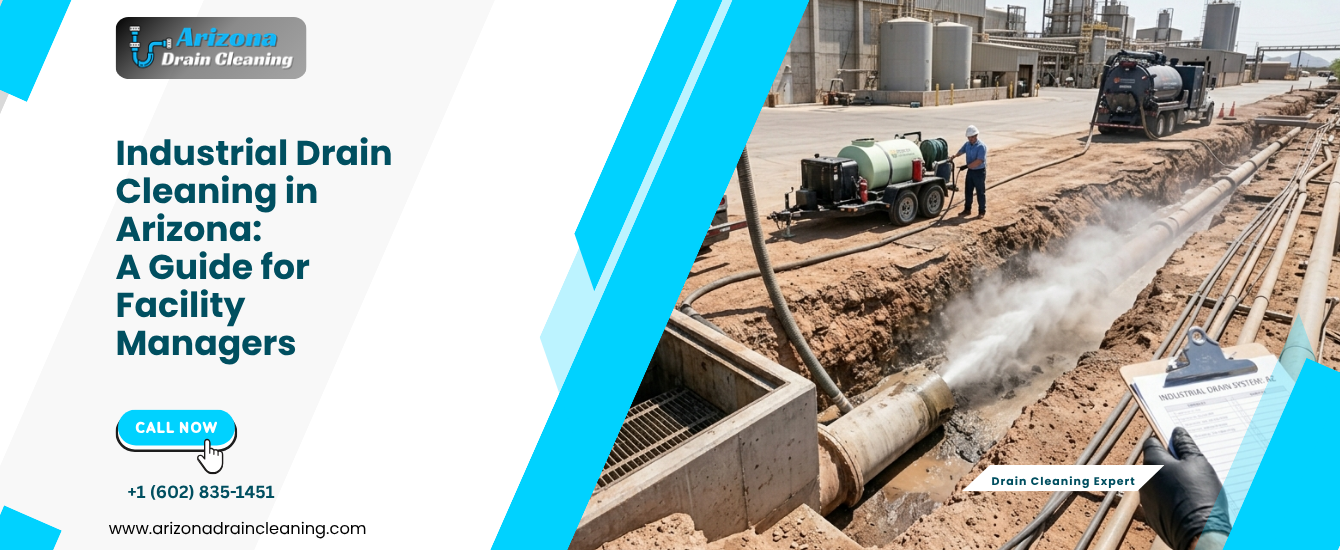
Industrial hydro jetting operates at pressures and flow rates that are substantially higher than residential or standard commercial jetting equipment to address the pipe diameters, accumulation densities, and line lengths encountered in industrial facilities. Where residential hydro jetting typically operates at 1,500 to 4,000 PSI, industrial jetting equipment for large-diameter main drain lines and main sewer connections may operate at 4,000 PSI or higher with significantly higher flow rates that generate the fluid momentum needed to carry dislodged material through long runs of large-diameter pipe to the outlet.
Specialized nozzle configurations for industrial applications include rotating nozzles that provide 360-degree coverage of large-diameter pipe interiors, penetrating nozzles for breaking through compacted sediment deposits, root-cutting nozzles for addressing root intrusion in main lines, and chain flail nozzles for removing hardened mineral scale and stubborn accumulation from pipe walls. The selection of nozzle configuration for a specific industrial drain cleaning application depends on the accumulation type identified during camera inspection, the pipe material and diameter, and the specific location and access conditions at the facility.
Industrial Vacuum Excavation and Sump Cleaning
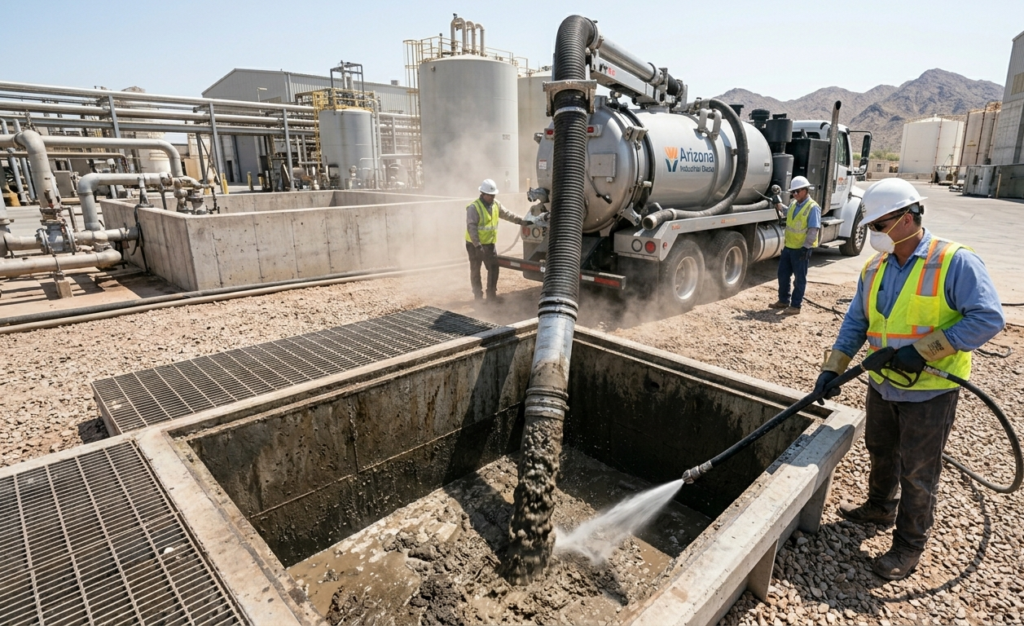
For industrial drain sumps, lift station wet wells, and below-grade collection structures that require cleaning of accumulated sediment, sludge, or process material, vacuum truck equipment with industrial capacity provides the extraction capability needed for the volumes involved. Industrial vacuum trucks combine high-vacuum suction with water injection capability to loosen compacted material and extract the resulting slurry, which is stored in the tank for transport to an approved disposal or processing facility.
For facilities with sumps containing petroleum-contaminated waste, the extracted material may require disposal as regulated waste rather than as general liquid waste. The service provider must be licensed for the transport and disposal of any regulated waste streams encountered during industrial sump cleaning. Facility managers should confirm disposal documentation and waste manifests as part of the service completion record.
Sludge Removal for Industrial Drain Systems
Biological sludge in industrial drain systems, particularly in food processing facilities and chemical operations where organic material creates conditions favorable to bacterial colonization, requires physical removal followed by appropriate treatment to reduce re-accumulation rates. Industrial-scale sludge removal combines vacuum extraction of accumulated biological material with enzymatic treatment or biocide application depending on the specific drain environment and the regulatory constraints on what can be discharged through the drain system.
For food processing facilities operating under FDA and USDA food safety programs, the selection of any treatment compounds applied to drain systems must be confirmed compatible with the facility’s food safety program requirements and must not create a food safety risk from treatment compound exposure in drain areas adjacent to production.
Building an Industrial Drain Maintenance Program for Arizona Facilities
Risk-Based Maintenance Prioritization
Not every drain in an industrial facility carries the same production risk or accumulation rate. An effective industrial drain maintenance program begins with a risk-based assessment that identifies the drains whose failure would have the most significant operational impact, the drains that receive the highest waste loads and therefore accumulate the fastest, and the drains that serve areas with the strictest regulatory compliance requirements.
The highest-priority drains in most industrial facilities are the main floor drain collectors serving active production areas, the sumps beneath production equipment wash-down stations, the drains serving regulated chemical handling or storage areas, and any drain whose failure would trigger an immediate production shutdown or environmental compliance event. These drains warrant the most frequent inspection and service intervals and the highest attention in the maintenance scheduling process.
Secondary-priority drains including utility area floor drains, employee restroom facilities, break room and kitchen drains, and loading dock area drains require regular service but at intervals calibrated to their lower accumulation rates and lower operational impact if they slow or back up.
Service Interval Framework for Arizona Industrial Facilities
The appropriate cleaning interval for each drain category depends on the waste load, the pipe diameter and configuration, the accumulation rate observed during camera inspection, and Arizona’s specific hard water conditions that add mineral scale accumulation to every drain regardless of the industrial waste stream it receives.
For high-load production area drains in food processing, chemical processing, and heavy manufacturing, quarterly floor drain cleaning by hydro jetting is the appropriate minimum interval. Very high-load drains in food processing operations with significant organic waste should be considered for monthly or bimonthly service. Main collector lines serving production areas warrant semi-annual camera inspection combined with hydro jetting when accumulation warrants it. Industrial sump cleaning should be scheduled based on sump fill rate observation, with most manufacturing sumps requiring annual or semi-annual service.
Scheduling Around Production Constraints
Industrial drain cleaning service in a functioning facility must be coordinated with production scheduling to minimize impact on operations. The preferred approach for major cleaning activities including main line hydro jetting and sump cleaning is to schedule service during planned production downtime, maintenance windows, holiday shutdowns, or shift change periods when the affected production areas are not operating.
For facilities with continuous production operations that do not have scheduled downtime windows, partial-area cleaning that addresses one section of the facility while the remainder continues to operate, combined with appropriate containment of cleaning activities to prevent cross-contamination of active production areas, is the practical approach. Facility managers should work with their maintenance and production scheduling teams to identify the least-impact windows for drain service and communicate those windows to the service provider well in advance to ensure scheduling availability.
Developing a relationship with a professional drain service provider who understands industrial facility scheduling constraints and can commit to specific service windows, including after-hours and weekend availability for facilities that can only accommodate drain work outside normal production hours, is one of the most operationally valuable aspects of an industrial drain maintenance program.
Documentation for Regulatory Compliance
Every industrial drain service at a regulated facility should be documented with the service date, the specific drains serviced, the method used, the volume and nature of material extracted, any observations about drain condition that affect compliance posture, and the disposal documentation for any regulated waste streams removed from the facility. This documentation supports both the facility’s environmental compliance records and its internal maintenance management system.
For facilities subject to the City of Phoenix Industrial Pretreatment Program, Maricopa County stormwater regulations, AZPDES permit requirements, or federal categorical pretreatment standards, the drain maintenance documentation is part of the compliance record that may be subject to inspection by regulatory agencies. Maintaining complete and accurate service records for all drain cleaning activity is not a bureaucratic exercise. It is a compliance obligation that protects the facility from enforcement actions based on incomplete records.
Warning Signs That Demand Immediate Industrial Drain Service
Drain Backup During Production Operations
Any floor drain backup that occurs during active production operations is a situation requiring immediate response. Standing water on a production floor creates a slip and fall hazard that OSHA regulations require be addressed before workers can safely continue operations in the affected area. In food processing facilities, standing water in a production area creates a potential product contamination situation that may require production line sanitization before restart. A production backup is not a situation to address at the next scheduled maintenance visit. It requires an emergency drain cleaning services call to a provider capable of responding to industrial scale drain situations promptly.
Odors from Drain Areas in Food Processing or Chemical Facilities
Persistent drain odors in food processing facilities indicate biological accumulation that creates product contamination risk and may trigger regulatory concern under the facility’s food safety plan. In chemical processing facilities, drain odors may indicate that volatile compounds are venting from the drain system into the work environment, creating both an air quality and a worker safety concern. Either situation requires professional assessment and cleaning rather than masking with deodorizing products that address the symptom without the cause.
Slow Drainage Across Multiple Floor Drains Simultaneously
Multiple floor drains in the same production area showing slow drainage simultaneously indicates a problem in the main collector line serving that area rather than in individual branch drains. A main collector that is significantly restricted creates a cascading slow drain effect across every floor drain connected to it. This situation will typically worsen rapidly as production wash-down continues to add load to an already restricted main line, and it should trigger a priority service call rather than a routine maintenance schedule.
Unexplained Changes in Process Drain Flow Patterns
In facilities with instrumented drain systems or lift stations, unexplained changes in flow rates, pump cycle frequency, or sump fill rates that cannot be explained by changes in production volume or process water use may indicate developing restriction in the drain infrastructure. Proactive investigation of these instrumentation signals, including camera inspection to assess pipe condition, can identify developing accumulation before it progresses to a failure event.
Industry-Specific Considerations for Arizona Industrial Facilities
Aerospace and Defense Manufacturing
Arizona is one of the most significant aerospace manufacturing states in the country, with major facilities including Boeing in Mesa, Honeywell Aerospace in Phoenix and Tucson, Raytheon in Tucson, L3Harris in Greenville, General Dynamics in Scottsdale, and numerous precision manufacturing suppliers throughout the Valley. Aerospace manufacturing drain systems receive specialized coatings, metalworking fluids, solvent cleaning compounds, and in some cases, materials with specific regulatory handling requirements under hazardous materials regulations.
Industrial drain cleaning in aerospace manufacturing facilities requires service providers who understand the facility’s specific regulatory environment, who can confirm that cleaning methods and any chemical treatments are compatible with the facility’s environmental permits, and who have the documentation and certification capabilities to support aerospace facility maintenance record requirements.
Semiconductor and Electronics Manufacturing
Arizona’s semiconductor industry, anchored by the TSMC fabrication facility in north Phoenix and the broader semiconductor supply chain concentrated in the Chandler, Mesa, and Tempe technology corridors, operates drain systems that receive highly pure process water reject streams, chemical mechanical planarization slurries, and specialized cleaning chemical waste that carries specific pretreatment and disposal requirements.
Drain cleaning in semiconductor and electronics manufacturing facilities requires coordination with the facility’s environmental engineering team to ensure that cleaning activities do not create pretreatment compliance events and that cleaning service providers meet the facility’s vendor qualification requirements for work in cleanroom-adjacent and chemically sensitive areas.
Food and Beverage Processing
Arizona’s food and beverage manufacturing sector, including dairy processing facilities in the Phoenix area, large-scale produce processing operations, meat and poultry processing, and beverage manufacturing, operates under FDA and in some cases USDA regulatory oversight that extends to the sanitation of drain systems in production areas. Kitchen drain cleaning methods and products used in food processing drain systems must be appropriate for use in food contact adjacent environments.
Industrial drain cleaning in food processing facilities typically occurs during scheduled sanitation downtime rather than during production, and the cleaning must be followed by appropriate sanitation of drain bodies and grates before production restart. The coordination between the facility’s food safety team and the drain service provider to ensure that cleaning activities support rather than compromise the facility’s food safety program is an essential element of industrial drain service in this sector.
Automotive Manufacturing and Service
Arizona’s automotive sector includes vehicle assembly operations, automotive parts manufacturing, automotive glass manufacturing, and the extensive automotive service and fleet maintenance operations supporting the Valley’s transportation infrastructure. These operations generate petroleum-contaminated drainage from coolants, lubricants, hydraulic fluids, and fuel spills that require appropriate handling during drain cleaning to prevent regulated petroleum waste from being discharged improperly.
Sewer line cleaning and floor drain maintenance at automotive facilities should include confirmation that petroleum-containing material extracted from drains and sumps is handled as regulated waste and disposed of through a licensed petroleum waste disposal contractor rather than discharged to the sewer system.
Frequently Asked Questions
How is industrial drain cleaning different from commercial drain cleaning?
Industrial drain cleaning differs from commercial cleaning in three fundamental ways: the waste streams are more diverse and often regulated, requiring specific compliance coordination before and after cleaning; the infrastructure is larger in pipe diameter, sump volume, and line length, requiring equipment sized for industrial applications; and the consequence of drain failure during production is categorically more serious, involving production shutdown, worker safety, and potential environmental compliance events rather than the operational inconvenience that a commercial drain backup creates. Industrial drain service providers need industrial-scale equipment, confined space entry capability, and understanding of industrial regulatory environments that standard commercial drain services do not necessarily possess.
What regulatory requirements apply to industrial drain cleaning in Arizona?
Industrial facilities in Arizona must comply with ADEQ and AZPDES stormwater program requirements, City of Phoenix or applicable municipality industrial pretreatment program requirements if discharging to the municipal sewer system, OSHA confined space entry requirements for any work in drain sumps or manholes, and any applicable federal categorical pretreatment standards for the specific industrial category of the facility. The specific regulatory obligations depend on the facility type, location, and the nature of the waste streams the drain system receives.
How often should industrial floor drains be cleaned in an Arizona manufacturing facility?
The appropriate interval depends on the waste stream, pipe diameter, and operational intensity. High-load production area drains receiving significant process fluid or organic waste should be cleaned quarterly at minimum. Main collector lines serving production areas warrant semi-annual camera inspection with cleaning as indicated. Hard water mineral scale accumulation in Arizona adds to every drain’s cleaning requirement regardless of the industrial waste load. Annual at minimum for lower-load secondary drains, with more frequent service for production-critical drain locations. A camera inspection baseline assessment provides the specific condition data needed to set appropriate service intervals for each drain category in a specific facility.
What should a facility manager do when a floor drain backs up during production?
Stop using the affected area for wash-down activities, assess whether the backup involves regulated waste that creates an immediate environmental compliance notification obligation, establish worker safety controls for the affected floor area, and contact an industrial drain cleaning service with emergency response capability. Document the time, nature, and affected area of the backup for both safety and regulatory compliance records. After the emergency is resolved, conduct a root cause assessment to determine whether the backup resulted from deferred maintenance that a scheduled program would have prevented.
Can industrial drain cleaning create an environmental compliance problem?
Yes, if not properly coordinated. Mobilizing accumulated petroleum, heavy metals, or other regulated materials from industrial drain pipes through high-pressure jetting can create a discharge to the sewer system that exceeds pretreatment permit limits if the concentration of mobilized material in the discharge exceeds permit thresholds. Coordinating with the facility’s EHS team before scheduling major drain cleaning activities, and potentially requesting that the service be performed in sections with appropriate settling time between sections to manage discharge concentrations, is the responsible approach for facilities with regulated industrial wastewater discharges.
What documentation should a facility manager maintain for industrial drain cleaning?
Service records should include the date and duration of service, the specific drains serviced, the cleaning method used, the volume and characterization of material extracted, waste disposal documentation including manifests for any regulated waste, any camera inspection reports with footage documentation, observations about drain condition relevant to compliance posture, and any follow-up recommendations from the service provider. This documentation supports both internal maintenance management and regulatory compliance recordkeeping for facilities subject to industrial pretreatment, stormwater, or hazardous waste program requirements.
The Bottom Line on Industrial Drain Cleaning in Arizona
Industrial drain cleaning in Arizona is not a service that can be deferred until production impact forces the issue without eventually creating costs, compliance exposures, and infrastructure damage that dwarf the preventive maintenance investment that would have kept the system functional. Arizona’s combination of hard water mineral accumulation, extreme summer heat that affects grease and organic material behavior inside pipes, and the aging industrial infrastructure in many of the Valley’s established manufacturing districts creates an industrial drain environment that rewards proactive maintenance and punishes deferred action with compounding severity.
The facility managers who manage industrial drain maintenance most effectively treat it as a compliance and operational continuity program rather than a reactive maintenance cost. They baseline their system with camera inspection, they set service intervals calibrated to their specific waste streams and Arizona’s water conditions, they schedule service around production constraints rather than waiting for failure to force the issue, and they maintain the documentation that supports both their internal maintenance programs and their regulatory compliance posture.
Arizona Drain Cleaning provides industrial-scale pipe inspection with video camera, hydro jetting, floor drain cleaning, sludge removal, sewer line cleaning, trenchless drain repair, and emergency drain cleaning services for industrial and manufacturing facilities throughout Phoenix, Mesa, Chandler, Tempe, Gilbert, Glendale, Peoria, Surprise, Goodyear, Tucson, and across Arizona. Contact us to schedule an industrial drain assessment or to discuss a maintenance program designed for your facility’s specific operational and compliance requirements.