
Drain cleaning in Peoria, AZ means something different depending on which part of this fast-growing city you live in, and Arizona Drain Cleaning knows every corner of it. Peoria is one of the most geographically and demographically diverse cities in the entire Northwest Valley, stretching from the historic blocks of Old Town in the south, where homes from the 1950s and 1960s sit on original drain infrastructure that has been accumulating decades of mineral scale and organic buildup, all the way through the master-planned luxury communities of Vistancia, Westwing Mountain, and the Lake Pleasant corridor in the north, where newer construction meets the same relentless hard water, aggressive root growth, and caliche soil that challenges every plumbing system in the Phoenix metro regardless of age.
If you are a Peoria homeowner dealing with a slow kitchen drain, a bathroom that gurgles when another fixture runs, a main sewer line that has backed up, or a drain that has been getting progressively worse for months despite multiple attempts to fix it, this guide is written for you. It explains exactly what is driving drain problems in Peoria’s specific environment, what the right solution looks like for different neighborhoods and property types, and what you can expect from Arizona Drain Cleaning when you call us: honest diagnosis, honest pricing, and the work that actually needs to be done.
Why Peoria Drains Need a Different Approach Than Most of the Country
Peoria’s drain maintenance reality is shaped by three converging forces that do not exist in the same combination anywhere else: extremely hard water from a blended CAP and SRP supply, irrigation-heavy landscaping that feeds aggressive root systems, and a city that grew so rapidly over the past three decades that radically different housing vintages share the same zip codes and sometimes the same streets. Understanding each of these forces is the foundation for understanding why your drain problem exists and what will actually fix it.
Peoria’s Water Is Extremely Hard and It Affects Every Drain in Your Home
The City of Peoria’s water utility blends surface water from the Colorado River delivered through the Central Arizona Project, water from the Salt and Verde Rivers through the Salt River Project, and groundwater from local wells. This blended supply ensures reliable delivery across one of Arizona’s fastest-growing cities, but it creates a water quality profile that is notoriously aggressive on plumbing systems. Hardness levels across Peoria’s distribution system typically range from 16 to 22 grains per gallon depending on the specific service zone and seasonal supply adjustments. To put that in context, water is classified as “hard” at anything above 7 grains per gallon and “very hard” above 10.5 grains per gallon. Peoria’s water is double that upper threshold at its median.
What does 16 to 22 grains per gallon mean for your drain pipes? Every gallon of water flowing through your drain system carries dissolved calcium and magnesium that deposits on the interior walls of the pipe as it passes through. In supply-side pipes and appliances, these minerals form the familiar white scale that coats showerheads, reduces water heater efficiency, and leaves spots on glassware. In drain lines, the same minerals combine with soap, shampoo, dish detergent, and cleaning products to form a compound that behaves very differently from these products in soft water environments. Rather than rinsing cleanly, soap in Peoria’s hard water reacts with dissolved calcium and magnesium to form a waxy, sticky residue that coats the interior walls of drain pipes.
This mineral-soap compound is not just an aesthetic issue inside your pipes. It is the adhesive surface that catches every other substance flowing through the drain alongside it. Hair catches on it in bathroom drains. Grease adheres to it in kitchen lines. Food debris, coffee grounds, and organic particles all stick to the rough, scaled surface rather than passing through to the sewer. The result is a drain pipe whose effective interior diameter narrows progressively over months and years until what was once a four-inch main line is functionally behaving like a two-inch line. Many Peoria homeowners experience a sudden-seeming clog that is actually the final stage of a years-long accumulation process reaching its tipping point.
The critical implication of this for drain cleaning in Peoria is that chemical drain products cannot address the underlying problem. They dissolve some organic material temporarily and may restore partial flow, but they do nothing to remove the mineral scale from the pipe walls. The rough, scaled surface remains in place, ready to catch the next accumulation cycle, and the drain slows again within weeks or months. Professional hydro jetting is the only method that physically removes the mineral-soap coating from the pipe interior and restores the smooth surface that allows everything to flow cleanly through.
Peoria’s Irrigation Culture Creates Active Root Intrusion Risk
Peoria is not a city that tolerates brown landscaping. The master-planned communities of Vistancia, Westwing Mountain, Fletcher Heights, Arrowhead Ranch, Trilogy, and Coldwater Ranch all maintain green, well-irrigated landscapes as a core part of their community character. Golf courses at the Peoria Sports Complex area and throughout the city’s planned communities operate sophisticated irrigation systems year-round. Individual homeowners maintain drip irrigation systems that keep desert-adapted trees, ornamental shrubs, and in many neighborhoods grass, well-watered through Arizona’s long dry seasons.
All of that irrigation creates something that most Peoria homeowners do not think about: well-developed, actively growing root systems in the landscaping immediately surrounding their homes. Those root systems grow toward moisture sources, and the most reliable moisture source in any residential yard is the sewer lateral running from the house to the municipal sewer main at the street. Sewer lines carry wastewater continuously, and any joint or connection point in the pipe that allows moisture to seep into the surrounding soil creates exactly the signal that root systems follow.
In Peoria’s newer PVC sewer systems installed with properly seated watertight joints, root intrusion is less likely but not impossible, particularly if construction activity disturbed the ground around the sewer lateral during development and the backfilled soil settled differently from the surrounding undisturbed desert ground. In older South Peoria and Old Town properties with cast iron or clay tile sewer lines, the multiple joints in these pipe systems provide numerous potential entry points that root systems in mature landscaping can find and exploit over time.
The Westwing Mountain neighborhood is a specific example worth noting. Its proximity to the Sonoran Desert foothills means natural desert wash patterns intersect with residential drainage infrastructure in ways that create unique conditions during monsoon events, and the established landscaping in this community has been developing since the mid-2000s, giving root systems nearly two decades to grow toward underground moisture sources including sewer laterals.
Caliche Soil, Ground Movement, and What It Does to Underground Pipes
Peoria sits on caliche-bearing desert soil throughout much of its urban footprint. Caliche is a calcium carbonate hardpan layer that creates rigid underground conditions resistant to digging and construction, and it transfers physical stress to buried pipes differently than softer, more yielding soils. When Peoria’s monsoon season brings intense, concentrated rainfall that saturates the soil rapidly before the desert heat dries it out just as fast, the expansion and contraction cycle that results puts ongoing physical stress on underground pipe joints throughout the city.
Over years and decades, this repeated stress cycling can cause pipe joints to shift slightly out of alignment, partially separate, or in some cases develop small cracks that allow soil infiltration into the line. These conditions do not cause immediate dramatic symptoms. They develop gradually and are typically discovered during a camera inspection performed because a homeowner noticed recurring slow drains or a pattern of problems that suggests something more than simple surface blockage is involved.
For older Old Town Peoria properties where sewer laterals have been in the ground since the Eisenhower administration, decades of caliche soil stress cycling have had real and cumulative effects on the underground pipe infrastructure. This is not a reason to panic. It is a reason to know what is actually inside your pipe before a preventable structural problem becomes an emergency repair situation.
Peoria by Neighborhood: What Your Drain System Is Actually Dealing With
Old Town Peoria and the 83rd Avenue Corridor
Old Town Peoria and the surrounding south Peoria neighborhoods represent the city’s original residential footprint. Homes here were built primarily during the 1950s through the 1970s using the pipe materials standard for those decades. Cast iron sewer laterals and, in some properties, galvanized steel drain lines are present throughout this older housing stock. Cast iron corrodes internally over decades, creating a progressively rougher, narrower pipe interior that accumulates mineral scale, grease, and debris significantly faster than a smooth PVC interior would. Galvanized steel suffers from the same internal deterioration and carries the additional challenge of releasing rust particles that compound blockages in the lines downstream.
Homes in Old Town Peoria and the 83rd Avenue corridor that have never had their sewer lines professionally inspected or cleaned are carrying infrastructure in an unknown condition. A camera inspection is the only way to find out what is actually inside the pipe, whether the material warrants cleaning or whether some structural deterioration has developed that should be addressed before cleaning is performed. Arizona Drain Cleaning approaches older Old Town properties with a camera inspection first and recommendations that reflect what the pipe actually shows, not what a service menu suggests.
Vistancia: Where Newer Construction Meets Hard Water Reality
Vistancia, in north Peoria, is among the most ambitious master-planned community developments in Arizona, with homes built primarily from the mid-2000s onward featuring modern PVC sewer systems, contemporary fixture packages, and the kind of large, open-concept kitchen layouts that generate significant grease output from active family cooking. The PVC pipe materials in Vistancia are corrosion-resistant and more root-intrusion-resistant at properly sealed joints than the older materials in South Peoria.
But Vistancia homeowners often operate under a false assumption that newer construction means the drain system does not need professional attention. The reality is that Peoria’s 16 to 22 grains per gallon water supply has been depositing mineral-soap accumulation inside Vistancia’s drain lines with every use cycle since the homes were first occupied. A Vistancia kitchen drain in a home built in 2008 and never professionally cleaned has 15 to 17 years of mineral-soap accumulation on its pipe walls. That accumulation does not care what year the house was built.
Vistancia kitchen drains and main sewer lines in homes with active family households are among the most commonly serviced drain systems. Arizona Drain Cleaning is handled in Peoria. The pattern is consistent: homeowners in well-maintained newer homes start noticing the kitchen drain slowing, try a chemical product that provides brief temporary improvement, and eventually call a professional when the problem becomes persistent. The professional service reveals what the chemical product was never going to fix: a pipe interior coated with years of hard water mineral-soap accumulation that requires hydro jetting to remove.
Westwing Mountain and Fletcher Heights
Westwing Mountain sits in the foothills of the Sonoran Desert in northwest Peoria, with homes built during the late 1990s and 2000s in a topographically varied landscape that creates unique drainage conditions. The hillside and foothill character of this neighborhood means elevation changes affect how underground pipes are positioned and how surrounding soil behaves during rainfall events. Natural desert washes that intersect with the neighborhood can redirect significant water volumes during monsoon events toward residential drainage infrastructure not designed for those flows, and the established landscaping in Westwing Mountain has been growing for 20 to 25 years.
Fletcher Heights is a family-oriented community with homes ranging from the late 1980s through the 2000s. Kitchen drains in active Fletcher Heights households with high cooking volumes are a consistent service call category for Arizona Drain Cleaning. The combination of hard water mineral accumulation and grease from regular family cooking creates a progressive restriction profile in kitchen branch lines that chemical products cannot resolve and that snaking addresses only temporarily without clearing the pipe wall accumulation that drives the recurrence.
Arrowhead Ranch and the Peoria-Glendale Boundary Communities
Arrowhead Ranch straddles the Peoria-Glendale boundary and shares the drainage conditions common to both cities: homes primarily from the late 1980s through the early 2000s, established mature landscaping with well-developed root systems, hard water accumulation in drain lines approaching or past 25 years of buildup, and the occasional older cast iron or early PVC sewer system in properties at the older end of the development period.
Root intrusion is a specific concern for Arrowhead Ranch properties with mature landscaping. The community’s established trees, including species like Eucalyptus, Chinese Elm, and Ash that are common in Valley communities developed during this era, have root systems that have been growing for 25 to 35 years. Camera inspection of main sewer lines in Arrowhead Ranch properties with dense mature landscaping close to the sewer lateral is a sound preventive investment that identifies any developing root entry before it progresses to a complete blockage requiring emergency service.
Trilogy, Coldwater Ranch, and North Peoria Golf Course Communities
The golf course communities of north Peoria, including Trilogy at Vistancia, Coldwater Ranch, and properties in the Lake Pleasant corridor, combine active irrigation infrastructure, newer residential construction, and the particular water quality profile of Peoria’s northernmost distribution zones. Golf course irrigation systems operate year-round at volumes that maintain intensely green fairways and landscaping in a desert environment, and the root systems of plants maintained by that irrigation are correspondingly well-developed and moisture-seeking.
Drain cleaning service calls in these communities tend to involve newer PVC systems that are in good structural condition but experiencing accumulation-driven restriction from hard water mineral-soap buildup in kitchen and bathroom drain lines, and in some properties, early-stage root tendrils at sewer lateral joints from maturing landscaping that is now reaching the age where underground root exploration becomes meaningful.
The Drain Services Arizona Drain Cleaning Provides Throughout Peoria
Standard Drain Snaking for Sinks, Tubs, Showers, and Toilets
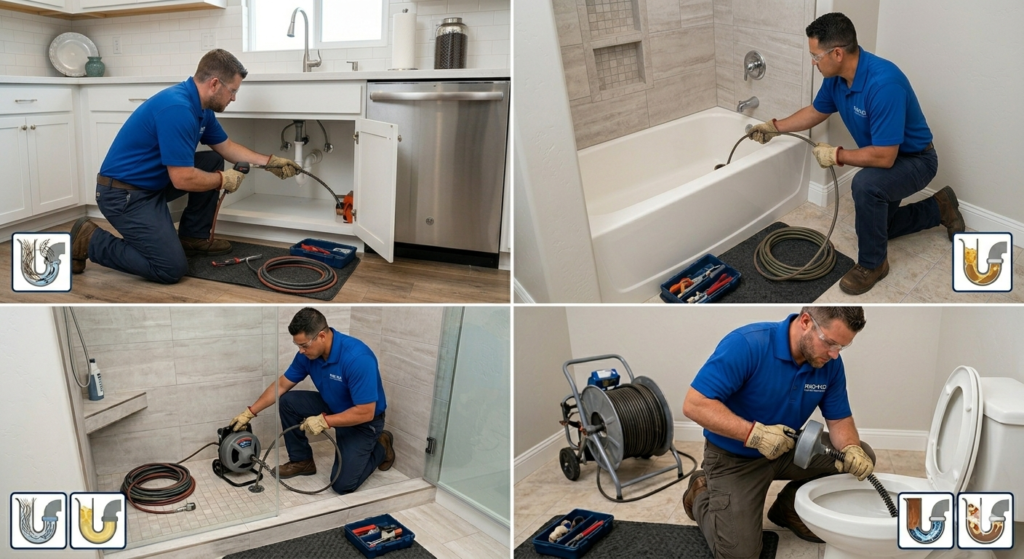
When a single fixture drain blocks acutely, a kitchen sink that was draining fine yesterday and is completely blocked today, mechanical drain snaking is the appropriate first-line response. A cable machine with the right cable diameter for the specific fixture and pipe size clears the localized blockage at its location and restores flow without the additional time and cost of a full hydro jet service.
The distinction that matters for Peoria homeowners is between an acute sudden blockage and a chronic, progressive, slow drain. An acute blockage in a previously well-functioning fixture is a snaking candidate. A drain that has been getting progressively slower over months, that has had the same problem recur repeatedly after prior snaking, or that is slow in multiple fixtures throughout the house simultaneously, is an accumulation problem that mechanical snaking will relieve temporarily but not resolve. That is a hydro jetting situation.
Hydro Jetting for Peoria’s Hard Water and Grease Buildup: The Method That Actually Works
Hydro jetting is the drain cleaning method that Arizona Drain Cleaning uses for chronic Peoria drain problems, and it is the method that delivers results that last measurably longer than snaking for the specific type of accumulation that Peoria’s hard water environment produces. The process uses a specialized nozzle attached to a high-pressure water supply, typically operating at pressures between 1,500 and 4,000 PSI depending on the pipe diameter and the nature of the blockage, to scour the interior walls of the pipe and flush all accumulated material completely out of the line toward the municipal sewer connection.
The nozzle design for hydro jetting is specifically engineered to direct water both forward through the blockage and backward against the pipe walls simultaneously, cleaning the full circumference of the pipe interior as it advances through the line. The result after a professional hydro jet service is a pipe interior that is clean, smooth, and restored to something close to its original flow capacity. The mineral-soap coating, the grease film, the biofilm layer, and any organic debris that had been narrowing the line are physically removed and flushed out, not pushed further down the pipe.
For a Peoria home where hard water has been accumulating on drain walls for 10, 15, or 20 years, the difference in flow after a professional hydro jet service compared to after a mechanical snake run is dramatic and immediately noticeable in everyday drain performance. The difference in how long the result lasts is equally dramatic, because clean pipe walls do not accumulate new material at the same rate as scaled, rough pipe walls. The smooth surface after jetting allows material to pass through rather than catching and building up.
Main Sewer Line Cleaning for Peoria Homes
When a Peoria homeowner notices that multiple drains throughout the house are slow or backed up at the same time, or hears a toilet gurgle when the washing machine drains, or sees water appearing at a floor drain when another fixture is in use, the cause is almost certainly in the main sewer line rather than in any individual fixture branch. These symptoms reflect a restriction or blockage in the single drain pipe that carries all of the home’s wastewater to the municipal connection, and they require main sewer line service, not fixture-level cleaning.
Main sewer line service in a Peoria home begins with accessing the exterior sewer cleanout, which in most properties built from the late 1980s onward is a double cleanout configuration located near the foundation. For older Old Town and South Peoria properties that predate the cleanout installation requirements in current plumbing code, the access point may need to be located through electronic pipe-tracing equipment, or the line may need to be accessed through a roof vent or toilet connection if no accessible cleanout exists.
A camera inspection before cleaning on the main sewer line confirms the nature of the restriction, the pipe’s structural condition, and whether the appropriate cleaning method is mechanical, hydro jetting, or a combination of both. After the cleaning, a post-service camera verification confirms the line is clear from end to end and provides documentation of the result.
Camera Inspection for Recurring Peoria Drain Problems
A video camera inspection of the Peoria home’s main sewer line is the single most valuable diagnostic investment available for any homeowner experiencing drain problems that return repeatedly after cleaning, for anyone buying or selling a home in Peoria and wanting accurate information about the sewer system’s condition, or for any property owner who simply wants to know what is actually inside their underground pipes before something forces the question.
The camera inspection involves feeding a high-definition waterproof camera through the sewer line from the cleanout access point. Real-time footage reveals the pipe material, the extent of scale and organic accumulation on the pipe walls, whether root intrusion is present at any joint and how developed it is, the alignment condition of pipe joints throughout the line, and whether any structural damage such as cracking or joint separation has occurred from soil movement or pipe deterioration. An above-ground electronic locating device marks the position of any problem areas in the yard so their location is precisely documented for any future repair work.
For Vistancia, Westwing Mountain, and other established Peoria master-planned communities where PVC sewer systems and mature irrigation-fed landscaping coexist, a camera inspection every two to three years is a sensible preventive approach. It costs far less than an emergency main line response and catches developing root intrusion at a stage where rooter service or hydro jetting can clear it cleanly rather than discovering a complete root blockage during a backup event.
Root Cutting and Clearing for Peoria Properties
Root intrusion in Peoria sewer lines cannot be addressed with a standard drain snake. The cable machine that clears a grease accumulation or an organic blockage does not have the cutting capacity to work through a root mass without appropriate root-cutting attachments. Arizona Drain Cleaning uses both mechanical root-cutting cable equipment for initial root mass removal and hydro jetting with root-cutting nozzle configurations to clear root material and clean the pipe section affected by the intrusion.
After root clearing, the camera inspection of the cleared line documents the joint condition at the root entry points. Joints where roots have been growing for an extended period may show evidence of widening or minor structural damage that warrants monitoring or eventual repair. Knowing the condition of those joints after clearing is important information for planning the maintenance interval for the next inspection, since a joint that allowed root entry once will allow it again as root growth resumes toward the sewer line’s moisture.
Same-Day Scheduling for Most Peoria Service Calls
Arizona Drain Cleaning covers the complete Peoria service area from Old Town and the 83rd Avenue corridor through Vistancia, Westwing Mountain, Fletcher Heights, Arrowhead Ranch, Coldwater Ranch, Trilogy, and the Lake Pleasant communities in north Peoria. For most standard residential drain cleaning calls, same-day scheduling is available. Emergency service is available for situations that cannot wait, including main line backups producing sewage inside the home. Call (602) 835-1451.
What Honest Drain Cleaning Service Looks Like in Peoria
The experience Arizona Drain Cleaning delivers in Peoria starts with a real conversation, not a scripted upsell. When you call, we ask focused questions about what you are experiencing: which fixtures are affected, whether the problem is isolated to one drain or appearing throughout the house, how long the situation has been developing, whether you have had prior service at this property, and whether there is any history of tree-related drain problems. These questions let us understand the situation accurately and arrive with the right equipment rather than making multiple trips.
We provide an honest estimate before any work begins. The estimate reflects the work actually needed for the specific situation your property presents, not a package built around what generates the highest invoice. We do not add line items after service that were not part of the discussion before it started. We do not charge travel fees. We do not manufacture urgency around problems that genuinely allow time for a thoughtful decision.
After service is complete, the technician walks through what was found, what was done, and any observations or recommendations worth knowing about before leaving your property. If the camera inspection found a condition that deserves monitoring or eventual repair, we explain it in plain language, describe the timeline implications honestly, and let you make an informed decision without pressure.
Commercial Drain Cleaning in Peoria: Restaurants, Retail, and Multi-Tenant Properties
Peoria’s commercial footprint has grown substantially alongside its residential population, with significant restaurant and food service density along the Loop 101 and Bell Road corridors, retail and commercial development serving the master-planned community populations throughout the city, multi-tenant residential buildings in south and central Peoria, and commercial facilities associated with the Peoria Sports Complex and surrounding areas.
Commercial drain cleaning in Peoria requires a different approach from residential service in several important ways. Restaurant kitchen drain lines generate grease volumes that exceed what residential kitchen lines carry by a significant margin, and addressing grease accumulation in a commercial kitchen drain line requires professional-grade hydro jetting equipment and, in many cases, regular scheduled service rather than reactive response. Grease trap maintenance for Peoria food service operations is a regulatory compliance obligation under the Arizona Department of Environmental Quality’s pretreatment standards and the City of Peoria’s local FOG control requirements.
Commercial properties also require scheduling that accommodates operational hours. A restaurant kitchen drain service cannot disrupt the dinner service rush. A multi-tenant residential building’s main sewer line cannot be taken out of service during peak occupancy hours without coordination. Arizona Drain Cleaning schedules commercial service in Peoria around operational needs, provides service documentation appropriate for property management files and compliance records, and delivers the professional-grade equipment and technician experience that commercial drain systems require.
Frequently Asked Questions
Why do my Peoria drains keep getting slow even after I use store drain cleaners?
Chemical drain cleaners dissolve some organic material at the point of contact, which is why they sometimes provide a few days or weeks of improved flow. But they do not remove the mineral scale from the interior walls of your drain pipes, and in Peoria’s hard water environment, that scale is the root cause of chronic drain restriction. The rough, scaled surface on the pipe walls catches new material immediately after the chemical product clears a temporary path, and the drain slows again on the same timeline as before. Professional hydro jetting physically removes the scale coating from the pipe walls and restores the smooth surface that allows material to flow through rather than accumulate. That is the difference between temporary relief and a result that actually lasts.
Is drain snaking the same as hydro jetting and which one does my Peoria home need?
They are fundamentally different methods that produce different results. Snaking uses a rotating cable to punch a mechanical path through a blockage without contacting the pipe walls. Jetting uses high-pressure water to scour the interior walls of the pipe clean. Snaking is the right tool for an acute sudden blockage in a fixture that was previously functioning well. Jetting is the right tool for any drain that has been progressively slowing over months, any drain where the same problem has recurred after prior snaking, and any main sewer line due for preventive maintenance in Peoria’s hard water environment. For most chronic slow drain situations in Peoria homes, particularly those more than seven to ten years old without prior professional service, hydro jetting delivers results that snaking simply cannot match.
How do I schedule same-day drain service in Peoria?
Call Arizona Drain Cleaning at (602) 835-1451. We cover the full Peoria service area including Old Town, Vistancia, Westwing Mountain, Fletcher Heights, Arrowhead Ranch, Coldwater Ranch, Trilogy, and north Peoria communities near Lake Pleasant. Same-day scheduling is available for most standard residential drain cleaning calls. Emergency service for main line backups and sewage situations receives priority response.
My Peoria home is only 10 to 12 years old. Does it really need professional drain cleaning?
Yes, for specific reasons related to Peoria’s water quality. Ten to twelve years of Peoria’s 16 to 22 grain per gallon water flowing through your drain lines has been depositing mineral-soap accumulation on your pipe walls with every use cycle throughout that period. The age of the construction does not stop the hard water accumulation process. Homes in Vistancia, Westwing Mountain, and Fletcher Heights that were built between 2008 and 2015 and have never had their drain lines professionally cleaned are operating with meaningful restriction that has been building for a decade or more. A professional hydro jet service on the kitchen drain line and main sewer line in a 10 to 12-year-old Peoria home typically produces a dramatic improvement in flow that surprises homeowners who assumed newer construction meant their drain system was still as new as it felt.
Do you work on commercial properties in Peoria?
Yes. Arizona Drain Cleaning serves restaurants, office buildings, retail spaces, multi-tenant residential buildings, and commercial facilities throughout Peoria with commercial drain cleaning, hydro jetting, camera inspection, and grease trap maintenance. Commercial service is scheduled around your operational hours to minimize disruption, and every service visit includes documentation appropriate for property management records and regulatory compliance files.
What should I do if my main sewer line backs up completely in Peoria?
Stop using water-consuming fixtures in the home immediately to avoid adding to the backup pressure in the line. Do not use toilets, run dishwashers, or run washing machine cycles until the line has been professionally cleared. Call Arizona Drain Cleaning at (602) 835-1451 for emergency service. A main line backup that has caused sewage to appear inside the home through floor drains or fixture connections is a health and safety issue that warrants same-day emergency response. We bring camera equipment and hydro jetting equipment on the same emergency call so the diagnosis and the cleaning happen together rather than requiring a return visit.
How often should a Peoria home have its drains professionally cleaned?
For most Peoria homes, a professional drain cleaning every 12 to 18 months is a sound preventive schedule that keeps mineral-soap accumulation from reaching the restriction level that causes problems. Homes with higher-than-average kitchen use, older pipe materials from the 1970s or 1980s, established mature landscaping near the sewer lateral, or a history of recurring drain problems may benefit from an annual service interval. Newer homes in north Peoria communities where the pipe system is in good structural condition and hard water accumulation is the primary concern can reasonably calibrate their interval based on observed drain performance after the first professional service establishes a clean baseline.