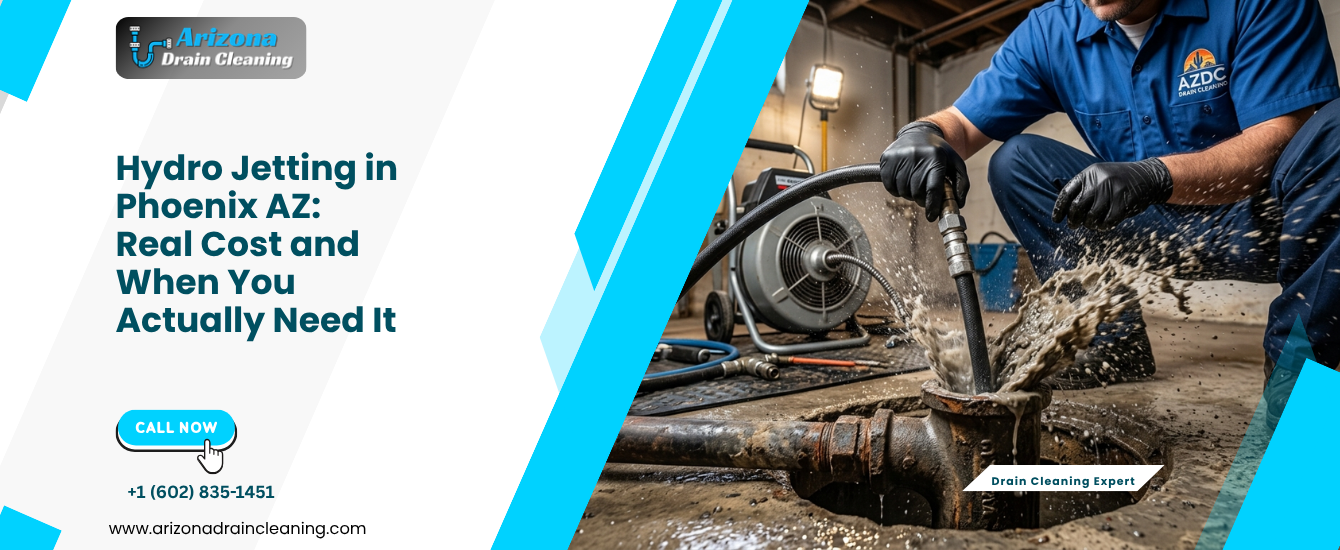
Hydro-jetting in Phoenix, AZ, sits in that category of plumbing services where the price is easy to quote but the real value comes from knowing when it actually solves your problem versus when it just temporarily masks it. At its core, hydro jetting uses high-pressure water to scour the inside of sewer and drain lines, removing grease, scale, roots, and built-up debris in a way that standard drain snaking simply cannot match. In most residential cases across the Phoenix metro area, the cost typically falls between $300 and $650, with an average around $450–$500 depending on pipe length, blockage severity, and cleanout accessibility.
But in Phoenix specifically, where hard water scale, grease accumulation, and root intrusion often overlap in the same line, the decision is less about price and more about diagnosis. A misidentified clog can lead to repeated service calls, while overusing hydro jetting on a structurally damaged pipe can accelerate failure. That’s why understanding when it’s necessary is just as important as knowing what it costs.
Here’s a practical breakdown of when hydro jetting is actually the right solution in Phoenix conditions:
| Situation | Is Hydro Jetting Appropriate? | Why It Matters |
|---|---|---|
| Grease-heavy kitchen line buildup | Yes | Cuts through hardened FOG layers effectively |
| Severe mineral scale from hard water | Yes | Restores pipe diameter better than snaking |
| Repeated clogs after snaking | Yes | Indicates underlying buildup, not a simple blockage |
| Tree root intrusion (light to moderate) | Sometimes | Works temporarily but may need follow-up repair |
| Collapsed or broken pipe | No | Can worsen damage and cause further failure |
| Simple, one-time clog | No | Snaking is usually sufficient and cheaper |
In Phoenix homes, the most common mistake is assuming all drain blockages are the same. In reality, many “clogs” are layered systems of grease, scale, and partial root intrusion that slowly build resistance over time. Hydro jetting becomes the right choice when those layers are thick enough that mechanical snaking only punches a hole through the problem instead of fully clearing it.
The city’s conditions also directly influence both need and pricing. Hard water accelerates internal pipe scaling, while desert landscaping increases the likelihood of root intrusion in older sewer lines. Combined, these factors make deep cleaning more common in Phoenix than in many other regions.
This is why companies like Arizona Drain Cleaning typically start with a sewer camera inspection before recommending hydro jetting. The footage confirms whether the blockage is soft (grease/debris), hardened (scale), or structural (pipe damage), ensuring that hydro jetting is used only when it will actually restore flow rather than temporarily push the problem further down the line.
What Hydro Jetting Actually Does to Your Phoenix Drain Pipes
Most Phoenix homeowners have heard of hydro jetting but have a vague sense of it as a more powerful drain cleaning method without a clear understanding of what specifically distinguishes it from the snaking service that most plumbers offer as their standard drain cleaning approach. The distinction matters because it is what determines whether hydro jetting is appropriate for your specific situation.
The Mechanism: Why High-Pressure Water Works Differently
A drain snake uses a rotating metal cable to break through or pull out a specific obstruction at a specific location in the pipe. It addresses the blockage itself but leaves everything else inside the pipe exactly as it was. The grease coating on the pipe wall. The mineral scale built up from Phoenix’s hard water. The soap scum layer from years of showers. The biofilm coating that produces drain odors. All of that remains after a snaking service, and it is precisely what causes the same drain to clog again months later because the rough, adhesive pipe wall surface it creates gives every new piece of debris something to cling to.
Hydro jetting uses pressurized water at 1,500 to 4,000 PSI delivered through a specialized omni-directional nozzle that simultaneously blasts forward to break through any existing obstruction and backward in a 360-degree spray pattern against the pipe wall. As the jetting hose advances through the pipe, every section of the pipe interior receives the high-pressure spray. The wall coating of grease, scale, soap residue, and biofilm that snaking leaves completely untouched is stripped from the pipe surface and flushed out through the system.
What Gets Removed That Snaking Cannot Touch
The list of what hydro jetting removes that snaking cannot is the practical reason the service costs more and is appropriate for situations where snaking provides only temporary relief. Grease deposits that have hardened against pipe walls over months or years of kitchen drain use. Calcium and magnesium mineral scale from Phoenix’s extremely hard municipal water supply has been depositing on pipe interiors continuously since the house was built. Soap scum compounds are formed by the reaction of soap with that same hard water that coats every drain pipe in the Valley. Bacterial biofilm colonies that are the source of persistent drain odors that keep coming back. Light root intrusion at joint locations where roots have entered but not yet created a solid mass.
After thorough hydro jetting, the pipe interior is genuinely clean from the wall surface inward rather than simply having a temporary flow channel cleared through the center of still-present accumulation. The result holds significantly longer than snaking under equivalent use conditions because the adhesive surface that enables rapid re-accumulation has been removed rather than bypassed.
Real Hydro Jetting Costs in Phoenix AZ: What You Are Actually Paying For
Hydro jetting in Phoenix runs between $362 and $620 for most residential sewer lines, with costs varying based on pipe length, clog severity, and accessibility. Here is a specific breakdown of what drives the cost within that range for Phoenix homeowners.
Standard Residential Drain Line Hydro Jetting
For a standard residential drain line serving a single fixture or a short branch run, the lower end of the Phoenix market range applies. A kitchen drain line or bathroom branch line that runs ten to twenty feet before joining the main stack typically costs between $300 and $450 for professional hydro jetting by a licensed contractor in the Phoenix metro area. This pricing reflects the shorter line length, the typically lighter accumulation in branch lines compared to main lines, and the shorter service time required for a shorter pipe run.
Main Sewer Line Hydro Jetting
The main sewer line from the house to the municipal connection is the most commonly hydro-jetted line in residential applications and carries the middle to upper portion of the Phoenix market price range. Hydro jetting cost in Phoenix averages $250 to $600, with main sewer line service typically landing between $400 and $650 for a standard residential property. The main line is longer than branch lines, carries the combined waste from the entire house, and in Phoenix-area homes built before 1990 often has the most significant accumulated grease and mineral scale because it has been receiving the cumulative load from every fixture in the house without ever being professionally cleaned.
Commercial Property Hydro Jetting
Commercial hydro jetting for restaurants, retail properties, and multi-family buildings in the Phoenix area carries a wider price range that reflects the greater variation in pipe diameter, line length, and accumulation severity across commercial applications. Standard commercial hydro jetting for restaurant kitchen floor drains or branch lines typically runs $400 to $700. Main line jetting for a larger commercial property can range from $600 to $1,500 or more depending on the scope of the system, the pipe diameter, the length of the line, and whether access is straightforward or requires additional setup.
What Affects the Price Within the Range
Several specific factors move the price for a Phoenix hydro jetting service within the applicable range, and understanding them helps you evaluate whether a quote you receive is reasonable for your specific situation.
Pipe length and diameter. Longer pipe runs take more time and more water volume to jet thoroughly. Larger-diameter pipes require more jetting time at higher flow rates. Both add to the service cost.
Severity and type of accumulation. A pipe with a few months of grease accumulation jets faster than one with years of compacted, mineral-encrusted buildup. The density of what needs to be removed directly affects the time required and the number of passes the technician needs to make.
Access conditions. A cleanout that is easily accessible at the surface allows the technician to set up and begin work quickly. A pipe that requires locating a buried cleanout, creating access at a different point, or working around extensive hardscape takes additional setup time that adds to the cost.
Camera inspection. Professional hydro jetting should be preceded by a pipe inspection with video camera that confirms the pipe is suitable for high-pressure jetting and identifies the specific nature and location of the accumulation. Some providers include camera inspection in the hydro jetting price. Others charge separately, typically $150 to $300 for the camera service. Either way, the camera inspection should happen before jetting begins.
Emergency versus scheduled service. A hydro jetting service call requested as an emergency outside normal business hours carries a premium rate of 25 to 50 percent above the standard service price. This is one of the practical financial arguments for addressing a slow drain before it becomes a complete backup that requires emergency response.
What Seems Cheap But Is Not a Real Deal
Hydro jetting quotes significantly below the Phoenix market range, typically anything under $200 for a main sewer line service, warrant scrutiny. Below-market pricing in the hydro jetting market typically indicates that residential-scale equipment rather than professional jetting equipment is being used and the cleaning will be less thorough, that no camera inspection is included and the line may not be suitable for jetting at the pressure being applied, that the company is unlicensed and therefore not accountable to Arizona Registrar of Contractors consumer protection standards, or that the quote is a lead price that will increase once the technician arrives and assesses the actual job. A legitimate hydro jetting service by a licensed Phoenix-area contractor in properly equipped trucks costs within the market range because the equipment, the training, the insurance, and the licensing all represent real costs.
When You Actually Need Hydro Jetting in Phoenix
This is the question that matters most to Phoenix homeowners who have been told by someone that they need hydro jetting and are wondering whether that recommendation matches their situation. Here are the specific conditions that make hydro jetting the appropriate service rather than a more expensive alternative to something simpler.
Your Drain Keeps Clogging After Being Snaked
If a professional drain snaking service was performed on a specific drain and the same drain is slow or backed up again within three to four months, the pipe wall condition is the problem. The snaking cleared the obstruction that time, but the coating on the pipe wall that causes debris to accumulate rapidly was not addressed. In Phoenix, where hard water mineral scale provides a continuous adhesive surface in every pipe, this recurrence pattern is extremely common in any home that has had its drains snaked repeatedly without a thorough hydro jetting service.
The recurrence pattern is not bad luck. It is the predictable consequence of cleaning only the obstruction rather than the surface that creates it. Hydro jetting breaks this cycle by removing the pipe wall coating, not just the current obstruction, leaving a smooth surface that resists re-accumulation for a significantly longer period.
Your Kitchen Drain Is Slow Despite Recent Maintenance
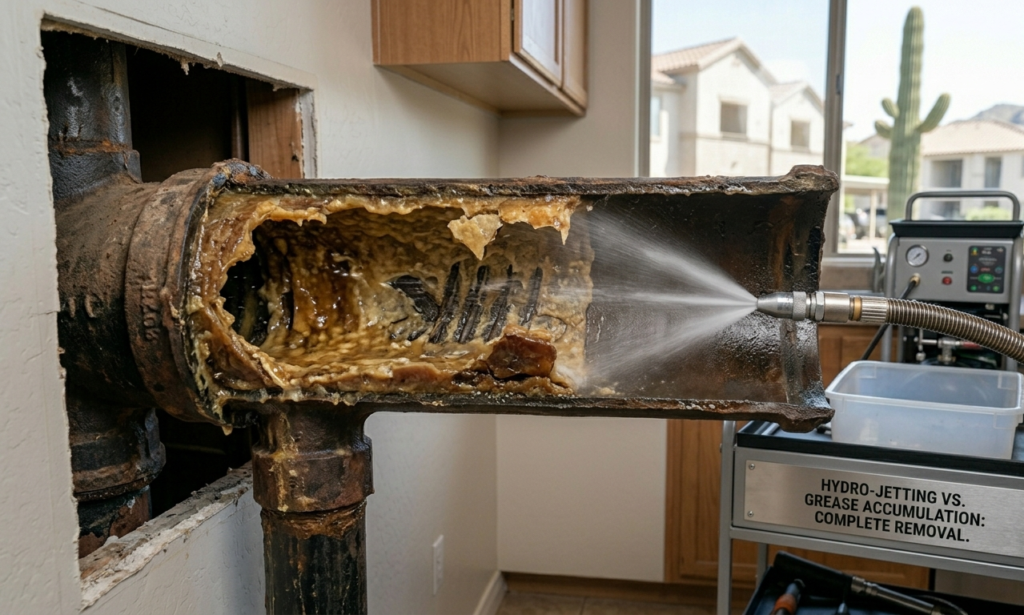
Kitchen drains in Phoenix homes accumulate grease faster than in most parts of the country because Arizona’s summer heat keeps cooking grease in a more fluid state inside the warm kitchen environment, allowing it to travel further into the drain pipe before solidifying against cooler pipe walls in the underground section. By the time a kitchen drain in a Phoenix home is noticeably slow, the grease accumulation has typically distributed across a longer section of pipe than a drain snake addresses effectively.
A kitchen drain cleaning by hydro jetting addresses the full length of the kitchen line rather than just the dense center of the obstruction closest to the drain opening. It is the appropriate service for any kitchen drain with more than one clog history and for any kitchen drain that has slowed despite a snaking service within the past year.
Multiple Drains Are Slow or Backing Up
When multiple fixtures in the house are draining slowly or backing up around the same time, the main sewer line rather than individual branch lines is almost certainly the source of the problem. A main line with significant accumulated grease, mineral scale, or root intrusion creates restricted flow that backs up through every connected fixture rather than affecting a single drain. This is a main sewer line problem, and the solution is sewer line cleaning by hydro jetting of the main line rather than snaking individual branch lines.
This is a situation where attempting to address the issue by snaking individual drains is inefficient at best and provides no lasting benefit because the restriction is in the shared infrastructure downstream of all the individual drains.
Your Home Was Built Before 1985 and has never had hydro jetting.
Phoenix experienced its most intensive residential development during the 1960s through the 1980s, and the homes from this era have original drain infrastructure that has been accumulating mineral scale, grease, and organic material for 40 to 60 years without ever being stripped from the pipe wall with high-pressure water. The Phoenix area throws some unique curveballs at residential plumbing, like hard water that leaves stubborn mineral scale inside pipes, shifting soil that stresses underground lines, and year-round warm temperatures that keep tree roots growing.
A camera inspection of the main sewer line in a Phoenix home from this era typically reveals an interior that looks nothing like the original clean pipe. The combination of decades of grease accumulation, continuous hard water mineral scale deposition, and in homes with mature landscaping, root intrusion at the original clay pipe joints, creates conditions where the effective interior diameter of the pipe may be a fraction of the original design specification. Hydro jetting of the main line in these homes is not optional maintenance. It is the service that restores the pipe to a functional condition that it has not been in for years.
You Have Tree Root Intrusion That Has Been Recently Cut
Phoenix neighborhoods with mature landscaping, particularly those with oleanders, citrus trees, mulberry trees, or any other large-root-system species common to Valley residential landscaping, face persistent root intrusion in underground sewer lines. When a drain snake with a cutting head is used to remove root intrusion, it cuts through the root mass and restores flow. But the cut roots regrow and the root entry points in the pipe joints remain open, meaning the problem returns at the same locations.
Hydro jetting after root cutting provides a more thorough removal of root material from the pipe interior, removing root fragments and debris that the cutting action left behind, and cleaning the pipe wall so that the treated line is in the best possible condition before root inhibitor treatment or before pipe rehabilitation is considered. It does not seal the joint entry points that roots exploit, which is a structural problem that requires trenchless drain repair to address permanently, but it produces the cleanest possible pipe condition as the starting point for whatever follow-up treatment is appropriate.
Before a Pipe Lining or Major Pipe Repair
Any significant pipe rehabilitation work including cured-in-place lining, pipe bursting preparation, or major structural repair requires the pipe to be thoroughly cleaned before the rehabilitation work begins. A cured-in-place liner requires a clean pipe wall to bond to correctly. Residual grease, scale, or debris between the liner and the host pipe creates weak points in the installation that reduce the service life and structural integrity of the liner. Hydro jetting is the standard pipe preparation step before any pipe lining project and is typically included in the total rehabilitation project scope.
Annual Preventive Maintenance for High-Use Phoenix Households
In a Phoenix household where cooking is frequent, where multiple people share a shower, and where hard water mineral scale is depositing continuously in every pipe, annual hydro jetting of the main sewer line and periodically of high-use branch lines is a preventive drain maintenance approach that prevents the accumulation from ever building to the level that causes a service-impacting drain failure. The annual cost of preventive hydro jetting is reliably less than the cost of the emergency service call and the property disruption that results from a main line backup that could have been prevented.
When Hydro Jetting Is Not What You Need
Being honest about when hydro jetting is the wrong service for a situation is as important as explaining when it is right. Recommending hydro jetting for every drain problem regardless of the specific situation is not a sign of quality service. It is a sign of a company that has one solution and applies it to everything.
A First-Time Simple Clog in a Single Drain
If a single shower, sink, or tub drain has slowed for the first time and has no history of repeated clogs, drain snaking is the appropriate first response. The problem is almost certainly a localized accumulation of hair and soap scum near the drain opening that a snake removes efficiently and economically. Recommending hydro jetting for a first-time slow shower drain is over-servicing the situation and creates a cost that the problem does not warrant.
Pipes That Are Too Old or Damaged for High-Pressure Jetting
Hydro jetting at high pressure is not safe for every pipe condition. Severely deteriorated pipe sections with cracked walls that have already lost structural integrity may be further damaged by high-pressure water that exploits existing fractures. Orangeburg pipe, the compressed wood pulp and pitch material used in some pre-1972 Phoenix residential construction, should not be hydro-jetted because the material is already deformed and degraded and high-pressure water can accelerate its deterioration.
This is the reason why a camera inspection before hydro jetting is not optional. The camera confirms that the pipe can safely receive high-pressure jetting and identifies any sections where pressure reduction or a different approach is warranted. A company that recommends hydro jetting without first performing a camera inspection of the pipe is either assuming the pipe condition is adequate or does not have the camera equipment to check. Neither situation is acceptable professional practice.
When Structural Repair Is What the Pipe Actually Needs
If camera inspection reveals that the slow drain or backup is caused by a structural defect rather than accumulated material, specifically a pipe belly where a section has sagged and permanently traps waste, a collapsed section, a separated joint, or severely offset pipe sections, hydro jetting addresses the symptom temporarily but not the cause. The pipe will back up again at the same location because the structural condition that creates the backup is unchanged by cleaning. Structural defects require structural solutions including drain repair and replacement or trenchless drain repair for the specific failed sections.
Why Phoenix’s Hard Water Makes Hydro Jetting More Valuable Here Than Most Cities
This is a point that is specific to Phoenix and the broader Valley, and it is worth understanding in detail because it directly affects how frequently Phoenix homeowners should consider hydro jetting as part of their drain maintenance approach.
Phoenix Water Hardness Numbers in Context
Phoenix municipal water consistently measures between 200 and 300 parts per million of total dissolved solids from its combined sources including Salt River Project surface water and groundwater supply. This places Phoenix water in the very hard to extremely hard category on standard water hardness scales, where anything above 180 parts per million is classified as very hard. For comparison, cities like Seattle and Portland measure below 30 parts per million, which is soft water. Chicago measures around 130 parts per million. Houston is typically around 170 parts per million. Phoenix at 200 to 300 parts per million is among the hardest municipal water supplies of any major American city.
Every shower, every sink use, every toilet flush, and every dish washing cycle that drains through your pipes is depositing calcium and magnesium scale on the interior of those pipes at a rate two to five times higher than what residents in most other major American cities experience. In a pipe that has been in service for ten years in a Phoenix home without professional cleaning, that is ten years of continuous mineral deposition at one of the highest rates in the country.
What This Means for Hydro Jetting Frequency
In a soft-water city, a household drain might need professional hydro jetting every three to five years as a maintenance interval to address accumulated organic material. In Phoenix, the same pipe with the same household use pattern may need hydro jetting every twelve to eighteen months to address the combination of organic accumulation and the mineral scale that deposits continuously from hard water and provides the adhesive surface that accelerates organic accumulation.
This is not a criticism of Phoenix water quality. It is simply the reality of the local water chemistry and its interaction with the plumbing in every house connected to the municipal supply. A Phoenix homeowner who has never had their main sewer line hydro-jetted and who has been in the same home for five or more years almost certainly has a main line interior condition that would be visibly improved by a professional cleaning, and whose drain performance would measurably improve following service.
The Difference Between Phoenix Hydro Jetting Companies: What Actually Matters
Equipment Specification and Pressure Capability
Not all hydro jetting equipment is equal, and the difference in equipment specification directly affects the quality of the cleaning result. Professional truck-mounted hydro jetting equipment capable of delivering 18 to 24 GPM at 3,000 to 4,000 PSI is the industry standard for thorough residential and commercial main line cleaning. Equipment that delivers significantly lower pressure or flow rate may not generate the fluid momentum needed to carry dislodged material through a longer main line run or to chip and dislodge hardened mineral scale from pipe walls.
When evaluating a hydro jetting provider in Phoenix, asking about their equipment specifications and whether they use truck-mounted or portable equipment for your specific job is a reasonable question that provides useful information about the likely quality of the service.
Licensed and Insured as a Non-Negotiable
In Arizona, any contractor performing drain or plumbing work with a combined labor and materials value over $1,000 must hold a valid Arizona Registrar of Contractors license in the appropriate classification. Hydro jetting of a residential sewer line meets this threshold. Requesting the ROC license number and verifying it at azroc.my.site.com before scheduling service takes two minutes and confirms that the company you are hiring is accountable to Arizona’s consumer protection standards, including the Residential Contractors’ Recovery Fund that can compensate homeowners up to $30,000 for damages caused by licensed contractor failures.
Camera Before Jetting: The Professional Standard
A professional hydro jetting service should begin with a camera inspection of the pipe to confirm its suitability for jetting and to document the pre-service condition. A company that arrives and begins jetting without camera inspection is either assuming the pipe condition is adequate, which is a risk assumption they are making with your pipes, or they do not have camera equipment and are therefore unable to provide the diagnostic foundation that professional service requires. Either situation is a concern.
Hydro Jetting vs Drain Snaking in Phoenix: The Cost-Effectiveness Comparison
The question of whether hydro jetting is worth the cost premium over snaking is answered most clearly by looking at the total cost over a realistic ownership window rather than just the per-service price.
A professional drain snaking service in Phoenix typically costs $150 to $350 for a standard residential drain. Hydro jetting for the same drain typically costs $350 to $600. The hydro jetting service costs roughly twice as much per visit.
However, a snaked kitchen drain in a Phoenix home with hard water and regular cooking activity may need service again in two to four months because snaking does not remove the mineral scale and grease layer on the pipe wall that causes rapid re-accumulation. At three snaking services per year at $250 average, that is $750 per year. A single hydro jetting service that removes the pipe wall coating and holds for twelve to eighteen months costs $450 to $550 and produces a longer interval before the next service is needed.
The annual cost comparison consistently favors hydro jetting for any drain with a pattern of recurring clogs, because the per-service cost premium of hydro jetting is more than offset by the extended service interval it produces. The homeowners who snaking their recurring problem drain repeatedly are paying more per year, experiencing more drain problems, and ending each year with a pipe interior in the same degraded condition they started with.
Frequently Asked Questions
How long does hydro jetting take for a Phoenix residential property?
On average, hydro jetting usually takes around an hour to complete, including the whole process of thoroughly flushing dirt, debris, roots, hair, oil, and other waste, as well as utilizing sewer line camera inspection to assess the pipes. More extensive accumulation, longer main line runs, or commercial applications with larger pipe diameters and more complex systems take proportionally longer.
Is hydro jetting safe for older Phoenix homes with aging pipes?
It is safe when performed after a camera inspection confirms the pipe’s structural integrity. The camera inspection identifies any sections where the pipe wall condition requires pressure adjustment or where a different approach is warranted. Performing hydro jetting on pipes that have been camera-confirmed as structurally sound does not damage them. Performing it on severely deteriorated pipe without prior inspection creates risk. The camera inspection is what makes the determination, which is why it is mandatory before professional hydro jetting on any pipe of unknown condition.
How long do hydro jetting results last in a Phoenix home?
In a Phoenix home with the Valley’s hard water and normal household use, main sewer line hydro jetting results typically last twelve to twenty-four months before the combination of grease accumulation and mineral scale deposition has progressed to the point where service performance is meaningfully reduced. High-use households with frequent cooking and multiple daily showers may be toward the shorter end of this range. Single-occupancy households or lower-use properties may see results hold for two to three years. Annual preventive hydro jetting for high-use properties is a practical maintenance approach that prevents the accumulation from ever building to a service-impacting level.
Can I hydro-jet my own drains in Phoenix?
Consumer-grade pressure washers and rental jetting equipment do not operate at the pressures and flow rates needed for effective pipe wall cleaning. Attempting to perform hydro jetting with undersized equipment typically results in flushing loose material through the drain without removing the pipe wall coating that causes rapid re-accumulation, which produces a temporary improvement similar to what snaking provides rather than the thorough pipe cleaning that professional hydro jetting delivers.
Does hydro jetting work for tree roots in Phoenix sewer lines?
Hydro jetting with a root-cutting nozzle removes root intrusion from the pipe interior effectively when the roots have not yet created a fully solid root mass that blocks the jetting hose from advancing. For advanced root intrusion, snaking with a cutting head may be needed first to create a pathway, followed by hydro jetting to clean the pipe thoroughly. Hydro jetting does not seal the joint entry points that roots exploit. Those entry points are structural defects that require trenchless drain repair to close permanently.
Should I get a camera inspection before hydro jetting in Phoenix?
Yes, always. The camera inspection confirms the pipe is structurally suitable for high-pressure jetting, identifies the specific nature and location of the accumulation so the jetting nozzle selection and technique are appropriate for what is actually in the pipe, and provides documentation of the pre-service pipe condition. It is not an optional add-on. It is the diagnostic foundation that makes the hydro jetting service accurate, safe, and optimally effective.
What is the best time of year to schedule hydro jetting in Phoenix?
There is no seasonal constraint on hydro jetting itself since it uses water that is temperature-adjustable and is performed from inside the pipe. However, from a Phoenix-specific maintenance planning perspective, scheduling main sewer line hydro jetting in late spring, typically April or May, positions the drain system in its best condition before the monsoon season summer heat period when grease behavior in pipes changes and before the onset of any outdoor drainage demands. For outdoor drain applications including yard drain cleaning and storm drain cleaning, pre-monsoon service in May or June is specifically timed to ensure full drainage capacity before the first storm event of the season.
The Bottom Line on Hydro Jetting in Phoenix AZ
Hydro jetting in Phoenix costs $300 to $650 for most residential applications and is worth every dollar of that range when it is the service your specific situation actually requires. It is the right choice for recurring drain clogs, grease-heavy kitchen lines, main sewer lines in older Phoenix homes with years of accumulated scale, root intrusion combined with thorough pipe cleaning, and any drain that has been snaked repeatedly without lasting results. It is not the right choice for a first-time simple clog that a snaking will clear effectively or for a pipe in such degraded structural condition that high-pressure water would create more problems than it solves.
The way to know which category your situation falls into is the camera inspection before any service recommendation. The footage makes the answer obvious and protects you from both over-service and under-service.
Arizona Drain Cleaning provides professional hydro jetting with pipe inspection with video camera for residential and commercial properties throughout Phoenix, Scottsdale, Mesa, Chandler, Gilbert, Tempe, Glendale, Peoria, Surprise, Goodyear, Queen Creek, Tucson, and all of Arizona. Call Arizona Drain Cleaning at (602) 835-1451 right now to schedule a camera inspection and get an honest, evidence-based recommendation about whether hydro jetting is what your drain situation actually needs.