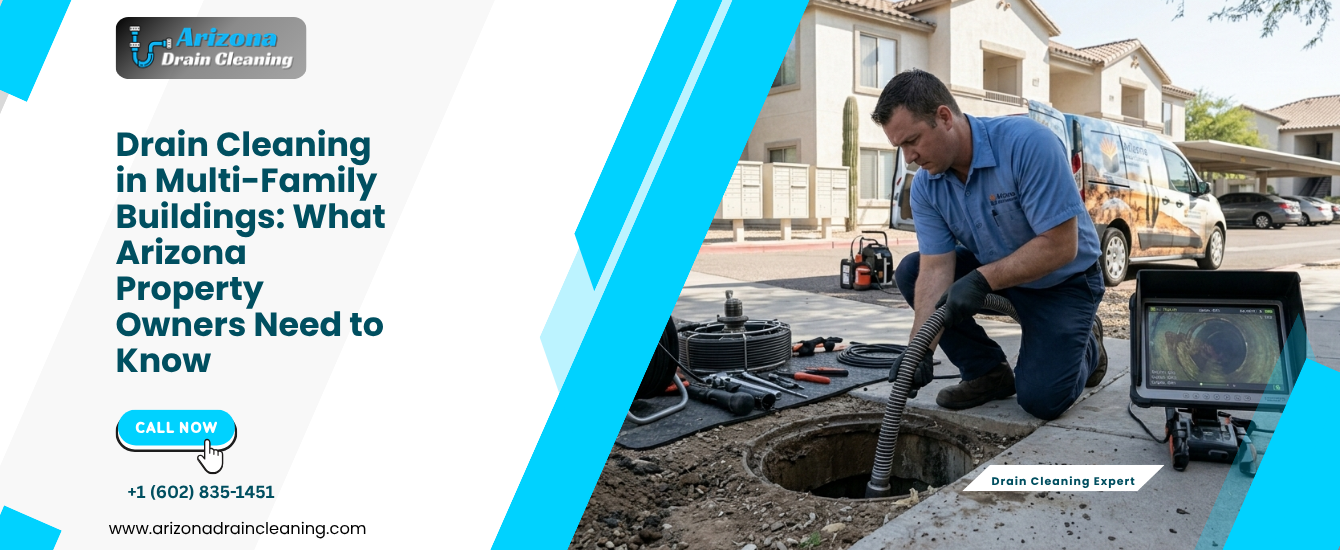
Drain cleaning in multi-family buildings is categorically more complex, more consequential, and more strategically demanding than drain maintenance in any single-family property. When you own or manage an apartment complex, a condominium building, a townhome community, or any other multi-unit residential property in Arizona, a single drain failure does not affect one household. Depending on where that failure occurs in the shared plumbing infrastructure, it can affect an entire stack of units simultaneously, generate tenant complaints and lease termination notices, create water damage to multiple units from a single backup event, and put you on the wrong side of Arizona’s landlord-tenant laws within 48 hours of the initial complaint. The team at Arizona Drain Cleaning works with property owners, asset managers, and property management companies across the Valley’s apartment, condominium, and multi-family housing markets, and the consistent reality we see is that the properties with proactive drain maintenance programs avoid the crisis situations entirely while the ones operating reactively spend far more per year on emergency service, property damage remediation, and tenant relations recovery than a scheduled maintenance program would cost. This guide covers everything Arizona multi-family property owners and managers need to know about drain cleaning, from how multi-family drainage systems work and where the critical failure points are, to Arizona legal obligations, the specific conditions that make Valley apartment drain systems more demanding than most states, and how to build a maintenance program that protects your property and your tenants.
How Multi-Family Building Drain Systems Work and Why They Fail Differently
Understanding the architecture of a multi-family building drainage system is the starting point for understanding why drain maintenance in these buildings requires a fundamentally different approach than single-family property maintenance.
Vertical Drain Stacks: The Shared Infrastructure Point
In a multi-family building with multiple floors, the primary drainage component is the vertical drain stack, a large-diameter vertical pipe that collects waste from every unit on every floor that connects to it and carries that combined waste flow downward to the underground building drain. Depending on the building size, there may be one stack or many stacks, typically one per building section or one per cluster of bathrooms aligned vertically through the structure.
The critical characteristic of a drain stack is that it is shared. Every unit connected to the same stack contributes its waste to the same vertical pipe, and every unit connected to that stack is affected when that pipe fails. A soap scum and hair accumulation that develops at a horizontal branch connection two floors up from the ground can restrict flow for every unit above that connection and, when it becomes a full blockage, can cause wastewater to back up into the lowest connected fixture in the stack, which is typically the ground floor unit’s tub or shower.
This cascade effect is what makes drain stack maintenance in multi-family buildings so different from branch line maintenance in a single-family home. In a house, a slow shower drain affects one shower. In a four-story apartment building, a drain stack problem can simultaneously affect every shower on every floor that connects to that stack.
Horizontal Underground Building Drains
At the base of the building, the waste from all vertical stacks collects into horizontal underground building drains that run beneath the slab or in below-grade utility corridors and carry the combined waste flow from the entire building to the municipal sewer connection. These underground lines, typically four to eight inches in diameter in residential multi-family buildings, are the highest-consequence component of the drainage system because a failure here affects every unit and every stack in the building simultaneously.
In Arizona’s multi-family housing stock, particularly in apartment complexes built during the Valley’s major development decades of the 1970s and 1980s, these underground building drains are original construction in cast iron or clay pipe that is now 40 to 60 years old. The combination of internal corrosion in cast iron lines, joint stress from Arizona’s clay and caliche soil expansion and contraction cycle, and the accumulated hard water mineral scale from decades of Arizona’s extremely hard municipal water supply creates underground building drain conditions that are frequently significantly worse than property owners know because the pipe condition is not visible and no camera inspection has ever been performed.
Shared Common Area Drains
Beyond the unit-serving drainage infrastructure, multi-family properties have extensive common area drain systems including laundry room floor drains and washing machine drains, pool and spa area drains, leasing office and clubhouse kitchen drains, fitness center floor drains, covered parking area drains, and outdoor area drains managing monsoon runoff from parking lots and common spaces. Each of these common area drain categories generates its own accumulation profile and its own failure consequences, and all of them are exclusively the property owner’s maintenance responsibility regardless of what any tenant lease says about individual unit drain care.
Arizona-Specific Conditions That Intensify Multi-Family Drain Challenges
Hard Water Scale in High-Volume Residential Systems
Arizona’s municipal water supply is among the hardest in the United States, with calcium and magnesium mineral content that deposits scale on every pipe interior connected to the system at a rate significantly higher than most of the country. In a single-family home, this scale builds on drain lines serving one household. In a fifty-unit apartment complex, the same scale builds on drain lines serving fifty households simultaneously, and the volume of soapy, mineral-rich wash water flowing through shared stacks and building drains is proportionally higher.
The practical consequence for multi-family property owners in Phoenix, Scottsdale, Mesa, Chandler, Gilbert, Tempe, and throughout the Valley is that drain line maintenance intervals calibrated for average national water conditions will consistently under-serve Arizona properties. A main stack or building drain cleaning interval that is adequate in a soft-water market may allow Arizona’s mineral scale to accumulate to service-disrupting levels in half the time. This is not a theoretical concern. It is a measurable difference in maintenance frequency requirements that every Arizona multi-family property manager should factor into their maintenance budgets and service schedules.
The Compounding Effect of Tenant Turnover and Variable Drain Habits
Multi-family properties by definition have a rotating occupancy that introduces variable and unpredictable drain use habits into the same shared infrastructure. Some tenants use hair strainers consistently. Others do not use them at all. Some households pour cooking grease down kitchen drains without awareness of the consequences. Others never do. Over the course of a two-year lease cycle across fifty units, the cumulative variation in what fifty households have collectively put down their drains creates accumulation patterns that are far more varied and potentially more severe than a single-family property occupied by one consistent household.
The shared infrastructure means that one tenant’s drain habits can affect the drain experience of everyone else on the same stack. A tenant on the fourth floor who routinely disposes of cooking oil in the kitchen sink creates grease accumulation in the shared stack that progressively affects drainage for every unit below. The property owner who has no visibility into individual tenant behavior bears the maintenance consequence of that behavior in their shared infrastructure.
Arizona’s Monsoon Season and Common Area Drainage
Every multi-family property in Arizona has outdoor common area drainage infrastructure that faces the same monsoon season vulnerability that affects all Arizona properties. Parking lot catch basins, building perimeter area drains, pool deck drains, and outdoor recreation area drainage all need to function at full capacity during the first major monsoon storm of the season, which may deliver an inch of rain in twenty minutes. Common area outdoor drains that have accumulated a full year of wind-blown desert dust and debris without professional cleaning will be overwhelmed during exactly this event, creating parking lot flooding, building entry ponding, and pool deck water that cannot drain fast enough to prevent overflow.
Pre-monsoon season cleaning of all outdoor common area drains is one of the most cost-effective maintenance investments available to Arizona multi-family property owners because the cost of the cleaning service is a tiny fraction of the cost of parking lot flood damage, slip-and-fall liability from flooded walkways, and tenant complaints generated by a preventable water management failure.
Aging Building Drain Infrastructure in the Valley’s Multi-Family Stock
The Phoenix metropolitan area experienced its most intensive multi-family residential development during the 1970s through the 1990s, when apartment complexes were built at scale to accommodate the Valley’s explosive population growth. Many of these properties, which remain significant components of the Valley’s rental housing supply today, were built with original drain infrastructure that has never been systematically assessed or professionally maintained. Original cast iron drain stacks in a 1978 apartment complex are now 47 years old. Original clay building drain lines beneath a 1975 condominium complex have absorbed 50 cycles of Arizona’s seasonal soil movement.
A property owner who acquires a Valley apartment complex built in this era and assumes the drain infrastructure is sound because the drains appear functional is assuming something that a camera inspection may quickly contradict. The visible portion of a drain system, the fixture, the drain body, and the trap, represents a tiny fraction of the total pipe length. The condition of the stacks, the building drain, and the sewer line is entirely invisible without professional inspection and may be dramatically worse than the visible surface suggests.
The Drain Problems Most Commonly Affecting Arizona Multi-Family Properties
Hair and Soap Scum Accumulation in Bathroom Branch Lines
Bathroom branch lines in apartment buildings, the individual drain lines serving unit showers, tubs, and sinks before they connect to the shared stack, accumulate hair and soap scum at the rate determined by the household’s use volume and hair care habits. In Arizona’s hard water environment, the soap scum component of this accumulation forms faster and hardens more completely than in soft-water markets because the reaction between soap and Arizona’s high-mineral water produces calcium and magnesium stearate compounds that adhere stubbornly to pipe walls.
Slow shower drains are the most common individual tenant drain complaint in multi-family properties and are almost always caused by this combination of hair mesh and soap scum accumulation. Most property managers address individual slow shower drain complaints with a basic snaking response. The limitation of this approach is that snaking removes the denser hair mass while leaving the soap scum and mineral scale coating on the pipe wall intact, which means the same drain will slow down again faster than it would have on a clean pipe. For units with recurring shower drain complaints, shower drain cleaning by hydro jetting at the branch line level removes the pipe wall coating and produces significantly longer intervals between service calls.
Kitchen Drain Grease Accumulation
Every kitchen in every unit in a multi-family property generates cooking grease that finds its way to the kitchen drain. In Arizona’s climate, the extreme summer heat keeps cooking grease in a more fluid state inside the warm apartment kitchen environment, which allows it to travel further into the shared drainage infrastructure before solidifying in the cooler underground pipe sections. This extended travel distance means grease from apartment kitchens accumulates not just in the immediately accessible branch line but throughout a longer section of the drain system where it is progressively harder to reach and remove.
In multi-family buildings with aging cast iron drain stacks, kitchen grease that has accumulated over years of consecutive tenant occupancies creates a dense coating that can narrow the interior of the stack significantly. Regular kitchen drain cleaning of both unit branch lines at turnover and of the shared stack on a scheduled maintenance basis is the approach that prevents this compounding accumulation from building to service-impacting levels.
Main Stack Blockages and Their Multi-Unit Consequences
A blockage that develops in a main drain stack rather than in an individual unit’s branch line is the multi-family drain scenario with the most significant tenant impact. When a shared stack develops a complete or near-complete blockage, the backup affects every unit connected above the blockage point. Wastewater that cannot flow down the stack surfaces at the lowest available fixture, typically the tub or shower drain in the ground-floor unit connected to that stack.
Stack blockages can result from accumulated grease and scale that has progressively narrowed the stack until flow is restricted, from a foreign object that a tenant has flushed or disposed of through a drain above the blockage point, from root intrusion at a joint in the underground building drain, or from a structural failure such as a collapsed section in an aging cast iron or clay stack. The appropriate response differs based on the cause, which is why a pipe inspection with video camera that identifies the location and nature of the blockage before service begins produces better and more lasting results than simply sending a snake down the stack and hoping for the best.
Laundry Room Drain Overloads
Shared laundry facilities in multi-family properties generate concentrated drain loads when multiple machines complete cycles simultaneously. The combination of lint, detergent residue, and hard water mineral deposits from Arizona’s municipal supply creates accumulation in laundry room floor drains and washing machine drain standpipes that builds faster than most property managers anticipate. A laundry room floor drain that has not been professionally cleaned in two or more years in an active multi-family laundry facility is very likely operating at reduced capacity and will fail during a peak laundry period with multiple simultaneous machine discharges.
Floor drain cleaning of shared laundry room drains should be included in every multi-family property’s annual maintenance program. The cost is minimal and the consequence of failing to include it, a laundry room flooding event during a Saturday afternoon when multiple tenants are using the facility simultaneously, creates both property damage and significant tenant relations damage that is vastly more expensive than the preventive cleaning.
Underground Building Drain Failures
When the underground building drain beneath the slab fails, whether through accumulation that has restricted flow throughout the line, through a pipe belly that traps waste, through collapsed sections in aging pipe, or through root intrusion at joints beneath the property, the impact is building-wide. Every stack in the building discharges to the building drain, which means a failed building drain backs up every stack and ultimately every unit in the building.
This is the scenario that produces the highest-profile, highest-cost drain emergency in multi-family property management. A sewage backup that affects multiple units simultaneously creates health and safety conditions that Arizona law treats with urgency, creates property damage to multiple unit’s flooring and belongings, creates guest displacement costs and potential claims, and generates tenant relations damage that can trigger lease termination requests and negative reviews that affect future occupancy.
A building drain that has never been camera-inspected in a property over 20 years old is an unknown risk that may be manageable or may be approaching catastrophic failure without any visible warning at the surface. The cost of a main sewer line inspection is negligible compared to the cost of the building-wide backup event it might prevent.
Arizona Legal Obligations for Multi-Family Property Drain Maintenance
Arizona Residential Landlord and Tenant Act Requirements
Under the Arizona Residential Landlord and Tenant Act, specifically Arizona Revised Statutes Section 33-1324, landlords must maintain in good and safe working order all plumbing and sanitary facilities supplied to tenants. For multi-family properties, this obligation extends not just to the plumbing within individual units but to all shared infrastructure including drain stacks, building drains, common area plumbing, and the sewer line connection serving the property.
When a tenant reports a drain problem that affects their unit, Arizona law requires the landlord to respond within a timeframe that reflects the severity of the condition. A slow drain may allow for a reasonable response window. A backed-up drain surfacing sewage in a tenant’s tub constitutes a condition materially affecting health and safety, and under Arizona Revised Statutes Section 33-1363, a tenant who provides written notice of a health and safety condition that is not remedied within five days may pursue remedies including lease termination and rent withholding. For multi-family property owners, a drain stack blockage that simultaneously affects multiple units creates multiple concurrent legal compliance clocks the moment those tenants provide written notice.
Documentation and Response Records
Every multi-family property should maintain a written record of every tenant drain complaint, the date received, the nature of the complaint, the property’s response, and the date and outcome of any service performed. In any subsequent dispute about the timeliness or adequacy of the property’s response to a drain complaint, this documentation is the evidence that supports the property’s compliance with its legal obligations. A property that can demonstrate a documented pattern of prompt, professional responses to tenant drain complaints is in a fundamentally different legal position than one that relies on undocumented verbal responses to tenant concerns.
Fair Housing Considerations in Drain Maintenance Response
For multi-family properties subject to federal Fair Housing Act requirements, responding to drain maintenance complaints consistently across all units and all tenant demographics is an obligation. A property that responds promptly to drain complaints from some tenants but delays response for others may face Fair Housing liability if the disparity in response aligns with protected class distinctions. Building a standardized, documented response protocol for drain complaints that applies uniformly across the property protects both tenants and the property owner.
Professional Drain Cleaning Methods for Multi-Family Properties
Video Camera Inspection as the Diagnostic Foundation
For any multi-family property that has not had its shared drain infrastructure professionally inspected, or for any building where drain problems are recurring without lasting resolution after repeated service calls, a systematic pipe inspection with video camera of the drain stacks and building drain is the appropriate starting point. The camera inspection reveals the actual interior condition of the shared infrastructure, identifies the specific nature and location of any accumulation or structural issues, and provides the documentation needed for maintenance planning and, where structural issues are found, for capital improvement proposals.
For property management companies overseeing portfolios of multi-family assets throughout the Valley, a systematic camera inspection program that assesses each property’s shared drain infrastructure on a rotating schedule provides the building-by-building condition data needed to prioritize maintenance investment across the portfolio rather than simply responding to whichever property generates the most urgent complaint calls.
Hydro Jetting for Drain Stacks and Building Drains
Hydro jetting of shared drain stacks and underground building drains provides the most thorough and lasting cleaning available for the shared infrastructure of multi-family buildings. The high-pressure water strips grease, mineral scale, soap scum, and biofilm from the pipe wall surface entirely rather than creating a temporary flow channel through the center of the accumulation. In shared drain stacks serving multiple units, a hydro-jetted stack flows at full capacity from wall to wall rather than at the reduced capacity of a stack that has been snaked but not fully cleaned.
For Arizona multi-family properties where hard water mineral scale is a continuous and progressive accumulation challenge, hydro jetting is particularly valuable because it is the only cleaning method that removes the mineral scale layer from pipe walls rather than simply passing through the center of it. A drain stack that is hydro-jetted annually in a Phoenix area apartment complex will perform consistently over years because the mineral scale accumulation is removed before it can build to a service-impacting level, rather than being allowed to progressively narrow the stack diameter between cleaning cycles.
Drain Snaking for Individual Unit Branch Line Issues
Drain snaking remains the appropriate responsive service for individual unit drain complaints where the issue is an isolated first-time clog in a unit branch line rather than a shared infrastructure problem. A single tenant’s slow shower drain that has not been a recurring issue is a reasonable candidate for branch line snaking as an efficient and economical first response. A slow shower drain that has been addressed with snaking three times in the past year on the same unit is no longer an isolated branch line maintenance issue. It is a signal that the pipe wall condition needs addressing with hydro jetting or that a structural issue exists that requires camera inspection to properly diagnose.
Sludge and Biofilm Treatment in Shared Drains
Multi-family building shared drains, particularly in laundry facilities, fitness centers, and pool areas, develop biofilm and sludge accumulation that produces persistent odors in common areas. Professional sludge removal combined with enzymatic treatment is the appropriate approach for common area drains where biological accumulation is the primary source of odor complaints. Enzymatic treatment applied on a monthly basis between professional service visits helps maintain the cleaned condition by digesting organic material before it builds to the level that produces noticeable odors.
Trenchless Repair for Failing Shared Infrastructure
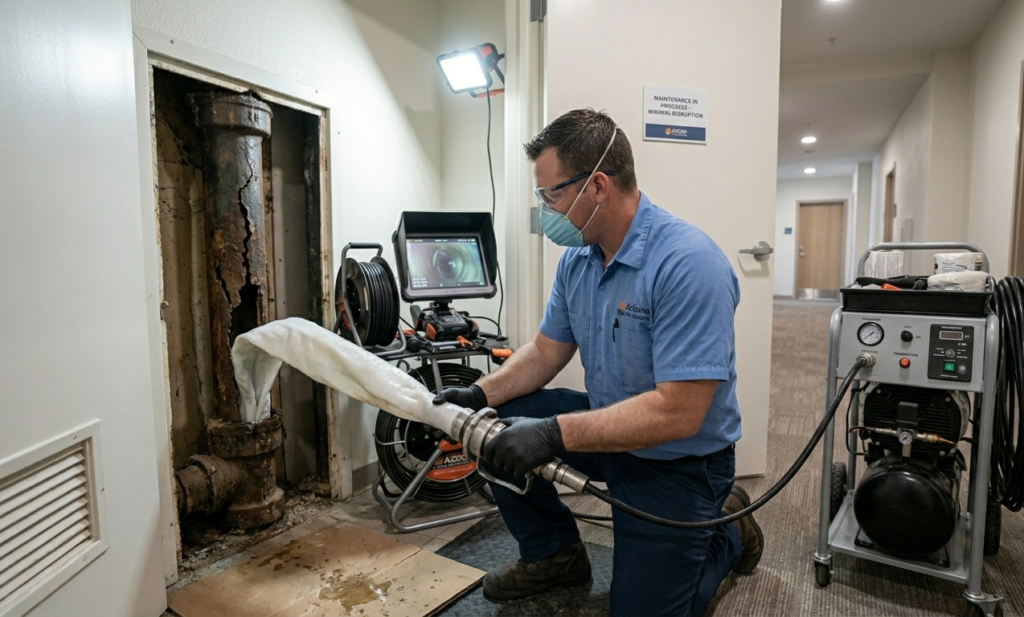
When camera inspection of the shared drain infrastructure in a multi-family building reveals structural failures in drain stacks or building drains, specifically cracked or collapsed pipe sections, separated joints, or severe corrosion in aging cast iron lines, trenchless drain repair using cured-in-place pipe lining is often the most practical repair option for occupied multi-family buildings. Cured-in-place lining rehabilitates a failing drain stack or building drain from within the existing pipe, without the surface disruption that traditional excavation and replacement would require in an occupied building.
For a drain stack serving occupied units, open excavation through finished walls and floors to access the stack for traditional replacement creates tenant displacement, construction noise and disruption, and surface restoration costs that cured-in-place lining largely avoids. The liner is inserted and cured with minimal access requirements, the restored pipe has a projected service life of 50 years or more, and the occupied units experience minimal disruption compared to traditional replacement.
Building a Drain Maintenance Program for Arizona Multi-Family Properties
Annual Pre-Monsoon Common Area Drain Service
Every multi-family property in Arizona should have all outdoor common area drains professionally cleaned before monsoon season begins, typically in April or May. This includes parking lot catch basins, building perimeter area drains, pool and spa deck drains, outdoor recreation area drains, and any covered parking area floor drains. The pre-monsoon cleaning ensures that every outdoor drain is at full capacity before the first storm event of the season.
Storm drain cleaning combined with catch basin cleaning as a coordinated pre-monsoon service program covers both the individual drain points and the connecting underground pipe network, ensuring the complete outdoor drainage pathway is functional rather than just the surface collection points.
Unit Turnover Drain Service
Every unit turnover is an opportunity to clean the branch line drains serving that unit and document their condition before the next tenant takes possession. A shower drain cleaned at turnover and documented as clear gives the incoming tenant a functional drain and gives the property a defensible maintenance record if the drain becomes the subject of a complaint during the new tenancy. The cost of including bathroom drain cleaning and kitchen drain cleaning in the turnover process is modest. The documentation and baseline condition value is significant.
Annual Shared Infrastructure Inspection and Service
The shared drain infrastructure of a multi-family building, specifically the drain stacks and underground building drain, should receive professional inspection and service on an annual basis as a minimum standard for properties over 20 years old in Arizona’s hard water environment. Newer properties may support a longer interval, but the combination of Arizona’s mineral scale accumulation rate and the aging pipe materials present in the Valley’s significant mid-century multi-family housing stock makes annual attention to the shared infrastructure a justified maintenance standard.
For larger multi-family properties, a systematic approach that inspects and services a portion of the shared infrastructure each year ensures that no component is overlooked while distributing the annual maintenance cost across budget years rather than concentrating it in a single year.
Responsive Service Protocol for Tenant Complaints
Every multi-family property should have a written protocol for responding to tenant drain complaints that establishes clear response time standards, specifies who authorizes service calls, and requires documentation of every complaint and response. The protocol should distinguish between individual unit branch line issues, which can typically be addressed within 24 to 48 hours, and shared infrastructure issues such as multi-unit backups or main stack problems, which require priority same-day response given their health and safety implications and their multi-tenant impact.
Establishing a relationship with a professional drain service provider who can respond promptly to both scheduled maintenance needs and emergency calls for your specific properties, and who understands the access requirements and tenant communication protocols for occupied multi-family buildings, is one of the most operationally valuable infrastructure decisions a multi-family property owner or manager can make.
Frequently Asked Questions
How often should the shared drain infrastructure of an Arizona apartment complex be professionally serviced?
For multi-family properties over 20 years old in Arizona’s hard water environment, annual inspection and service of the shared drain stacks and underground building drain is the appropriate minimum standard. Newer properties with PVC drain infrastructure may support a two-year interval. Properties that have never had camera inspection of their shared infrastructure should schedule one regardless of building age to establish a baseline condition assessment before setting a maintenance interval.
Who is responsible when a tenant’s drain backup is caused by the shared building drain?
The property owner is responsible for maintaining the shared infrastructure, including drain stacks and building drains, in functional condition. When a unit-level backup is caused by a shared infrastructure failure rather than by the individual tenant’s branch line or fixture, the repair cost is entirely the property owner’s responsibility under the Arizona Residential Landlord and Tenant Act. Conversely, a backup definitively caused by a tenant’s disposal of inappropriate material into their branch line may be chargeable to the tenant with appropriate documentation.
Can hydro jetting be performed in an occupied multi-family building without displacing tenants?
Yes, in most cases. Hydro jetting of drain stacks is typically performed from roof access or from ground-level cleanouts rather than from within individual units, and the cleaning process generally does not require access to occupied unit interiors. Tenants on the stack being cleaned should be notified in advance and advised not to use their plumbing fixtures for a specified period during the cleaning process. Service scheduling during daytime hours when many tenants are at work minimizes the notification burden and the operational impact of the service.
What should I do when multiple units on the same stack back up simultaneously?
A multi-unit backup affecting units on the same stack simultaneously is a shared infrastructure emergency requiring immediate professional response. Notify affected tenants promptly, advise them not to use any plumbing fixtures until the situation is resolved, contact a professional drain service capable of same-day emergency response to multi-family properties, and document the time of discovery, the tenants notified, and every step taken in response. A pipe inspection with video camera following the emergency service confirms whether the backup was caused by accumulated material in the stack, a structural failure, or a foreign object, and determines what follow-up maintenance or repair is needed to prevent recurrence.
Is it worth investing in a scheduled preventive drain maintenance program for a multi-family property?
Consistently yes, particularly for Arizona properties where hard water mineral scale, monsoon season outdoor drain demands, and the compounding accumulation effects of multi-tenant occupancy create maintenance needs that are more intensive than most property owners initially budget for. The annual cost of a comprehensive scheduled maintenance program covering shared infrastructure inspection and service, common area drain cleaning, and unit turnover drain service is typically a small fraction of the cost of a single significant drain emergency that affects multiple units. The documentation value, the tenant satisfaction value, and the protection of the physical infrastructure value of proactive maintenance consistently exceed the cost of the program over any multi-year ownership period.
How does Arizona’s hard water affect drain maintenance frequency in multi-family buildings?
Hard water mineral scale deposits continuously on every pipe connected to Arizona’s municipal water supply at a rate two to five times higher than soft-water markets. In a multi-family building where dozens or hundreds of households are simultaneously depositing mineral scale through their shared drain infrastructure, the accumulation rate in shared stacks and building drains is proportionally higher than in single-family applications. This means maintenance intervals calibrated for average national water conditions consistently under-serve Arizona multi-family properties. Annual shared infrastructure cleaning that would be conservative in a soft-water market is a justified standard in the Valley’s hard water environment.
The Bottom Line on Drain Cleaning for Arizona Multi-Family Properties
Multi-family drain maintenance in Arizona carries consequences that scale with the number of units connected to every shared component of the system. A building drain that fails affects every tenant. A drain stack that backs up affects every unit on that stack. An outdoor drain that overflows during a monsoon storm affects every tenant who needs to access the building or the parking lot. The shared nature of multi-family drainage infrastructure is what makes proactive maintenance not just good practice but a legal and financial imperative for Arizona property owners.
The multi-family property owners and managers who handle drain maintenance most effectively share three consistent practices: they invest in camera inspection of their shared infrastructure rather than operating with unknown pipe conditions, they build maintenance schedules around the properties’ actual needs rather than generic intervals, and they respond to tenant drain complaints with documented speed and professionalism that protects both the tenants and the property’s legal compliance posture.
Arizona Drain Cleaning provides comprehensive drain maintenance services for multi-family properties throughout the Valley including pipe inspection with video camera, hydro jetting, drain snaking, shower drain cleaning, bathroom drain cleaning, kitchen drain cleaning, floor drain cleaning, sewer line cleaning, trenchless drain repair, storm drain cleaning, catch basin cleaning, and emergency drain cleaning services for apartment complexes, condominium buildings, townhome communities, and all other multi-family property types across Phoenix, Scottsdale, Mesa, Chandler, Gilbert, Tempe, Glendale, Peoria, Surprise, Goodyear, Queen Creek, Tucson, and throughout Arizona. Contact us to schedule a shared infrastructure assessment or to discuss a comprehensive maintenance program designed for your specific multi-family property.